


12 Top Healthcare Software Development Companies for HealthTech Innovators
Choosing a partner to build healthcare software is a high-stakes decision. The industry is governed by strict regulations, complex data standards, and the critical need for user-friendly applications for both clinicians and patients. Finding one of the top healthcare software development companies isn't just about hiring coders; it's about securing a strategic partner who understands the intricate landscape of health tech, from HIPAA compliance to FHIR interoperability. A misstep can lead to security breaches, regulatory fines, and a product that fails to meet the needs of its users.
- What to Know
- What Defines a Top Healthcare Software Development Company?
- How to Choose the Right Healthcare Software Developers
- 1. Verify Domain Expertise and Past Projects
- 2. Scrutinise Their Knowledge of Regulations and Standards
- 3. Evaluate Their Technical Capabilities and Team Structure
- 4. Check Client References and Industry Reputation
- The 12 Top Healthcare Software Development Companies for 2026
- 1. ScienceSoft
- 2. Itransition
- 3. Arkenea
- 4. Vention
- 5. ELEKS
- 6. Andersen Lab
- 7. Saritasa
- 8. Intellectsoft
- 9. Oxagile
- 10. Belitsoft
- 11. Appinventiv
- 12. Sidebench
- Understanding Pricing Models and Development Costs
- Frequently Asked Questions (FAQ)
- What is the largest healthcare software company?
- What are the top healthcare IT companies?
- What is the most popular healthcare software?
- How much does it cost to develop custom healthcare software?
- Final Thoughts
This guide is designed to help you navigate this complex choice. We'll break down what makes a development firm truly exceptional in the healthcare space, how to evaluate potential partners, and provide a curated list of leading companies. Whether you're a startup with a groundbreaking idea for a wellness app or an established hospital looking to modernise your patient management system, this review will give you the clarity needed to move forward with confidence.
What to Know
- Compliance is Non-Negotiable: The best healthcare software firms prioritise regulatory compliance (like HIPAA, GDPR, and HITECH) from day one. Their development process should have security and data protection built into its core, not as an afterthought.
- Specialisation Matters: Generalist software developers often lack the specific knowledge required for health tech. Look for companies with a proven track record in healthcare, demonstrated by case studies in areas like EMR/EHR systems, telemedicine, or medical AI.
- Interoperability is Key: A firm's expertise with standards like HL7 and FHIR is crucial. This ensures your software can communicate with other health systems, which is essential for modern patient care and data exchange.
- Vetting is a Multi-Step Process: Choosing a partner goes beyond looking at their website. It requires a thorough evaluation of their technical skills, project management style, communication protocols, and client references to ensure they are the right fit for your project's specific needs.
What Defines a Top Healthcare Software Development Company?
In the world of software development, the healthcare sector is unique. Unlike e-commerce or entertainment apps, health tech solutions handle incredibly sensitive data and directly impact patient well-being. This means the criteria for what makes a development company “top-tier” are far more stringent. It’s a combination of technical prowess, deep industry knowledge, and an unwavering commitment to security and ethics.
First and foremost, expertise in regulatory compliance is the bedrock. A company that doesn't live and breathe standards like the Health Insurance Portability and Accountability Act (HIPAA) in the US, the General Data Protection Regulation (GDPR) in Europe, and other regional data protection laws is not a viable partner. This goes beyond simply signing a Business Associate Agreement (BAA). True experts integrate compliance into every stage of the software development lifecycle, from initial design and database architecture to deployment and ongoing maintenance.
They conduct regular risk assessments and ensure all data transmission and storage is encrypted and secure.
Second, technical proficiency must be tailored to healthcare’s specific needs. This includes a deep understanding of data interoperability standards like Health Level Seven (HL7) and Fast Healthcare Interoperability Resources (FHIR). Without this, a new application becomes an isolated data silo, unable to communicate with existing Electronic Health Record (EHR) systems, hospital databases, or laboratory information systems. The ability to build solutions that can seamlessly exchange data is what separates the best healthcare software firms from the rest.
Finally, a user-centric design philosophy is critical. Healthcare software is used by a diverse range of people, from tech-savvy doctors to elderly patients. The user interface (UI) and user experience (UX) must be intuitive, accessible, and efficient. A top firm employs UX designers who specialise in healthcare and understand the workflows of clinicians, reducing administrative burden and minimising the risk of errors.
For patients, the software should be empowering and easy to use, encouraging engagement with their own health management.

How to Choose the Right Healthcare Software Developers

Selecting the right development partner is one of the most critical decisions you'll make for your health tech project. The right team can turn your vision into a compliant, scalable, and successful product, while the wrong one can lead to wasted resources, compliance failures, and a solution that misses the mark. A structured evaluation process is essential to mitigate these risks.
1. Verify Domain Expertise and Past Projects
Don't just take their word for it. Ask for a portfolio of their healthcare projects and detailed case studies. Look for experience that aligns with your specific needs. If you're building a telemedicine platform, have they built one before? If your project involves AI for medical imaging, do they have data scientists with relevant experience?
Pay close attention to the results they achieved for previous clients. Did they help a startup secure funding? Did they improve clinical efficiency at a hospital by a measurable percentage? A portfolio of successful, real-world healthcare applications is the strongest indicator of their capabilities.
2. Scrutinise Their Knowledge of Regulations and Standards
This is a make-or-break criterion. During your initial conversations, probe their understanding of HIPAA, HITECH, and GDPR. Ask them to describe their process for ensuring compliance throughout development. They should be able to speak confidently about data encryption, access controls, audit trails, and secure data storage.
Similarly, assess their familiarity with interoperability standards like HL7 and FHIR. Ask how they've implemented these standards in past projects to connect disparate systems. A team that understands these protocols can build a future-proof product that integrates well within the broader healthcare ecosystem.
3. Evaluate Their Technical Capabilities and Team Structure
Review the technologies they specialise in. Do they have expertise in the programming languages, cloud platforms (like AWS, Azure, or Google Cloud with HIPAA-compliant services), and database technologies that are best suited for your project? A modern health tech application often requires a diverse skill set, including front-end, back-end, mobile, and DevOps engineers.
Inquire about the structure of their development teams. Who will you be communicating with? Will you have a dedicated project manager? Understanding their communication style, project management methodology (e.g., Agile, Scrum), and reporting frequency will help you gauge whether their workflow aligns with your expectations.
Pro Tip: Ask for anonymised résumés of the team members who would potentially work on your project. This allows you to assess their individual experience and qualifications without compromising privacy, giving you a clearer picture of the talent you'd be hiring.
4. Check Client References and Industry Reputation
Online reviews on platforms like Clutch or GoodFirms are a good starting point, but they don't tell the whole story. Ask the company for two or three client references from past healthcare projects and make the effort to speak with them. Prepare questions about their experience with the firm's communication, timeliness, problem-solving skills, and the overall quality of the final product.
Ask specifically about how the firm handled challenges or unexpected changes during the project. Their response to adversity is often more telling than their performance when everything is going smoothly. A transparent and collaborative partner is invaluable when navigating the complexities of software development.
The 12 Top Healthcare Software Development Companies for 2026
Here is our curated list of leading health tech companies and development firms, selected based on their industry focus, technical expertise, client reviews, and proven track record in building compliant and innovative healthcare solutions.
1. ScienceSoft
With over three decades in IT and a dedicated healthcare practice spanning nearly 20 years, ScienceSoft is a heavyweight in the industry. They offer a full spectrum of services, from IT consulting and strategy to the development of complex, enterprise-grade medical software. Their extensive experience makes them a safe bet for large organisations and projects with significant compliance hurdles.
- Best For: Large healthcare enterprises, hospitals, and companies needing complex, custom software solutions with a focus on data analytics and security.
- Key Services: Custom EMR/EHR development, telemedicine platforms, medical imaging analysis software, IoT for remote patient monitoring, and healthcare data analytics.
- Pros: Extensive experience with HIPAA, HITECH, and FDA regulations. Strong capabilities in data science and AI. A large team allows for scalability on major projects.
- Cons: Their enterprise focus might make them less agile or cost-effective for early-stage startups with limited budgets.
2. Itransition
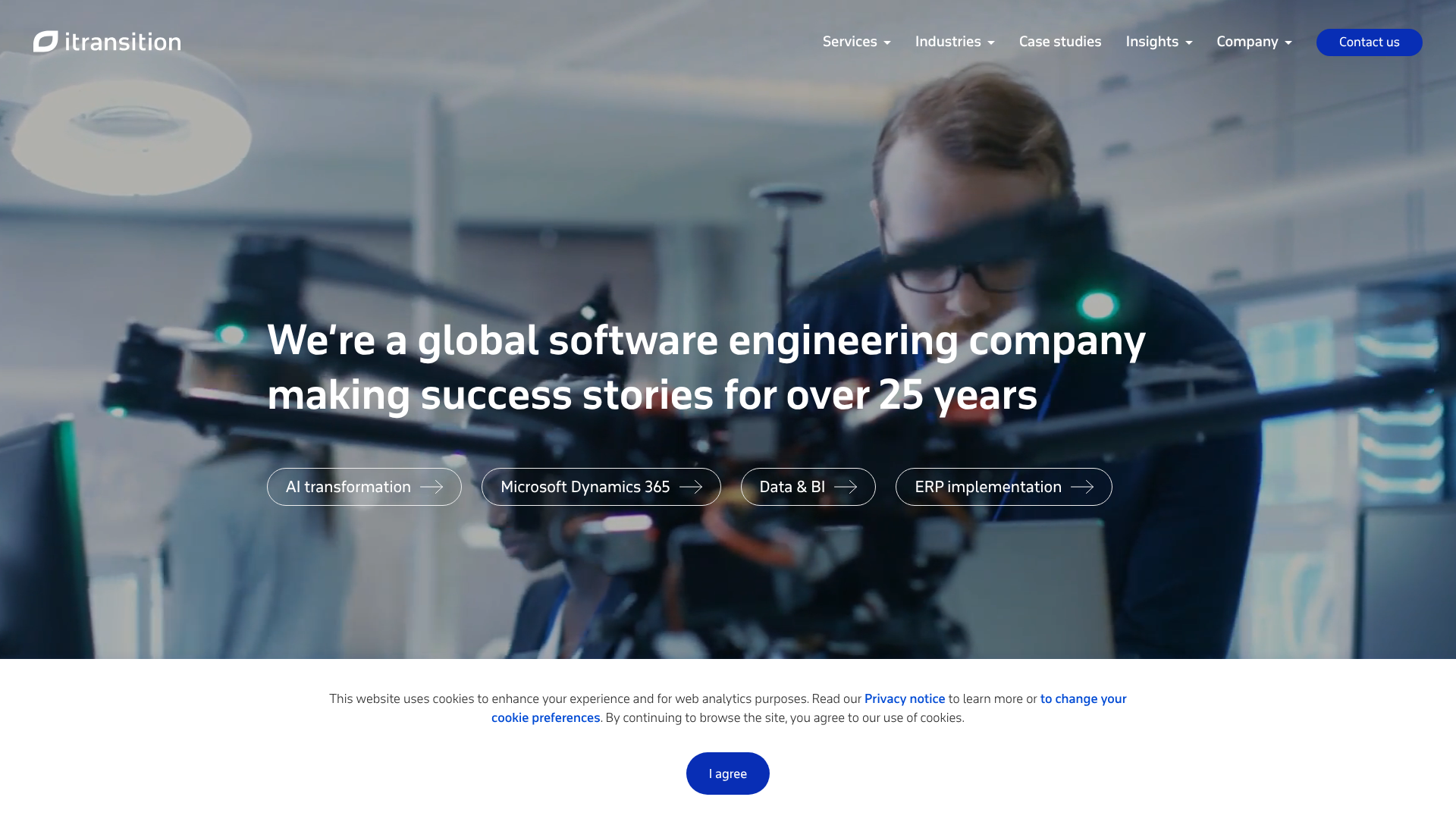
Itransition is a large, versatile software development company with a strong and well-established healthcare division. They are known for their ability to handle large-scale data systems and for their expertise in building custom CRM solutions tailored to the unique needs of healthcare providers. Their global presence allows them to serve a wide range of clients.
- Best For: Healthcare organisations looking to build custom patient relationship management (CRM) systems, modernise legacy systems, or develop AI-powered diagnostic tools.
- Key Services: Healthcare CRM development, AI for diagnostics, health information exchange (HIE) solutions, and mobile health (mHealth) applications.
- Pros: Deep expertise in managing and securing large volumes of patient data. Strong focus on AI and machine learning applications in healthcare. Flexible engagement models.
- Cons: As a very large firm, smaller projects may not always receive the same level of dedicated attention as enterprise-level contracts.
3. Arkenea
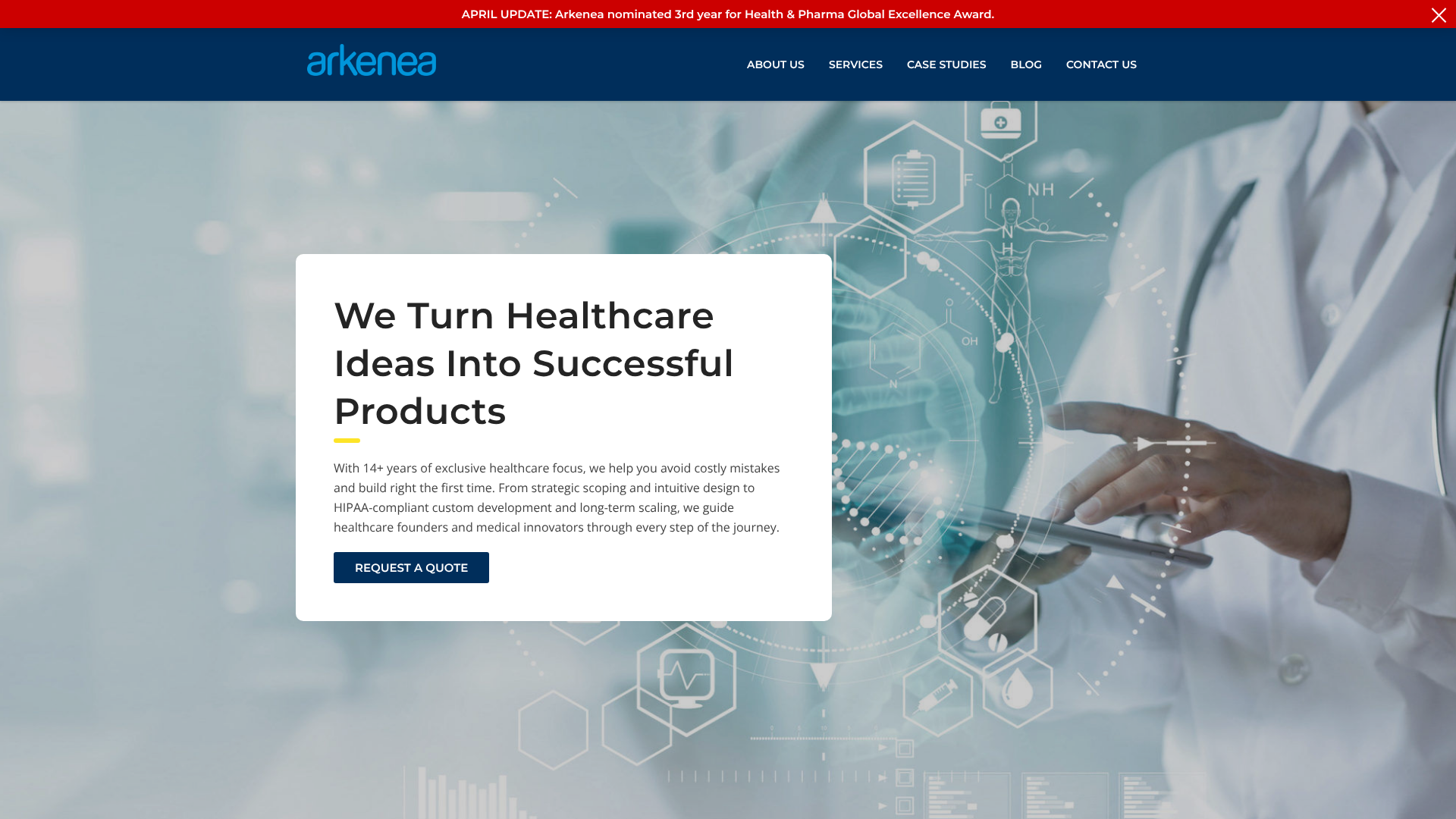
Arkenea stands out by focusing exclusively on the healthcare industry. This specialisation gives them a deep understanding of the unique challenges and opportunities in health tech. They are particularly well-regarded for their work with startups and innovators, helping them navigate the journey from idea to a market-ready, compliant product.
- Best For: Health tech startups and entrepreneurs who need a specialised partner for mobile app development, HIPAA compliance, and go-to-market strategy.
- Key Services: Custom healthcare app development, EMR/EHR integration, telemedicine app development, and HIPAA compliance consulting.
- Pros: 100% healthcare-focused, providing deep domain knowledge. Strong experience with the startup ecosystem. Excellent track record in building user-friendly mobile apps.
- Cons: Their focus on startups and mobile applications may make them less suitable for large-scale enterprise system overhauls.
4. Vention
Vention is a large-scale software development partner that provides access to a vast pool of engineering talent. While they serve multiple industries, they have a robust healthcare practice known for tackling technically challenging projects. They are a good choice for companies that need to assemble a large, skilled development team quickly.
- Best For: Well-funded startups and established companies that need to scale their engineering teams quickly with top-tier talent for complex projects.
- Key Services: Web and mobile application development, cloud engineering, AR/VR solutions for medical training, and blockchain for healthcare data security.
- Pros: Access to over 3,000 engineers. Ability to build dedicated teams tailored to specific project needs. Strong reputation for high-quality code and engineering practices.
- Cons: Their model is focused on team augmentation and dedicated teams, which may be more expensive than project-based outsourcing for smaller scopes.
5. ELEKS
ELEKS is a global technology partner that excels in software innovation and complex problem-solving. Their healthcare practice is particularly strong in areas like AI-driven diagnostics, modernising legacy systems, and developing software that is regulated as a medical device (SaMD). They blend strategic consulting with high-end engineering.
- Best For: Companies working on cutting-edge medical devices, AI-powered diagnostic tools, and those needing to modernise complex, mission-critical legacy software.
- Key Services: Medical device software (SaMD), AI and machine learning for healthcare, data science, and legacy system modernisation.
- Pros: Strong R&D capabilities. Expertise in regulated software environments. A strategic approach that goes beyond just coding to include product strategy and design.
- Cons: Their focus on complex, high-end projects means they are not the most budget-friendly option for simpler applications.
6. Andersen Lab
Andersen Lab is a full-cycle software development company with a significant footprint in the healthcare IT sector. They have a reputation for delivering reliable software and have a well-defined process for working on healthcare projects, ensuring that compliance and quality are maintained throughout. They offer a balanced mix of services suitable for mid-sized to large businesses.
- Best For: Mid-sized companies and enterprises looking for a reliable, long-term technology partner for custom software development and IT staff augmentation.
- Key Services: Custom healthcare software, telemedicine solutions, pharmacy management systems, and dental practice software.
- Pros: A large team of over 3,500 specialists. Well-established development and quality assurance processes. Experience across a wide range of healthcare sub-domains.
- Cons: May lack the niche specialisation of a smaller, healthcare-only firm.
7. Saritasa
Saritasa is a US-based custom software development company known for its high-quality project management and transparent communication. They have a strong portfolio of healthcare projects, including complex web applications, mobile apps, and IoT solutions. Their client reviews frequently praise their collaborative approach and technical proficiency.
- Best For: Businesses that value strong project management and clear communication, and are looking to build custom web, mobile, or IoT solutions.
- Key Services: Custom web and mobile app development, AR/VR training tools, IoT device integration, and database development.
- Pros: Highly rated for project management and client communication. US-based team for clients who prefer local collaboration. Expertise in emerging technologies like AR/VR.
- Cons: As a US-based firm, their rates may be higher than those of offshore or nearshore companies.
8. Intellectsoft

Intellectsoft is a digital transformation consultancy that provides engineering solutions to global organisations. Their healthcare practice focuses on creating impactful digital experiences and leveraging technology to improve patient outcomes. They are skilled at integrating emerging technologies like AI and blockchain into clinical workflows.
- Best For: Forward-thinking healthcare organisations looking to implement innovative digital solutions and improve patient engagement through technology.
- Key Services: Patient engagement platforms, IoT and connected medical devices, AI-powered chatbots, and blockchain for health records.
- Pros: Strong focus on digital transformation and strategy. Expertise in integrating new technologies into existing healthcare environments. Global delivery model.
- Cons: Their consulting-led approach may be more involved and costly than what a simple development project requires.
9. Oxagile
Oxagile is a software development company with a notable specialisation in building online video solutions. This translates into a strong capability for developing high-quality, real-time telemedicine and virtual care platforms. They understand the nuances of secure video streaming, which is a critical component of modern telehealth.
- Best For: Companies focused on building robust telemedicine, virtual care, or remote patient monitoring platforms that rely heavily on real-time video.
- Key Services: Telemedicine and telehealth platforms, EHR/EMR software, patient portals, and custom healthcare web applications.
- Pros: Deep expertise in real-time video technology. Proven experience in building secure and scalable telehealth solutions. A strong portfolio of healthcare projects.
- Cons: Their specialisation in video might mean they are less focused on other areas of healthcare IT compared to more generalised firms.
10. Belitsoft
Belitsoft is a software development company based in Eastern Europe that offers a cost-effective yet high-quality alternative for custom software development. They have a dedicated healthcare IT team with experience in a variety of projects, from E-learning platforms for medical professionals to complex hospital management systems.
- Best For: Businesses looking for a budget-friendly development partner without significantly compromising on quality, especially for web-based platforms.
- Key Services: E-learning for healthcare, hospital management software, EHR/EMR development, and custom web portals.
- Pros: Competitive pricing due to their location. A strong emphasis on quality assurance and testing. Good client retention rate, suggesting reliable long-term partnerships.
- Cons: Time zone differences could pose a communication challenge for clients in North America.
11. Appinventiv
Appinventiv is a digital product engineering company with a strong focus on mobile-first solutions. They have gained recognition for their innovative work in the health tech space, particularly in creating engaging patient-facing apps that use AI and IoT. They are a good partner for those looking to build a modern, consumer-grade healthcare application.
- Best For: Startups and enterprises focused on creating innovative, user-centric mobile health (mHealth) and wellness applications.
- Key Services: mHealth app development, wearable device integration, AI and machine learning, and blockchain solutions.
- Pros: Strong design (UI/UX) capabilities. Expertise in mobile technologies and patient engagement. A large portfolio of successful app launches.
- Cons: Primarily focused on mobile and app development, so may not be the best fit for backend-heavy enterprise systems.
12. Sidebench
Sidebench is a strategy, design, and development consultancy based in the US. They are known for their human-centred approach and have received awards for their work. They partner with innovative enterprises and have a notable case study of working with the Children's Hospital Los Angeles, demonstrating their ability to tackle meaningful and complex healthcare challenges.
- Best For: Organisations that need a strategic partner to help with product strategy and design in addition to development, particularly for impactful, user-focused projects.
- Key Services: Product strategy, UX/UI design, mobile and web app development, and systems integration.
- Pros: Award-winning design and strategy team. Proven success in the non-profit and healthcare sectors. A collaborative, partnership-based approach.
- Cons: As a premium, US-based consultancy, their services come at a higher price point.
Understanding Pricing Models and Development Costs
Budgeting for custom healthcare software development can be challenging because costs can vary dramatically based on the project's complexity, features, and regulatory requirements. Understanding the common pricing models used by healthcare software developers can help you plan your investment and find a structure that aligns with your project's needs.
Common Pricing Models
Fixed Price: This model involves a single, predetermined price for the entire project. It's best suited for small-to-medium projects with very clearly defined requirements, scope, and timelines. The main advantage is budget predictability. However, it lacks flexibility; any changes or additions to the scope will require a new contract and additional costs, which can slow down development.
Time & Materials (T&M): With this model, you pay for the actual time and effort spent by the development team. It's typically billed at an hourly, daily, or monthly rate. T&M offers maximum flexibility, making it ideal for large, complex projects where requirements may evolve. It allows for agile development and iterative changes, but it also means the final cost is not fixed, which requires careful budget management.
Dedicated Team: In this model, you hire an entire development team from the company that works exclusively on your project. You pay a fixed monthly fee per team member. This approach gives you the most control over the development process and resources, almost like having an in-house team. It's an excellent choice for long-term, large-scale projects that require ongoing development and support.
Factors Influencing Cost
The final price tag for your software is influenced by several key factors:
- Project Complexity: A simple patient portal will cost significantly less than a full-featured EHR system with AI-powered analytics.
- Compliance and Security: Implementing the robust security measures required by HIPAA and other regulations adds complexity and cost to development and testing.
- Integrations: The need to integrate with third-party systems like EHRs, billing platforms, or lab systems increases development time and cost.
- Team Location: Development rates vary significantly by region. A team in North America or Western Europe will generally have higher hourly rates than a team in Eastern Europe or Asia.
As a rough guide, a simple Minimum Viable Product (MVP) for a health app might start in the range of £40,000 – £60,000, while a complex, feature-rich platform can easily run into the hundreds of thousands or even millions of pounds.
Pro Tip: When requesting quotes, provide potential partners with a detailed project brief or Request for Proposal (RFP). The more detail you provide about your requirements, the more accurate their cost estimates will be, allowing for a more meaningful comparison.
Frequently Asked Questions (FAQ)
Here are answers to some common questions people have when searching for the best health tech partners.
What is the largest healthcare software company?
The largest healthcare software company by market share, particularly in the United States, is Epic Systems Corporation. They are a product-based company that develops, sells, and supports its own proprietary Electronic Health Record (EHR) software. It's important to distinguish them from the development companies listed in this article. Epic sells a ready-made (though highly customisable) product, whereas the firms we've discussed are service-based companies you hire to build completely custom software from the ground up.
What are the top healthcare IT companies?
The term "healthcare IT companies" is broad and includes several categories. The largest are the enterprise EHR providers like Epic Systems, Cerner (now part of Oracle Health), and athenahealth. Then there are the medical device manufacturers like Philips Healthcare and GE Healthcare, which also have significant software divisions. Finally, there are the leading health tech companies and development firms like ScienceSoft and Itransition, which specialise in creating custom software solutions for the industry.
What is the most popular healthcare software?
By far, the most widely used type of healthcare software is the Electronic Health Record (EHR) or Electronic Medical Record (EMR) system. These platforms are the digital backbone of modern hospitals and clinics, used for patient charting, ordering tests, prescribing medications, and billing. Systems from Epic and Cerner are dominant in the hospital market, holding a significant majority of the market share in the US and other parts of the world.
How much does it cost to develop custom healthcare software?
The cost varies widely depending on the project's scope. A simple Minimum Viable Product (MVP) for a mobile health app could cost between £40,000 and £80,000. A more complex telemedicine platform could range from £100,000 to £250,000. A full-scale, custom EHR system for a hospital is a massive undertaking that can easily exceed £1 million.
The key cost drivers are feature complexity, the number of required integrations, and the stringent security and compliance requirements.
Final Thoughts
Choosing from the top healthcare software development companies is a decision that will shape the future of your project and potentially your organisation. The ideal partner is more than just a vendor; they are a collaborator who brings deep industry expertise, a rigorous approach to compliance, and the technical skill to bring your vision to life.
As you evaluate your options, look beyond the sales pitch. Scrutinise their case studies, speak with their past clients, and challenge their understanding of the complex regulatory landscape. The due diligence you perform today will pay dividends in the form of a secure, compliant, and effective software product that truly serves the needs of clinicians and patients.
The firms listed here represent some of the best healthcare software firms in the industry, but the right choice always depends on your unique project requirements, budget, and long-term goals. Use this guide as a starting point to build your shortlist and begin the crucial process of finding the perfect technology partner for your journey.