


AI-Powered Content Generation: A Marketer's Guide to Scaling in 2026
Creating high-quality content consistently is one of the biggest challenges for any marketing team. The demand for fresh blog posts, engaging social media updates, and compelling video scripts is relentless. This is where ai-powered content generation comes in, offering a powerful way to augment human creativity, automate repetitive tasks, and scale your output without sacrificing quality. By using sophisticated algorithms, these tools can help you produce everything from initial drafts to polished final pieces in a fraction of the time it would normally take.
- What You'll Learn
- What Exactly Is AI-Powered Content Generation?
- The Core Benefits: Why Marketers Are Adopting AI Content Creation
- Beyond Text: Exploring Different Types of Automated Content Generation
- Choosing the Right AI Writing Tools for Your Needs
- Define Your Primary Use Case
- Evaluate Ease of Use
- Check for Quality and Originality
- Consider Integration Capabilities
- Top AI Content Generation Tools Recommended for 2026
- 1. Jasper (formerly Jarvis): Best for Versatility and Quality
- 2. Writesonic: Best for SEO-Focused Content and Landing Pages
- 3. Pictory: Best for Turning Text into Video
- 4. Synthesia: Best for Creating Professional AI Avatar Videos
- Understanding Pricing and Cost Structures
- The Pros and Cons of AI-Powered Content Generation
- How to Use AI to Automate Content Creation (A Practical Workflow)
- Step 1: Ideation and Research
- Step 2: Prompt Engineering
- Step 3: Generating the First Draft
- Step 4: Human Editing and Fact-Checking (The Crucial Step)
- Step 5: Optimisation and Publishing
- Frequently Asked Questions About AI Content Creation
- Is AI-generated content penalised by Google?
- Can AI replace human content creators?
- How can I ensure the content is original?
- What is the best AI tool for beginners?
- Final Thoughts: The Future of Content is Human-AI Collaboration
This guide explains exactly what AI content creation is, how it works, and how you can use it to your advantage. We'll cover the key benefits, the different types of content you can create, and what to look for when choosing a tool. We will also review some of the top platforms available today to help you make an informed decision.
What You'll Learn
- What AI Content Generation Is: Understand the technology behind these tools and how they have evolved from simple text spinners to sophisticated creative partners.
- The Key Benefits for Marketers: Discover how automated content generation can help you increase speed, overcome writer's block, and reduce costs.
- How to Choose the Right Platform: Learn the essential criteria for selecting an AI tool that aligns with your specific use case, brand voice, and budget.
- Top Tool Recommendations: Get an overview of leading platforms for text, video, and audio creation, including their strengths and weaknesses.
- The Importance of Human Oversight: Realise why the most effective approach is a collaboration between human creativity and AI efficiency, not a complete replacement.
What Exactly Is AI-Powered Content Generation?
AI-powered content generation refers to the use of artificial intelligence, specifically machine learning models, to create written, visual, or audio content. At its core, it uses technologies like Natural Language Processing (NLP) and Natural Language Generation (NLG) to understand human language prompts and produce new, original content based on the patterns it has learned from vast amounts of data.
Think of it like an incredibly advanced autocomplete function. These AI models, known as Large Language Models (LLMs), have been trained on billions of text and image examples from the internet. This training allows them to understand context, grammar, tone, and style. When you give an AI writing tool a prompt, like "write a blog post intro about the benefits of remote work," it predicts the most logical sequence of words to form coherent and relevant sentences and paragraphs.
Early forms of automated content generation were clunky and often produced robotic, nonsensical text. However, modern systems are far more sophisticated. They can write with nuance, adopt specific brand voices, create compelling marketing copy, and even generate code or artistic images. The technology has moved beyond simple text to encompass a wide range of media, making it a versatile asset for content teams.
The Core Benefits: Why Marketers Are Adopting AI Content Creation
Marketers are constantly under pressure to produce more content for more channels, all while maintaining high standards. AI content creation directly addresses these challenges by offering a suite of benefits that streamline workflows and amplify results.
Unprecedented Speed and Scale
This is perhaps the most significant advantage. An AI tool can generate a first draft of a 1,000-word article in minutes, a task that could take a human writer several hours. This speed allows marketing teams to scale their content production dramatically, filling their editorial calendars and targeting more niche keywords without a proportional increase in headcount or budget.
Overcoming Writer's Block
Every creator faces the blank page. AI writing tools act as an excellent brainstorming partner. By providing a simple idea or a few keywords, you can get multiple headlines, outlines, or introductory paragraphs to kickstart the creative process. This removes the initial friction and helps writers move directly into refining and adding their unique insights.
Cost-Effectiveness
While professional human writers are invaluable, their services come at a premium. An AI content generation platform subscription often costs less per month than commissioning a few freelance articles. This makes it possible for small businesses and startups to compete on the content front with larger organisations, producing a high volume of material without a massive investment.
Enhanced Personalisation
AI can quickly generate multiple variations of an ad, email subject line, or social media post. This allows for A/B testing at scale and the creation of highly personalised content tailored to different audience segments. For example, you can create five different versions of a product description, each targeting a different customer pain point, in the time it would take to write one manually.

Beyond Text: Exploring Different Types of Automated Content Generation
While the term "AI writing tools" is common, modern AI's creative capabilities extend far beyond the written word. The technology is now multi-modal, enabling the creation of a full spectrum of digital assets. This allows for a more integrated and efficient content strategy where a single idea can be repurposed into multiple formats with ease.
AI-Generated Text
This is the most established form of AI content creation. It includes everything from long-form blog posts and articles to short-form copy for social media, advertisements, and product descriptions. Tools like Jasper and Writesonic excel at this, offering templates for virtually any written format a marketer might need.
AI-Generated Images
Using text-to-image models, these platforms can create unique, high-quality images from simple text descriptions. This is incredibly useful for blog post headers, social media visuals, and presentation slides, eliminating the need for stock photography. Platforms like OpenArt provide access to this technology, allowing you to generate custom visuals that perfectly match your content's theme.
AI-Generated Video
Video creation has traditionally been complex and expensive. AI is changing that. Tools like Pictory can automatically transform a blog post or script into an engaging video, complete with stock footage, music, and captions. For more professional presentations, platforms like Synthesia allow you to create videos featuring realistic AI avatars, perfect for corporate training and marketing announcements.
AI-Generated Audio
High-quality voiceovers no longer require a recording studio. Text-to-speech (TTS) platforms can convert written text into natural-sounding audio in various languages and accents. This is ideal for podcast intros, video narrations, and accessibility features. Services like Murf AI and ElevenLabs are leaders in this space, offering voices that are nearly indistinguishable from human speech.
Choosing the Right AI Writing Tools for Your Needs
With a rapidly growing market, selecting the best AI content creation tool can feel overwhelming. The right choice depends entirely on your specific goals, workflow, and budget. Focusing on a few key criteria can help you narrow down the options and find a platform that will become a valuable part of your toolkit.
Define Your Primary Use Case
What type of content will you be creating most often? If your focus is on long-form SEO articles, you'll want a tool with strong research and optimisation features. If you primarily need short, punchy copy for social media and ads, a tool with templates for these formats is a better fit. For video or audio, you'll need a specialised platform.
Evaluate Ease of Use
An AI tool should save you time, not create a new learning curve. Look for platforms with a clean, intuitive interface. Many offer free trials, which are a great way to test the user experience before committing. Can you easily find the features you need? Is the process of generating and editing content straightforward?
Pro Tip: When testing a tool, try giving it the same prompt you would give a human writer. Assess not only the quality of the output but also how much editing and refinement it requires. The best tools provide a strong first draft that only needs polishing.
Check for Quality and Originality
High-quality output is non-negotiable. The content should be coherent, grammatically correct, and sound natural. Most top-tier tools also include a built-in plagiarism checker to ensure the content it generates is original. This is crucial for maintaining your website's integrity and SEO standing.
Consider Integration Capabilities
To maximise efficiency, choose a tool that fits into your existing workflow. Look for integrations with platforms you already use, such as WordPress, Google Docs, or marketing automation software like HubSpot. Some tools, like those offered by Semrush, integrate AI writing directly into their SEO and marketing suites, creating a powerful, all-in-one solution.
Top AI Content Generation Tools Recommended for 2026
Here are a few of the leading platforms across different content types, each with unique strengths that cater to different marketing needs.
1. Jasper (formerly Jarvis): Best for Versatility and Quality
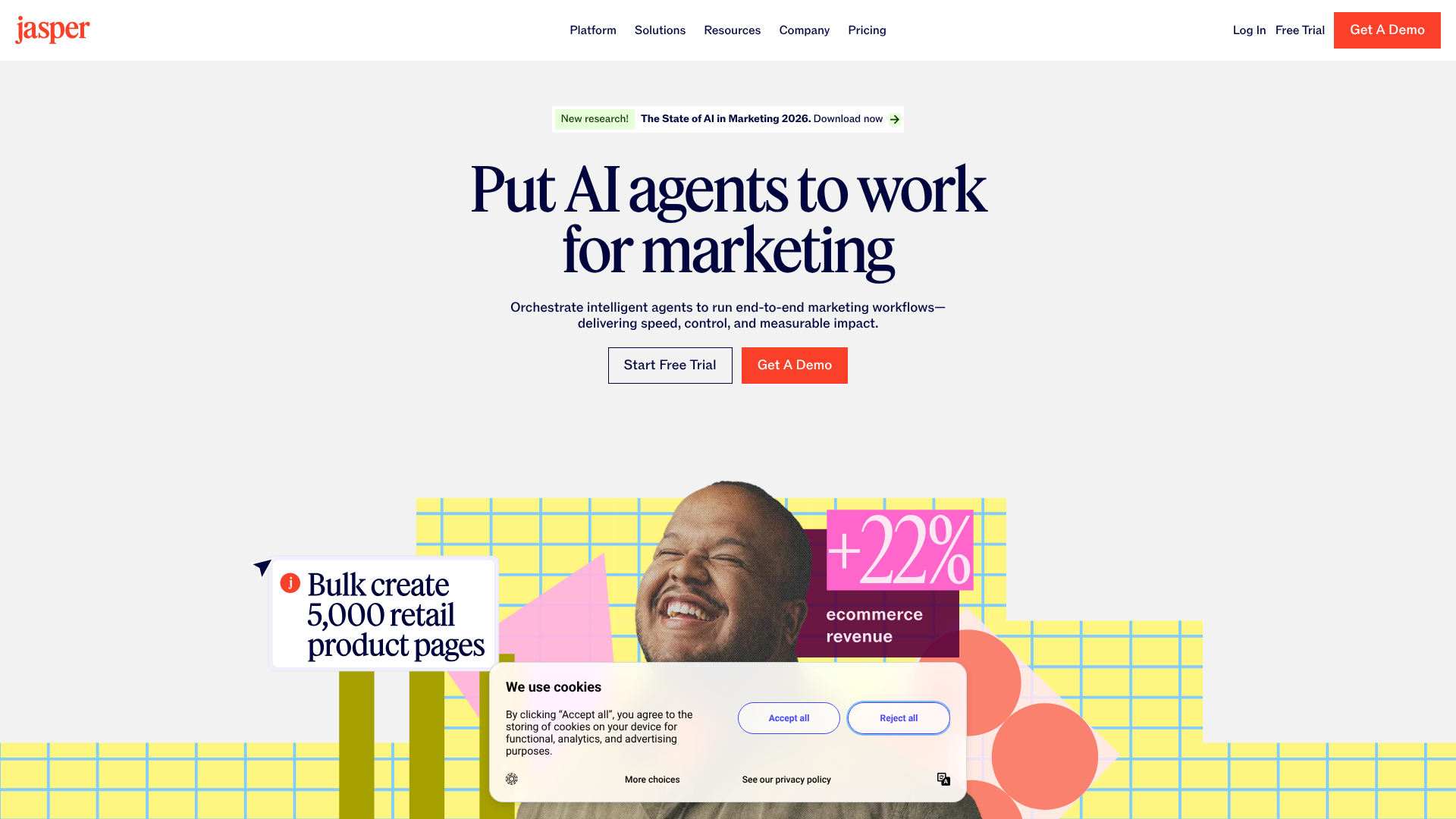
Jasper is one of the most well-known and respected names in AI writing. It's designed to be an all-purpose content partner, offering over 50 templates for everything from blog posts and video scripts to Google Ads copy and email newsletters. Its long-form editor is particularly powerful, allowing you to compose entire articles with a high degree of control.
Jasper's 'Brand Voice' feature lets you train the AI on your own content, ensuring that everything it produces aligns with your established style and tone. This makes it an excellent choice for businesses that want to maintain brand consistency across all their communications.
Pros
- Extremely high-quality and natural-sounding output.
- Vast library of templates for almost any content need.
- Powerful long-form editor and collaboration features.
Cons
- Can be more expensive than some competitors.
- The sheer number of features can have a slight learning curve for new users.
2. Writesonic: Best for SEO-Focused Content and Landing Pages
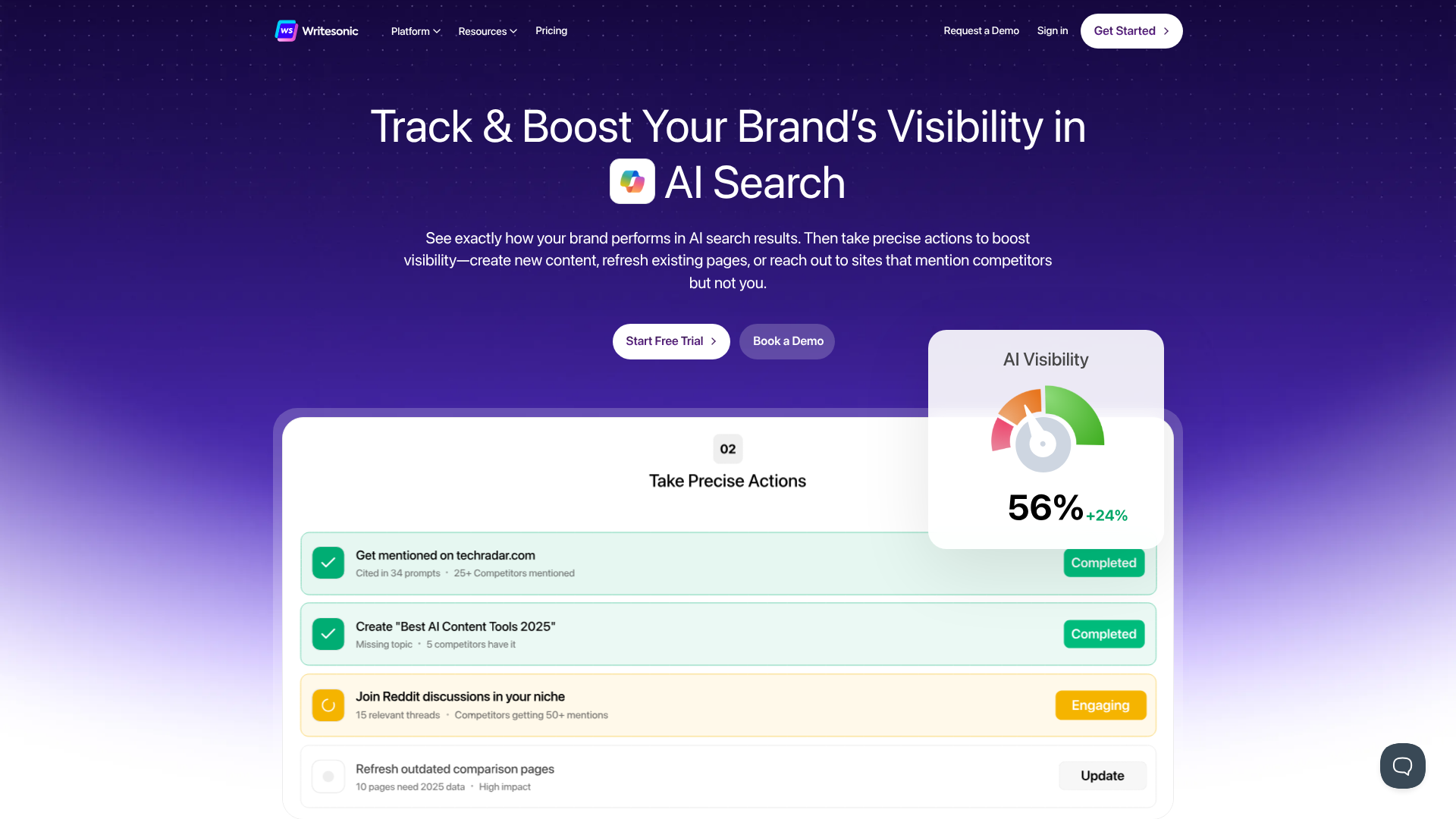
Writesonic is a powerful competitor to Jasper, with a particular focus on creating marketing and SEO-optimised content. Its AI Article Writer can generate a complete, 1,500-word blog post that is optimised for search engines. It also has excellent tools for creating high-converting landing pages and ad copy.
One of Writesonic's standout features is its integration with Surfer SEO, which provides data-driven recommendations for optimising your content to rank on Google. It also includes Photosonic for AI image generation and Audiosonic for text-to-speech, making it a comprehensive content suite.
Pros
- Excellent features for creating SEO-optimised articles.
- Includes AI image and audio generation tools.
- Often more affordable than other premium options.
Cons
- The user interface can sometimes feel less polished than top competitors.
- Long-form content may occasionally require more editing for flow.
3. Pictory: Best for Turning Text into Video
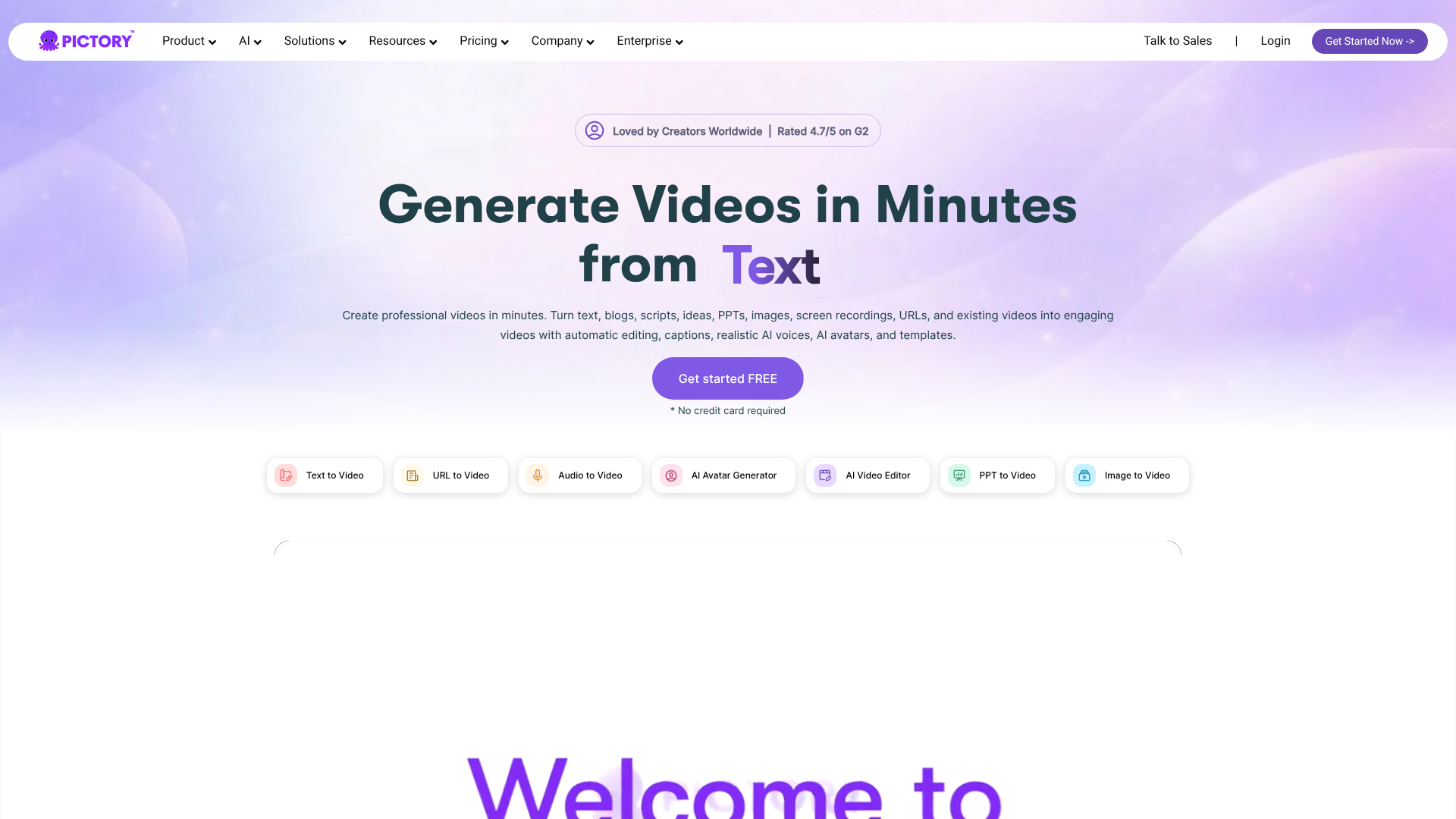
Pictory makes video creation accessible to everyone, regardless of technical skill. Its core feature allows you to paste in the text from a blog post or a script, and the AI will automatically create a professional-looking video. It analyses the text, selects relevant stock video clips and images from a massive library, and adds captions and music.
This is an incredibly efficient way to repurpose your existing written content into a new format for platforms like YouTube and LinkedIn. You can edit the visuals, choose a voiceover (AI or your own), and brand the video with your logo and colours in minutes.
Pros
- Extremely fast and easy way to create videos from text.
- Huge library of licensed stock media.
- Automatically adds captions, which is great for social media.
Cons
- The AI's choice of visuals sometimes needs manual adjustment.
- Less customisation than a traditional video editor.
4. Synthesia: Best for Creating Professional AI Avatar Videos
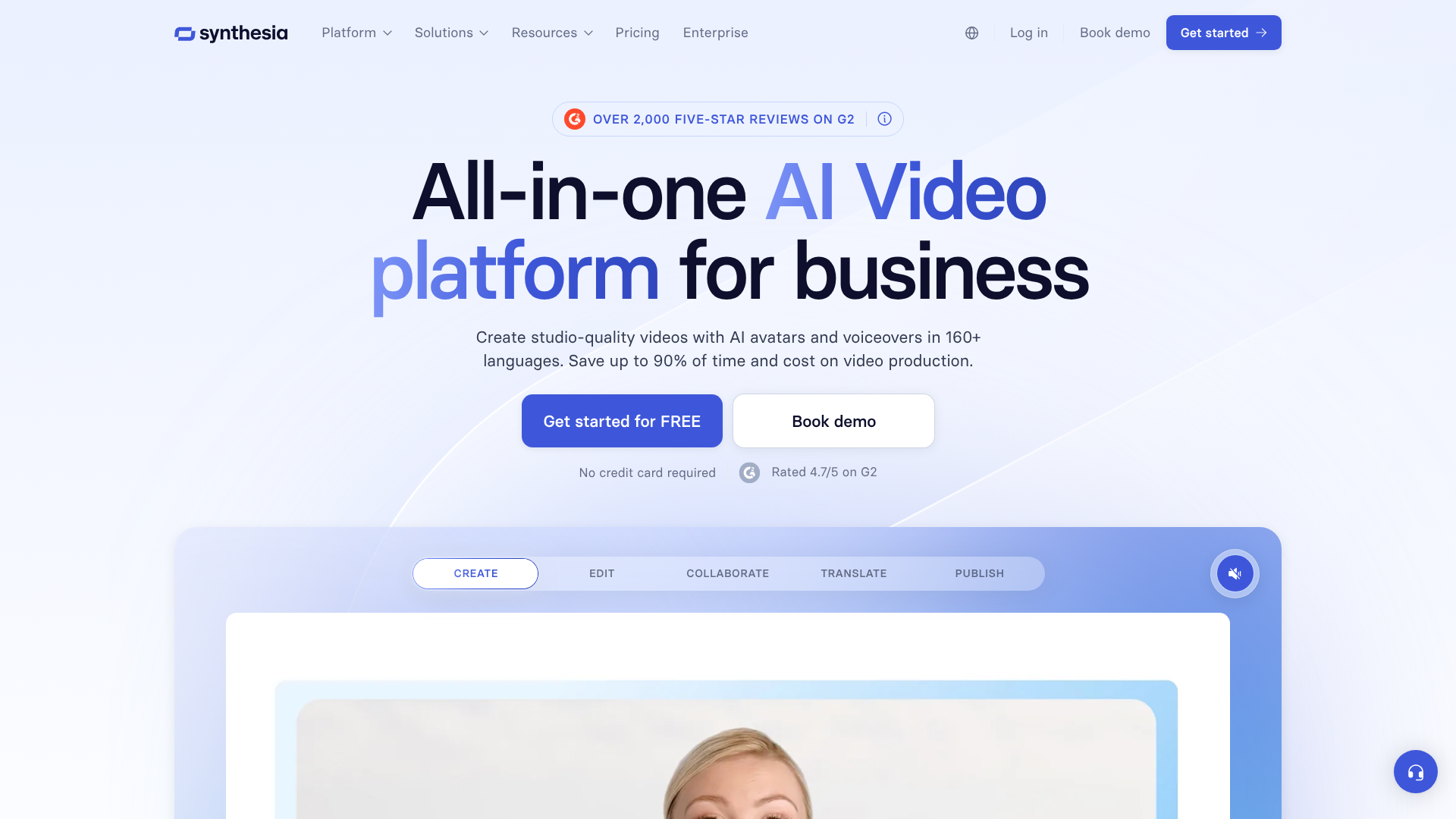
Synthesia takes AI video to the next level by using realistic AI avatars. You simply type your script, choose an avatar and a background, and the platform generates a video of the avatar speaking your text. It supports over 120 languages and offers a diverse range of avatars.
This technology is perfect for creating corporate training materials, product explainers, and internal communications without the need for cameras, actors, or studios. The result is a clean, professional video that can be produced quickly and at a fraction of the cost of a traditional video shoot.
Pros
- Creates highly professional and polished videos.
- No need for filming equipment or actors.
- Supports a massive number of languages.
Cons
- The avatars, while realistic, may not be suitable for all brand aesthetics.
- Pricing is geared more towards businesses than individual creators.
Understanding Pricing and Cost Structures
The cost of AI content tools can vary widely, but most platforms follow a few common pricing models. Understanding these structures will help you compare options and find a plan that provides the best value for your usage level.
Subscription Tiers
This is the most common model. Platforms offer several monthly or annual plans, with higher-priced tiers providing more features, higher word or credit limits, and more user seats. A basic plan might be suitable for a solo blogger, while a business plan would be necessary for a marketing team.
Pay-As-You-Go Credits
Some services, particularly for image or video generation, operate on a credit system. You purchase a bundle of credits and use them to generate content. This can be a cost-effective option if your content needs are sporadic rather than constant.
Free Tiers and Trials
Nearly every major platform offers a free trial or a limited free-forever plan. These are excellent for testing the tool's quality and interface. Free plans typically come with strict limits on the amount of content you can generate each month, but they are perfect for getting a feel for the software before you invest.
A Quick Cost Comparison
| Feature | Jasper | Writesonic | Pictory |
|---|---|---|---|
| Pricing Model | Subscription Tiers | Subscription Tiers | Subscription Tiers |
| Free Trial | Yes | Yes (with free plan) | Yes |
| Primary Focus | High-quality, versatile text | SEO content & marketing copy | Text-to-video creation |
| Starting Price | Typically starts around £30-£50/month | Often more affordable, with plans under £20/month | Starts around £15-£20/month |
| Best For | Teams needing top-tier quality and brand voice control. | Marketers focused on SEO and lead generation. | Content creators wanting to repurpose articles into videos. |
Note: Pricing is subject to change. Please visit the respective websites for the most current information.
The Pros and Cons of AI-Powered Content Generation
While AI offers transformative potential, it's essential to have a balanced perspective. It is a powerful tool, but it comes with limitations that require human oversight. Understanding both sides helps you integrate AI into your workflow responsibly and effectively.
The Advantages (The "Pros")
- Efficiency and Speed: Drastically reduces the time it takes to produce content, from initial idea to final draft.
- Scalability: Allows you to increase your content output significantly without a linear increase in resources.
- Cost Reduction: Can be more affordable than hiring additional writers or agencies, especially for high-volume needs.
- Idea Generation: Serves as an excellent tool for brainstorming and overcoming creative blocks.
The Limitations and Risks (The "Cons")
- Factual Inaccuracies: AI models can "hallucinate" and present incorrect information as fact. All outputs must be fact-checked by a human expert.
- Lack of True Creativity: AI generates content based on existing patterns. It cannot create truly novel ideas, express genuine emotion, or share personal experiences.
- Potential for Generic Content: Without careful prompting and editing, AI-generated content can sound bland and lack a unique perspective.
- Requires Human Oversight: It is not a "set it and forget it" solution. The best results come from a partnership where AI generates the draft and a human editor refines, fact-checks, and adds strategic insight.
How to Use AI to Automate Content Creation (A Practical Workflow)
Integrating AI effectively is about creating a new workflow that blends machine efficiency with human expertise. Here is a step-by-step process for using AI as a content creation assistant.
Step 1: Ideation and Research
Start with your content strategy. Use traditional methods and tools like Semrush to identify keywords and topics. Define your target audience, the goal of the piece, and the key points you want to cover. This strategic direction is something only a human can provide.
Step 2: Prompt Engineering
Your input quality directly determines the output quality. Write a detailed prompt for the AI. Include the topic, target audience, desired tone of voice, keywords to include, and a rough outline. The more context you provide, the better and more relevant the AI's first draft will be.
Step 3: Generating the First Draft
Feed your detailed prompt into your chosen AI tool. Let the machine do the heavy lifting of structuring the content, writing the initial paragraphs, and fleshing out the sections based on your outline. This is the primary time-saving step.
Step 4: Human Editing and Fact-Checking (The Crucial Step)
This is where you add the real value. Review the AI-generated draft for accuracy, tone, and flow. Correct any factual errors, rephrase awkward sentences, and inject your own expertise, anecdotes, and unique perspective. This human touch is what separates great content from generic content.
Pro Tip: Use an editing tool like Grammarly alongside your AI writer. The AI can generate the text, and Grammarly can help you polish the grammar, style, and clarity to a professional standard during the editing phase.
Step 5: Optimisation and Publishing
Finally, perform your standard on-page SEO checks. Ensure your keywords are placed naturally, add internal and external links, and format the content for readability with headings, lists, and images. Once you're satisfied, publish the piece. This collaborative process ensures you get the speed of AI without sacrificing the quality and authority that comes from human expertise.
Frequently Asked Questions About AI Content Creation
Here are answers to some of the most common questions people have about using AI for content.
Is AI-generated content penalised by Google?
No, Google does not penalise content simply because it was created using AI. Google's focus is on the quality and helpfulness of the content, regardless of how it was produced. As long as your content is original, accurate, and provides value to the reader (demonstrating Experience, Expertise, Authoritativeness, and Trustworthiness – E-E-A-T), it can rank well. The key is to use AI as a tool to create high-quality content, not to produce low-quality spam.
Can AI replace human content creators?
It is highly unlikely that AI will completely replace human creators. AI lacks genuine creativity, emotional intelligence, and the ability to share personal experiences or provide deep, strategic insights. The future of content creation is a collaborative one, where humans guide the strategy and provide the creative spark, while AI handles the more repetitive and time-consuming aspects of drafting and production. AI is best viewed as an assistant, not a replacement.
How can I ensure the content is original?
Reputable AI content generation tools are designed to produce original content and not plagiarise existing work. They create new sentences and paragraphs based on learned patterns rather than copying and pasting from their training data. To be certain, always use the built-in plagiarism checker that most top-tier platforms offer before publishing any content.
What is the best AI tool for beginners?
For beginners focused on written content, a tool like Writesonic is often a great starting point. It has an intuitive interface, a generous free plan to get started, and helpful templates that guide you through the creation process. For those looking to easily create videos from text, Pictory is exceptionally user-friendly and requires no prior video editing experience.
Final Thoughts: The Future of Content is Human-AI Collaboration
AI-powered content generation is not a passing trend; it's a fundamental shift in how we create and scale digital content. These tools offer incredible opportunities to boost efficiency, overcome creative hurdles, and produce a higher volume of quality work than ever before. However, they are not magic wands. The best results will always come from a thoughtful partnership between human strategy and artificial intelligence.
By using AI to handle the first draft, you free up valuable time to focus on what truly matters: strategy, creativity, and adding the unique human insights that resonate with your audience. The goal isn't to automate your job away, but to augment your capabilities and allow you to achieve more.
If you're ready to explore how AI can fit into your workflow, consider trying a versatile writing assistant like Jasper for its quality and brand voice features, or Writesonic for its strong focus on SEO. For repurposing your content into video, a tool like Pictory can unlock new channels for your message with minimal effort.