

Online Courses for Web Development: A Buyer's Guide for Beginners
Choosing from the vast number of online courses for web development can feel overwhelming, especially when you're just starting. With options ranging from free, self-guided curricula to intensive, university-backed bootcamps, finding the right fit is crucial for turning your learning efforts into a successful career. This guide is designed to help you navigate the options, understand what to look for, and select a course that aligns perfectly with your goals, budget, and learning style.
- Quick Summary
- What Are Online Courses for Web Development?
- Key Features to Look for in Web Development Courses
- Comprehensive and Modern Curriculum
- Strong Emphasis on Project-Based Learning
- Access to Instructor Support and Mentorship
- An Active and Engaged Community
- Career Services and Job-Seeking Support
- How to Choose the Right Online Web Development Classes for You
- 1. Assess Your Learning Style
- 2. Define Your Career Goals
- 3. Consider Your Time Commitment
- 4. Set a Realistic Budget
- Top Recommendations: The Best Online Courses for Web Development in 2026
- Best Free Option: The Odin Project
- Best Comprehensive Bootcamp: The Web Developer Bootcamp by Colt Steele (Udemy)
- Best for Professional Certificates: Coursera
- Best for Interactive Learning: Codecademy
- Understanding Pricing and Value
- Free vs. Paid Courses: What's the Difference?
- One-Time Purchase vs. Subscription Models
- Are Expensive Bootcamps Worth It?
- The Rise of Course Creation Platforms
- Frequently Asked Questions
- Is web development dead due to AI?
- Is 40 too old to become a web developer?
- Can I learn web development online for free?
- Which 6 month IT course is best?
- Final Thoughts
Web development remains one of the most in-demand skills in the tech industry. The right online course can provide the structured knowledge and practical projects needed to build a strong portfolio and land your first job. Whether you aim to become a front-end, back-end, or full-stack developer, your journey begins with a single, well-chosen educational path.
Quick Summary
- Define Your Goal First: Before choosing a course, decide if you want to be a front-end (visuals), back-end (server-side), or full-stack (both) developer. This focus will narrow down your options significantly.
- Look for Project-Based Learning: The best web development courses emphasise building real projects. A strong portfolio of completed work is more valuable to employers than a certificate alone.
- Free Can Be Fantastic: Don't overlook free resources. Platforms like The Odin Project offer a comprehensive, job-ready curriculum at no cost, though they require immense self-discipline.
- Certificates Matter (Sometimes): Certificates from reputable sources like Google, Meta, or major universities via platforms like Coursera can add weight to your CV, especially when you're new to the field.
- Community is Key: Learning to code can be isolating. Choose a course with an active community (like a Discord or Slack channel) for support, collaboration, and networking.
What Are Online Courses for Web Development?
Online courses for web development are structured educational programmes delivered over the internet that teach individuals how to build and maintain websites and web applications. Unlike traditional classroom settings, these courses offer flexibility, allowing you to learn from anywhere with an internet connection. They cover the essential building blocks of the web, from the visual elements you see on a page to the complex server-side logic that powers it.
The curriculum typically starts with foundational languages. You'll begin with HTML (HyperText Markup Language) to structure web content, CSS (Cascading Style Sheets) to style it, and JavaScript to make it interactive. These three technologies form the core of front-end development, which focuses on the user-facing part of a website.
As you progress, many online web development classes introduce you to more advanced concepts. This can include front-end frameworks like React or Angular, which help build complex user interfaces more efficiently. You might also explore back-end development, which involves server-side languages like Node.js, Python, or Ruby, and databases like MongoDB or PostgreSQL. A course that covers both front-end and back-end technologies is often called a "full-stack" programme.
These courses come in various formats. Some are self-paced video libraries on platforms like Udemy, while others are structured, cohort-based bootcamps with live instruction and strict deadlines. Others, offered by universities on platforms like edX or Coursera, provide a more academic approach, often culminating in a professional certificate.
Key Features to Look for in Web Development Courses
With so many options available, identifying high-quality web development courses requires looking beyond the marketing hype. Certain key features are strong indicators of a programme that will deliver real value and prepare you for a job in the industry. Focusing on these elements will help you make an informed decision.
Comprehensive and Modern Curriculum
The technology landscape changes quickly. A good course must teach a modern tech stack that is currently in demand. Check that the curriculum covers fundamental HTML5, CSS3 (including concepts like Flexbox and Grid), and modern JavaScript (ES6+). For more advanced learning, look for popular frameworks and libraries like React, Vue, or Svelte for the front-end, and Node.js with Express for the back-end. The course content should be updated regularly to reflect current industry best practices.
Strong Emphasis on Project-Based Learning
Watching video lectures is not enough to become a developer. You learn by doing. The most effective online courses are built around a portfolio of projects. You should be building things from day one, starting with simple web pages and progressing to complex, full-stack applications. These projects are not just for practice; they become the portfolio you show to potential employers. A course that provides clear project briefs, guidance, and examples of finished products is invaluable.
Access to Instructor Support and Mentorship
When you get stuck on a coding problem (and you will), having access to help is critical. Look for courses that offer support from instructors or teaching assistants. This could be through Q&A forums, dedicated Slack or Discord channels, or one-on-one mentorship sessions. The quality and responsiveness of this support system can make a huge difference in your learning journey and prevent you from giving up out of frustration.
An Active and Engaged Community
Learning alongside a community of peers provides motivation, support, and networking opportunities. Many top courses foster a strong community where students can ask questions, share their work, and collaborate on projects. This peer-to-peer interaction simulates a real-world development team environment and helps you build soft skills. An active community is a sign of a healthy and well-regarded programme.
Career Services and Job-Seeking Support
Ultimately, the goal for many is to get a job. Some of the more intensive bootcamps and programmes offer career services to help with this transition. This can include CV and portfolio reviews, interview preparation, and even connections with hiring partners. While not always necessary, especially for self-starters, these services can provide a significant advantage when you're ready to enter the job market.
How to Choose the Right Online Web Development Classes for You

Selecting the perfect course is a personal decision that depends on your individual circumstances. A programme that's ideal for a recent graduate with ample free time might be a poor fit for a working professional changing careers. Here’s a framework to help you decide.
1. Assess Your Learning Style
First, understand how you learn best. Are you a visual learner who benefits from video tutorials and diagrams? Or do you prefer a hands-on, kinesthetic approach where you learn by building things immediately? Some people thrive with the structure of live classes and deadlines, while others need the flexibility of a self-paced course they can fit around their existing schedule. Be honest about what works for you. A mismatch in learning style can lead to frustration and a higher chance of dropping out.
2. Define Your Career Goals
What do you want to achieve? Your goal determines the type of course you need. If you want to become a front-end developer, you can focus on courses that specialise in HTML, CSS, JavaScript, and a framework like React. If you're interested in data and server logic, a back-end course focusing on Python, Node.js, and databases is more appropriate. For those who want to be versatile, a full-stack programme is the way to go. Having a clear goal prevents you from learning technologies you won't use.
3. Consider Your Time Commitment
How much time can you realistically dedicate to learning each week? An intensive, full-time bootcamp might require 40-60 hours per week and promises to get you job-ready in 3-6 months. A part-time or self-paced course offers more flexibility, allowing you to learn for 10-15 hours a week over a longer period. Look at your current work, family, and social commitments to determine what is sustainable. It's better to make slow, consistent progress than to burn out from an overly ambitious schedule.
4. Set a Realistic Budget
Online web development classes have a massive price range. You can find excellent free resources, affordable one-time purchase courses for under £100, and comprehensive bootcamps that cost over £10,000. Determine what you are willing and able to invest. Remember that a higher price doesn't always guarantee better quality. Some of the best-regarded curricula are free (like The Odin Project), while some expensive courses may not deliver on their promises. Focus on the value provided—curriculum, support, and projects—rather than just the price tag.
Pro Tip: Before committing to a paid course, try their free introductory materials or a similar free course on the same topic. This helps you confirm that you enjoy web development and that the platform's teaching style works for you before making a financial investment.
Top Recommendations: The Best Online Courses for Web Development in 2026
Navigating the sea of available courses can be tough. Based on curriculum quality, student outcomes, and community reputation, here are some of the top recommendations for learning web development online today.
Best Free Option: The Odin Project

The Odin Project is not just a course; it's a complete, open-source curriculum for becoming a full-stack developer. It is highly respected in the development community for its rigorous, project-based approach. It doesn't hold your hand; instead, it teaches you how to find answers and solve problems like a real developer by curating the best free resources from across the web.
Pros
- Completely Free: There are no costs, fees, or subscriptions. The entire curriculum is available to everyone.
- Job-Focused: The curriculum is designed to get you hired, focusing on practical skills and a strong portfolio.
- Active Community: It has a massive and very active Discord community where you can get help from fellow students and alumni.
Cons
- Requires Extreme Self-Discipline: With no instructors or deadlines, you are entirely responsible for your own progress.
- Text-Based: The learning is primarily through reading articles and documentation, which may not suit visual learners.
Best Comprehensive Bootcamp: The Web Developer Bootcamp by Colt Steele (Udemy)
Often cited as the course that launched thousands of developer careers, Colt Steele's bootcamp on Udemy is a phenomenal value. It has been recently updated to cover a completely modern tech stack, including Node.js, Express, MongoDB, and React. It's a self-paced course that provides the comprehensive feel of a bootcamp for a fraction of the price.
Pros
- Incredible Value: You get hundreds of hours of high-quality video content for a low, one-time purchase price (especially during Udemy sales).
- Highly Engaging Instructor: Colt Steele is known for his clear, concise, and engaging teaching style.
- Project-Heavy: The course culminates in a large, full-stack project that makes a great portfolio piece.
Cons
- Limited Direct Support: While there is a Q&A section, you don't get the dedicated mentorship of a traditional bootcamp.
- Self-Paced Can Be a Downside: The lack of a fixed schedule requires personal motivation to complete.
Best for Professional Certificates: Coursera
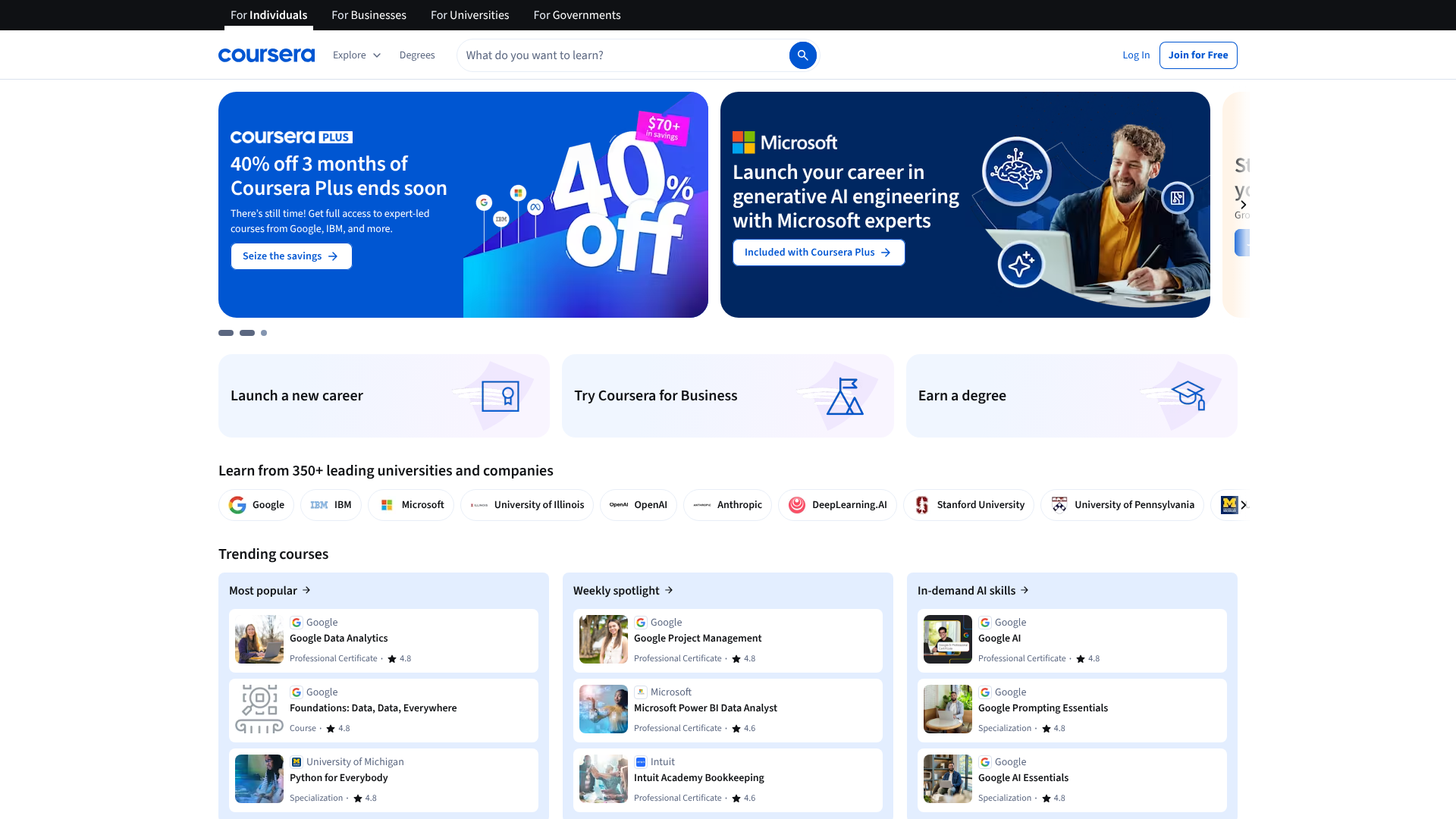
Coursera partners with top companies and universities to offer professional certificates. For web development, the Meta Front-End Developer and Meta Back-End Developer Professional Certificates are excellent, beginner-friendly programmes. They are designed by Meta engineers and provide a structured path to becoming job-ready, covering everything from foundational skills to advanced topics like React and Django.
Pros
- Reputable Certification: A certificate from a company like Meta or Google can add significant credibility to your CV.
- Structured Learning: The courses are broken down into weekly modules with clear deadlines, keeping you on track.
- Financial Aid Available: Coursera offers financial aid to those who cannot afford the monthly subscription fee.
Cons
- Subscription-Based: The cost can add up if you take a long time to complete the certificate.
- Less Community Interaction: While there are forums, the sense of community can be less vibrant than in dedicated bootcamps.
Best for Interactive Learning: Codecademy
Codecademy is famous for its interactive, in-browser learning environment. You read a short explanation and immediately apply the concept in a coding window on the same screen. This instant feedback loop is fantastic for beginners. Their "Full-Stack Engineer" career path is a comprehensive programme that covers everything you need to know, from front-end to back-end development.
Pros
- Hands-On Approach: You write code from the very first lesson, which helps solidify concepts quickly.
- Well-Structured Paths: The career paths guide you through a logical progression of skills and technologies.
- Great for Beginners: The interactive style is less intimidating than setting up a local development environment right away.
Cons
- Can Lead to Tutorial Purgatory: It can be easy to rely on the in-browser prompts without learning how to code independently.
- Pro Version Required for Full Paths: The most valuable content, including career paths and projects, is behind a subscription.
Understanding Pricing and Value
The cost of online web development courses varies dramatically, from completely free to tens of thousands of pounds. Understanding the different pricing models and what you get for your money is key to finding the right balance of cost and value for your situation.
Free vs. Paid Courses: What's the Difference?
Free courses, like The Odin Project or freeCodeCamp, offer surprisingly comprehensive curricula. They are excellent for self-motivated learners who are good at finding information independently. The primary trade-off is the lack of direct support. You rely on community forums and your own problem-solving skills.
Paid courses typically offer more structure and support. This can include video lectures, direct access to instructors or mentors, a curated learning path, and career services. You are paying for convenience, expert guidance, and a more streamlined learning experience. For many, this support system is what makes the difference between finishing the course and giving up.
One-Time Purchase vs. Subscription Models
Platforms like Udemy often use a one-time purchase model. You buy a course and have lifetime access to it. This is great for value, as you can often get a 100+ hour course for less than £20 during a sale. The downside is that you are on your own to complete it.
Subscription models, used by platforms like Coursera, Codecademy, and LinkedIn Learning, give you access to a whole catalogue of courses for a monthly or annual fee. This is great if you want to learn multiple topics or are unsure which path to take. However, the costs can accumulate over time, creating pressure to finish quickly.
Are Expensive Bootcamps Worth It?
Intensive coding bootcamps, with prices often exceeding £10,000, represent the highest tier of investment. Are they worth it? For some, yes. These programmes offer a highly structured, immersive environment with live instruction, dedicated mentors, and extensive career support. They are designed to take you from zero to job-ready in a matter of months.
The high cost is for the intensity, accountability, and career network. If you need that level of structure and can afford the investment, a bootcamp can be a fast track into the industry. However, you can achieve the same outcome with more affordable options if you have the self-discipline to see them through.
The Rise of Course Creation Platforms
Beyond the major learning platforms, a growing number of expert developers and educators are creating their own specialised web development courses. They host these on powerful Learning Management System (LMS) platforms, offering unique content that often dives deeper into niche topics than a generalist course might.
This trend is great for learners, as it provides more choice and access to highly specialised knowledge. For instance, you might find a course dedicated entirely to advanced CSS animations or performance optimisation in React. These expert-led courses are often hosted on platforms designed specifically for online education.
Platforms like Teachable and LearnWorlds empower these creators to build and sell their own high-quality courses. When you see an independent developer offering a premium course, they are often using one of these systems. For aspiring developers, it's worth remembering that once you gain expertise, creating and selling your own educational content on these platforms can become a rewarding career path in itself. Similarly, open-source tools like Tutor LMS allow individuals to build sophisticated learning sites on WordPress, further democratising online education.
Frequently Asked Questions
Here are answers to some of the most common questions people have when considering a career in web development.
Is web development dead due to AI?
No, web development is not dead, but it is evolving. AI tools like GitHub Copilot and ChatGPT are becoming powerful assistants for developers, helping them write code faster, debug problems, and learn new concepts. They are tools that augment a developer's skills, not replace them.
Critical thinking, problem-solving, architectural design, and user experience considerations are still uniquely human skills. AI can generate code snippets, but it can't understand a client's business needs or design a complex, scalable application from scratch. The role of a developer is shifting from just writing code to being a problem-solver who uses code—and AI—as a tool to build solutions.
Is 40 too old to become a web developer?
Absolutely not. There is no age limit to becoming a web developer. Many people successfully transition into tech from other careers in their 30s, 40s, 50s, and beyond. In fact, older career-changers often bring valuable soft skills from their previous professions, such as project management, communication, and client handling.
The tech industry is more focused on your skills and portfolio than your age. If you can demonstrate that you can build high-quality websites and applications, you can find a job. Your diverse experience can be a significant asset, not a liability.
Can I learn web development online for free?
Yes, you can absolutely learn web development online for free. There is an incredible amount of high-quality free material available. Resources like The Odin Project, freeCodeCamp, and web.dev (from Google) provide comprehensive, structured curricula that can take you from a complete beginner to a job-ready developer.
The main challenge with the free route is that it requires a high degree of self-motivation, discipline, and resourcefulness. You will need to be comfortable with reading documentation and solving problems on your own. But for those with the drive, it is a completely viable path to a new career without any financial investment.
Which 6 month IT course is best?
For a 6-month timeframe, an intensive coding bootcamp is often the most direct route to becoming a web developer. These programmes are specifically designed to be fast-paced and immersive, covering a full-stack curriculum in about 24 weeks. Many bootcamps, both online and in-person, fit this model.
However, a self-paced option can also work if you can dedicate full-time hours to it. For example, completing a comprehensive certificate on Coursera or a career path on Codecademy could be done within six months with focused effort. The "best" course depends on your budget and learning style, but bootcamps are structured specifically for this rapid transformation.
Final Thoughts
Embarking on the journey to learn web development online is an exciting step towards a rewarding and creative career. The sheer number of courses available today means there is a perfect path for everyone, regardless of your background, budget, or schedule. The key is to start with a clear understanding of your own goals and learning preferences.
Focus on courses that prioritise building real-world projects, as your portfolio will be your most valuable asset in the job market. Don't be afraid to start with free resources to confirm your interest before investing in a paid programme. Whether you choose a self-guided curriculum, a budget-friendly video course, or an intensive bootcamp, consistency and persistence are the true keys to success.
The right online course is not just an expense; it's an investment in your future. By making an informed choice using the framework in this guide, you can set yourself up for a successful and fulfilling career building the web.