


Lead Capture Landing Page Blueprint: A 2026 Guide for Marketers
In digital marketing, traffic is only half the battle. Getting visitors to your website is a great start, but the real goal is to turn that anonymous traffic into tangible contacts you can nurture into customers. This is where a well-designed lead capture landing page becomes your most valuable asset. It’s a specialised webpage with one single, focused objective: to convert a visitor into a lead by persuading them to share their contact information.
- What You'll Learn
- What Exactly is a Lead Capture Landing Page?
- The Critical Role of Lead Capture Pages in Digital Marketing
- The Essential Elements of an Effective Lead Capture Landing Page
- 1. The Compelling Headline
- 2. The Supporting Sub-headline
- 3. The Hero Shot
- 4. Persuasive Body Copy
- 5. Social Proof
- 6. The Lead Capture Form
- 7. The Call-to-Action (CTA) Button
- Best Practices for Designing a High-Converting Page
- Maintain a Clear Visual Hierarchy
- Use Whitespace Strategically
- Choose Colours with Purpose
- Ensure Mobile Responsiveness
- Tools and Software for Creating Lead Capture Landing Pages
- Common Mistakes to Avoid on Your Landing Page
- How to Optimise Lead Capture Landing Pages for Conversions
- The Essential Role of A/B Testing
- Case Studies: Successful Lead Capture Pages in Action
- Integrating Lead Capture Pages with Your CRM System
- Frequently Asked Questions (FAQ)
- What is the difference between a lead page and a landing page?
- What makes a good landing page for lead generation?
- What are the two main types of landing pages?
- Is Leadpages good for beginners?
- Final Thoughts
Unlike a homepage that serves many purposes, a landing page for leads is stripped of all distractions. It removes the main navigation, sidebars, and extra links, focusing the visitor's attention entirely on the offer and the action you want them to take. Whether you're offering an ebook, a webinar registration, or a free consultation, this page is the critical handshake between your business and a potential customer.
This guide provides a complete blueprint for creating, optimising, and deploying effective lead capture pages. We'll cover everything from the core components and design principles to the best tools and testing strategies that turn clicks into conversions.
What You'll Learn
- The Core Anatomy: A lead capture page has specific, essential elements—like a compelling headline, a clear offer, and a frictionless form—that work together to drive conversions.
- Design That Converts: Effective design isn't just about looking good. It's about using visual hierarchy, colour psychology, and whitespace to guide the user's eye directly to the call-to-action.
- Tools Make It Easier: You don't need to be a developer to build a great page. Modern landing page builders like Leadpages and Unbounce offer templates and drag-and-drop editors to simplify the process.
- Testing is Non-Negotiable: The most successful marketers don't guess; they test. A/B testing different elements of your page is the only way to systematically improve your conversion rates over time.
- Integration is Key: Capturing a lead is the first step. Integrating your landing page with a CRM or email marketing platform like ActiveCampaign automates follow-up and nurtures leads efficiently.
What Exactly is a Lead Capture Landing Page?
A lead capture landing page is a standalone web page created specifically for a marketing or advertising campaign. Its sole purpose is to collect contact information—or 'capture leads'—from visitors. A visitor typically arrives on this page after clicking a link in an email, a social media post, a search engine result, or an online advertisement.
The key differentiator between a lead capture page and other pages on your website, like your homepage or blog, is its singular focus. A homepage is like a reception area; it has multiple doors leading to different parts of your business (About Us, Products, Blog, Contact). In contrast, a lead capture page is a room with only one exit: the submission form. It intentionally removes standard website navigation to eliminate distractions and guide the user toward a single conversion goal.
This type of page is often called a "lead generation landing page" because its function is central to the lead generation process. The exchange is simple and transparent: you offer something of value (a lead magnet), and in return, the visitor provides their information, such as a name and email address. This value proposition is the heart of every effective landing page for leads.
The Critical Role of Lead Capture Pages in Digital Marketing
Lead capture landing pages are not just a 'nice-to-have' in a digital marketing strategy; they are a fundamental component for growth and scalability. Their importance stems from their ability to efficiently convert paid or organic traffic into measurable business opportunities. Without them, marketing efforts can feel like shouting into the void, generating clicks but no lasting connections.
One of the primary benefits is improved conversion rates. By sending campaign traffic to a focused page that matches the message of the ad or link they clicked, you create a seamless user experience. This relevance and focus dramatically increase the likelihood of a visitor taking action compared to sending them to a busy homepage. A higher conversion rate directly translates to a lower cost per acquisition (CPA), making your marketing budget more effective.
Furthermore, these pages are essential for audience segmentation. You can create different landing pages for different offers, campaigns, or audience segments. A visitor who downloads an ebook about SEO has different interests than one who signs up for a webinar on social media marketing. By capturing leads through specific pages, you can automatically segment them into different email lists and deliver highly relevant follow-up content, which is crucial for effective lead nurturing.
Finally, a lead generation landing page provides clear, measurable data. You can track exactly how many people visited the page and how many converted. This allows you to calculate the precise ROI of your campaigns and make data-driven decisions to optimise your strategy. It transforms marketing from a cost centre into a predictable revenue driver.
The Essential Elements of an Effective Lead Capture Landing Page


Every high-converting lead capture landing page is built from a set of core components that work in harmony to persuade and convert. Understanding the role of each element is the first step to building a page that works. Think of it as the anatomy of a conversion machine.
1. The Compelling Headline
Your headline is the first thing a visitor reads and is arguably the most important element. It must grab their attention immediately and clearly communicate the primary benefit of your offer. It should be benefit-oriented, concise, and match the messaging from the ad or link that brought the visitor to the page.
2. The Supporting Sub-headline
A sub-headline sits directly below the main headline and provides a little more detail. It can be used to expand on the benefit, add context, or create a sense of urgency. It bridges the gap between the attention-grabbing headline and the more detailed copy that follows.
3. The Hero Shot
A hero shot is a high-quality image or short video that visually represents your offer. If you're offering an ebook, show a mockup of the cover. If it's a software trial, show a screenshot of the software in action. Visuals help people process information faster and can make your offer feel more tangible and desirable.
4. Persuasive Body Copy
The body copy explains the offer in more detail. It should be scannable, often using bullet points to highlight key benefits and features. Focus on what the visitor will gain by filling out the form. Address their pain points and position your offer as the solution.
5. Social Proof
People are more likely to take an action if they see that others have done so and had a positive experience. Social proof can take many forms: customer testimonials, logos of well-known companies you've worked with, star ratings, or the number of downloads or sign-ups. This builds trust and reduces anxiety for the visitor.
6. The Lead Capture Form
This is where the conversion happens. The form should be as simple as possible. Only ask for the information you absolutely need. Every additional field you add creates friction and can decrease your conversion rate. For most top-of-funnel offers, a name and email address are sufficient.
7. The Call-to-Action (CTA) Button
The CTA is the button the visitor clicks to submit their information. It should be visually prominent, using a contrasting colour to stand out from the rest of the page. The text on the button should be action-oriented and specific, such as "Download Your Free Guide" or "Reserve Your Webinar Seat" instead of a generic "Submit".
Best Practices for Designing a High-Converting Page
Beyond the core elements, certain design and psychological principles can significantly lift the performance of your lead capture page. An effective design guides the user's attention, builds trust, and makes the conversion process feel effortless. It’s about creating a path of least resistance to the CTA.
Maintain a Clear Visual Hierarchy
Visual hierarchy is the arrangement of elements to show their order of importance. Your headline should be the largest text on the page, followed by the sub-headline, and then the body copy. The CTA button should be the most visually striking element, drawing the eye naturally. Use size, colour, and placement to guide visitors through the page in the intended order.
Use Whitespace Strategically
Whitespace (or negative space) is the empty area around elements on your page. Don't be afraid to use it generously. Whitespace reduces clutter, improves readability, and helps key elements like your form and CTA button stand out. A crowded page can feel overwhelming and confusing, causing visitors to leave.
Choose Colours with Purpose
Colour psychology plays a subtle but powerful role in conversion. Use a colour palette that aligns with your brand. More importantly, use a high-contrast colour for your CTA button to make it pop. For example, if your page has a blue and white theme, an orange or green button will command attention. The goal is to make the desired action impossible to miss.
Ensure Mobile Responsiveness
As of 2026, a significant portion of web traffic comes from mobile devices. Your lead capture landing page must look and function perfectly on screens of all sizes. This means large, easy-to-tap buttons, readable font sizes without zooming, and forms that are simple to fill out on a small touchscreen. Most modern landing page builders handle this automatically, but always test your page on a real mobile phone before launching a campaign.
Pro Tip: Use the "one-screen rule" as a guideline. Keep your most critical elements—the headline, a key benefit, and the CTA—visible "above the fold" without the need for scrolling. While users are accustomed to scrolling, presenting the core value proposition immediately can improve engagement.
Tools and Software for Creating Lead Capture Landing Pages
Thankfully, you no longer need a team of developers and designers to create professional, high-converting landing pages. A wide range of software-as-a-service (SaaS) tools makes it possible for marketers to build and launch pages in minutes, not weeks. These platforms offer templates, drag-and-drop editors, and built-in analytics.
Choosing the right tool often depends on your budget, technical skill, and specific needs like integration capabilities.
| Feature | Leadpages | Unbounce | ClickFunnels | Instapage |
|---|---|---|---|---|
| Best For | Small businesses & beginners | Marketers focused on A/B testing | Sales funnel creation | Enterprises & teams |
| Ease of Use | Very high | High | Medium | High |
| Key Feature | High-speed pages, affordability | AI-powered Smart Traffic & testing | Full funnel building | AdMap & personalisation |
| Pricing | Starts around £30/month | Starts around £70/month | Starts around £100/month | Custom pricing |
Top Landing Page Builders to Consider:
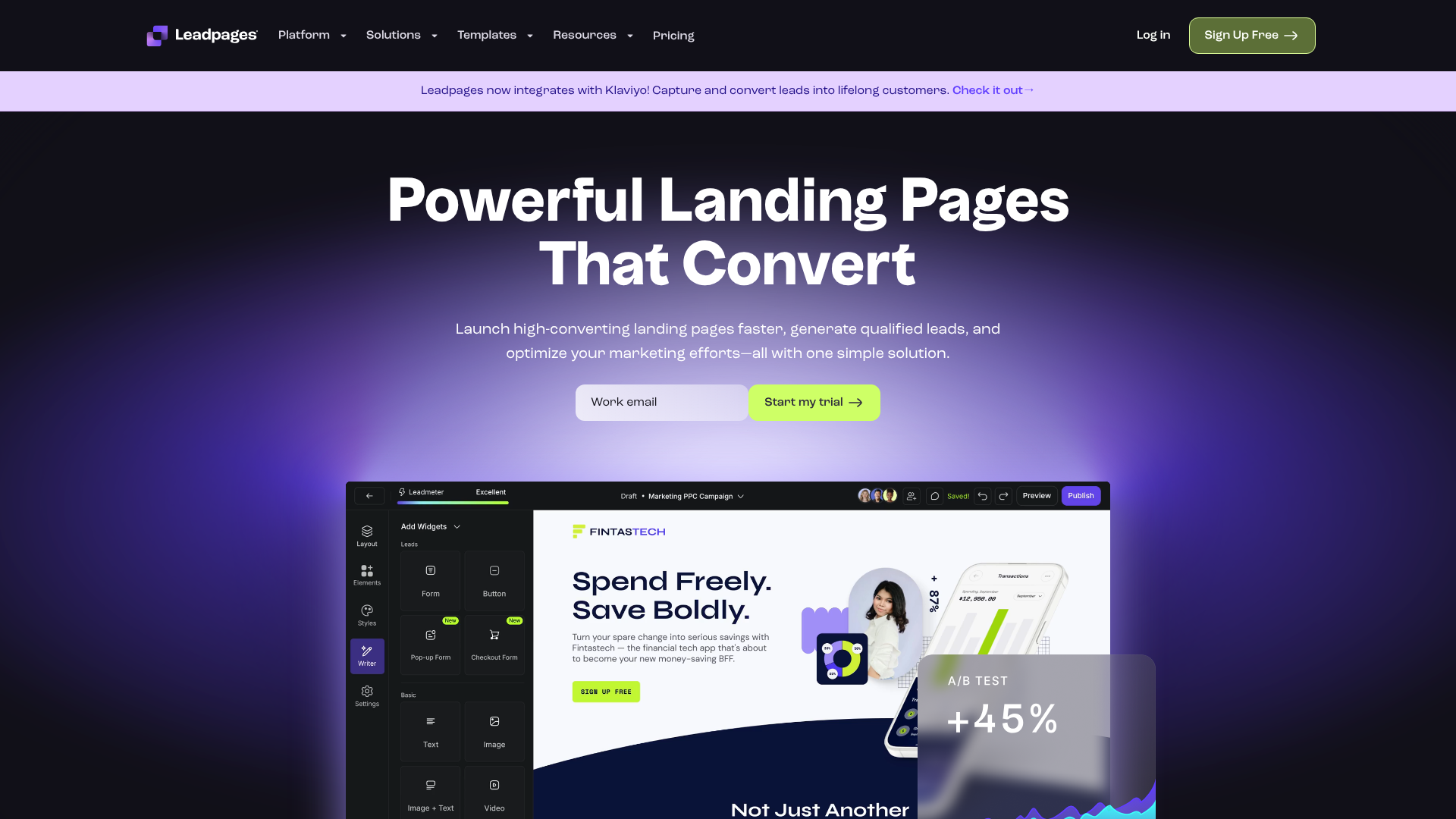
Leadpages: Known for its ease of use and affordability, Leadpages is an excellent choice for small businesses, solopreneurs, and beginners. It offers a vast library of mobile-responsive templates and a straightforward drag-and-drop builder. It also includes features like pop-ups and alert bars to capture leads across your entire website.
Unbounce: A powerful and flexible platform favoured by performance marketers. Unbounce offers robust A/B testing capabilities and a feature called Smart Traffic, which uses AI to automatically direct visitors to the landing page variant they're most likely to convert on. It provides pixel-perfect control over your page design.
Instapage: Geared towards larger teams and enterprises, Instapage excels at personalisation at scale. Its unique AdMap feature allows you to connect your ads directly to relevant post-click landing pages, ensuring message match and improving ad quality scores. It also offers powerful collaboration tools for teams.
ClickFunnels: While it can build standalone landing pages, ClickFunnels is designed for creating entire sales funnels. It's a good option if your lead capture page is the first step in a multi-page sequence, such as a webinar registration followed by an upsell page. It's an all-in-one solution for marketers focused on direct-response sales.
Common Mistakes to Avoid on Your Landing Page
Even with the best tools, it's easy to make mistakes that can sabotage your conversion rates. Being aware of these common pitfalls is the first step to avoiding them. A small error can have a big impact on your campaign's performance.
Too Many Calls-to-Action (CTAs): This is the cardinal sin of landing page design. Your page should have one goal and one corresponding CTA. Adding links to your social media, blog, or other products creates exit routes that distract visitors from the primary conversion action.
Asking for Too Much Information: Every form field you add creates friction. A long form can feel intrusive and time-consuming, causing visitors to abandon it. Only ask for the information you absolutely need for the initial follow-up. You can always gather more data later in the customer relationship.
Weak or Unclear Value Proposition: Your offer must be compelling and clearly articulated. If visitors can't understand what they're getting and why it's valuable within a few seconds, they will leave. Use your headline and body copy to spell out the benefits in simple, direct language.
Slow Page Load Speed: In an era of instant gratification, a slow-loading page is a conversion killer. Every second of delay increases your bounce rate. Optimise your images, use a fast hosting provider, and choose a landing page builder known for speed (like Leadpages) to ensure your page loads almost instantly.
Lack of Social Proof: A page without testimonials, logos, or other forms of social proof can feel untrustworthy. Visitors are inherently sceptical. Providing evidence that others trust you and have benefited from your offer helps to overcome this scepticism and build credibility.
How to Optimise Lead Capture Landing Pages for Conversions
Creating a landing page is just the beginning. The real magic happens through continuous optimisation. Conversion Rate Optimisation (CRO) is the systematic process of increasing the percentage of visitors who take the desired action. It involves data analysis, hypothesis creation, and rigorous testing.
Start by establishing a baseline. Before you make any changes, you need to know your current conversion rate. Use the analytics in your landing page builder or Google Analytics to track visits and conversions. Once you have this number, you can set a goal for improvement.
Next, analyse user behaviour. Tools like Hotjar or Microsoft Clarity can provide heatmaps and session recordings that show you exactly where users are clicking, how far they are scrolling, and where they might be getting stuck. This qualitative data can reveal friction points that quantitative data (like bounce rate) can't.
Based on your analysis, form a hypothesis. For example: "I believe that changing the CTA button text from 'Submit' to 'Get My Free Ebook' will increase conversions because it is more specific and value-oriented." A good hypothesis is a clear, testable statement about a change you believe will lead to a specific outcome.
The Essential Role of A/B Testing
The primary method for testing your optimisation hypotheses is A/B testing, also known as split testing. A/B testing is a simple but powerful experiment where you compare two versions of your page (Version A, the original, and Version B, the variation) to see which one performs better.
Here's how it works: you create a variation of your page with one single element changed—for instance, a different headline. Your landing page software then directs 50% of your traffic to Version A and 50% to Version B. After a statistically significant number of visitors have seen both versions, you can compare the conversion rates to see which one was more effective.
What should you test? The possibilities are nearly endless, but it's best to start with elements that have the biggest potential impact:
- Headline: Test different angles, benefits, or tones.
- Call-to-Action (CTA): Test the button text, colour, size, and placement.
- Form: Test the number of fields or the layout.
- Images/Video: Test different visuals or using a video instead of a static image.
- Copy: Test long-form vs. short-form copy or different benefit bullet points.
It is crucial to only test one element at a time. If you change the headline and the CTA button colour simultaneously, you won't know which change was responsible for the increase or decrease in conversions. A/B testing is a methodical process that, over time, can lead to substantial improvements in your lead generation efforts.
Case Studies: Successful Lead Capture Pages in Action
Theory is helpful, but seeing real-world examples can make these concepts click. Let's look at a few hypothetical case studies to see how different businesses might apply these principles.
Case Study 1: The SaaS Company
- Business: A project management software company called "TaskFlow".
- Offer: A 14-day free trial of their software.
- Landing Page Strategy: They created a lead generation landing page with the headline, "Finish Projects 30% Faster. Start Your Free TaskFlow Trial Today." The hero shot was a short, 60-second video showing the software's clean interface in action. The form only asked for a work email and password to create an account. For social proof, they displayed logos of well-known clients like Slack and Dropbox. The CTA button was bright green and said, "Start My Free Trial".
- Result: The page converted at 25%, significantly higher than their previous strategy of sending ad traffic to their homepage.
Case Study 2: The E-commerce Brand
- Business: An online store selling organic skincare called "GlowNature".
- Offer: A 15% discount on the first order in exchange for an email sign-up.
- Landing Page Strategy: They used a pop-up lead capture form on their website. The headline was, "Want 15% Off Your First Order?" The copy was minimal, simply stating, "Join our newsletter for exclusive deals and skincare tips." The form only required an email address. The background image was a beautiful shot of their products with natural ingredients.
- Result: They grew their email list by 400% in three months, creating a powerful channel for repeat sales and promotions.
Integrating Lead Capture Pages with Your CRM System
Capturing a lead is a great first step, but what happens next is just as important. Manually downloading leads from your landing page tool and uploading them to your email or CRM system is inefficient and prone to error. This is why direct integration is a non-negotiable feature for any serious marketing operation.
Integrating your lead capture page with a Customer Relationship Management (CRM) or email marketing platform automates the entire process. When a visitor fills out your form, their contact information is instantly and automatically sent to your other systems. This allows for immediate follow-up, which is critical for conversion.
For example, you can set up an automation where anyone who downloads your ebook from a landing page is immediately sent an email with a link to the ebook. They are also tagged as interested in that specific topic and added to a lead nurturing sequence. This sequence could be a series of 3-5 automated emails sent over a week, providing more value on the topic and gently introducing your product or service.
Platforms like ActiveCampaign and GetResponse combine email marketing, automation, and CRM features, making them powerful hubs for your lead management. Most dedicated landing page builders, like Leadpages and Unbounce, offer seamless, one-click integrations with these and hundreds of other marketing tools. This automation frees up your time, ensures no lead falls through the cracks, and creates a professional, timely experience for your new contacts.
Pro Tip: Use hidden fields on your lead capture form to pass through campaign information (e.g., traffic source, ad campaign name). This data can be sent to your CRM, allowing you to track which channels are generating the most valuable leads over time, not just the most sign-ups.
Frequently Asked Questions (FAQ)
What is the difference between a lead page and a landing page?
The terms are often used interchangeably, but there's a subtle distinction. "Landing page" is a broad term for any page a visitor "lands" on after clicking a link. This could be a sales page, a product page, or a lead capture page. A "lead page" or "lead capture page" is a specific type of landing page whose sole purpose is to generate leads by collecting contact information through a form.
So, all lead capture pages are landing pages, but not all landing pages are lead capture pages. Another common type is a "click-through" landing page, which aims to warm up a visitor before sending them to a shopping cart or registration page, without a form on the page itself.
What makes a good landing page for lead generation?
A good landing page for lead generation excels in three areas: clarity, relevance, and value. It must have a single, clear goal (the conversion) and be free of distractions. The messaging on the page must be highly relevant to the ad or link the visitor clicked to get there (this is called message match).
Most importantly, it must offer a compelling value exchange. The lead magnet—be it a guide, webinar, or discount—must be valuable enough that the visitor feels it's a fair trade for their contact information. Combined with a frictionless user experience and strong social proof, these elements create a powerful conversion tool.
What are the two main types of landing pages?
The two primary types of landing pages are Lead Generation Landing Pages and Click-Through Landing Pages. As we've discussed, lead generation pages (or lead capture pages) use a form to collect information about a visitor, turning them into a lead.
A click-through landing page, on the other hand, does not have a form. Its goal is to persuade a visitor to click through to another page, typically a checkout or registration page. It's used to provide more information and warm up a prospect before they make a purchase decision, common in e-commerce and SaaS funnels.
Is Leadpages good for beginners?
Yes, Leadpages is widely considered one of the best landing page builders for beginners. Its interface is intuitive, and its template library is extensive, allowing users to get a professional-looking page live very quickly without needing any coding knowledge. The platform is specifically designed to be user-friendly, focusing on speed and simplicity while still offering powerful features for lead generation.
Final Thoughts
A lead capture landing page is more than just a page on your website; it's a focused, strategic tool designed to turn anonymous visitors into valuable leads. By understanding its core components, adhering to design best practices, and committing to continuous testing and optimisation, you can build a reliable engine for business growth.
Start by focusing on clarity and value. Ensure your offer is compelling and that your page communicates that value instantly. Use trusted tools like Leadpages for ease of use or Unbounce for advanced testing to streamline the creation process. And never forget to connect your pages to your CRM or email platform to automate your follow-up.
Building a high-converting lead generation landing page is a skill that blends art and science. It requires creativity in your copy and design, and analytical rigour in your testing. By mastering this skill, you'll create a predictable and scalable way to fuel your sales pipeline and grow your business for years to come.