
Best Time to Send Email Campaigns: A Data-Backed Guide for Marketers (2026)
You've crafted the perfect subject line, written compelling copy, and designed a beautiful email. You hit 'send' and wait for the glowing results, only to be met with a disappointingly low open rate. This common frustration often has less to do with your content and more to do with a single, critical factor: timing. Finding the best time to send email campaigns is one of the most effective levers you can pull to increase engagement, yet it's frequently overlooked.
- Quick Summary
- Why Your Email Campaign Timing Matters More Than You Think
- The Generally Accepted "Best" Times to Send Emails
- How to Find the Optimal Email Send Time for Your Audience
- Step 1: Analyse Your Existing Data
- Step 2: Understand Your Audience Persona
- Step 3: Run A/B Tests on Your Send Times
- Step 4: Use Send Time Optimisation (STO) Tools
- B2B vs. B2C: A Tale of Two Timetables
- Advanced Strategies to Stand Out in the Inbox
- The Tools That Make Perfect Timing Possible
- ActiveCampaign: For Advanced Automation
- Selzy: For Simplicity and AI-Powered Insights
- GetResponse: The All-in-One Solution
- Common Mistakes to Avoid with Email Campaign Timing
- Frequently Asked Questions (FAQ)
- What is the best time of day to send an email campaign?
- What is the 80/20 rule in email marketing?
- What are the 4 P's of email marketing?
- What is the 3 email rule?
- Final Thoughts: Your Path to Perfect Timing
It’s not about magic; it’s about meeting your audience where they are, when they're most likely to listen.
This guide moves beyond generic advice to give you a data-backed framework for discovering the ideal send time for your specific audience. We'll explore industry benchmarks, the crucial differences between B2B and B2C timing, and the tools that can automate this entire process. By understanding the science behind the send, you can ensure your hard work actually gets seen, read, and acted upon.
Quick Summary
- Mid-Week is Prime Time: Data consistently shows that Tuesday, Wednesday, and Thursday deliver the highest engagement rates. Mondays are often for catching up, and by Friday, attention starts shifting to the weekend.
- Target Key Time Windows: The most effective times are generally late morning (around 10 AM) and early afternoon (around 2 PM). These windows align with work breaks and periods of high focus.
- Audience Dictates Everything: The golden rule is to know your audience. B2B timing strategies (workday hours) differ significantly from B2C strategies, which can succeed in evenings and on weekends.
- Benchmarks Are a Starting Point, Not a Rule: While industry data provides a great starting point, your own audience's behaviour is the ultimate source of truth. Always use your analytics and A/B testing to refine your approach.
- Leverage Technology: Modern email service providers (ESPs) offer features like Send Time Optimisation (STO) and time-zone sending, which automatically deliver emails at the ideal moment for each individual subscriber.
Why Your Email Campaign Timing Matters More Than You Think
Sending an email is like trying to have a conversation in a crowded room. If you speak at the wrong moment, your message gets lost in the noise. The average office worker receives over 120 emails per day, creating a fierce competition for attention. The ideal email campaign timing isn't just a minor detail; it's a strategic advantage that directly impacts your key performance indicators (KPIs).
When an email lands at the top of an inbox at a moment the recipient is actively checking it, the probability of it being opened skyrockets. Conversely, an email sent at 3 AM might be buried under dozens of other messages by the time your subscriber wakes up, making it a prime candidate for the 'select all, delete' treatment. Proper timing ensures your message gets prime visibility.
Beyond just opens, timing influences click-through rates (CTR) and conversions. An email about a flash sale sent during a lunch break is more likely to be acted upon than one sent during a busy morning meeting. By aligning your send with your audience's daily rhythms and psychological states, you increase the chances of them not just seeing your message, but also taking the desired action. Ultimately, optimising your send time is a high-impact, low-effort way to improve your entire email marketing ROI.
The Generally Accepted "Best" Times to Send Emails
While the ultimate answer lies in your own data, decades of email marketing have produced reliable industry benchmarks. These are the patterns observed across billions of emails sent by platforms like Mailchimp, HubSpot, and Omnisend. Think of these as your starting hypothesis before you begin testing.
These general guidelines are based on typical work schedules and daily routines, making them a powerful starting point for most businesses. They provide a solid foundation from which you can begin to test and tailor a strategy specific to your audience.
The Best Days of the Week
Not all weekdays are created equal. Subscriber behaviour fluctuates significantly from the start of the week to the end.
- Tuesday: Widely regarded as the best day to send emails. By Tuesday, people have cleared their weekend backlog and settled into their work routine. They are organised and ready to engage with new content.
- Wednesday & Thursday: These are also top-tier days for email engagement. They maintain the momentum of Tuesday without the 'pre-weekend' distraction that begins on Friday. Many studies show Thursday can be particularly strong for conversions and revenue per recipient.
- Monday: Often the worst day. Inboxes are flooded with emails that accumulated over the weekend, and people are in 'triage mode', rapidly deleting or archiving anything non-essential to plan their week.
- Friday: Engagement typically drops as people wind down for the weekend. Their focus shifts from their inbox to their evening and weekend plans, making them less likely to engage with promotional content.
- Saturday & Sunday: Traditionally low for B2B, weekends can be a goldmine for B2C businesses. People have more leisure time to browse retail sites, read newsletters, and engage with hobby-related content. Saturday mornings, in particular, can show high open rates for e-commerce brands.
The Best Times of the Day
Once you've picked a day, zeroing in on the right time is the next step. Different time slots cater to different daily habits.
- 10 AM – 11 AM: This is often cited as the number one time slot. By 10 AM, most people have had their morning coffee, dealt with urgent tasks, and are settling into their work. It's a common time for a mid-morning break, which often includes checking emails.
- 2 PM – 3 PM: The post-lunch slump is real, and it's great for email marketers. People often use this time to avoid more demanding tasks, and browsing their inbox is a common distraction. It's another peak engagement window before the end-of-day rush begins.
- 6 AM – 8 AM: This window targets the 'first look' crowd. A significant number of people check their phones and emails as soon as they wake up or during their morning commute. An email that's at the top of their inbox at 7 AM has a high chance of being read.
- 8 PM onwards: For B2C, the evening can be highly effective. After dinner, people are relaxed, often browsing on their tablets or phones from the sofa. This is a prime time for online shopping and consuming content from their favourite brands.
How to Find the Optimal Email Send Time for Your Audience
Industry benchmarks are valuable, but they represent an average of millions of different audiences. Your subscribers are unique. A B2B software company targeting UK executives will have a vastly different optimal send time than an e-commerce brand selling yoga mats to millennials in Australia. The key to unlocking your best results is to move from general knowledge to specific data about your own list.
This process involves a mix of analysis, empathy, and systematic testing.
Step 1: Analyse Your Existing Data
Your most valuable resource is your own history. Every email campaign you've ever sent is a data point. Dive into the analytics dashboard of your email service provider and look for patterns. Most platforms, including ActiveCampaign and GetResponse, offer detailed reports that break down performance by day of the week and time of day.
Look beyond open rates. While important, you should also analyse click-through rates and conversion rates. You might find that while 10 AM on Tuesday gets the most opens, 8 PM on Thursday gets more clicks and sales. This insight is crucial for understanding when your audience is not just available to read, but ready to act.
Step 2: Understand Your Audience Persona
Data tells you what is happening, but your audience persona tells you why. Think deeply about the daily life of your ideal customer.
- Who are they? A corporate CEO will have a different email schedule than a university student or a stay-at-home parent.
- What does their day look like? Do they have a 9-to-5 job? Do they work shifts? When are their breaks? When do they commute?
- Where are they located? This is a critical and often-missed point. If you have a global or national audience, sending a single email blast at 9 AM in your local time is a recipe for failure. You must segment your audience by time zone to ensure your message arrives at the appropriate local time for everyone.
Step 3: Run A/B Tests on Your Send Times
Once you have a hypothesis based on your data and persona, it's time to test it scientifically. A/B testing, or split testing, is the most reliable way to determine the best time for email blasts.
Here’s a simple process:
- Create a Hypothesis: For example, "I believe sending at 2 PM will get a higher click-through rate than sending at 10 AM."
- Segment Your List: Take a statistically significant portion of your list and split it randomly into two equal groups (Group A and Group B). 3.
Send the Same Email: Send the exact same email to both groups, with only one variable changed: the send time. Send to Group A at 10 AM and Group B at 2 PM. 4. Measure and Analyse: Wait at least 24-48 hours to allow for results to stabilise.
Compare the open rate, click-through rate, and conversion rate for both groups. 5. Declare a Winner and Repeat: If one time consistently outperforms the other over several tests, you have found a more optimal window. You can then use this new time as your control and test it against another variable.
Step 4: Use Send Time Optimisation (STO) Tools
Manually testing can be time-consuming. Fortunately, technology can do the heavy lifting for you. Many modern ESPs now offer Send Time Optimisation (STO) or predictive sending features. These tools use machine learning to analyse the historical engagement data of each individual subscriber on your list.
Instead of sending an email to everyone at 10 AM, an STO feature will deliver the email to Subscriber A at 8:15 AM because that's when they always open, to Subscriber B at 2:30 PM, and so on. It personalises the delivery time at scale. Platforms like Selzy and Moosend have built-in STO features that can significantly boost engagement by automating this entire process, taking the guesswork out of finding the perfect moment.
Pro Tip: When A/B testing, only change one variable at a time. If you test a new send time and a new subject line simultaneously, you won't know which change was responsible for the difference in performance. Isolate your variables for clean, actionable data.
B2B vs. B2C: A Tale of Two Timetables
The context in which a person receives your email dramatically changes how they interact with it. An email received during work hours is viewed through a professional lens, while an email received during leisure time is viewed through a personal one. This fundamental difference is why B2B (business-to-business) and B2C (business-to-consumer) email strategies require distinct approaches to timing.
Failing to recognise this difference can lead to sending the right message at precisely the wrong time. A B2B webinar invitation sent on a Saturday morning is likely to be ignored, just as a B2C flash sale announcement sent during a Monday morning meeting might be missed. Tailoring your timing to the correct context is essential.
Ideal Timing for B2B Campaigns
For B2B audiences, the inbox is a professional workspace. Their engagement is almost exclusively tied to the standard workweek. The goal is to reach them when they are at their desks, focused on work-related tasks, and in a mindset to evaluate business solutions.
- Best Days: Tuesday, Wednesday, and Thursday are the undisputed champions. These are core workdays when professionals are most productive and receptive to business proposals, industry news, and educational content.
- Best Times: Mid-morning (10 AM – 11 AM) and early-to-mid afternoon (1 PM – 3 PM) are the sweet spots. These times avoid the morning rush and the end-of-day wrap-up. They often coincide with periods when professionals are taking a short break from a major task and checking their email.
- What to Avoid: Weekends are almost always a dead zone for B2B email. Similarly, sending emails outside of standard business hours (e.g., after 6 PM) is generally ineffective, as your message will likely be buried by the next morning.
Optimal Timing for B2C Campaigns
B2C audiences interact with email on their own terms, mixing it in with their personal lives. Their engagement is driven by leisure, personal interest, and shopping habits. The goal is to reach them when they are relaxed and in a consumer mindset.
- Best Days: While weekdays can still be effective, weekends often perform exceptionally well. Saturday mornings can be a peak time for e-commerce promotions as people plan their weekend shopping. Sunday evenings are also strong, as people wind down and browse online before the week begins.
- Best Times: Weekday evenings (7 PM – 10 PM) are a prime window. After work and dinner, people are often on their couches with their phones or tablets, browsing social media and checking personal email. Lunch breaks (12 PM – 2 PM) on weekdays are another strong opportunity for a quick browse.
- Content is Key: The optimal email send time for B2C can also depend on the product. An email for a pizza delivery service will perform best right before dinner time, while an email promoting travel deals might do well on a dreary weekday afternoon when people are dreaming of an escape.
Advanced Strategies to Stand Out in the Inbox

Once you've mastered the basics of day-and-time scheduling, you can implement more advanced tactics to gain a further edge. In a crowded inbox, small optimisations can lead to significant gains in visibility and engagement. These strategies are about understanding the technical and psychological nuances of email delivery.
The "Off-the-Hour" Sending Trick
A vast majority of marketers schedule their campaigns to go out exactly on the hour or half-hour (e.g., 10:00 AM or 10:30 AM). This creates a massive, simultaneous rush of emails hitting the servers of major inbox providers like Gmail and Outlook. This can sometimes lead to your email being slightly delayed or throttled as the servers process the load.
To avoid this digital traffic jam, schedule your emails for an unusual minute, such as 10:08 AM or 2:22 PM. While it may seem minor, this simple trick ensures your email is sent during a slightly less competitive moment, potentially improving its delivery speed and inbox placement. It's a small detail that can help you slip past the main crowd.
Time Zone Sending: A Non-Negotiable
We mentioned this earlier, but it bears repeating as an advanced strategy: if you aren't sending based on the recipient's local time zone, you are leaving money on the table. It is one of the most impactful features offered by modern ESPs. Sending an email at "9 AM" should mean it arrives at 9 AM in London for your British subscribers, 9 AM in New York for your American subscribers, and 9 AM in Sydney for your Australian subscribers.
Manually segmenting and scheduling for every time zone is impossible. This is where you must use the built-in functionality of your email platform. It's a foundational feature that turns a poorly-timed global blast into a series of perfectly-timed local messages.
Segmenting by Engagement Level
Inbox providers use initial engagement signals to decide whether to place your email in the primary inbox or the promotions tab (or even spam). If the first batch of recipients opens and clicks your email at a high rate, it signals to Gmail that your content is valuable, improving its deliverability for the rest of your list.
You can use this to your advantage. Create a segment of your most engaged subscribers—those who have opened or clicked an email in the last 30-60 days. Schedule your campaign to send to this hyper-engaged segment first, about 30-60 minutes before the main send. Their positive engagement will "warm up" the campaign, sending strong positive signals to inbox providers and boosting its overall performance.
The Tools That Make Perfect Timing Possible
Manually tracking, testing, and scheduling emails for different segments and time zones is a complex and inefficient task. The key to implementing a sophisticated timing strategy at scale is to use a powerful Email Service Provider (ESP). These platforms are designed not just to send emails, but to send them intelligently. Here are a few top recommendations that excel at scheduling and optimisation.
ActiveCampaign: For Advanced Automation
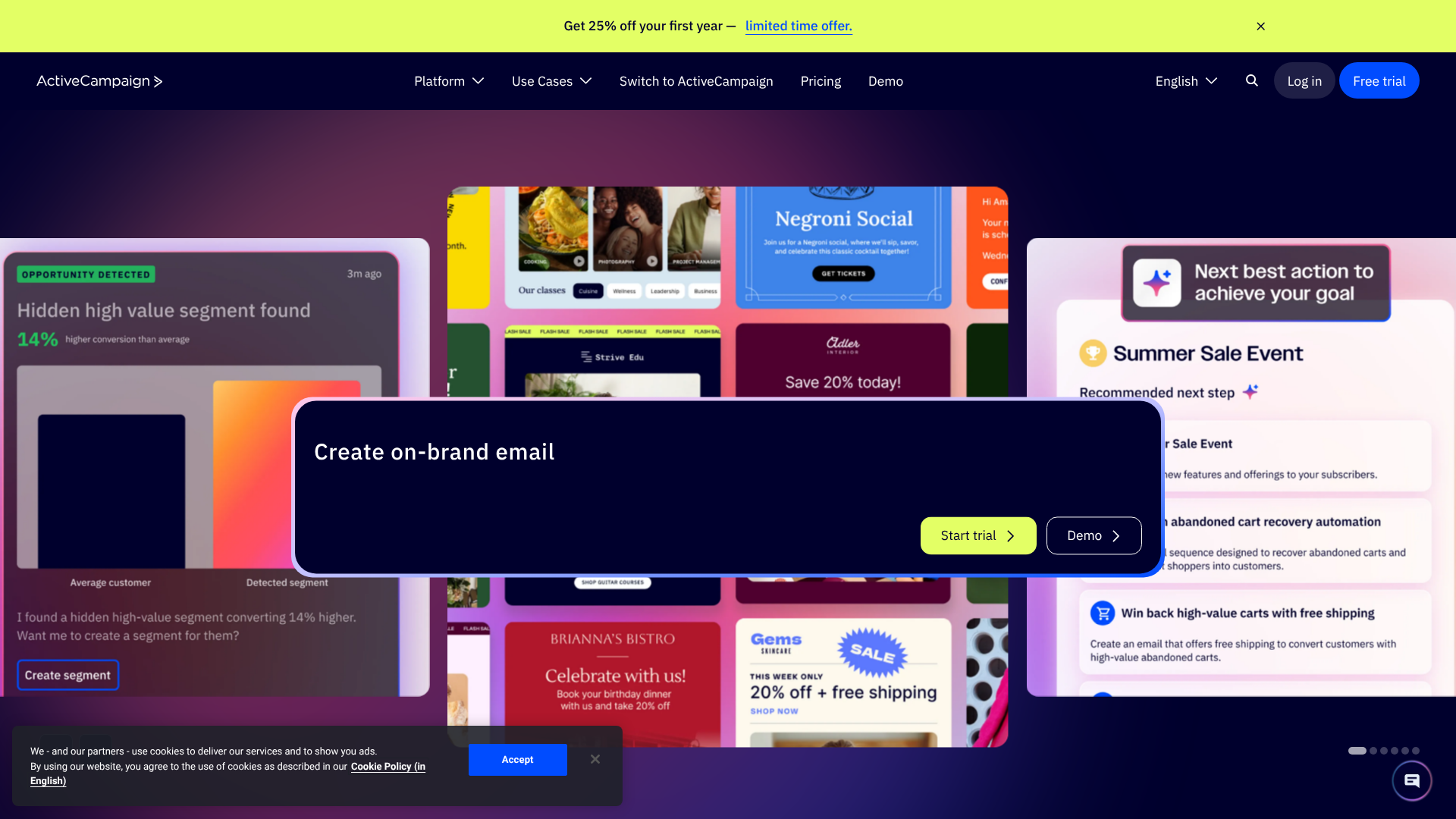
ActiveCampaign is a market leader known for its incredibly powerful marketing automation and CRM capabilities. For email timing, its standout feature is "Predictive Sending."
Predictive Sending works similarly to STO, using machine learning to determine the optimal send time for each contact. You simply select the "Send with Predictive Sending" option, and ActiveCampaign handles the rest, delivering your campaign over a 24-hour period to maximise individual engagement. This is ideal for businesses that want the most advanced, hands-off approach to timing optimisation.
- Pros: Extremely powerful automation and segmentation, deep analytics, integrated CRM, high deliverability rates.
- Cons: Can have a steeper learning curve for absolute beginners, and its pricing can be higher than simpler tools.
- Pricing: ActiveCampaign offers several tiered plans based on features and contact list size. For the latest pricing, it's best to visit their website.
Selzy: For Simplicity and AI-Powered Insights
Selzy is an excellent choice for small to medium-sized businesses and marketers who want powerful features without a complex interface. It focuses on user-friendliness while still providing smart tools to improve results.
Selzy offers a Send Time Optimisation feature that analyses your audience's past behaviour to recommend the best time to send your next campaign. It presents this data in an easy-to-understand format, allowing you to make an informed decision with a single click. It strikes a great balance between AI-powered assistance and user control.
- Pros: Very intuitive and easy-to-use interface, affordable pricing with a generous free plan, solid AI-based recommendations.
- Cons: May lack some of the highly advanced, enterprise-level automation features found in platforms like ActiveCampaign.
- Pricing: Selzy has a free plan for up to 1,500 contacts and offers very competitive pricing on its paid tiers. Check their website for current details.
GetResponse: The All-in-One Solution
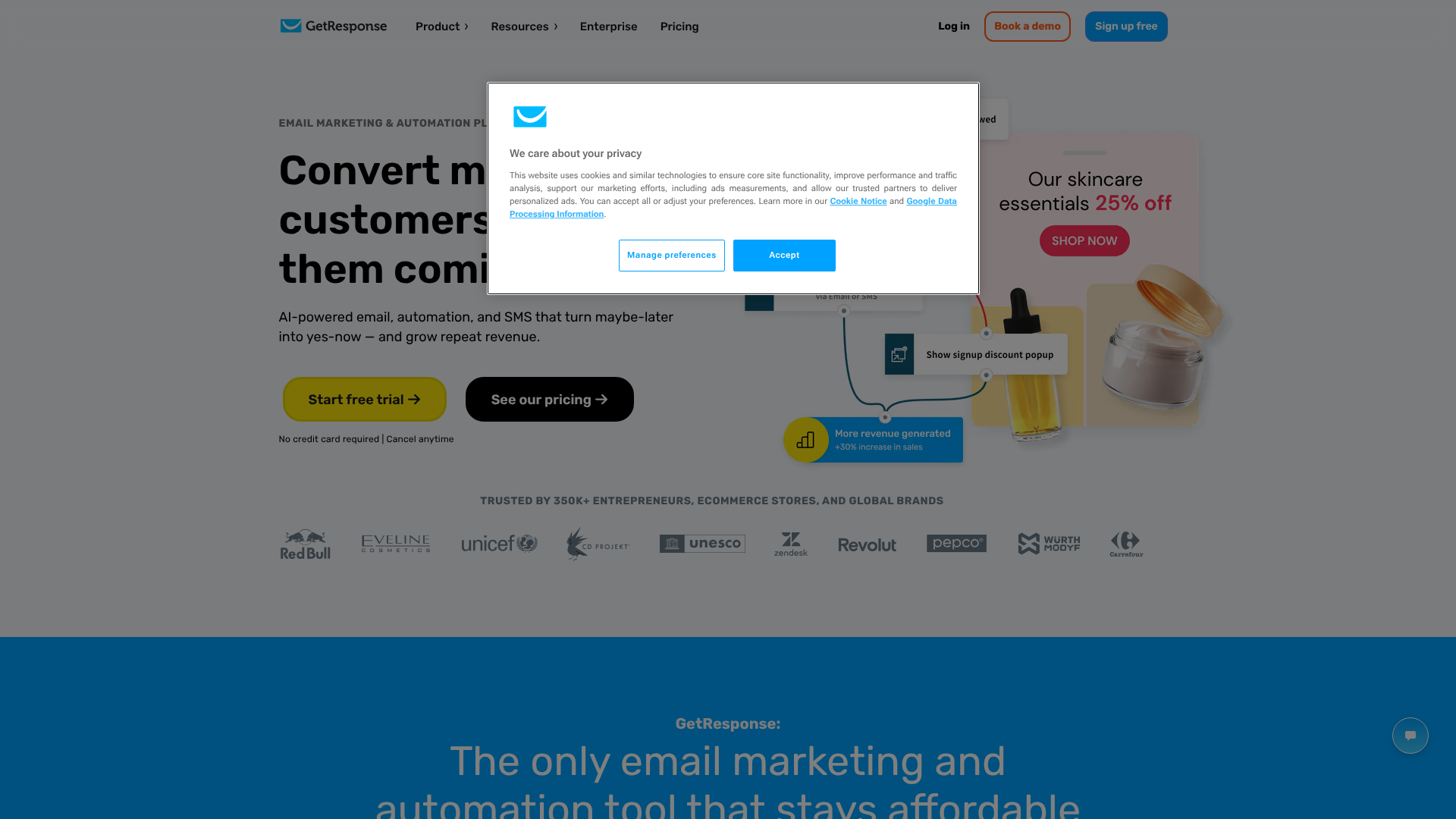
GetResponse positions itself as an all-in-one marketing platform, offering not just email but also landing pages, conversion funnels, and webinar hosting. Its email timing feature is called "Perfect Timing."
Like other STO tools, Perfect Timing delivers your message at the moment your subscriber is most likely to open it, based on their historical data. When combined with its time-zone sending feature, it ensures your campaigns are always delivered at the right local moment for maximum impact. It's a great option for marketers who want to manage multiple aspects of their campaigns within a single tool.
- Pros: Comprehensive suite of marketing tools beyond email, user-friendly drag-and-drop editor, good value for the number of features offered.
- Cons: The interface can feel a bit cluttered for users who only need basic email functionality.
- Pricing: GetResponse offers a range of packages, including a free-forever plan. Visit their site for a full breakdown of features and costs.
Common Mistakes to Avoid with Email Campaign Timing
Knowing what to do is only half the battle; knowing what not to do can save you from costly mistakes that suppress your open rates and damage your sender reputation. Many marketers fall into common traps when it comes to scheduling. Here are the most critical ones to avoid.
Ignoring Your Own Data: This is the cardinal sin of email timing. It's tempting to read a blog post (like this one!), see that "10 AM on Tuesday" is the best time, and set that as your permanent schedule. Benchmarks are a starting point, not the final destination. Your audience is unique, and your own analytics are the only source of truth for what works for them.
Forgetting About Time Zones: Sending a single email blast at 9 AM EST is a guaranteed way to annoy or miss a huge portion of your audience. That email will arrive at 6 AM in California (too early), 2 PM in London (good!), and 1 AM the next day in Sydney (terrible). Always use your ESP's time-zone sending feature.
Being Inconsistent: If you send emails sporadically—one on a Monday morning, the next three weeks later on a Friday afternoon—you never build a routine with your audience or gather consistent data. Sending at a regular cadence (e.g., every Tuesday morning) helps train your audience to expect your emails and allows you to build a reliable dataset on what timing works best.
Overlooking Mobile Users: Over 50% of emails are now opened on mobile devices. This changes the game for timing. Mobile users often check their email first thing in the morning from bed, during their commute, or last thing at night. Don't assume engagement is limited to desktop-centric work hours. These 'off-peak' mobile windows can be highly effective, especially for B2C brands.
Pro Tip: Don't forget to account for holidays and seasonal events. Sending a major promotional campaign on Christmas Day or a national bank holiday will likely result in poor performance. Use a marketing calendar to plan around these dates and adjust your schedule accordingly.
Frequently Asked Questions (FAQ)
What is the best time of day to send an email campaign?
The most widely effective times to send an email campaign are late morning, around 10 AM, or early afternoon, around 2 PM. The 10 AM slot often catches people after they've handled urgent morning tasks, while the 2 PM slot aligns with the common post-lunch productivity dip when people are more likely to check their inbox. However, this can vary; B2C brands often find success in the evenings (around 8 PM) when people are relaxing at home.
What is the 80/20 rule in email marketing?
The 80/20 rule, also known as the Pareto Principle, suggests that 80% of your results will come from 20% of your efforts (or subscribers). In email marketing, this often means that 20% of your subscribers will generate 80% of your opens, clicks, and conversions. This highlights the importance of identifying and nurturing your most engaged audience segment, as they drive a disproportionate amount of your success.
What are the 4 P's of email marketing?
The 4 P's are a classic marketing framework adapted for email. They are:
- Product: The item or service you are offering. Your email must clearly communicate its value and benefits. * Price: The cost of your product and the terms of the offer (e.g., discount, free shipping).
This must be clear and compelling. * Place: In email marketing, 'place' refers to the inbox and the subsequent landing page. The journey from email to conversion must be smooth. * Promotion: This is the email campaign itself—the messaging, creative, and call-to-action used to persuade the subscriber.
What is the 3 email rule?
The "3 email rule" is a general guideline often used in sales and follow-up sequences. It suggests that you should not give up after one attempt to contact someone. A common approach is to send an initial email, followed by a second gentle reminder a few days later, and a final, 'break-up' style email as a last attempt. The idea is to be persistent without being annoying, but the exact number of emails can and should be adapted based on context and audience response.
Final Thoughts: Your Path to Perfect Timing
There is no single, universal "best time to send email campaigns" that works for every business, every time. While industry benchmarks provide an invaluable starting point—mid-week, mid-day—the real secret to unlocking your highest engagement lies in a continuous cycle of analysis, testing, and refinement.
Start with the general best practices outlined in this guide. Then, dive into your own analytics to understand the unique behaviour of your subscribers. Use that knowledge to form a hypothesis and run A/B tests to validate it. Most importantly, use the powerful scheduling and optimisation tools available in modern email platforms to automate this process and deliver every message at the perfect moment for each individual.
Timing is one of the few variables in email marketing that is completely within your control. By treating it with the strategic importance it deserves, you ensure your message not only gets delivered but also gets the attention it needs to drive results. If you're ready to take the guesswork out of your scheduling, consider exploring the send-time optimisation features in tools like Selzy or the predictive sending in ActiveCampaign. Your open rates will thank you.