


Voice Recognition Medical Software: A Clinician's Guide for 2026
The burden of clinical documentation is a well-known challenge in modern healthcare. Clinicians often spend hours each day typing notes, filling out electronic health records (EHRs), and managing administrative tasks, which leads to burnout and less time for patient care. This is where voice recognition medical software offers a powerful solution, transforming how medical professionals capture patient information. By converting spoken words into accurate, structured text directly within clinical systems, this technology promises to give clinicians back their most valuable resource: time.
- What to Know
- What is Voice Recognition Medical Software, Exactly?
- The Core Benefits: More Than Just Typing Faster
- Slash Documentation Time and Reduce Burnout
- Enhance Clinical Accuracy and Detail
- Improve Patient Engagement
- Streamline Workflows with EHR Integration
- Key Features to Look for in Healthcare Dictation Software
- Medical Vocabulary and Speciality Dictionaries
- High Accuracy Rate
- EHR/EMR Integration Capabilities
- Ambient Listening and AI Scribing
- Mobile Accessibility
- Security and Data Protection Compliance
- How to Choose the Right Medical Voice Software for Your Practice
- Assess Your Practice Size and Needs
- Evaluate EHR Compatibility
- Consider Your Speciality
- Request Demos and Free Trials
- Top Voice Recognition Software for Healthcare in 2026
- 1. Nuance Dragon Medical One (Microsoft)
- 2. Freed AI
- 3. Heidi Health
- 4. Amazon Transcribe Medical
- 5. Philips SpeechLive
- Understanding the Pricing and Costs Involved
- The Pros and Cons of Adopting Medical Voice Software
- Frequently Asked Questions (FAQ)
- What is the voice recognition software in healthcare?
- What is the best dictation software that is HIPAA compliant?
- Are medical transcriptionists still in demand?
- What are the disadvantages of voice recognition software?
- How much does Dragon Medical dictation cost?
- Final Thoughts
This guide explains everything you need to know about medical voice software. We'll cover what it is, the essential features to look for, how to choose the right platform for your practice, and review some of the top options available today. Whether you're a solo practitioner or part of a large hospital trust, understanding this technology is the first step towards a more efficient and less stressful workday.
What to Know
- Core Function: Voice recognition software for healthcare is a specialised tool that uses artificial intelligence (AI) to accurately transcribe spoken clinical language, including complex medical terminology, into text for patient notes and EHRs.
- Primary Benefit: Its main advantage is a significant reduction in administrative time. This helps to combat clinician burnout, improves the quality of documentation, and allows for more face-to-face time with patients.
- Essential Features: Unlike standard dictation tools, medical-grade software must offer high accuracy with specialised vocabularies, seamless EHR integration, and strict HIPAA (or equivalent data protection) compliance to protect patient data.
- Market Leaders: While Nuance Dragon Medical One has long been the industry standard, a new wave of AI-powered ambient scribes like Freed AI and Heidi Health are offering innovative, user-friendly alternatives that automatically structure conversations into clinical notes.
What is Voice Recognition Medical Software, Exactly?
At its core, voice recognition medical software is a technology designed to understand and transcribe the unique language of medicine. It's far more advanced than the voice-to-text feature on your mobile phone. While consumer tools struggle with terms like "pharmacokinetics" or "cholecystectomy," medical dictation software is specifically trained on vast libraries of medical terms, drug names, procedures, and acronyms across dozens of specialities.
Think of it as a hyper-intelligent medical stenographer that is always available. It listens as you speak and converts your dictation into written text in real-time. This text can be inserted directly into a patient's EHR, a referral letter, or any other clinical document, eliminating the need for manual typing. This process saves an enormous amount of time and reduces the risk of typographical errors that can occur during manual data entry.
The technology has evolved significantly over the years. Early versions required users to speak slowly and train the software extensively to recognise their voice and speech patterns. Modern solutions, however, use sophisticated AI and deep learning models. They can understand natural language, different accents, and even filter out background noise, achieving accuracy rates of 99% or higher right out of the box.
The Rise of the AI Ambient Scribe
A recent and powerful development is the AI "ambient scribe." Instead of actively dictating, a clinician can simply have a natural conversation with a patient while the software listens in the background. The AI then intelligently identifies the clinically relevant information, structures it into a standard format like a SOAP (Subjective, Objective, Assessment, Plan) note, and presents it for the clinician to review and approve. This is a monumental step forward, as it almost completely removes the administrative barrier during patient consultations.
The Core Benefits: More Than Just Typing Faster

Adopting healthcare dictation software goes far beyond simple convenience. It addresses some of the most pressing issues in the medical field today, from professional burnout to the quality of patient care. The benefits create a positive ripple effect throughout a clinical practice.
Slash Documentation Time and Reduce Burnout
This is the most immediate and impactful benefit. Clinicians can speak at a natural pace, which is typically three to four times faster than the average person can type. According to research, physicians can spend up to two hours on administrative tasks for every hour of direct patient care. By automating documentation, medical voice software can give back hours to a clinician's day, reducing the after-hours "pajama time" spent catching up on notes and directly combating a primary cause of burnout.
Enhance Clinical Accuracy and Detail
When a clinician is rushing to type notes between appointments, important details can be missed or oversimplified. Dictating allows for a more natural and detailed narrative. A doctor can capture the full nuance of a patient's story in their own words, leading to richer, more comprehensive clinical notes. This improved detail supports better clinical decision-making, ensures continuity of care, and provides a more robust record for billing and legal purposes.
Improve Patient Engagement
One of the biggest complaints from patients is that their doctor spends the consultation staring at a computer screen instead of looking at them. By using an ambient AI scribe or a mobile dictation app, clinicians can maintain eye contact and engage more meaningfully with their patients. This strengthens the doctor-patient relationship, improves communication, and can lead to better health outcomes. The patient feels heard, and the clinician can focus completely on them, not the keyboard.
Streamline Workflows with EHR Integration
Modern voice recognition software for healthcare is designed to fit directly into existing clinical workflows. With seamless EHR integration, dictated text flows directly into the correct fields in the patient's record. This eliminates the cumbersome process of copying and pasting text between applications. Custom voice commands can also be created to automate repetitive tasks, such as inserting standard text blocks, signing off on notes, or navigating through the EHR system, further boosting efficiency.
Key Features to Look for in Healthcare Dictation Software
Not all voice recognition platforms are created equal, especially in a medical context. When evaluating options, there are several critical features to prioritise to ensure the tool is effective, secure, and genuinely helpful for your practice.
Medical Vocabulary and Speciality Dictionaries
The software's ability to understand complex medical language is non-negotiable. The best systems are pre-loaded with extensive vocabularies covering general medicine as well as numerous specialities like cardiology, oncology, and orthopaedics. This ensures that when you say "myocardial infarction," it doesn't type "my old cardio infraction." Look for software that continuously updates its dictionaries to include new drug names and procedures.
High Accuracy Rate
Accuracy is paramount, as errors in clinical notes can have serious consequences. Leading solutions today boast accuracy rates of 99% and higher. This is achieved through advanced AI that learns and adapts to your individual speech patterns, accent, and cadence over time. The less time you spend making corrections, the more efficient the process becomes.
EHR/EMR Integration Capabilities
To be truly useful, the software must integrate smoothly with your existing Electronic Health Record (EHR) or Electronic Medical Record (EMR) system. Check if the software is certified to work with major platforms like Epic, Cerner, AthenaHealth, or eClinicalWorks. Deep integration allows you to dictate directly into any text field within the EHR, making the workflow feel natural and uninterrupted.
Ambient Listening and AI Scribing
For practices looking to be at the forefront of efficiency, ambient listening is a key feature. This technology allows the software to listen to a natural patient-doctor conversation and automatically generate a structured clinical note. It distinguishes between speakers, filters out small talk, and pulls out the relevant clinical data. This feature can almost entirely eliminate manual note-taking during a visit.
Mobile Accessibility
Healthcare doesn't just happen at a desk. Clinicians need to document on the go, whether they are doing rounds in a hospital, visiting a patient at home, or simply moving between exam rooms. A good solution will offer a secure mobile app for smartphones and tablets, allowing you to dictate notes, review documents, and sign off on records from anywhere.
Security and Data Protection Compliance
Given the sensitive nature of patient information, the software must be fully compliant with data protection regulations like HIPAA in the US or GDPR in the UK and Europe. This means all data, whether at rest or in transit, must be encrypted. The provider should be willing to sign a Business Associate Agreement (BAA) or equivalent, legally guaranteeing they will safeguard protected health information.
Pro Tip: Before committing to a platform, ask for a live demonstration that shows the software working directly within your specific EHR system. This is the best way to confirm that the integration is as smooth as the sales pitch claims.
How to Choose the Right Medical Voice Software for Your Practice
Selecting the right software is a critical decision that will impact your daily operations. The best choice depends on your practice's unique characteristics, including its size, speciality, and technical infrastructure. Following a structured evaluation process can help you find the perfect fit.
Assess Your Practice Size and Needs
The needs of a large hospital are very different from those of a small, independent clinic.
- For Large Hospitals/Trusts: You'll need an enterprise-grade solution that offers centralised management, robust security protocols, and scalability to support hundreds or thousands of users. Platforms like Nuance Dragon Medical One or Philips SpeechLive are often built for this environment.
- For Small to Mid-Sized Practices: Flexibility, ease of use, and affordability are typically higher priorities. Modern AI scribes like Freed AI or Heidi Health are excellent options, as they are often quicker to set up and may offer more straightforward subscription pricing without the need for complex enterprise contracts.
Evaluate EHR Compatibility
This is a make-or-break factor. Your chosen software must work flawlessly with your EHR system. Create a shortlist of voice recognition providers and verify that they are official partners with your EHR vendor. If they aren't, the integration may be clunky or unreliable.
During a demo, test how well it populates different fields, from patient history to assessment and plan sections.
Consider Your Speciality
While many platforms have extensive general medical vocabularies, some are better suited for certain specialities. If you work in a field with highly specific terminology, such as radiology or pathology, look for a solution that offers a dedicated dictionary for that area. Some providers, like VoiceboxMD, market themselves on the strength of their speciality-specific AI models.
Request Demos and Free Trials
Never buy without trying. Almost all reputable vendors offer a free trial or a personalised demonstration. This is your opportunity to test the software in your own environment with your own accent and dictation style. Use the trial period to assess its accuracy, ease of use, and how well it fits into your team's daily routine.
Involve a few members of your clinical staff in the trial to get a range of feedback before making a final decision.
Top Voice Recognition Software for Healthcare in 2026
The market for medical dictation software is dynamic, with established leaders competing against innovative AI startups. Here is a look at some of the top solutions making an impact in 2026. Note that pricing is often quote-based or per user, so it's best to contact the vendors directly for specifics.
| Feature | Nuance Dragon Medical One | Freed AI | Heidi Health | Amazon Transcribe Medical | Philips SpeechLive |
|---|---|---|---|---|---|
| Best For | Large hospitals, enterprise | Small to mid-sized clinics | Clinician-led practices | Custom-built applications | Hybrid workflows |
| Key Feature | Industry-standard accuracy | AI-generated SOAP notes | Ambient AI assistant | Developer API | AI + human transcription |
| EHR Integration | Extensive (most major EHRs) | Good (growing list) | Good (growing list) | Custom (via API) | Good (most major EHRs) |
| HIPAA/GDPR | Yes | Yes | Yes | Yes | Yes |
| Pricing Model | Per user, per month subscription | Per user, per month subscription | Per user, per month subscription | Pay-as-you-go (per second) | Tiered subscriptions |
1. Nuance Dragon Medical One (Microsoft)
Dragon Medical One is the long-standing industry benchmark. As a cloud-based platform, it offers exceptional accuracy (99%) and can be accessed from any workstation or mobile device. Its strength lies in its deep, time-tested integrations with nearly every major EHR system on the market. It's a reliable, powerful choice for large organisations that need a scalable and secure solution.
- Pros: Extremely high accuracy, extensive EHR integrations, robust security features, strong mobile app.
- Cons: Can be more expensive than newer competitors, the user interface can feel less modern than AI-native scribes.
2. Freed AI
Freed AI represents the new generation of AI medical scribes. It's designed specifically for smaller, independent practices and focuses on ease of use. Freed listens to patient conversations and automatically generates structured, chart-ready SOAP notes. It supports over 90 languages and is praised for its intuitive interface and quick setup, making it a fantastic option for clinics wanting to modernise without a massive IT project.
- Pros: Automatically creates structured notes, very user-friendly, excellent for small practices, multi-language support.
- Cons: Integration list is still growing compared to Dragon, may not have all the enterprise features needed by large hospitals.
3. Heidi Health
Heidi Health is another rapidly growing AI assistant that is popular with clinicians for its focus on reducing after-hours work. Its ambient AI captures patient dialogue in real-time and helps draft summaries, follow-ups, and referral letters. Users report that it can reduce their documentation time by up to 80%, a significant factor in improving work-life balance.
- Pros: Excellent at reducing after-hours charting, clinician-friendly design, strong ambient AI capabilities.
- Cons: As a newer player, it is continuously expanding its features and integrations.
4. Amazon Transcribe Medical
This is not an out-of-the-box software but a powerful service for healthcare organisations with development teams. Amazon Transcribe Medical provides a highly accurate, HIPAA-compliant speech-to-text API. It's the ideal choice for building custom voice solutions, such as integrating voice capabilities directly into a proprietary EHR system or developing a unique telehealth platform. It's powerful and cost-effective but requires technical expertise to implement.
- Pros: High accuracy, pay-as-you-go pricing is cost-effective, ideal for custom development, backed by AWS security.
- Cons: Requires developers to build an application around it; not a ready-to-use tool for clinicians.
5. Philips SpeechLive
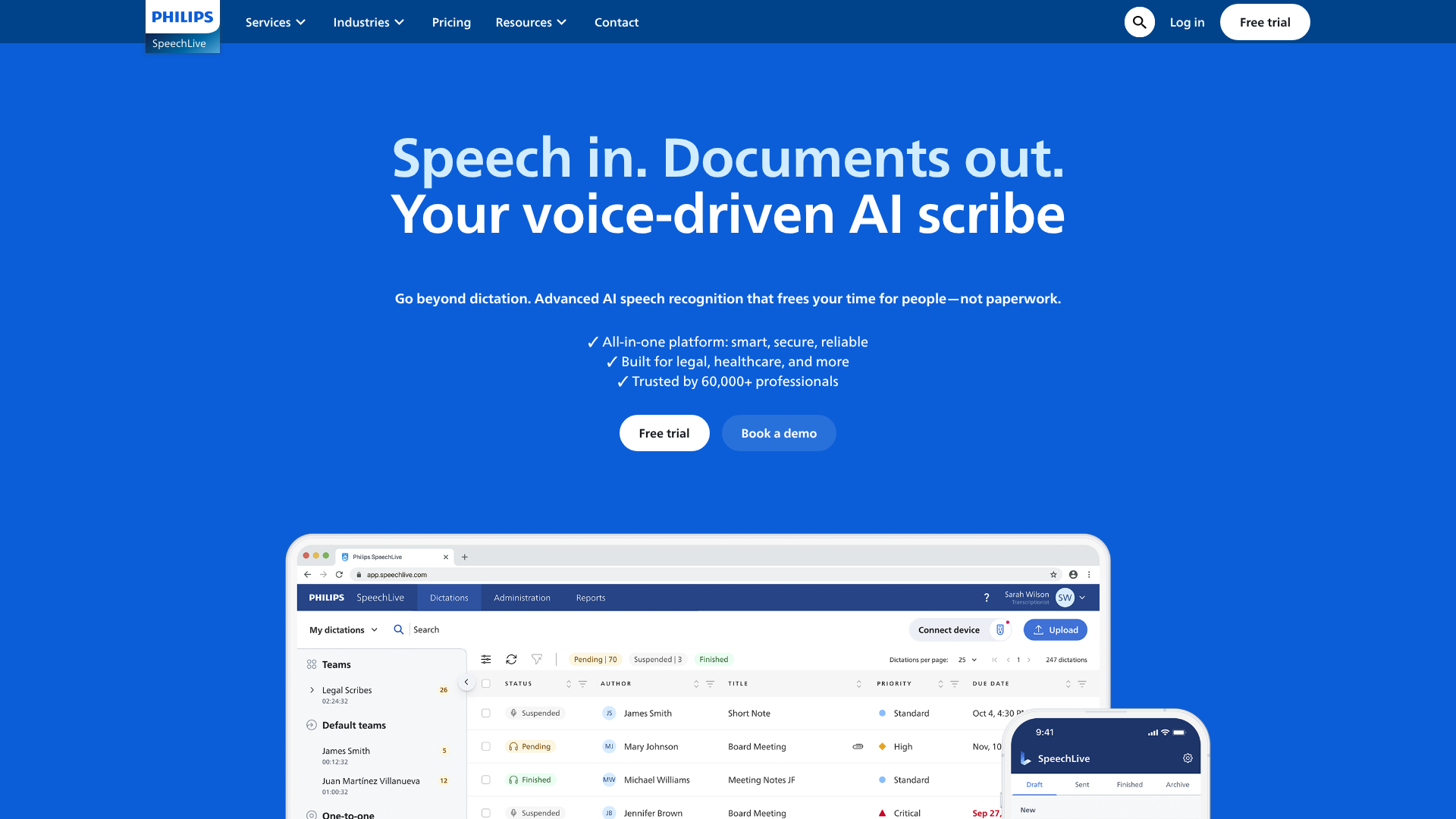
Philips offers a flexible solution that bridges the gap between pure AI and human services. SpeechLive provides real-time speech recognition, but it also gives users the option to send recordings to a professional human transcriptionist for maximum accuracy, especially for complex cases or speakers with heavy accents. This hybrid approach makes it a versatile choice for practices that want the speed of AI with the quality assurance of a human review.
- Pros: Combines AI with optional human transcription, flexible workflow options, strong mobile features.
- Cons: The human transcription service adds to the overall cost.
Implementing any new software requires training to ensure your team can use it effectively. For healthcare professionals looking to enhance their documentation skills, platforms like MedBridge offer continuing education courses on clinical documentation improvement, which can help your team maximise the benefits of these powerful tools.
Understanding the Pricing and Costs Involved
The cost of voice recognition medical software can vary widely based on the provider, the features included, and the number of users. It's important to understand the different pricing models to accurately budget for the investment.
Most modern solutions operate on a Software as a Service (SaaS) model, typically billed as a monthly or annual subscription per user. This model is predictable and usually includes software updates, maintenance, and customer support. For a leading platform like Dragon Medical One, you can expect to pay around £80-£100 per user per month.
Newer AI scribes like Freed AI or Heidi Health often have similar per-user subscription models, sometimes with tiered pricing based on the number of minutes transcribed or the level of features required. Some may offer a free trial or a limited free plan, which is a great way to test the service.
For API-based services like Amazon Transcribe Medical, the model is typically pay-as-you-go. You are charged based on the number of seconds or minutes of audio transcribed each month. This can be extremely cost-effective for organisations with fluctuating usage or for those just starting to build a voice-enabled application.
When evaluating cost, it's crucial to look beyond the subscription fee and consider the Return on Investment (ROI). Calculate the value of the time saved by your clinicians. If a £90 per month subscription saves a doctor five hours of documentation time per month, the ROI is substantial, not only in terms of productivity but also in improved job satisfaction and reduced burnout.
The Pros and Cons of Adopting Medical Voice Software
While the benefits are compelling, it's important to have a balanced view. Like any technology, there are potential drawbacks to consider before implementation.
Pros
- Massive Time Savings: Clinicians can document significantly faster, freeing up time for patient care or reducing the need for after-hours work.
- Reduced Clinician Burnout: By tackling one of the biggest administrative burdens, this software directly addresses a key driver of burnout.
- Improved Note Quality: Dictation often leads to more detailed and narrative-rich clinical notes compared to hurried typing.
- Better Patient Focus: Enables clinicians to maintain eye contact and engage more directly with patients during consultations.
- Increased Revenue: Faster documentation can lead to more efficient patient throughput and more accurate coding for billing.
Cons
- Initial Cost and Investment: Subscription fees can be a significant expense, especially for smaller practices.
- Implementation and Training: There is a learning curve. Staff will need time and training to become proficient and integrate the software into their workflow.
- Accuracy is Not Perfect: While accuracy is very high, it's not 100%. All dictated notes must be reviewed and proofread by the clinician before signing off, which still requires time.
- Privacy and Security Risks: If you choose a non-compliant provider, you risk exposing sensitive patient data. Sticking with reputable, HIPAA/GDPR-compliant vendors is essential.
- Dependency on Technology: If the software or internet connection goes down, it can disrupt workflows, so having a backup documentation method is wise.
Frequently Asked Questions (FAQ)
What is the voice recognition software in healthcare?
Voice recognition software in healthcare is a specialised technology that converts spoken language from clinicians into written text. It's designed with an extensive medical vocabulary to accurately capture patient notes, referral letters, and other clinical documentation directly within an EHR. Modern versions use AI to understand natural language and even structure conversations into organised notes.
What is the best dictation software that is HIPAA compliant?
Many top-tier solutions are HIPAA compliant, but Nuance Dragon Medical One is widely considered the industry standard for its security and deep EHR integrations. Other excellent HIPAA-compliant options include AI-powered scribes like Freed AI and Heidi Health, as well as flexible platforms like Philips SpeechLive. The "best" option depends on your practice's specific needs, size, and EHR system.
Are medical transcriptionists still in demand?
The role of a medical transcriptionist has evolved due to this technology. While the demand for traditional transcriptionists who type from audio recordings has decreased, new roles have emerged. There is a growing need for clinical documentation specialists and editors who review and edit AI-generated text for accuracy and completeness. Some services, like Philips SpeechLive, even incorporate human transcriptionists into their workflow for quality assurance.
What are the disadvantages of voice recognition software?
The main disadvantages include the initial cost of subscriptions, the time required for implementation and staff training, and the fact that it's not 100% accurate. Clinicians must still proofread every note, which takes time. There's also a risk of workflow disruption if the system experiences technical issues, and a dependency on the technology can develop.
How much does Dragon Medical dictation cost?
Pricing for Nuance Dragon Medical One is typically on a per-user, per-month subscription basis. While costs can vary based on the reseller and the size of the contract, you can generally expect to pay between £80 and £100 per user per month in the UK. It's always best to get a direct quote for the most accurate and up-to-date pricing information.
Final Thoughts
Voice recognition medical software is no longer a futuristic concept; it's a practical and increasingly essential tool for the modern healthcare practice. By automating one of the most time-consuming parts of a clinician's job, it offers a direct path to reducing burnout, improving the quality of patient records, and, most importantly, fostering better patient-doctor relationships.
Whether you choose an established industry leader like Dragon Medical One or an innovative AI scribe like Freed AI, the key is to select a solution that fits your workflow, integrates with your EHR, and meets the highest standards of security. The initial investment in cost and training is often repaid many times over in saved time and improved professional well-being.
Ultimately, the goal of this technology is to shift the focus from the computer screen back to the patient. By handling the administrative load, it empowers clinicians to do what they do best: provide exceptional care.