

A Manager's Guide to Risk Management in Construction Projects (To Avoid Delays)
Construction is an industry of high stakes and tight margins. A single unforeseen event—a supply chain disruption, a safety incident, or a critical design error—can derail timelines and obliterate budgets. This is where a structured approach to risk management in construction projects becomes not just a best practice, but a fundamental pillar of success. It's the systematic process of identifying, analysing, and responding to potential threats before they become costly realities, ensuring your project stays on track from groundbreaking to handover.
- What You'll Learn
- What is Risk Management in Construction Projects? A Clear Definition
- The Core Process: A Step-by-Step Guide to Managing Risks in Construction
- Step 1: Risk Identification
- Step 2: Risk Assessment and Analysis
- Step 3: Risk Response and Mitigation Planning
- Step 4: Risk Monitoring and Control
- Common Types of Construction Project Risk You Must Address
- Financial and Economic Risks
- Technical and Performance Risks
- Safety and Environmental Risks
- Legal and Contractual Risks
- Key Benefits: Why Effective Construction Risk Management is Non-Negotiable
- Choosing the Right Tools and Strategies for Your Projects
- Essential Manual Tools: The Risk Register and Risk Matrix
- The Role of Construction Management Software
- Top Software Recommendations for Risk Management
- Evaluating Costs and ROI: What to Expect
- Pros and Cons of Different Risk Management Approaches
- The Proactive, Integrated Approach (Using Software)
- The Traditional, Manual Approach (Using Spreadsheets)
- Frequently Asked Questions (FAQ)
- What are the 5 pillars of risk management?
- What is the risk management process in construction?
- What are the four main types of construction risk?
- What are the 7 principles of risk management?
- Final Thoughts
This guide breaks down the complexities of construction risk management into a clear, actionable framework. We'll explore the core processes, the types of risks you'll face, and the modern tools that can help you stay ahead of uncertainty. By proactively managing risks in construction, you can protect your profits, ensure worker safety, and build a reputation for delivering projects reliably and efficiently.
What You'll Learn
- The Core Process: Risk management follows a four-step cycle: identifying potential threats, assessing their likelihood and impact, planning a response, and continuously monitoring them throughout the project.
- Key Risk Categories: Construction projects face a wide array of risks, including financial (budget overruns), technical (design flaws), safety (site accidents), and legal (contract disputes).
- Essential Tools: The risk register and risk matrix are fundamental tools for tracking and prioritising threats. Modern software can automate and streamline this entire process.
- Proactive vs. Reactive: An effective strategy is proactive, not reactive. It focuses on preventing problems before they occur rather than just dealing with them after the fact.
- Benefits Beyond Budget: Good risk management improves safety, enhances stakeholder confidence, reduces legal disputes, and leads to more predictable project outcomes.
What is Risk Management in Construction Projects? A Clear Definition
At its core, risk management in construction projects is a proactive discipline designed to control future events as much as possible. It's not about eliminating risk entirely—that’s impossible in such a dynamic industry. Instead, it’s about identifying potential uncertainties, understanding their potential consequences, and implementing strategies to minimise their negative impact while maximising potential opportunities.
Think of a project manager as the captain of a ship. Before setting sail, a good captain checks the weather forecast (identifies risks), plots a course around potential storms (mitigates risks), and keeps a constant watch on the radar (monitors risks). They don't wait for the storm to hit to start making plans. This is the essence of managing risks in construction: navigating the project through a sea of variables to reach its destination safely, on time, and within budget.
This process involves more than just creating a list of what could go wrong. It's a continuous cycle that is integrated into every phase of the project, from initial design to final completion. It requires input from all stakeholders, including architects, engineers, contractors, and clients, to build a comprehensive picture of the project's risk landscape.
The Core Process: A Step-by-Step Guide to Managing Risks in Construction
Effective construction risk management isn't a single action but a continuous, four-step cycle. This framework provides a structured way to handle uncertainty, turning potential chaos into a manageable process. By following these steps, teams can move from a reactive, firefighting mode to a proactive, strategic mindset.
Step 1: Risk Identification
The first step is to identify every potential risk that could affect the project. You can't manage a risk you don't know exists. This is a comprehensive brainstorming effort that should involve the entire project team and key stakeholders. The goal is to create a long list of potential issues, leaving no stone unturned.
Common methods for risk identification include:
- Checklists: Using historical data from previous projects to create checklists of common risks.
- Expert Interviews: Consulting with experienced professionals, engineers, and site supervisors who have firsthand knowledge of what can go wrong.
- Site Inspections: Walking the site to identify location-specific hazards, such as soil conditions, access issues, or environmental concerns.
- Document Reviews: Analysing project plans, specifications, and contracts to find potential ambiguities or conflicts.
Step 2: Risk Assessment and Analysis
Once you have a list of risks, you need to determine which ones deserve the most attention. This is done by assessing each risk based on two key factors: its likelihood (probability of occurring) and its impact (the severity of the consequences if it does occur). This analysis can be qualitative, quantitative, or a mix of both.
A common tool for this is the Risk Matrix. This visual grid helps you plot each risk based on its likelihood and impact, typically on a scale (e.g., 1-5 or Low-Medium-High). Risks that fall into the high-likelihood, high-impact quadrant (the top-right corner) are your top priorities. This allows you to focus your resources where they are needed most, rather than treating all risks equally.
Step 3: Risk Response and Mitigation Planning
After prioritising your risks, you need to decide how to handle them. There are generally four main strategies, often called the "4 T's" of risk response:
- Treat (Mitigate): This is the most common strategy. You take active steps to reduce the likelihood or impact of a risk. For example, implementing stricter safety protocols to reduce the risk of accidents or ordering materials early to mitigate supply chain delays.
- Transfer (Share): This involves shifting the financial impact of a risk to a third party. The most common examples are purchasing insurance or using specific clauses in contracts with subcontractors. A well-drafted contract can clarify who is responsible for what, which is where services like LegalContracts can be useful for creating clear, enforceable agreements.
- Tolerate (Accept): For risks with a low likelihood and low impact, the most cost-effective solution may be to simply accept them. You acknowledge the risk exists but decide not to spend time or money on it, often setting aside a contingency fund to cover it if it occurs.
- Terminate (Avoid): This strategy involves changing the project plan to eliminate the risk altogether. For instance, if a specific construction method is deemed too hazardous, you might choose an alternative method, even if it's more expensive.
Step 4: Risk Monitoring and Control
Risk management is not a set-it-and-forget-it activity. The project environment is constantly changing, so new risks can emerge and the status of existing risks can change. Continuous monitoring is essential. This is typically managed using a Risk Register, a live document that tracks all identified risks, their status, and the response plans in place.
Regular team meetings should be held to review the risk register, discuss any new threats, and assess the effectiveness of the mitigation strategies. This ongoing vigilance ensures that the risk management plan remains relevant and effective throughout the project's lifecycle.
Common Types of Construction Project Risk You Must Address
A construction project is a complex undertaking, and the sources of risk are numerous. Understanding the different categories of construction project risk helps teams organise their identification and mitigation efforts more effectively. While there are many ways to classify them, most risks fall into one of the following key areas.
Financial and Economic Risks
These risks are directly related to the project's budget and financial viability. They are often among the most critical to manage, as they can quickly lead to project failure.
- Budget Overruns: Costs exceeding the planned budget due to poor estimation, scope creep, or unexpected expenses.
- Material Price Volatility: Sudden increases in the cost of essential materials like steel, timber, or concrete.
- Inflation and Interest Rate Changes: Broader economic shifts that can increase project financing costs.
- Client Financial Issues: The risk that the client may be unable to make payments on time.
Technical and Performance Risks
These relate to the technical aspects of the project and the performance of the work itself. They can lead to rework, delays, and quality issues.
- Design Errors or Omissions: Flaws in the architectural or engineering plans that are discovered during construction.
- Scope Creep: Uncontrolled changes or additions to the project scope without corresponding adjustments to time and budget.
- Poor Quality Workmanship: Substandard work from contractors or subcontractors that requires correction.
- Unforeseen Site Conditions: Discovering unexpected issues on-site, such as poor soil quality or hidden utilities.
Safety and Environmental Risks
Construction sites are inherently dangerous places, making safety a top priority. Environmental risks have also become increasingly significant due to stricter regulations.
- Worker Accidents and Injuries: The most critical risk, with severe human and financial consequences.
- Equipment Failure: Malfunctions in heavy machinery or tools that can cause accidents or delays.
- Hazardous Materials: The improper handling or discovery of materials like asbestos or lead.
- Environmental Non-Compliance: Failing to adhere to environmental regulations, leading to fines and work stoppages.
Legal and Contractual Risks
These risks arise from the complex web of contracts, permits, and regulations that govern a construction project.
- Contractual Disputes: Disagreements with clients, subcontractors, or suppliers over the terms of a contract.
- Permitting and Regulatory Delays: Issues with obtaining the necessary permits or failing to comply with building codes.
- Labour Disputes: Strikes or other labour issues that can halt work on the project.
- Insurance Gaps: Inadequate insurance coverage that leaves the project exposed to significant financial loss.
Pro Tip: Don't overlook organisational risks. Things like poor communication channels, inexperienced project management, or high staff turnover can be just as damaging as a technical failure. A clear communication plan is a powerful risk mitigation tool.
Key Benefits: Why Effective Construction Risk Management is Non-Negotiable
Implementing a formal process for managing risks in construction requires an upfront investment of time and resources. However, the long-term benefits far outweigh the costs, transforming how projects are delivered and perceived. The advantages go well beyond simply avoiding disaster; they create a more stable, predictable, and profitable project environment.
First and foremost is improved project predictability. By identifying potential problems early, you can develop contingency plans and build more realistic schedules and budgets. This reduces the number of last-minute surprises and fire drills, leading to smoother project execution and fewer delays. Stakeholders, from investors to clients, gain confidence when they see a project that is in control of its destiny.
Another critical benefit is enhanced safety. A systematic approach to risk management forces teams to proactively identify and address site hazards. This leads to fewer accidents, protects the well-being of workers, and reduces the significant financial and reputational costs associated with safety incidents. A safe site is an efficient site.
Effective construction risk management also leads to better decision-making. When you analyse risks based on data and probability, you move away from gut feelings and towards informed choices. This allows you to allocate resources more effectively, focusing on the threats that pose the greatest danger to the project's objectives. It also helps in evaluating opportunities, allowing you to take calculated risks that could lead to positive outcomes.
Finally, it significantly reduces disputes and litigation. Many legal battles in construction stem from unexpected events where responsibility is unclear. A strong risk management plan, supported by clear contractual agreements, allocates risk from the outset. This clarity helps prevent disagreements from escalating into costly and time-consuming legal disputes.
Choosing the Right Tools and Strategies for Your Projects

Having a process is one thing; having the right tools to execute it is another. The effectiveness of your risk management strategy depends heavily on the tools you use to identify, track, and communicate risks. These range from simple documents to sophisticated software platforms, and the right choice depends on the scale and complexity of your project.
Essential Manual Tools: The Risk Register and Risk Matrix
Even on the simplest projects, two tools are indispensable. The Risk Register is the master document for your risk management efforts. It's typically a spreadsheet or table that lists every identified risk, its potential impact, its likelihood, the planned response, and the person responsible for managing it. This document should be a living file, updated regularly throughout the project.
The Risk Matrix, as mentioned earlier, is a visual tool used during the assessment phase. It helps you prioritise risks by plotting them on a grid of likelihood versus impact. This simple visualisation is incredibly powerful for communicating priorities to the entire team and ensuring everyone is focused on the most significant threats.
The Role of Construction Management Software
While spreadsheets can work for smaller projects, they quickly become unwieldy and prone to error as complexity grows. Modern construction management software centralises risk management into a single platform, offering several advantages:
- Real-Time Data: Everyone works from the same, up-to-date information, eliminating version control issues.
- Improved Collaboration: Team members can report risks, update statuses, and communicate directly within the platform.
- Automation: The software can automate notifications, track deadlines for mitigation tasks, and generate reports.
- Integration: Risk data can be linked to other project areas like scheduling, budget, and daily reports, providing a holistic view.
Top Software Recommendations for Risk Management
When considering software, look for platforms that integrate risk management with other core project functions. A tool that connects financial data, site safety, and project scheduling provides a much more powerful way to manage risk.
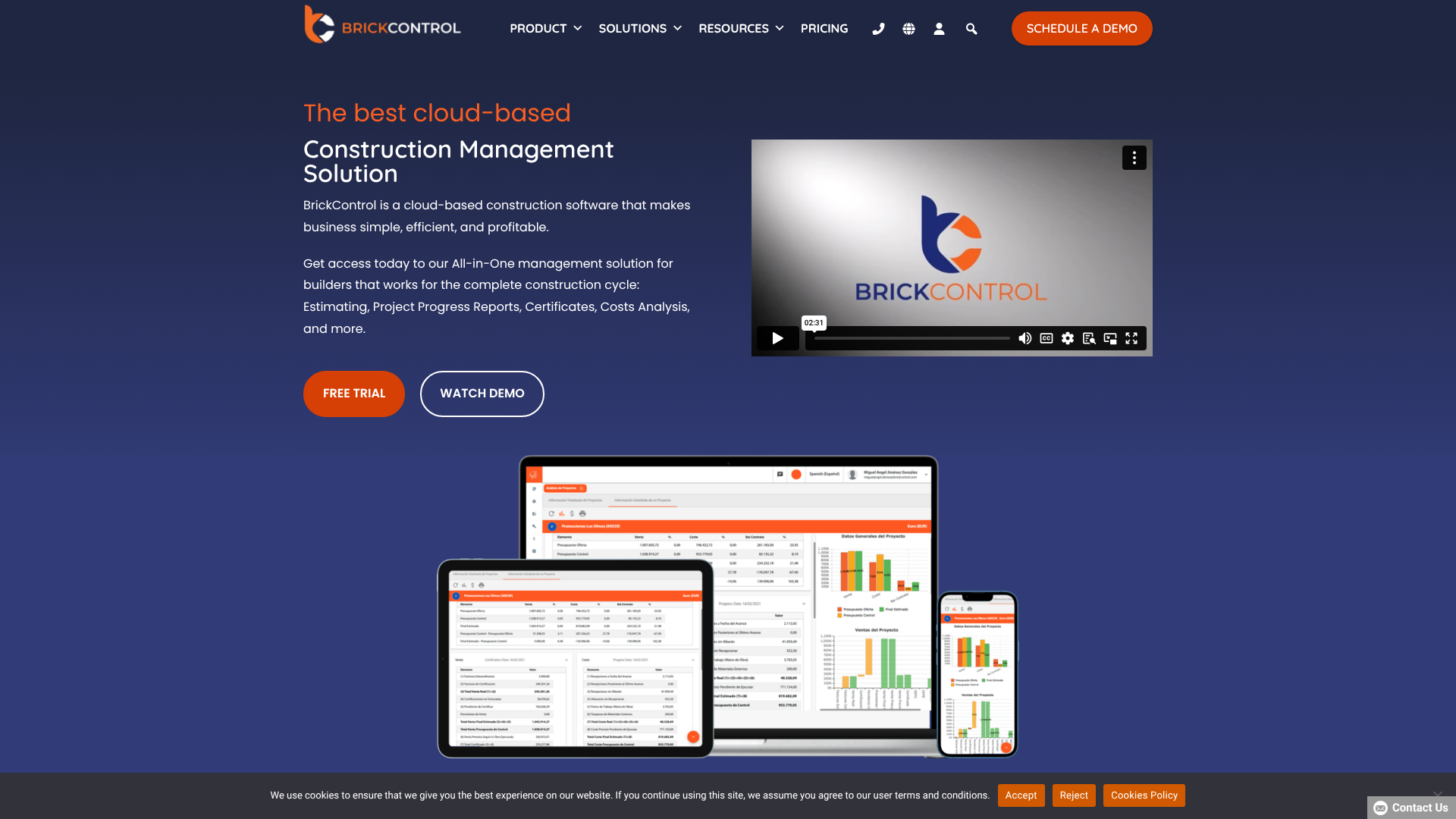
For example, a comprehensive platform like BrickControl helps manage the financial and operational side of a project. By providing real-time visibility into costs, procurement, and scheduling, it allows managers to spot deviations from the plan early, mitigating financial and performance risks before they escalate.
For projects where safety and compliance are paramount, a specialised platform is often the best choice. HammerTech focuses specifically on managing safety, quality, and daily site operations. It streamlines safety inspections, worker inductions, and incident reporting, directly addressing some of the highest-impact risks on any construction site.
Evaluating Costs and ROI: What to Expect
When discussing risk management, it's easy to focus on the cost of tools and processes. However, the more important conversation is about the cost of not managing risk. A single major incident—a structural failure, a serious injury, or a major lawsuit—can cost millions and cause irreparable damage to a company's reputation. The investment in risk management is an investment in preventing these catastrophic outcomes.
The cost of implementing a risk management programme can vary widely. For a small project, it might just be the time invested in creating and maintaining a risk register. For larger organisations, it could involve purchasing dedicated software, hiring a risk manager, and conducting team-wide training. Software pricing models typically vary, with options like per-user/per-month subscriptions, tiered plans based on features, or pricing based on the total value of the projects being managed.
For specific tools, it's always best to visit their websites for the latest pricing information.
However, the focus should be on the Return on Investment (ROI). Effective risk management delivers ROI in several ways:
Reduced Contingency Costs: By proactively managing risks, you can reduce the amount of money you need to hold in contingency funds for unexpected problems. * Lower Insurance Premiums: Insurers often offer lower premiums to companies that can demonstrate a robust and formal risk management process. * Avoidance of Direct Costs: This includes preventing costs from rework, fines, legal fees, and project delays.
Improved Profitability: By keeping projects on time and on budget, you protect your profit margins.
Ultimately, risk management should not be viewed as an expense but as a core business function that protects and enhances profitability.
Pros and Cons of Different Risk Management Approaches
There are two primary approaches to managing construction project risk: a modern, integrated approach that uses dedicated software, and a traditional, manual approach that relies on spreadsheets and documents. Each has its own set of advantages and disadvantages.
The Proactive, Integrated Approach (Using Software)
This approach uses a central software platform to manage all risk-related activities, integrating them with other project management functions.
Pros:
- Real-Time Visibility: All stakeholders have access to the latest information, enabling faster and more informed decisions.
- Improved Collaboration: Centralised communication prevents information from getting lost in emails or spreadsheets.
- Data-Driven Insights: Software can analyse trends across projects, helping to identify recurring risks and improve future planning.
- Standardisation and Consistency: Ensures that all projects follow the same risk management process, improving quality and predictability.
Cons:
- Initial Cost: There is an upfront cost for the software subscription and implementation.
- Training Requirement: The team will need to be trained on how to use the new system effectively.
- Implementation Time: It can take time to set up the software and migrate existing processes.
The Traditional, Manual Approach (Using Spreadsheets)
This approach relies on tools like Microsoft Excel to create risk registers and email for communication. It's common in smaller companies or on less complex projects.
Pros:
- Low Initial Cost: There are no software subscription fees, as most companies already have office software.
- Familiarity: Most team members are already comfortable using spreadsheets and email.
- Simple to Start: It's quick and easy to create a basic risk register in a spreadsheet.
Cons:
- Prone to Human Error: Manual data entry can lead to mistakes, and it's easy for formulas to break.
- Data Silos: Information is scattered across different files and inboxes, making it difficult to get a complete picture.
- Lack of Real-Time Updates: It's hard to ensure everyone is working from the latest version of the risk register.
- Not Scalable: This approach becomes chaotic and unmanageable on large or complex projects.
Pro Tip: The best approach often involves a transition. You can start with a manual system to build the discipline and process, then migrate to a software solution as your projects grow in complexity to gain the benefits of integration and real-time data.
Frequently Asked Questions (FAQ)
What are the 5 pillars of risk management?
While different frameworks exist, a common way to think about the pillars of risk management in a business context involves five key activities. These are: 1) Risk Identification, the process of finding and documenting potential risks. 2) Risk Assessment, analysing the likelihood and impact of identified risks. 3) Risk Control/Mitigation, implementing strategies to reduce or eliminate risks.
- Risk Financing, planning how to cover the costs of risks that do occur, such as through insurance or contingency funds. 5) Risk Monitoring, continuously tracking risks and the effectiveness of control measures.
What is the risk management process in construction?
The risk management process in construction is a continuous cycle designed to control uncertainty. It typically consists of four main stages: 1. Risk Identification: Brainstorming and listing all potential risks. **2.
Risk Analysis & Assessment:** Evaluating each risk's probability and potential impact, often using a risk matrix. 3. Risk Response Planning: Deciding on a strategy for each significant risk (e.g., avoid, transfer, mitigate, or accept). **4.
Risk Monitoring & Control:** Regularly reviewing the status of risks and the effectiveness of response plans throughout the project lifecycle, often using a risk register.
What are the four main types of construction risk?
Construction risks can be grouped into many categories, but four main types cover most potential issues. These are 1. Financial Risks, which include budget overruns, material price increases, and funding issues. **2.
Technical Risks**, related to design errors, poor workmanship, and unforeseen site conditions. 3. Safety & Environmental Risks, covering everything from on-site accidents to non-compliance with environmental regulations. **4.
Legal & Contractual Risks**, which involve disputes with clients or subcontractors, permitting delays, and insurance issues.
What are the 7 principles of risk management?
The internationally recognised standard for risk management, ISO 31000, outlines several principles for making risk management effective. The key principles state that the process should be: 1. Integrated into all organisational activities. **2.
Structured and comprehensive**. 3. Customised to the organisation's context. **4.
Inclusive** of all stakeholders. 5. Dynamic and responsive to change. **6.
Based on the best available information**. 7. Considerate of human and cultural factors.
Final Thoughts
Effective risk management in construction projects is far more than an administrative task; it is a strategic imperative. It's the framework that allows project managers to navigate uncertainty with confidence, protecting their teams, budgets, and timelines from the countless variables that can arise on a job site. By moving from a reactive to a proactive stance, you transform risk from a source of stress into a manageable component of a successful project.
Whether you start with a simple risk register or implement a sophisticated software solution, the key is to make the process a continuous and integral part of your project culture. The discipline of identifying, assessing, and mitigating risks consistently will always yield a powerful return, leading to safer sites, happier clients, and a stronger bottom line.
If you're looking to streamline your processes and gain real-time control over project variables, exploring modern tools can be a valuable next step. Platforms like BrickControl for comprehensive project management or HammerTech for specialised safety compliance can provide the visibility and control needed to effectively manage construction project risk in today's complex environment.