


Good Landing Page Experience Attributes: A Marketer's Guide to Higher Conversions
You've done the hard work. You've crafted the perfect ad, targeted the right audience, and driven a wave of traffic to your website. But instead of a flood of new leads or sales, you hear crickets. This frustrating scenario often points to a single culprit: a poor landing page experience.
- Essential Points
- What Exactly Defines a Good Landing Page Experience?
- The Core Attributes of Effective Landing Pages
- 1. Flawless Message Match and Relevance
- 2. Lightning-Fast Loading Speed
- 3. A Crystal-Clear and Singular Call-to-Action (CTA)
- 4. Clean, Uncluttered, and User-Friendly Design
- 5. Compelling and Scannable Copywriting
- 6. Ironclad Trust and Credibility Signals
- 7. A Seamless Mobile-First Experience
- How to Implement These Good Landing Page Traits
- Top Landing Page Builders for a Superior Experience
- 1. Leadpages: Best for Simplicity and Speed
- 2. Unbounce: Best for AI-Powered Optimisation
- 3. Instapage: Best for Personalisation at Scale
- 4. ClickFunnels: Best for Sales Funnel Integration
- Comparing Costs: What to Expect from Landing Page Builders
- The Overall Pros and Cons of Prioritising Landing Page Experience
- Frequently Asked Questions About Landing Page Experience Factors
- Final Thoughts: It's All About the User
Understanding the attributes of a good landing page experience is not just a design exercise; it's a critical component of any successful digital marketing campaign, directly impacting your conversion rates and return on investment.
A great landing page acts as your best salesperson. It meets visitors exactly where they are, answers their immediate questions, builds trust, and guides them effortlessly towards a single, desired action. It’s the crucial bridge between a user's initial interest and their final conversion, and getting it right can transform your entire marketing performance.
This guide breaks down exactly which attributes describe a good landing page experience. We'll explore the core principles, from message match and loading speed to user trust and mobile design, providing you with a clear framework to audit your own pages and build new ones that convert.
Essential Points
- Relevance is Paramount: A good landing page must have a perfect 'message match' with the ad or link that brought the visitor. The headline, copy, and offer should directly reflect the user's initial intent.
- Speed is a Feature: Pages that load in under three seconds see significantly higher conversion rates. Slow pages frustrate users and are penalised by search engines, making speed a non-negotiable attribute.
- Clarity and Simplicity Win: The best landing pages have a single, clear goal supported by a prominent call-to-action (CTA). They eliminate distractions like site navigation to keep the user focused on the conversion task.
- Trust is the Foundation: Without trust, no one will convert. Effective landing pages use social proof, testimonials, security badges, and professional design to build credibility instantly.
- Mobile-First is the Standard: With the majority of traffic coming from mobile devices, a landing page must be designed for a seamless experience on a small screen, with large tap targets and easy-to-read text.
What Exactly Defines a Good Landing Page Experience?

A landing page isn't just any page on your website. It's a specialised, standalone page created for a specific marketing or advertising campaign. When a user clicks on a Google Ad, a link in an email, or a social media promotion, they should arrive at a page designed exclusively to fulfil the promise of that link. The 'experience' is the sum of all interactions a user has on that page, from the moment it loads to the moment they click the call-to-action button.
So, what separates a good experience from a bad one? A good landing page experience is defined by its ability to be relevant, trustworthy, and easy to navigate. It minimises friction and cognitive load, making it as simple as possible for the visitor to say "yes" to your offer. It feels less like a sales pitch and more like a helpful, direct solution to the problem the user was trying to solve when they clicked your ad.
For platforms like Google Ads, the landing page experience is a critical component of your Quality Score. Google actively assesses your page to determine if it's likely to provide a good experience for users. A high-quality experience leads to a better Quality Score, which in turn can lead to lower costs per click (CPC) and better ad positions. This means focusing on these attributes isn't just good for users; it's good for your budget.
The Core Attributes of Effective Landing Pages
To truly understand what makes a landing page successful, we need to break down the specific landing page experience factors that contribute to its performance. These are the foundational elements that work together to persuade and convert visitors.
1. Flawless Message Match and Relevance
Message match is the principle that your landing page content should directly align with the ad or link that brought the user there. If your ad promises a "50% Discount on Winter Coats," your landing page headline must echo that exact offer. This immediate confirmation tells the user they are in the right place, reducing confusion and lowering the chance they'll hit the 'back' button.
This attribute is all about meeting expectations. Imagine clicking an ad for a specific product only to land on a generic homepage. You'd feel lost and frustrated. A strong message match creates a seamless journey, reassuring the visitor and maintaining the momentum from their initial click.
This is arguably one of the most crucial attributes of effective landing pages.
2. Lightning-Fast Loading Speed
In the digital world, patience is a scarce resource. According to Google, 53% of mobile site visitors will leave a page that takes longer than three seconds to load. Every second of delay dramatically increases your bounce rate and kills potential conversions. Speed isn't just a technical detail; it's a fundamental part of the user experience.
A fast-loading page feels professional and efficient, reflecting positively on your brand. To achieve this, focus on optimising image sizes, using a content delivery network (CDN), minimising code, and choosing a reliable hosting provider. Many modern landing page builders are specifically optimised for speed, handling the technical heavy lifting for you.
3. A Crystal-Clear and Singular Call-to-Action (CTA)
Every great landing page is built around a single, focused goal. This could be downloading an ebook, signing up for a webinar, or purchasing a product. The Call-to-Action (CTA) is the button or link that enables the user to complete that goal. A common mistake is to clutter a landing page with multiple, competing CTAs, which leads to decision paralysis.
Your primary CTA should be impossible to miss. Use a contrasting colour that makes it stand out from the rest of the page, and ensure the button text is action-oriented and clear (e.g., "Get Your Free Guide" instead of "Submit"). Placing the CTA 'above the fold' (visible without scrolling) is a best practice, but it should also be repeated further down the page for longer landing pages.
4. Clean, Uncluttered, and User-Friendly Design
Visual chaos is a conversion killer. A good landing page uses a clean layout, ample white space, and a clear visual hierarchy to guide the user's eye towards the most important elements—namely, the headline, the key benefits, and the CTA. The design should support the message, not distract from it.
One of the most effective design choices for a landing page is the removal of the main website navigation menu. By eliminating links to your 'About Us' or 'Blog' pages, you remove exit routes and keep the visitor focused on the single conversion goal. The design should be simple, scannable, and entirely centred on the action you want the user to take.
5. Compelling and Scannable Copywriting
Visitors don't read landing pages; they scan them. Your copy must be structured to deliver the most important information quickly. This means using a powerful, benefit-driven headline, clear subheadings, and concise bullet points to break up text and highlight key advantages.
Focus your writing on the user's needs and desires. Instead of listing product features, explain the benefits and the transformation the user will experience. For example, instead of saying "Our software has a 128-bit encryption feature," say "Keep your data safe and secure with military-grade encryption." This user-centric language is far more persuasive.
Pro Tip: Use the 'voice of the customer' in your copy. Incorporate phrases and pain points from actual customer reviews or surveys. This makes your message more relatable and authentic, building a stronger connection with the visitor.
6. Ironclad Trust and Credibility Signals
Before a user gives you their email address or credit card information, they need to trust you. Trust signals are elements on your page that build credibility and reduce perceived risk. Without them, even the most compelling offer will fail.
There are many types of trust signals you can use:
Customer Testimonials: Quotes or videos from happy customers. * Reviews and Ratings: Star ratings from platforms like Trustpilot or Google. * Security Badges: SSL certificates (the padlock icon in the browser) and logos from security companies like McAfee or Norton. * Social Proof: Logos of well-known companies you've worked with or mentions of the number of customers you have.
Guarantees: A money-back guarantee or a clear and fair privacy policy.
7. A Seamless Mobile-First Experience
Today, designing for mobile isn't an afterthought; it's the priority. A mobile-first approach means you design the experience for the smallest screen first and then adapt it for larger screens like tablets and desktops. This ensures the core experience is optimised for the majority of users.
On mobile, this means large, easily tappable buttons, readable font sizes without pinching or zooming, and simple forms that are easy to complete with your thumbs. The layout should be a single column, making it easy to scroll through the content without any horizontal panning. A clunky mobile experience is a guaranteed way to lose conversions.

How to Implement These Good Landing Page Traits
Knowing the attributes of a good landing page is one thing; successfully implementing them is another. Marketers generally have two primary paths for creating and launching landing pages: custom development or using a dedicated landing page builder.
Custom Development involves working with web developers to code a landing page from scratch. This approach offers complete creative freedom and control over every single element. However, it is often slow, expensive, and requires technical expertise for any changes or A/B tests. For most marketing teams, this process is too cumbersome to keep up with the demands of modern campaigns.
Landing Page Builders, on the other hand, are software platforms specifically designed to help marketers create, launch, and optimise high-converting landing pages without writing a single line of code. These tools are built around the very principles we've just discussed, offering features that make implementation fast and easy.
Choosing a landing page builder is often the most efficient and effective option. They provide professionally designed templates that are already optimised for speed and mobile devices. Their drag-and-drop editors allow you to easily customise layouts, add trust signals, and ensure your message match is perfect. Furthermore, they come with built-in analytics and A/B testing capabilities, which are essential for ongoing optimisation.
Top Landing Page Builders for a Superior Experience
Selecting the right tool can make all the difference in bringing your campaigns to life. These platforms are designed to help you effortlessly incorporate the good landing page traits that drive results. Here are some of the top recommendations in the market.
1. Leadpages: Best for Simplicity and Speed
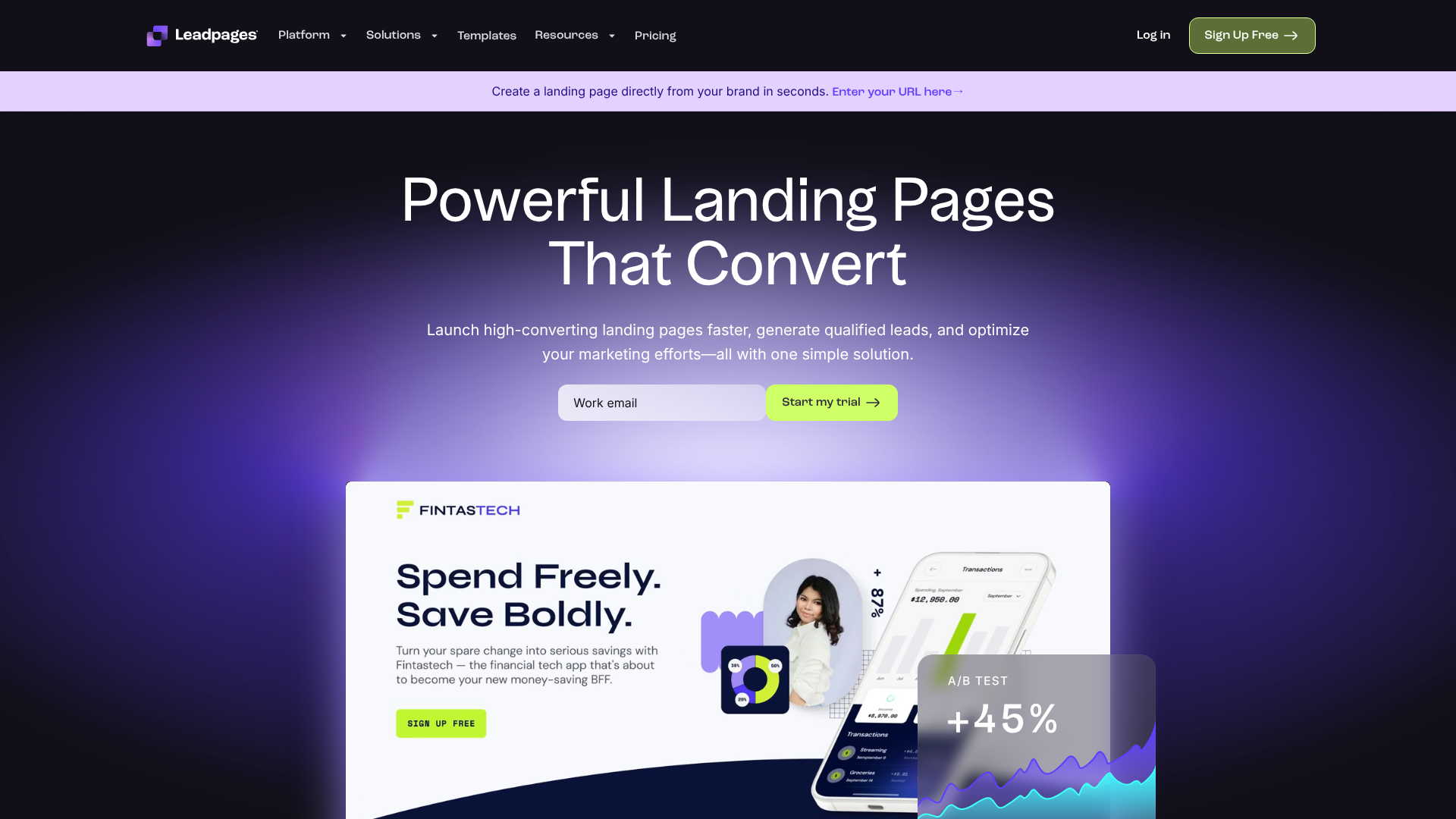
Leadpages is renowned for its ease of use and focus on generating leads. It offers a vast library of high-converting, mobile-responsive templates that you can customise with an intuitive drag-and-drop editor. One of its standout features is its emphasis on loading speed; pages built with Leadpages are consistently among the fastest in the industry.
The platform includes built-in conversion tools like pop-ups and alert bars, and it provides straightforward analytics to track your performance. If you're a small business owner or a marketer who needs to launch effective landing pages quickly without a steep learning curve, Leadpages is an excellent choice.
Pros:
- Extremely user-friendly and intuitive.
- Industry-leading page load speeds.
- Affordable pricing plans.
Cons:
- A/B testing is not available on the base plan.
- Fewer advanced customisation options compared to competitors.
2. Unbounce: Best for AI-Powered Optimisation
Unbounce is a powerful and flexible platform aimed at marketers who are serious about optimisation. Its classic drag-and-drop builder offers granular control over page design, allowing for pixel-perfect placement of elements. Where Unbounce truly shines is with its AI-powered features.
Its 'Smart Traffic' tool automatically analyses a visitor's attributes and sends them to the landing page variant most likely to convert for them. This goes beyond traditional A/B testing and can significantly lift conversion rates. Unbounce is ideal for data-driven marketing teams looking to squeeze the maximum performance out of their campaigns.
Pros:
- Advanced A/B testing and AI optimisation tools.
- High degree of design flexibility.
- Integrates with a wide range of marketing tools.
Cons:
- Can have a steeper learning curve for beginners.
- Higher price point than some alternatives.
3. Instapage: Best for Personalisation at Scale
Instapage is built for enterprise and advertising teams that need to deliver personalised experiences across multiple campaigns. Its standout feature is 'AdMap,' which allows you to visualise your ad campaigns and easily connect ad groups to unique, message-matched landing page experiences.
This makes it incredibly efficient to ensure every single ad has a perfectly relevant landing page, which is crucial for maximising Quality Score and conversion rates. Instapage also offers robust collaboration tools and lightning-fast page speeds, making it a top choice for teams managing large-scale advertising efforts.
Pros:
- Unmatched personalisation and message-matching capabilities.
- Excellent for managing large, complex campaigns.
- Fast page load speeds and reliable uptime.
Cons:
- The most expensive option on this list.
- May be overly complex for smaller businesses.
4. ClickFunnels: Best for Sales Funnel Integration
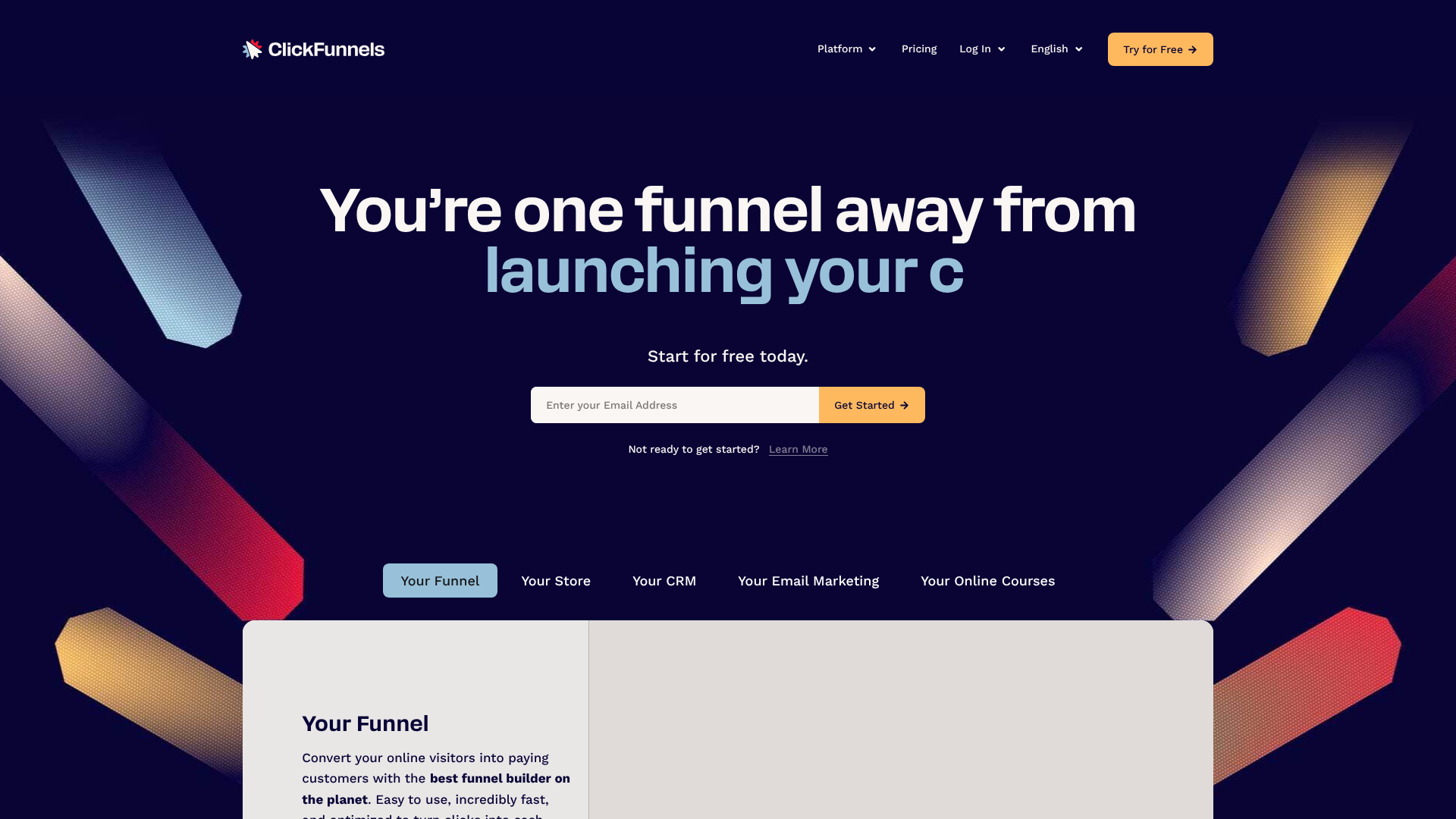
While the others focus on single landing pages, ClickFunnels is designed to build entire sales funnels. It allows you to create a series of pages that guide a visitor through the entire customer journey, from initial lead capture to purchase and even upsells. Each step in the funnel is a type of landing page optimised for a specific action.
ClickFunnels is ideal for businesses selling products, courses, or services online who need more than just a single page. It simplifies the process of creating complex conversion pathways, making it a powerful tool for direct-response marketing.
Pros:
- All-in-one solution for building complete sales funnels.
- Simple to create upsells, downsells, and order bumps.
- Strong focus on direct-response marketing principles.
Cons:
- Page editor is less flexible than Unbounce or Instapage.
- Can be more than what's needed if you only require simple landing pages.
Comparing Costs: What to Expect from Landing Page Builders
Pricing for landing page builders typically follows a tiered subscription model based on features and traffic volume. It's important to choose a plan that aligns with your needs for features like A/B testing, integrations, and the number of pages you can publish. Below is a general comparison to give you an idea of the investment.
| Platform | Ideal For | Starting Price (Approx.) | Key Feature |
|---|---|---|---|
| Leadpages | Small Businesses & Solopreneurs | ~$49/month | Ease of use & speed |
| Unbounce | Data-Driven Marketers | ~$99/month | AI-powered optimisation |
| Instapage | Enterprise & Ad Agencies | ~$299/month | Scalable personalisation |
| ClickFunnels | Online Entrepreneurs & Funnel Builders | ~$147/month | All-in-one funnel building |
Note: Pricing is subject to change. Please visit the official websites for the most current and detailed pricing information.
The Overall Pros and Cons of Prioritising Landing Page Experience
Investing time and resources into creating a great landing page experience is a strategic decision. Like any strategy, it comes with significant benefits and a few challenges to consider.
Advantages
- Higher Conversion Rates: This is the primary benefit. By removing friction and building trust, you make it easier for visitors to take your desired action, directly improving your campaign's ROI.
- Improved Ad Quality Score & Lower CPC: For paid search campaigns, Google rewards advertisers who provide a great user experience with higher Quality Scores, leading to lower advertising costs.
- Enhanced Brand Perception: A professional, fast, and easy-to-use landing page reflects well on your brand, building trust and credibility with potential customers from their very first interaction.
- Better Data and Insights: By testing different elements on your landing pages, you gain valuable insights into what headlines, offers, and messages resonate most with your audience. This data can inform your broader marketing strategy.
Potential Challenges
- Requires Time and Resources: Crafting a high-quality experience isn't instantaneous. It requires thoughtful planning, copywriting, design, and potentially investment in tools.
- Can Involve a Learning Curve: While landing page builders are designed to be user-friendly, there is still a learning curve involved in mastering their features and understanding optimisation principles.
- Ongoing Testing is Necessary: A landing page is never truly 'finished'. To achieve the best results, you must continuously test and iterate on your designs, which requires an ongoing commitment.
Frequently Asked Questions About Landing Page Experience Factors
Here are answers to some common questions marketers have about creating effective landing pages.
What are the elements of a good landing page?
A good landing page includes several key elements working in harmony: a compelling, benefit-driven headline that matches the ad, clear and concise copy, high-quality images or video, trust signals like testimonials or security badges, a simple lead capture form, and a single, prominent call-to-action (CTA) button.
What is a key characteristic of an effective landing page?
The single most important characteristic is focus. An effective landing page is laser-focused on one specific conversion goal. This singular purpose is reflected in its design (no navigation), its copy (centred on one offer), and its call-to-action (only one primary button).
How can you improve your landing page experience?
Start with an audit. Use a tool like Google PageSpeed Insights to check your loading time. Review your ad copy and landing page headline to ensure perfect message match. A/B test different elements, starting with your headline and CTA button.
Finally, ask a colleague or friend to navigate the page and provide feedback on any points of confusion or friction.
What are the three main types of landing pages?
The three most common types are:
- Lead Generation Pages: Also known as 'lead capture' pages, their goal is to collect user data, such as a name and email address, via a form. They typically offer something of value in return, like an ebook or a webinar. 2.
Click-Through Pages: These pages are designed to 'warm up' a visitor before sending them to another page to complete a transaction. They provide key details about a product or offer and have a CTA that usually says something like "Learn More" or "See Pricing," which then leads to a shopping cart or registration page. 3. Squeeze Pages: This is an aggressive form of a lead generation page.
It's extremely simple, with a bold headline, a very brief description of an offer, and a form, all designed to 'squeeze' an email address out of the visitor with minimal distraction.
What is the main goal of a landing page?
The main goal of any landing page is to facilitate a conversion. A 'conversion' is a specific, predefined action that you want the visitor to take. This could be anything from making a purchase or filling out a form to downloading a file or signing up for a free trial.
Final Thoughts: It's All About the User
Ultimately, all the attributes that describe a good landing page experience boil down to a single, guiding principle: focus on the user. A page that is clear, fast, trustworthy, and directly relevant to the user's needs will always outperform one that is not.
By systematically implementing and testing these core traits, you move beyond simply building web pages and start engineering conversion-focused experiences. This strategic shift is what separates struggling campaigns from highly profitable ones. It's a direct investment in your marketing effectiveness and a clear path to achieving a better return on your efforts.
If you're ready to build high-converting pages without the technical headache, tools like Leadpages and Unbounce are excellent starting points. For those building complete sales funnels, ClickFunnels provides a powerful, all-in-one solution to guide customers through every step of the journey.