


7 Best AI Writing Tools for Marketers & Authors (2026 Rankings)
Finding the best AI writing tools can feel overwhelming with new options appearing almost daily. These platforms promise to speed up content creation, break through writer's block, and even optimise your work for search engines. But which ones actually deliver on that promise? This guide cuts through the noise to give you a clear, tested breakdown of the top AI writing software available today, helping you choose the right assistant for your specific goals, whether you're scaling a marketing blog or crafting your next novel.
- Quick Summary
- What Exactly is AI Writing Software?
- Key Features to Look For in the Best Writing Tools AI Offers
- Content Generation Quality
- Customisation and Tone Control
- SEO Optimisation Features
- Plagiarism Checker
- Integrations and Workflow
- How to Choose the Right AI Writing Tool for Your Needs
- For Marketers and SEO Specialists
- For Authors and Creative Writers
- For Students and Academics
- For Business Professionals and Teams
- The 7 Best AI Writing Tools in 2026 (Tested & Ranked)
- 1. Jasper (formerly Jarvis): Best for Marketing Teams & Content Scalability
- 2. Writesonic: Best All-Rounder for Versatility and Factual Content
- 3. Grammarly: Best for Editing and Polishing Your Writing
- 4. QuillBot: Best for Paraphrasing and Academic Writing
- 5. Surfer SEO: Best for SEO-Optimised Content
- 6. Sudowrite: Best for Fiction and Creative Storytelling
- 7. Claude 3.5 Sonnet: Best for Natural, Human-Like Prose
- AI Writing Tools: Pricing and Cost Comparison
- The Pros and Cons of Using AI Writing Software
- Frequently Asked Questions (FAQ)
- Which AI writing tool is the best?
- Can I legally publish a book written by AI?
- Which AI is better than ChatGPT?
- Is ChatGPT the best AI for writers?
- What is the best AI right now for creative writing?
- Can Amazon tell if a book was written by AI?
- Final Thoughts: Integrating AI as a Partner, Not a Replacement
Quick Summary
- Best for Marketing Teams: Jasper (formerly Jarvis) excels at creating brand-consistent marketing copy at scale with its advanced Brand Voice and Campaign features.
- Best All-Rounder: Writesonic offers a versatile suite of tools, from factual article generation with live web data to AI image creation, making it a great multi-purpose choice.
- Best for Editing & Polish: Grammarly is the industry standard for improving clarity, tone, and correctness, acting as an essential final check for any writer.
- Best for Paraphrasing: QuillBot provides a powerful paraphrasing engine that is ideal for academics, students, and anyone needing to rephrase content while maintaining its original meaning.
- Best for SEO Content: Surfer SEO is unmatched for creating content briefs and optimising articles to rank on Google, focusing on data-driven recommendations.
What Exactly is AI Writing Software?
AI writing software uses artificial intelligence, specifically large language models (LLMs), to understand, generate, and modify human text. Think of it as a highly advanced assistant that has been trained on a massive dataset of books, articles, and websites. This training allows it to recognise patterns, grammar, styles, and context, enabling it to produce original content based on the prompts you provide.
Unlike a simple spell checker or grammar tool that identifies basic errors, AI writing software can perform much more complex tasks. It can draft entire blog posts, write email subject lines, brainstorm ideas, summarise long documents, and even change the tone of your writing from formal to casual with a single click. These tools analyse your input and predict the most logical sequence of words to follow, creating coherent and often high-quality text.
There are generally two types of tools in this category. Generative AI tools, like Jasper or Writesonic, create new content from scratch based on your instructions. AI-assisted writing tools, like Grammarly, focus more on enhancing and refining text that you have already written. Many of the best platforms today combine both capabilities, offering a complete solution for the entire writing process.
Key Features to Look For in the Best Writing Tools AI Offers


When evaluating different AI writing platforms, certain features stand out as essential for a productive and effective experience. Understanding these will help you distinguish between a basic tool and a truly powerful writing partner. The best writing tools AI has developed focus on both creation and refinement.
Content Generation Quality
The core function of any AI writer is its ability to generate text. Look for tools that produce natural, coherent, and contextually relevant content. The best platforms allow you to specify output quality, often using advanced models like GPT-4, and provide options for different types of content, from long-form articles to social media captions.
Customisation and Tone Control
A generic AI voice won't work for every brand or project. Top AI writing apps allow you to define a specific tone of voice (e.g., professional, witty, empathetic) or even create a custom 'Brand Voice' by uploading your existing content. This ensures all generated text aligns with your unique style guide.
SEO Optimisation Features
For marketers and content creators, SEO is non-negotiable. Some AI tools integrate directly with SEO data platforms or have built-in features to help you write content that ranks. This can include keyword suggestions, content brief generation, and real-time optimisation scores based on top-ranking competitors.
Plagiarism Checker
To maintain credibility and avoid SEO penalties, your content must be original. A built-in plagiarism checker is a crucial feature that scans the generated text against existing content on the web. This gives you peace of mind that the AI-produced content is unique before you publish it.
Integrations and Workflow
The most effective tools fit into your existing workflow. Look for integrations with platforms you already use, such as WordPress, Google Docs, or browser extensions. A smooth workflow saves significant time by eliminating the need to constantly copy and paste between applications.
How to Choose the Right AI Writing Tool for Your Needs
The 'best' tool is subjective and depends entirely on your primary use case. A novelist has very different needs from a marketing manager. Here’s how to narrow down your options based on your profession and goals.
For Marketers and SEO Specialists
If your job involves creating blog posts, ad copy, and social media updates, you need a tool built for speed, scale, and optimisation. Prioritise platforms with strong SEO features, brand voice customisation, and templates for various marketing formats. Tools like Jasper and Surfer SEO are designed specifically for this audience, helping you create high-ranking content efficiently.
For Authors and Creative Writers
Creative writing requires a different kind of AI—one that can help with brainstorming, character development, and descriptive language without sounding robotic. Look for tools designed for fiction, with features like plot generators, character prompts, and style emulation. Sudowrite is the clear leader in this niche, acting as a creative partner rather than just a content generator.
For Students and Academics
Academic writing demands precision, proper citation, and clarity. The best AI writing software for students will include a powerful paraphraser, a summariser for research papers, and a citation generator. QuillBot is a popular choice in this category, helping students articulate their ideas correctly and avoid accidental plagiarism.
For Business Professionals and Teams
For general business communication, such as writing emails, reports, and presentations, you need a tool that focuses on clarity, professionalism, and correctness. A platform like Grammarly is invaluable. It not only corrects mistakes but also suggests improvements in tone and conciseness, ensuring your professional communications are always polished.
The 7 Best AI Writing Tools in 2026 (Tested & Ranked)
After extensive testing and comparison, here are the top AI writing tools that stand out for their features, quality of output, and specific use cases. Each one serves a different primary purpose, ensuring there's a perfect fit for every type of writer.
1. Jasper (formerly Jarvis): Best for Marketing Teams & Content Scalability
Jasper has established itself as a premium tool for marketing and content teams that need to produce high-quality content at scale. Its standout feature is 'Brand Voice', which allows you to train the AI on your website, style guides, and product catalogues to ensure every piece of content it generates is perfectly on-brand.
The platform's 'Campaigns' feature is also a major benefit for marketers. You can create a full suite of assets for a marketing campaign from a single brief, generating everything from blog posts and email sequences to social media ads and press releases. This cohesive approach saves hours of work and ensures messaging consistency across all channels.
While it sits at a higher price point, the investment is often justified for businesses that rely on a steady stream of content to drive growth. Its user interface is clean and intuitive, making it easy for entire teams to collaborate on projects.
Pros
- Excellent brand voice feature ensures content consistency.
- Powerful campaign workflows for creating multiple marketing assets at once.
- High-quality output suitable for professional use.
- Strong integration with other marketing tools like Surfer SEO.
Cons
- Can be more expensive than other options on the market.
- May have a steeper learning curve to use all advanced features effectively.
If your focus is on scaling your marketing efforts with consistently on-brand content, Jasper is a powerful and reliable choice.
2. Writesonic: Best All-Rounder for Versatility and Factual Content
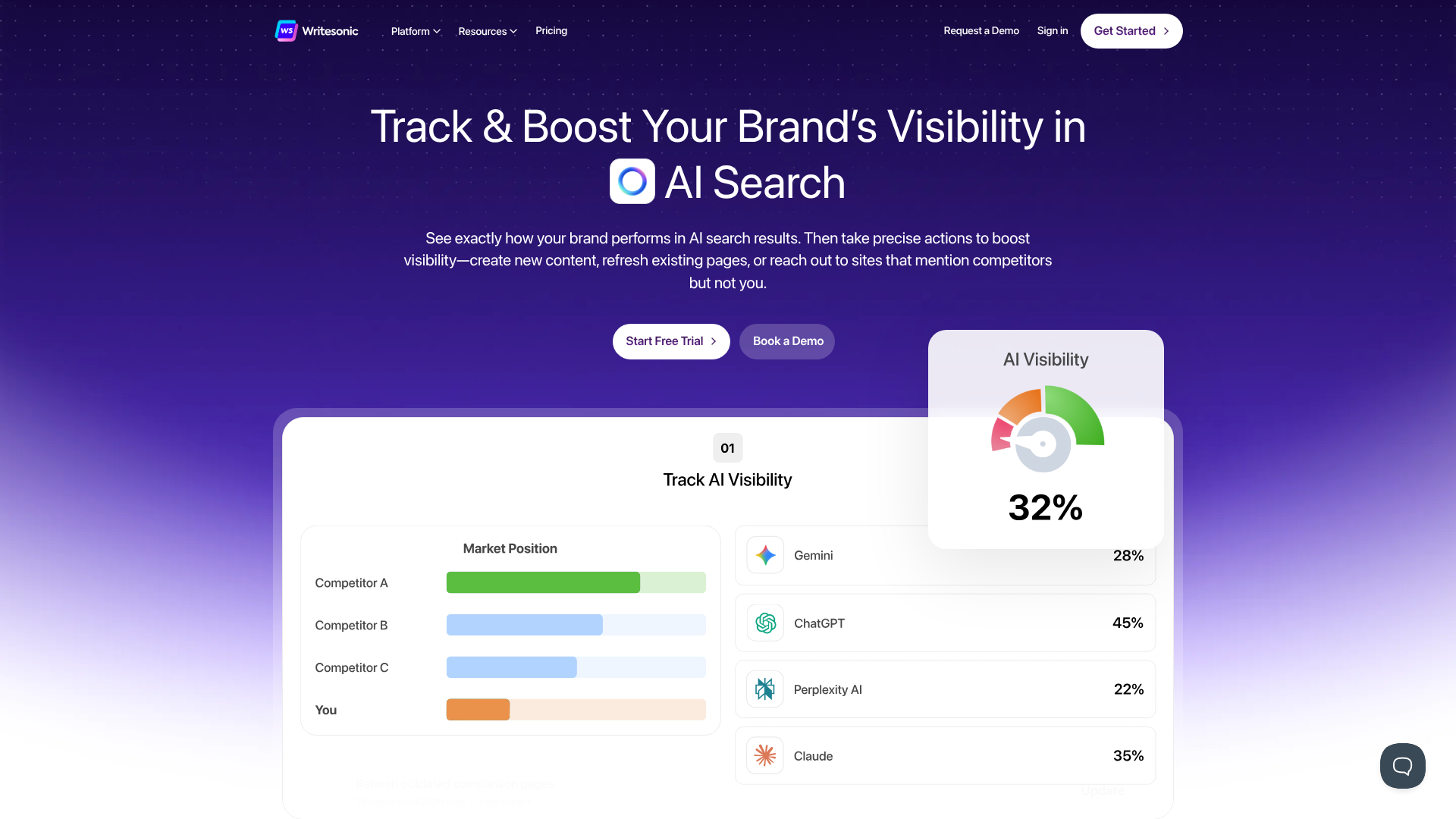
Writesonic is a powerful and versatile AI writer that caters to a wide range of users, from bloggers to e-commerce businesses. One of its key differentiators is its ability to integrate with Google Search, allowing it to write factual, up-to-date articles on current events or niche topics. This feature, called 'Factual & Up-to-date Content', helps overcome the common AI problem of generating outdated or incorrect information.
Beyond text, Writesonic has expanded into a full content creation suite. It includes Photosonic for generating AI images and Audiosonic for creating voiceovers, making it a one-stop shop for multimedia content. With over 100 templates for everything from landing pages to Quora answers, it provides a solid starting point for almost any writing task.
Its flexible pricing, including a generous free trial, makes it accessible for individuals and small businesses looking for a powerful tool without the enterprise-level price tag of competitors like Jasper.
Pros
- Generates factual content with real-time web data.
- Includes AI image and audio generation tools.
- Offers a wide variety of templates for specific use cases.
- More affordable pricing plans compared to some competitors.
Cons
- The user interface can feel slightly cluttered with so many features.
- Long-form content may sometimes require more editing for flow.
For those who need a flexible tool that handles both factual writing and multimedia creation, Writesonic offers exceptional value.
3. Grammarly: Best for Editing and Polishing Your Writing
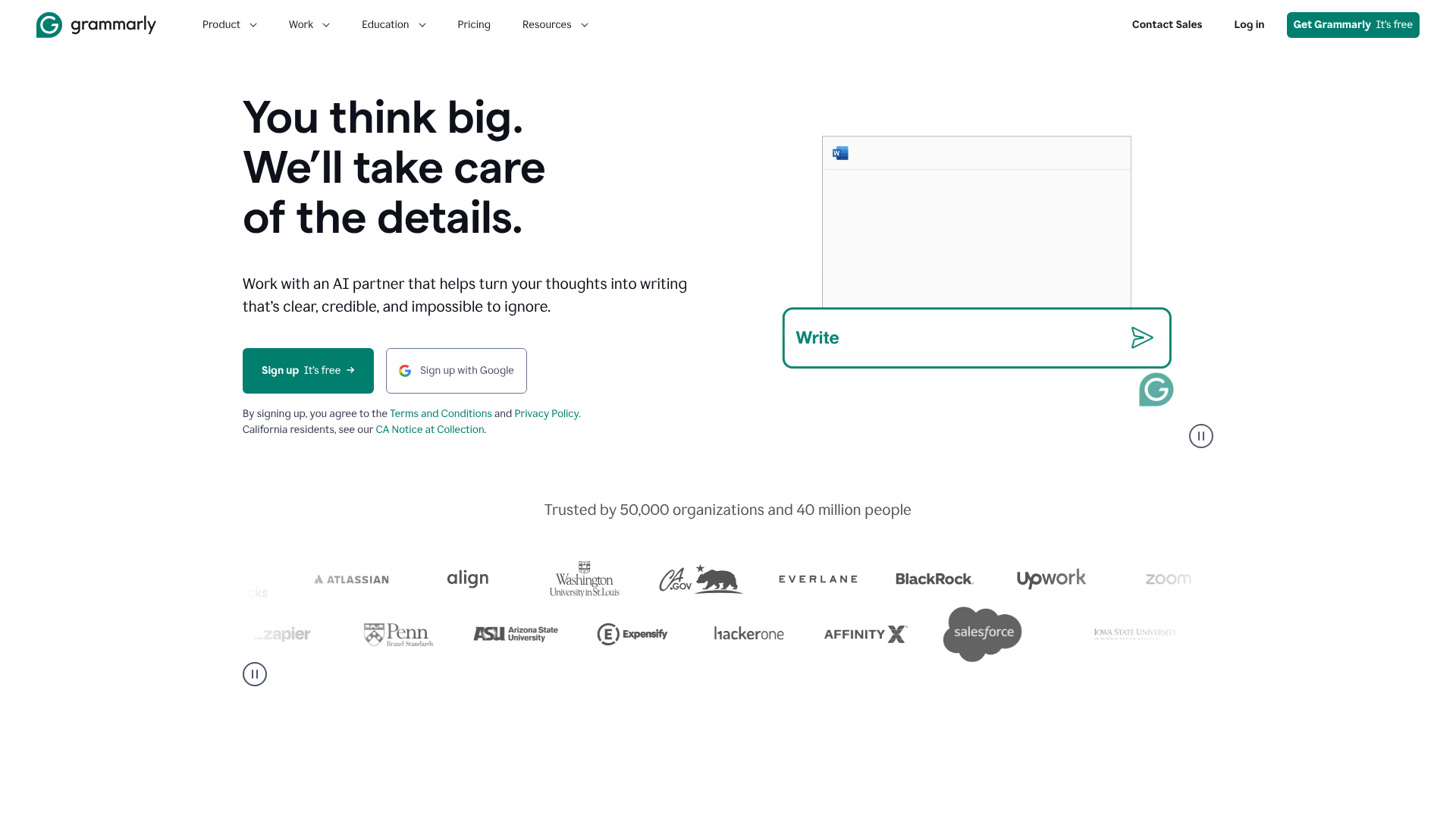
While many tools focus on generating content from scratch, Grammarly shines as an AI-powered writing assistant that improves what you've already written. It goes far beyond basic spell checking, offering suggestions on clarity, engagement, tone, and delivery. It's an indispensable tool for ensuring every piece of writing is professional and error-free.
With the introduction of GrammarlyGO, it now also offers generative AI capabilities. You can use it to compose, ideate, and reply within the apps you already use, like Gmail and Google Docs. However, its core strength remains in its sophisticated editing engine. It helps you rephrase awkward sentences, suggests more impactful vocabulary, and ensures your tone is appropriate for your audience.
The plagiarism checker is also among the best available, making it a trusted tool for students, academics, and professional writers who need to guarantee the originality of their work.
Pros
- Industry-leading grammar, spelling, and punctuation correction.
- Advanced suggestions for tone, clarity, and style.
- Seamless integration with browsers, Microsoft Office, and Google Docs.
- Reliable plagiarism checker.
Cons
- Generative AI features are less advanced than dedicated writers like Jasper.
- The free version is limited, and some suggestions can be overly prescriptive.
Every writer, regardless of skill level, can benefit from the safety net that Grammarly provides.
4. QuillBot: Best for Paraphrasing and Academic Writing
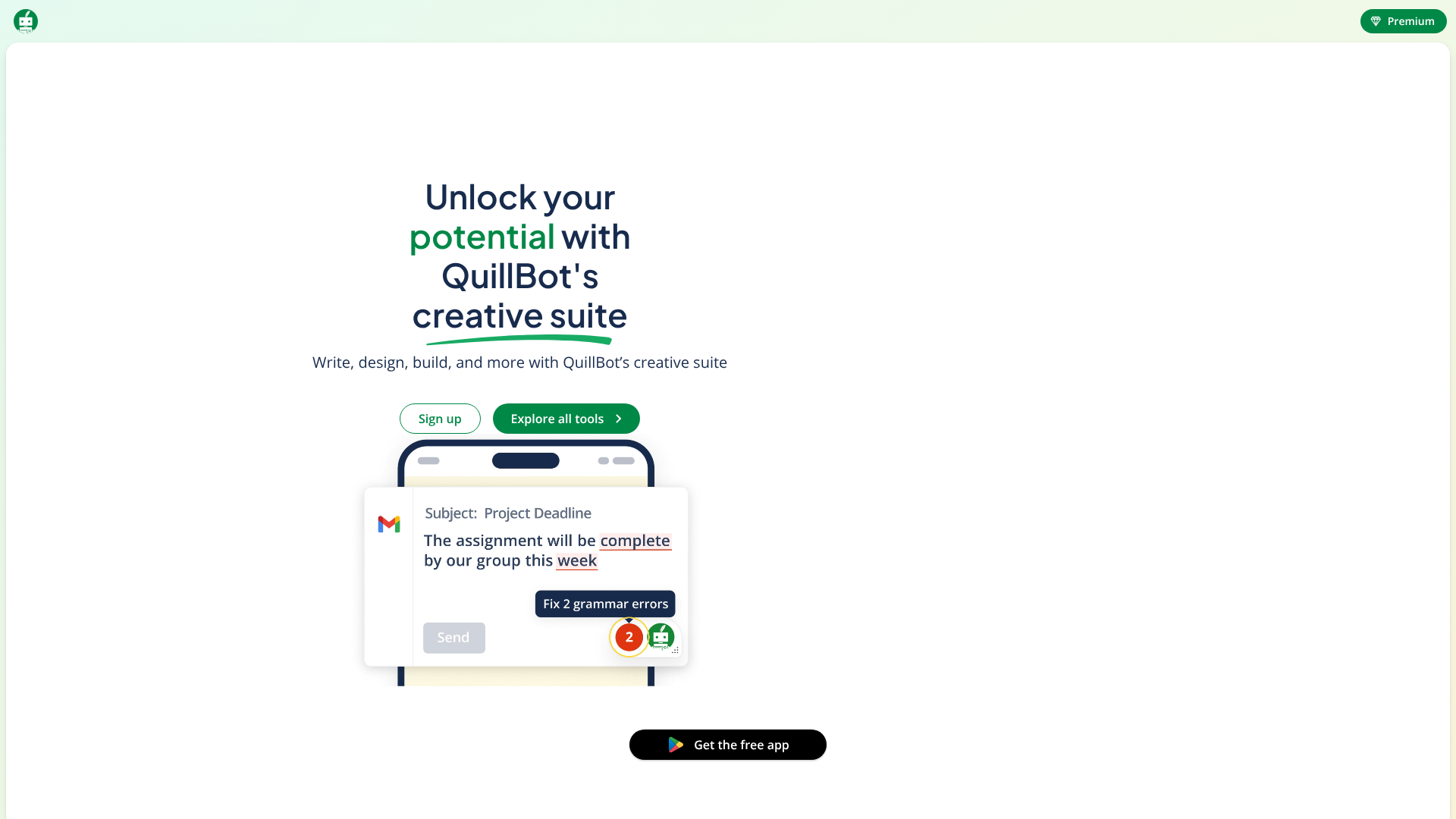
QuillBot has carved out a niche as the go-to tool for paraphrasing and summarising text. It's particularly popular among students and researchers who need to articulate complex ideas from source material in their own words. Its paraphrasing tool offers multiple modes, such as 'Standard', 'Fluency', and 'Creative', allowing you to control the degree of change in the rewritten text.
In addition to its paraphraser, QuillBot offers a suite of other useful tools. The Summarizer can condense long articles or papers into key points, while the Citation Generator helps create accurate citations in various formats (APA, MLA, Chicago). This makes it an all-in-one academic writing assistant.
While it can generate sentences, its primary function is not long-form content creation. Instead, it excels at refining and restructuring existing text, making it a perfect companion for the research and drafting phases of writing.
Pros
- Best-in-class paraphrasing tool with multiple modes.
- Excellent for academic use with summariser and citation generator.
- User-friendly interface and affordable pricing.
- Integrates with Chrome and Microsoft Word.
Cons
- Not designed for generating long-form content from scratch.
- Over-reliance on the paraphraser can lead to a loss of the original nuance.
If you frequently work with source material and need to rephrase it accurately, QuillBot is an essential tool for your arsenal.
5. Surfer SEO: Best for SEO-Optimised Content
Surfer SEO is less of an AI writer and more of an AI-powered content optimisation platform. It analyses the top-ranking pages for your target keyword and generates a detailed content brief. This brief includes recommended word count, keywords to use, and structural suggestions to help you create an article that is built to rank.
Its Content Editor provides a real-time optimisation score as you write, grading your content against hundreds of on-page SEO factors. While it has its own AI writer (Surfer AI) to generate articles based on its briefs, its primary value comes from its deep analytical power. Many content teams use Surfer to create the brief and then use another AI writer like Jasper or Writesonic to write the draft, before bringing it back into Surfer for final optimisation.
It's a data-driven tool for serious content marketers who understand that writing is only half the battle; optimisation is what gets you seen.
Pros
- Provides data-backed briefs for creating high-ranking content.
- Real-time content score helps guide the writing process.
- Excellent for competitive analysis and identifying content gaps.
- Integrates with Jasper, Google Docs, and WordPress.
Cons
- Primarily an SEO tool, not a general-purpose writer.
- Can be expensive for individuals or small teams.
6. Sudowrite: Best for Fiction and Creative Storytelling
Sudowrite is a magical tool designed specifically for fiction writers. It doesn't write your book for you; instead, it acts as a creative brainstorming partner. If you're stuck on a description, its 'Describe' feature can generate sensory details based on a simple prompt. If you need to expand a scene, the 'Expand' feature can add more depth and action.
One of its most beloved features is 'Story Bible', which allows you to store all your character sheets, plot points, and world-building lore in one place. The AI can then reference this information to maintain consistency throughout your manuscript. Sudowrite helps authors overcome writer's block by offering suggestions and alternative phrasings, all while adapting to their unique writing style.
It's not meant for writing blog posts or marketing copy. It is a specialised instrument for novelists and short story writers looking to enhance their creative process.
Pros
- Features are tailored specifically for creative and fiction writing.
- Excellent for brainstorming, description, and expanding scenes.
- 'Story Bible' feature helps maintain story consistency.
- Adapts to your writing style over time.
Cons
- Not suitable for non-fiction or marketing content.
- Can sometimes generate suggestions that don't fit the plot.
7. Claude 3.5 Sonnet: Best for Natural, Human-Like Prose
Developed by Anthropic, Claude has gained a reputation for producing some of the most natural and nuanced prose of any AI model. Users often report that its output sounds less 'robotic' and more thoughtful compared to other general-purpose models. It excels at tasks that require a deep understanding of context and a sophisticated writing style.
Claude's large context window (200K tokens) is a significant advantage, allowing it to process and recall information from very long documents. This makes it ideal for summarising research papers, analysing contracts, or maintaining context over a long, complex conversation. It's a powerful tool for professionals who need an AI that can handle dense information.
While it doesn't have the specialised templates of a tool like Jasper, its raw writing ability makes it a top contender for anyone who prioritises the quality and readability of the generated text above all else.
Pros
- Generates exceptionally natural and human-like text.
- Large context window is great for working with long documents.
- Strong analytical and summarisation capabilities.
- Generally considered safer and less prone to generating harmful content.
Cons
- Lacks the marketing-specific features and templates of other tools.
- The user interface is more basic compared to dedicated writing platforms.
AI Writing Tools: Pricing and Cost Comparison
Understanding the cost is crucial before committing to a tool. Pricing structures vary widely, from free plans with limited features to expensive enterprise subscriptions. Here’s a quick comparison of the tools we've discussed.
| Tool | Best For | Free Plan | Starting Price (per month) | Key Feature |
|---|---|---|---|---|
| Jasper | Marketing Teams | 7-day free trial | Visit site for current pricing | Brand Voice & Campaigns |
| Writesonic | All-Round Versatility | Yes (limited words/month) | Visit site for current pricing | Factual Content Generation |
| Grammarly | Editing & Polish | Yes (core corrections) | Visit site for current pricing | Advanced Tone & Style Suggestions |
| QuillBot | Paraphrasing & Academic | Yes (limited features) | Visit site for current pricing | Multi-mode Paraphraser |
| Surfer SEO | SEO Optimisation | No | Visit site for current pricing | Data-driven Content Briefs |
| Sudowrite | Creative Writing | Free trial | Visit site for current pricing | Story-focused Writing Tools |
| Claude | Natural Prose | Yes (with usage limits) | Visit site for current pricing | Large Context Window |
Pro Tip: Many tools offer significant discounts for annual billing. If you find a tool you love and plan to use it long-term, paying annually can save you up to 20-30%.
The Pros and Cons of Using AI Writing Software
While these tools offer incredible benefits, it's important to approach them with a balanced perspective. They are powerful assistants, but they also have limitations that require human oversight.
The Advantages
- Increased Speed and Efficiency: The most obvious benefit is the ability to produce content much faster than writing manually. This allows content teams to scale their output significantly.
- Overcoming Writer's Block: When you're staring at a blank page, AI can provide a starting point, an outline, or a few initial paragraphs to get your creative momentum going.
- Idea Generation: AI tools are excellent for brainstorming. You can ask for blog post ideas, headline variations, or different angles on a topic to spark your creativity.
- Improved SEO: Specialised tools can help you create content that is optimised for search engines from the ground up, increasing your chances of ranking for target keywords.
The Disadvantages & Limitations
- Factual Inaccuracies: AI models can 'hallucinate' or generate information that sounds plausible but is completely false. Always fact-check any claims, statistics, or data produced by an AI.
- Lack of Originality and Emotion: AI learns from existing data, so it can struggle to produce truly original ideas or convey deep human emotion. The output can sometimes feel generic or soulless without a human touch.
- The 'AI Voice': Over-reliance on AI can lead to content that has a distinct, slightly robotic feel. Human editing is essential to inject personality and a unique voice into the text.
- Requires Skilled Prompting: The quality of the output is directly related to the quality of your input. Learning how to write effective prompts is a skill in itself.
Frequently Asked Questions (FAQ)
Which AI writing tool is the best?
There is no single 'best' tool; it depends entirely on your needs. For marketing teams, Jasper is often the top choice. For creative writers, Sudowrite is unparalleled. For general-purpose, factual writing, Writesonic offers great versatility. And for editing, Grammarly is essential for everyone.
Can I legally publish a book written by AI?
Copyright law around AI-generated content is still evolving. In the United States, the Copyright Office has stated that works created solely by AI without human authorship are not eligible for copyright protection. However, if a human author has significantly modified, arranged, or selected the AI-generated content, the work may be copyrightable. It's crucial to be transparent about the use of AI and understand that you may not hold exclusive rights to purely AI-generated text.
Which AI is better than ChatGPT?
'Better' depends on the task. For producing natural, nuanced prose and handling long documents, many users find Claude 3.5 Sonnet superior. For specialised tasks like SEO content, Surfer SEO is better. For fiction, Sudowrite is better. ChatGPT is an excellent generalist, but specialised tools often outperform it in their specific domains.
Is ChatGPT the best AI for writers?
ChatGPT is a fantastic and versatile tool for brainstorming, outlining, and drafting. However, it lacks the specialised features of dedicated writing platforms. It doesn't have the brand voice controls of Jasper, the SEO analytics of Surfer, or the creative writing prompts of Sudowrite. It's a powerful starting point, but professional writers often use it in combination with other, more specialised tools.
What is the best AI right now for creative writing?
Sudowrite is widely considered the best AI tool for creative writing. It's built from the ground up to assist fiction authors with brainstorming, descriptive writing, and plot development. Its features are designed to augment a writer's creativity, not replace it, making it a favourite in the author community.
Can Amazon tell if a book was written by AI?
Amazon's policies require authors to disclose the use of AI in their work. While AI detection tools exist, they are not always accurate and can produce false positives. However, readers can often spot low-quality, unedited AI content, which can lead to poor reviews and damage an author's reputation. The best practice is to use AI as a tool and heavily edit the output to ensure it meets human quality standards.
Final Thoughts: Integrating AI as a Partner, Not a Replacement
The rise of top AI writing apps has fundamentally changed the content creation landscape. These tools are not here to replace human writers but to augment their abilities, making them faster, more efficient, and more creative. The key is to view them as a collaborator—an assistant that can handle the heavy lifting of drafting and research, freeing you up to focus on strategy, originality, and adding that essential human touch.
By understanding your own needs and the specific strengths of each platform, you can choose a tool that seamlessly integrates into your workflow. Whether you're optimising a blog post with Surfer, polishing an email with Grammarly, or brainstorming a novel with Sudowrite, the right AI partner can elevate your writing to new heights.
If you're ready to start exploring, consider your primary goal. For scaling marketing content with a consistent voice, Jasper is a leading choice. For a versatile, all-in-one platform that handles factual articles and more, Writesonic provides incredible value. And to ensure every word you write is perfect, Grammarly remains an indispensable part of any writer's toolkit.