


Attributes of Effective Landing Pages: A Marketer's Guide for 2026
A visitor clicks your ad, intrigued by your offer. They land on your page, and within seconds, they decide whether to stay or leave. That split-second decision is dictated by the landing page experience. Understanding which attributes describe a good landing page experience is not just about aesthetics; it's the science behind turning clicks into customers.
- What You'll Learn
- What Defines a Good Landing Page Experience?
- The Core Attributes of Effective Landing Pages
- 1. Flawless Clarity and Message Match
- 2. A Compelling Headline and Persuasive Copy
- 3. A Singular, Focused Call-to-Action (CTA)
- 4. Lightning-Fast Page Speed
- 5. Flawless Mobile-First Responsiveness
- 6. Powerful Trust and Credibility Signals
- How to Build a High-Converting Landing Page with the Right Tools
- Comparing Landing Page Builders: Features & Pricing
- The Pros and Cons of Focusing on Landing Page Experience
- Frequently Asked Questions (FAQ)
- What are the core elements of a good landing page?
- What makes a landing page successful?
- What are the three main types of landing pages?
- What is landing page experience in Google Ads?
- Final Thoughts
It’s the difference between a campaign that thrives and one that merely survives.
An effective landing page acts as your best digital salesperson. It’s focused, persuasive, and makes it incredibly easy for a visitor to say "yes". It removes friction, answers questions before they're asked, and guides the user seamlessly towards a single, specific goal. Without these foundational elements, even the most brilliant ad campaign will fall flat, wasting your budget and leaving potential revenue on the table.
This guide breaks down the essential landing page experience factors you need to master. We'll move beyond vague advice and give you a clear framework for creating pages that not only look great but, more importantly, convert. From the psychology of a compelling headline to the technical details of page speed, you'll learn how to build an experience that respects your visitor's time and delivers on your promises.
What You'll Learn
- Message Match is Paramount: The most critical attribute is ensuring your landing page content perfectly matches the ad or link the visitor clicked. This consistency builds immediate trust and reduces bounce rates.
- Speed and Mobile Design are Non-Negotiable: A slow or poorly designed mobile page is a conversion killer. Your page must load in under three seconds and offer a flawless experience on any device.
- A Single, Clear CTA Wins: Every effective landing page is built around one primary goal, represented by a clear, compelling call-to-action (CTA). Multiple offers create confusion and dilute results.
- Trust Signals Build Confidence: Elements like testimonials, security badges, and clear contact information are essential for overcoming visitor scepticism and encouraging them to convert.
What Defines a Good Landing Page Experience?
A good landing page experience is a seamless and focused journey that guides a visitor from a point of interest (like an ad or a search result) to a point of action (a conversion) with minimal friction. Think of it as a digital handshake and a direct conversation. The visitor arrives with a specific expectation, and a great landing page immediately confirms they're in the right place and shows them the next step.
This experience is defined by clarity, relevance, and efficiency. When a user lands, they shouldn't have to think. The value proposition should be instantly obvious, the copy should speak directly to their needs, and the path to conversion should be brightly lit. It’s the opposite of a typical website homepage, which often presents dozens of options and navigation paths.
A landing page removes all distractions to focus on a single objective.
Conversely, a poor landing page experience is jarring and confusing. It’s characterised by a disconnect between the ad and the page content, slow loading times, a cluttered design, and multiple competing calls-to-action. This creates cognitive dissonance, frustrates the user, and almost always results in a quick click of the 'back' button. In essence, a good experience delivers on a promise, while a bad one breaks it.
The Core Attributes of Effective Landing Pages


To truly understand what makes a landing page work, you need to break it down into its core components. These are the non-negotiable good landing page traits that form the foundation of any high-converting page. Mastering each of these will dramatically improve your campaign performance.
1. Flawless Clarity and Message Match
Message match is the principle of keeping your messaging consistent from the ad creative to the landing page headline. If a user clicks an ad for a "50% Discount on Blue Running Shoes," the landing page headline must echo that exact offer. This immediate confirmation tells the user they are in the right place, fulfilling the expectation set by the ad.
This alignment is crucial for building trust within the first few seconds. When the message doesn't match, it creates confusion and suspicion, causing visitors to bounce. A strong message match lowers your bounce rate, increases time on page, and signals to ad platforms like Google that your page is highly relevant, which can improve your Quality Score and lower your ad costs.
To achieve this, meticulously align your ad copy, keywords, and landing page headlines. Every campaign or ad group should ideally have its own dedicated landing page with tailored messaging. This ensures every visitor, regardless of the ad they clicked, receives a perfectly consistent and relevant experience.
2. A Compelling Headline and Persuasive Copy
Your headline is the first thing a visitor reads and arguably the most important element on the page. It has about three to five seconds to grab their attention and convince them to keep reading. A great headline clearly communicates the primary benefit of your offer and connects with the visitor's pain point.
Beyond the headline, your body copy must be persuasive, concise, and easy to scan. Use short paragraphs, bullet points, and bold text to highlight key benefits. Focus on what the user will get or achieve with your offer, not just a dry list of features. The goal is to lead the visitor from the headline's promise to the call-to-action's solution.
Great copy uses the voice of the customer. It reflects their language, understands their problems, and presents your offer as the ideal solution. Tools like Surfer SEO can help you analyse top-ranking content to understand what language and topics resonate most with your target audience, ensuring your copy is both persuasive and SEO-friendly.
3. A Singular, Focused Call-to-Action (CTA)
One of the most common mistakes in landing page design is offering too many choices. A successful landing page has one goal, and therefore, one primary call-to-action (CTA). Whether it's "Download the eBook," "Start Your Free Trial," or "Get a Quote," the entire page should be designed to funnel the visitor towards that single action.
Your CTA button should be visually prominent. Use a contrasting colour that makes it stand out from the rest of the page. The button copy should be action-oriented and clear, telling the user exactly what will happen when they click it (e.g., "Get My Free Guide" is better than "Submit").
Removing all other distractions, including the main website navigation menu, is a common best practice. This creates a closed loop, leaving the visitor with only two options: convert or leave. This singular focus dramatically increases the likelihood of them taking the desired action.
4. Lightning-Fast Page Speed
In today's fast-paced digital world, patience is in short supply. Page speed is a critical landing page experience factor. According to data from Google, 53% of mobile visitors will abandon a page if it takes longer than three seconds to load. Every second of delay directly translates into lost conversions.
Fast loading times are essential not only for user experience but also for your search engine rankings and ad performance. Google's Core Web Vitals are a set of metrics that measure real-world user experience for loading performance, interactivity, and visual stability. A page that performs well on these metrics is more likely to rank higher and achieve a better Quality Score in Google Ads.
To improve your page speed, optimise your images by compressing them, use a content delivery network (CDN), minimise code, and choose a reliable hosting provider. Using a dedicated landing page builder often takes care of these technical optimisations for you, ensuring your pages are built for speed from the ground up.
5. Flawless Mobile-First Responsiveness
With the majority of web traffic now coming from mobile devices, your landing page must provide an exceptional experience on a small screen. This goes beyond simply shrinking your desktop site. A true mobile-first design considers the user's context and behaviour on a phone.
This means large, easily tappable buttons, simple forms that are easy to fill out with a thumb, and font sizes that are readable without pinching to zoom. The most important information and the CTA should be visible "above the fold" without requiring the user to scroll extensively. The layout should be single-column and uncluttered.
Testing your page on various devices is crucial. What looks good on a new iPhone might be unusable on an older Android model. Tools like Leadpages and Unbounce offer built-in mobile previews, allowing you to design and optimise the mobile version of your page separately to ensure a perfect experience for every visitor.
6. Powerful Trust and Credibility Signals
When a visitor lands on your page for the first time, they are naturally sceptical. You need to earn their trust before they'll hand over their email address or credit card information. Trust signals are elements that build credibility and reduce perceived risk.
Social proof is one of the most powerful trust signals. This includes customer testimonials, star ratings, reviews, case studies, and logos of well-known clients you've worked with. Seeing that others have had a positive experience with your brand provides powerful validation.
Other important trust signals include security badges (like SSL certificates), clear privacy policy links, and easily accessible contact information. These elements show that you are a legitimate and trustworthy business that values its customers' security and privacy.
How to Build a High-Converting Landing Page with the Right Tools
Knowing the attributes of a good landing page is one thing; implementing them effectively is another. While you could code a page from scratch, dedicated landing page builders have become the go-to solution for marketers. They provide the framework, templates, and optimisation tools needed to launch high-performing campaigns quickly.
These platforms are designed specifically for conversion. They offer drag-and-drop editors, pre-built templates that are already optimised for mobile and speed, and integrated features like A/B testing and analytics. This allows you to focus on your messaging and offer, rather than getting bogged down in technical details.
Choosing the right tool depends on your budget, technical skill, and the complexity of your campaigns. A good builder should make it easy to implement all the core attributes we've discussed, from creating a clear message match to adding trust signals and ensuring lightning-fast performance.
Top Landing Page Builder Recommendations for 2026
Here are a few of the top platforms that excel at helping you create effective landing page experiences.
1. Leadpages
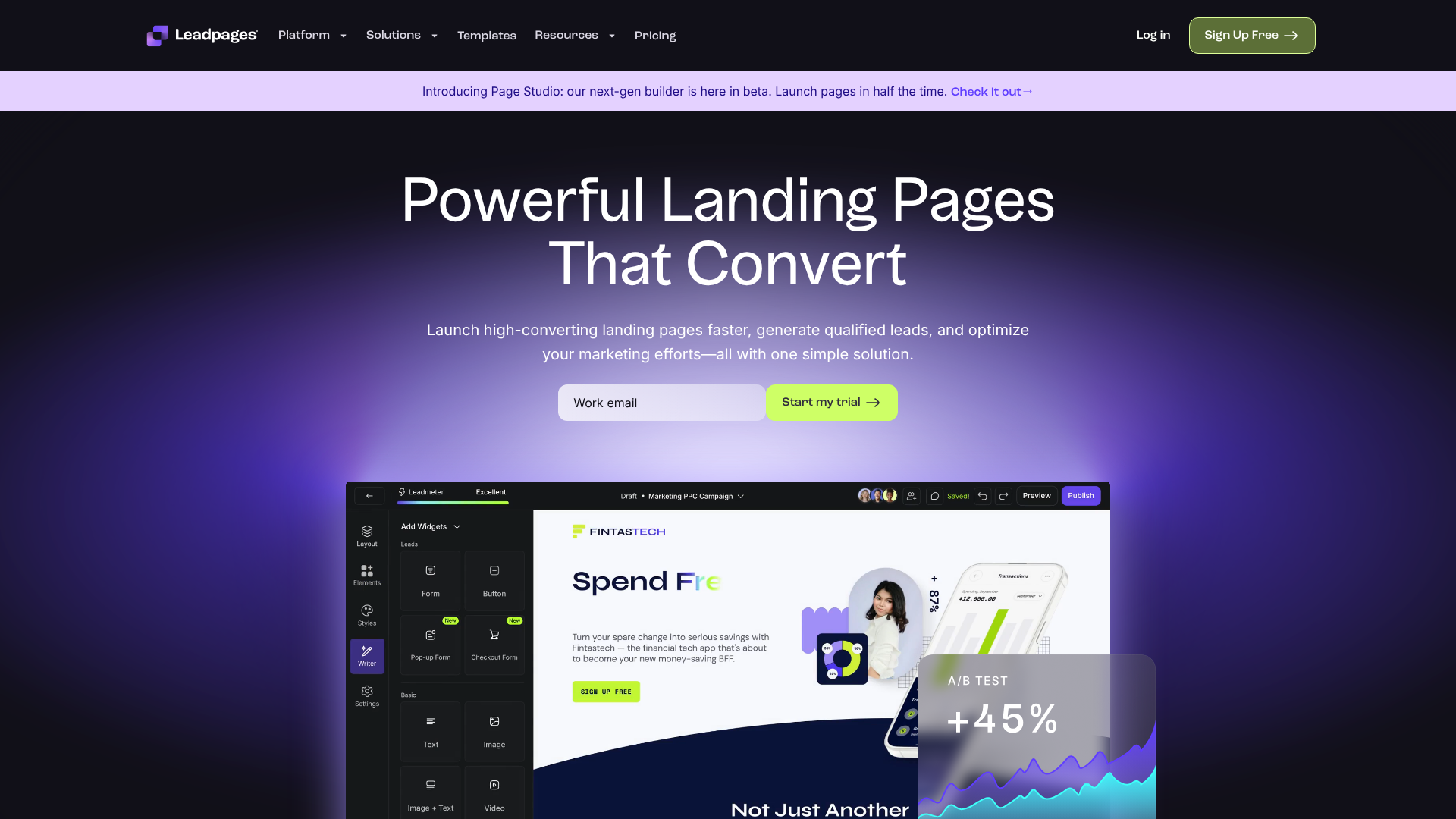
Leadpages is an excellent choice for small businesses, entrepreneurs, and marketers who need to create high-converting landing pages without a steep learning curve. Its primary strengths are its ease of use and affordability. The platform offers a vast library of mobile-responsive templates that you can customise with a user-friendly drag-and-drop editor.
It also includes features like pop-ups and alert bars to help you capture leads across your entire website. Leadpages is built for speed, with industry-leading load times that help maximise your conversions. It's a fantastic all-in-one solution for anyone who values speed of implementation and straightforward functionality.
Pros
- Extremely user-friendly and intuitive, perfect for beginners.
- Large selection of professionally designed, mobile-responsive templates.
- Very affordable pricing plans compared to competitors.
- Excellent page load speeds.
Cons
- The drag-and-drop editor can feel slightly less flexible than some competitors.
- A/B testing features are not available on the most basic plan.
2. Unbounce
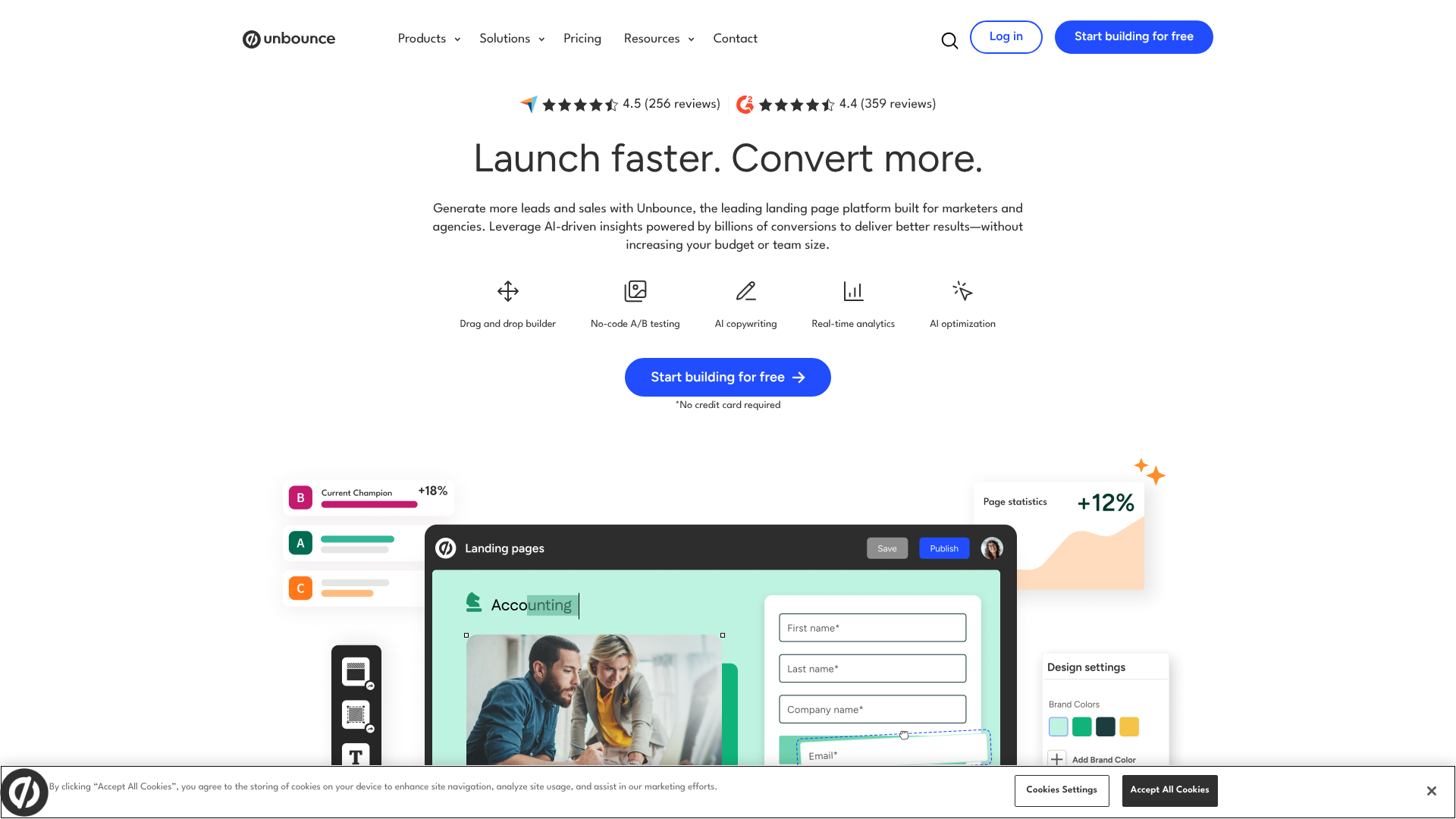
Unbounce is a more powerful and flexible platform aimed at marketing teams and agencies that require advanced customisation and optimisation features. Its drag-and-drop builder offers pixel-perfect precision, allowing you to build any design you can imagine without needing a developer.
Its standout feature is Smart Traffic, an AI-powered tool that automatically analyses a visitor's attributes and sends them to the landing page variant most likely to convert. This goes beyond traditional A/B testing and can provide a significant lift in conversions. Unbounce is the ideal choice for performance marketers who are serious about data-driven optimisation.
Pros
- Highly flexible and powerful drag-and-drop editor.
- Advanced features like Smart Traffic (AI optimisation) and Dynamic Text Replacement.
- Strong integration capabilities with other marketing tools.
- Excellent for agencies and experienced marketers.
Cons
- Higher price point than many other builders.
- Can have a steeper learning curve for complete beginners.
3. Instapage
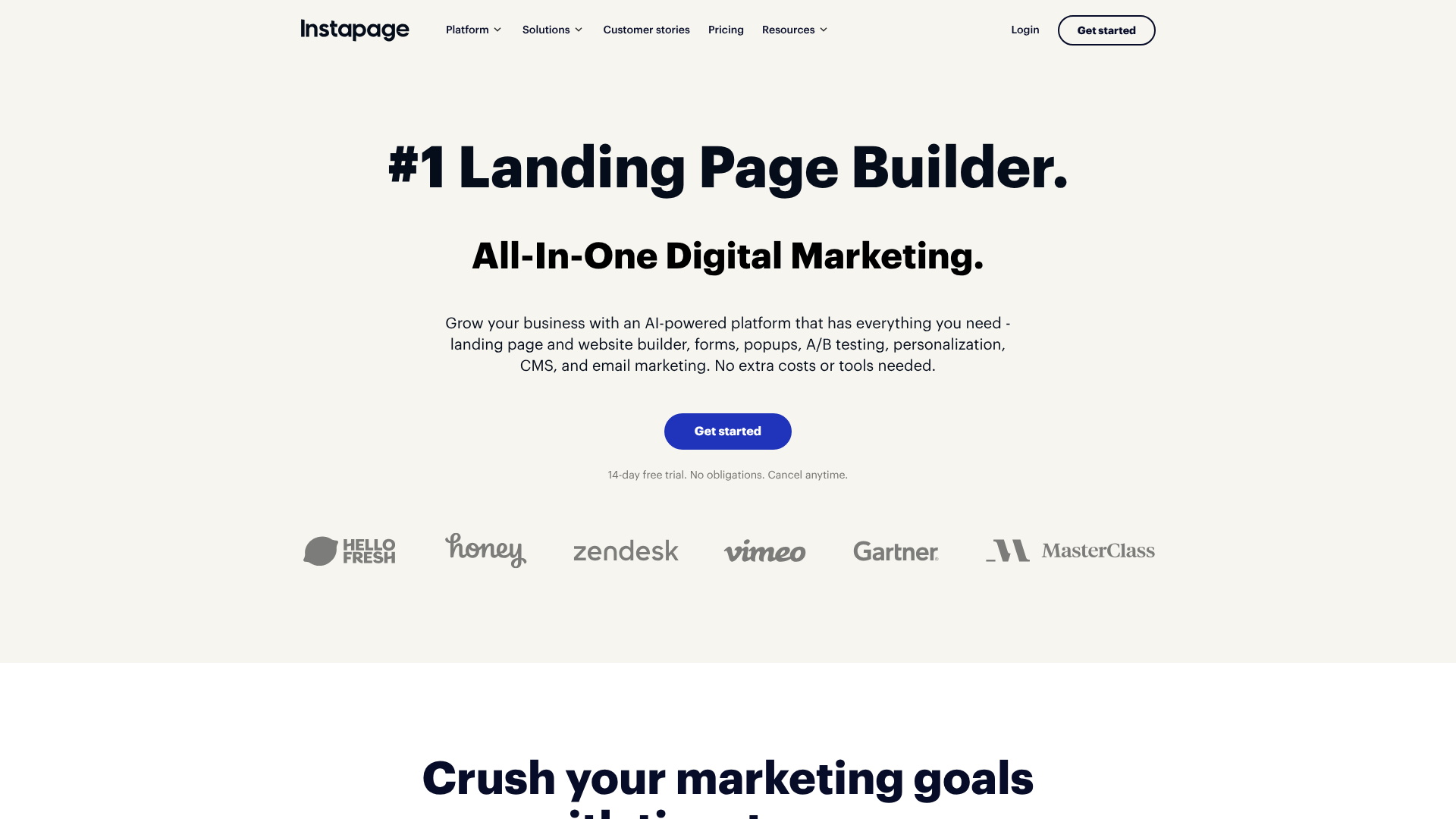
Instapage is an enterprise-level landing page platform designed for large marketing teams and agencies that need to create personalised landing pages at scale. It offers a robust suite of features focused on collaboration, personalisation, and advertising optimisation.
Key features include AdMap, which allows you to visualise your ad campaigns and connect each ad to a unique, message-matched landing page experience. It also offers unparalleled collaboration tools for teams and lightning-fast page speeds through its Thor Render Engine. Instapage is the best solution for organisations with complex campaigns and a need for scalable personalisation.
Pros
- Best-in-class personalisation and ad-to-page mapping features.
- Excellent collaboration tools for large teams.
- Incredibly fast page loading speeds.
- Detailed analytics and heatmaps.
Cons
- The most expensive option, geared towards enterprise clients.
- May be overly complex for small businesses or individual users.
Pro Tip: For those building complete marketing funnels beyond a single page, a tool like ClickFunnels might be a better fit. It's designed to guide a customer through a multi-step sales process, from initial lead capture to checkout and upsells.
Comparing Landing Page Builders: Features & Pricing
Choosing the right platform can be challenging. This table provides a high-level overview to help you compare the key differences between our top recommendations. For the most up-to-date pricing, always visit the official websites.
| Feature | Leadpages | Unbounce | Instapage |
|---|---|---|---|
| Best For | Small Businesses & Beginners | Performance Marketers & SMBs | Enterprise & Agencies |
| Ease of Use | Very High | Medium | Medium |
| Key Feature | Affordability & Templates | AI-Powered Smart Traffic | Scalable Personalisation |
| A/B Testing | Yes (on higher plans) | Yes (Advanced) | Yes (Advanced) |
| Integrations | Good | Excellent | Excellent |
| Pricing | $ | $$ | $$$$ |
When making your decision, consider your immediate needs and future goals. If you're just starting out, Leadpages offers everything you need at a great price. If your focus is on rigorous testing and optimisation, Unbounce is a worthy investment. For large-scale, personalised campaigns, Instapage is in a class of its own.
The Pros and Cons of Focusing on Landing Page Experience
Dedicating resources to optimising your landing pages offers significant advantages, but it's also important to understand the potential challenges. A balanced view helps you create a sustainable and effective strategy.
The Advantages
- Higher Conversion Rates: This is the most direct benefit. A well-optimised page that follows best practices will convert a higher percentage of visitors into leads or customers, maximising the return on your ad spend.
- Improved Ad Quality Score: Platforms like Google Ads reward advertisers who provide a great user experience. A relevant, fast, and trustworthy landing page leads to a higher Quality Score, which can result in lower costs-per-click and better ad positions.
- Enhanced Brand Perception: A professional, seamless landing page experience reflects positively on your brand. It shows that you are credible and customer-focused, building trust even with visitors who don't convert immediately.
- Better Campaign Insights: By focusing on a single goal per page, you get much cleaner data. This makes it easier to analyse campaign performance, understand what messaging works, and make data-driven decisions for future marketing efforts.
The Potential Challenges
- Requires Time and Resources: Creating unique, message-matched landing pages for every ad group or campaign takes time. Continuous A/B testing and analysis also require dedicated resources.
- Risk of Analysis Paralysis: With so many elements to test (headlines, copy, images, CTA buttons), it can be easy to get lost in the data and lose sight of the bigger picture. It's important to prioritise tests based on their potential impact.
- Technical Hurdles (Without a Builder): If you're not using a dedicated landing page platform, ensuring fast load times and perfect mobile responsiveness can be technically challenging and may require developer assistance.
Frequently Asked Questions (FAQ)
Here are answers to some of the most common questions about landing page experiences.
What are the core elements of a good landing page?
The core elements of a good landing page are all designed to support a single conversion goal. This includes a compelling, benefit-oriented headline that matches the ad, persuasive and scannable copy, high-quality and relevant visuals (like a hero image or video), trust signals such as testimonials or client logos, a simple and frictionless form, and a single, visually prominent call-to-action (CTA) button.
What makes a landing page successful?
A landing page is successful when it achieves its specific conversion goal at a high rate. Success is measured by its conversion rate—the percentage of visitors who take the desired action. This is driven by providing a great user experience, which includes delivering on the promise of the ad, loading quickly, being easy to navigate (especially on mobile), and building enough trust to convince the visitor to act.
What are the three main types of landing pages?
There are several types, but the three most common are Lead Generation pages, Click-Through pages, and Squeeze pages. Lead Generation pages (or lead capture pages) use a form to collect visitor information, like an email address, in exchange for an offer. Click-Through pages are designed to warm up a visitor to an offer before sending them to a transaction page, like an e-commerce checkout. Squeeze pages are an aggressive form of lead gen page, designed with minimal copy to capture an email address with a highly compelling offer.
What is landing page experience in Google Ads?
In Google Ads, landing page experience is a component of your Quality Score. It's Google's evaluation of how relevant and useful your landing page is to someone who clicks your ad. Google analyses factors like relevance to keywords and ad copy, ease of navigation, transparency about your business, and page load time. A high-quality landing page experience can lead to lower ad costs and better ad placements.
Final Thoughts
Understanding which attributes describe a good landing page experience is fundamental to modern digital marketing. It’s a discipline that blends user psychology with clean design and technical performance to create a focused path to conversion. By prioritising clarity, speed, trust, and a single call-to-action, you transform your landing pages from simple web pages into powerful conversion assets.
The journey doesn't end once a page is published. The best marketers are constantly testing, learning, and iterating. Use A/B testing to experiment with different headlines, images, and CTA buttons to continuously improve your results. The insights you gain will not only boost your conversion rates but also give you a deeper understanding of your customers.
If you're ready to start building pages that convert, using a dedicated platform is the most efficient path forward. Tools like Leadpages and Unbounce remove the technical barriers, allowing you to launch and test beautiful, high-performing landing pages in a fraction of the time. By applying the principles in this guide, you'll be well on your way to creating experiences that delight users and drive business growth.