

AI Writing Generator Explained: How to Create Content Faster for Your Business
An AI writing generator is a tool that uses artificial intelligence to create written content automatically. From blog posts and marketing emails to social media updates and even fiction, these tools can produce human-like text based on a simple prompt or instruction you provide. They are not just simple spellcheckers; they are sophisticated systems designed to understand context, tone, and style to help you generate content more efficiently.
- What You'll Learn
- What Exactly Is an AI Writing Generator?
- How Do AI Writing Generators Actually Work?
- Real-World Applications: Who Uses AI Writing Tools?
- The Pros and Cons of Using an AI Writing Generator
- A Look at Popular AI Writing Generator Tools
- The Shifting Landscape: Impact on Content Creation
- The Elephant in the Room: Ethical Considerations
- What's Next? Future Trends in AI Writing Technology
- The Importance of User Experience and Interface Design
- Case Studies: AI Writing Generators in Action
- Frequently Asked Questions
- Can Google detect AI-generated content?
- Will using an AI writing generator hurt my SEO?
- What is the best free AI writing generator?
- Can an AI text generator truly replace human writers?
- Final Thoughts
For businesses, marketers, and writers, this technology offers a powerful way to overcome writer's block, scale content production, and free up time for more strategic tasks. Instead of starting from a blank page, you can use an AI text generator to create a solid first draft in seconds, which you can then refine and perfect. It's like having a junior writing assistant available 24/7.
This guide explains everything you need to know about how these tools work, their practical applications, the best options available, and the ethical considerations you should keep in mind. We'll explore how to use this technology responsibly to enhance your creativity and productivity, not replace it.
What You'll Learn
- What an AI Writing Generator Is: Understand the core technology behind these tools, including how they learn from vast amounts of data to produce coherent text.
- Practical Business Applications: Discover how different industries, from marketing to e-commerce, use automated writing software to improve efficiency and output.
- Key Benefits and Realistic Limitations: Learn about the significant advantages, such as speed and idea generation, as well as the crucial drawbacks, like the potential for factual inaccuracies.
- How to Choose the Right Tool: Get an overview of popular AI writing tools, their key features, and what makes each one suitable for different needs.
- The Future of Content Creation: Explore how the role of the writer is evolving and how to use AI as a collaborative partner rather than a replacement for human creativity.
What Exactly Is an AI Writing Generator?
An AI writing generator is a software application that uses artificial intelligence, specifically natural language processing (NLP) and natural language generation (NLG), to create text. You give it a command—known as a prompt—and it generates a written response. This prompt can be as simple as "write a tweet about the benefits of coffee" or as complex as "create a 500-word blog post introduction about sustainable fashion, written in an informative and optimistic tone."
The core purpose of this technology is to assist with the writing process. It can help brainstorm ideas, structure an article, write entire paragraphs, or even just rephrase a sentence to make it clearer. Think of it less as a magic button that creates perfect content and more as a powerful assistant that handles the heavy lifting of drafting, allowing you to focus on editing, fact-checking, and adding your unique human perspective.
These tools are becoming increasingly integrated into other platforms. For example, many marketing suites and SEO tools now include a built-in writing AI tool to help users create content for campaigns directly within their existing workflow. This integration makes the technology more accessible and practical for everyday business tasks.
How Do AI Writing Generators Actually Work?

At the heart of every modern AI writing generator is a large language model (LLM). An LLM is a type of AI that has been trained on an enormous dataset of text and code, often billions of words from books, articles, websites, and other sources across the internet. This training process allows the model to learn the patterns, grammar, syntax, context, and nuances of human language.
When you enter a prompt, the AI doesn't "understand" it in the human sense. Instead, it uses its training to predict the most statistically likely sequence of words that should follow your input. It's like an incredibly advanced version of the autocomplete feature on your phone, but instead of predicting the next word, it predicts the next sentence, paragraph, or entire article.
This process is powered by a complex neural network architecture called a "transformer," which is exceptionally good at handling sequential data like text. It can weigh the importance of different words in the input prompt to generate more relevant and coherent output. The quality of the output depends heavily on two things: the quality and size of the training data and the clarity of your prompt. A vague prompt will likely result in generic content, while a detailed, specific prompt gives the AI the necessary context to produce a more tailored and useful response.
Real-World Applications: Who Uses AI Writing Tools?
AI writing generators are not just for tech enthusiasts; they have practical applications across a wide range of industries. Their ability to produce text quickly makes them valuable for any role that involves creating written content.
Marketing and Advertising
This is perhaps the biggest use case. Marketers use AI text generators to draft blog posts, social media captions, website copy, email newsletters, and ad copy. For example, a marketing team can generate ten different headline variations for a landing page in under a minute to A/B test which one performs best. Tools like HubSpot are even integrating AI assistants to help marketers create campaign assets faster.
E-commerce
Online retailers often have thousands of products, each requiring a unique description. Writing these manually is a monumental task. An automated writing software can generate compelling, SEO-friendly product descriptions at scale, saving hundreds of hours and helping products get discovered more easily in search results.
Business and Corporate Communications
Professionals use these tools to draft internal memos, business proposals, reports, and professional emails. For instance, if you need to write a difficult email to a client, you can ask the AI to draft it in a polite and professional tone, giving you a starting point to edit.
Education and Academia
Students and researchers can use a writing AI tool to brainstorm ideas for essays, summarise long research papers, or check their grammar and style. However, it's crucial to use these tools ethically and avoid plagiarism. They should be used for assistance, not for creating the final work itself.
The Pros and Cons of Using an AI Writing Generator
Like any technology, AI writing generators come with a distinct set of advantages and disadvantages. Understanding both is key to using these tools effectively and responsibly.
Key Benefits
- Increased Speed and Efficiency: The most obvious benefit is speed. An AI can generate a 1,000-word article draft in minutes, a task that could take a human writer hours. This allows content teams to scale their output significantly.
- Overcoming Writer's Block: Staring at a blank page can be intimidating. AI generators provide an excellent starting point, offering ideas, outlines, and initial paragraphs that you can build upon. This can be a huge help for kickstarting the creative process.
- Consistency in Tone and Style: For brands that need to maintain a consistent voice across all their communications, an AI can be trained or prompted to adhere to specific style guidelines, ensuring all content feels cohesive.
- Cost-Effectiveness: While professional human writers are invaluable, using an AI for first drafts and simple content tasks can be more cost-effective, especially for small businesses or startups with limited budgets.
Significant Limitations
- Lack of Originality and Creativity: AI models generate text based on patterns they've seen in their training data. They cannot create truly original ideas or express genuine emotion. The output can sometimes feel generic or derivative.
- Potential for Factual Inaccuracies: AI generators do not have a real-world understanding and can confidently state incorrect information, a phenomenon known as "hallucination." All facts, figures, and important claims must be rigorously fact-checked by a human.
- No Real-World Experience or Nuance: An AI cannot draw on personal experiences, cultural context, or subtle human nuances. This is especially important for content that requires empathy, opinion, or deep subject-matter expertise.
- Requires Human Oversight: AI-generated content is rarely ready to publish as-is. It requires a human editor to review for accuracy, tone, flow, and originality. The AI is a tool to assist, not replace, the writer.
A Look at Popular AI Writing Generator Tools
The market for AI writing tools has exploded, with many options available for different needs and budgets. Here’s a comparison of some of the most popular choices, including several powerful platforms you can start with.
| Feature | Jasper | Writesonic | QuillBot | Grammarly |
|---|---|---|---|---|
| Best For | High-quality marketing copy & long-form content | All-in-one content creation (text, audio, images) | Paraphrasing, summarising, and academic writing | Grammar checking and improving existing text |
| Key Feature | Brand Voice & SEO Mode | Audiosonic & Photosonic Integrations | Co-Writer & Citation Generator | Tone detection & style suggestions |
| Free Plan | No, but offers a free trial | Yes, with monthly word limits | Yes, with limitations | Yes, for basic grammar checks |
| Pricing | Visit their website for current plans | Visit their website for current plans | Premium plans available | Premium plans available |
1. Jasper (formerly Jarvis)
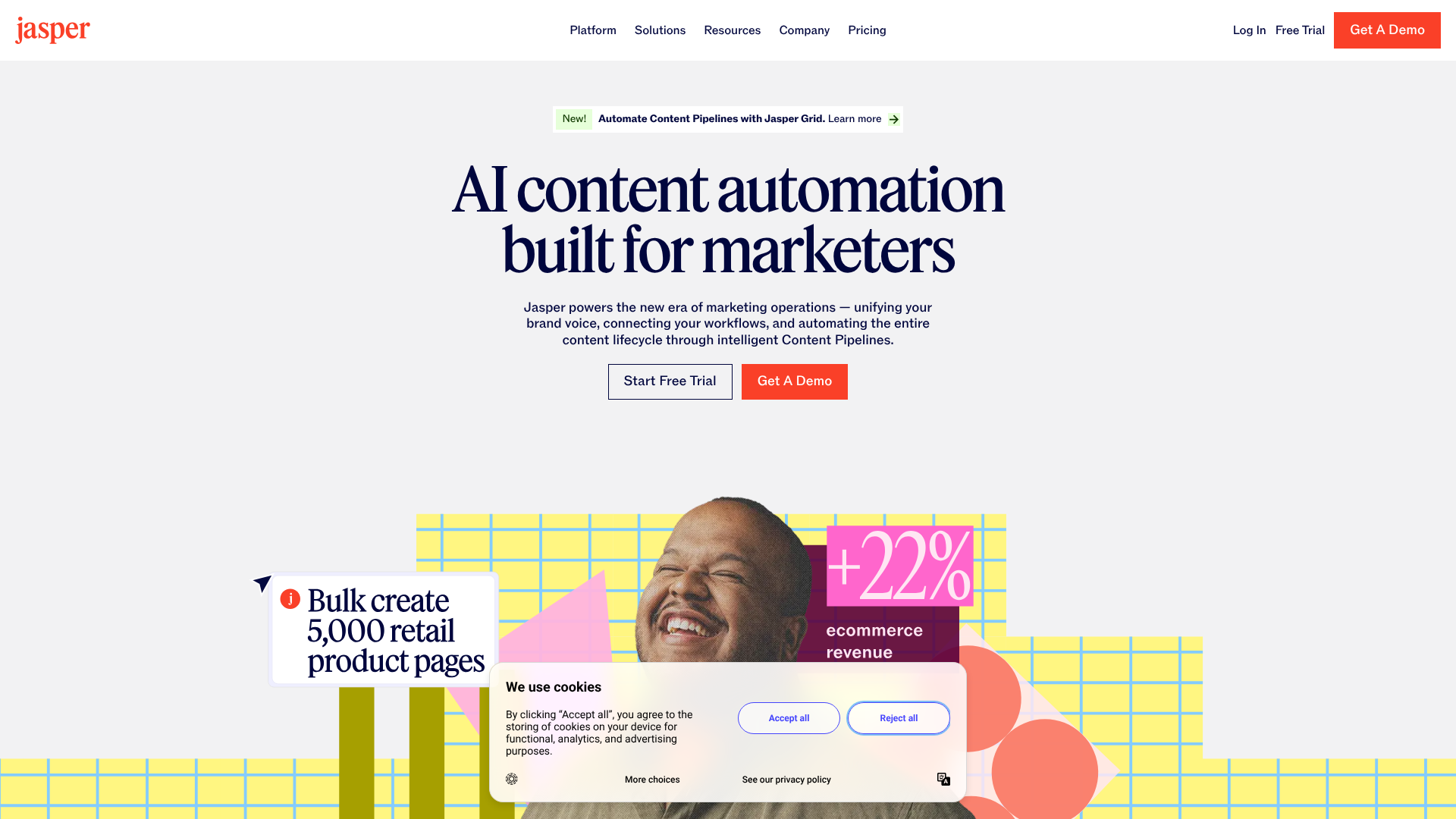
Jasper is one of the most well-known names in the AI writing space, recognised for its high-quality output and focus on marketing and business content. It offers a huge library of templates for everything from blog posts to Google Ads copy.
Pros
- Excellent Output Quality: Jasper is often praised for producing text that sounds natural and requires less editing than some competitors.
- Brand Voice Feature: You can teach Jasper about your company's style and tone, ensuring all generated content is on-brand.
- Strong Community and Support: Jasper has a large, active user community and provides extensive tutorials to help you get the most out of the tool.
Cons
- Higher Price Point: It's one of the more expensive options, which might be a barrier for individuals or small businesses.
- No Free Plan: While it offers a trial, there is no permanent free plan for light users.
If you're serious about integrating AI into your content workflow and need consistently high-quality copy, Jasper is a top contender worth exploring.
2. Writesonic
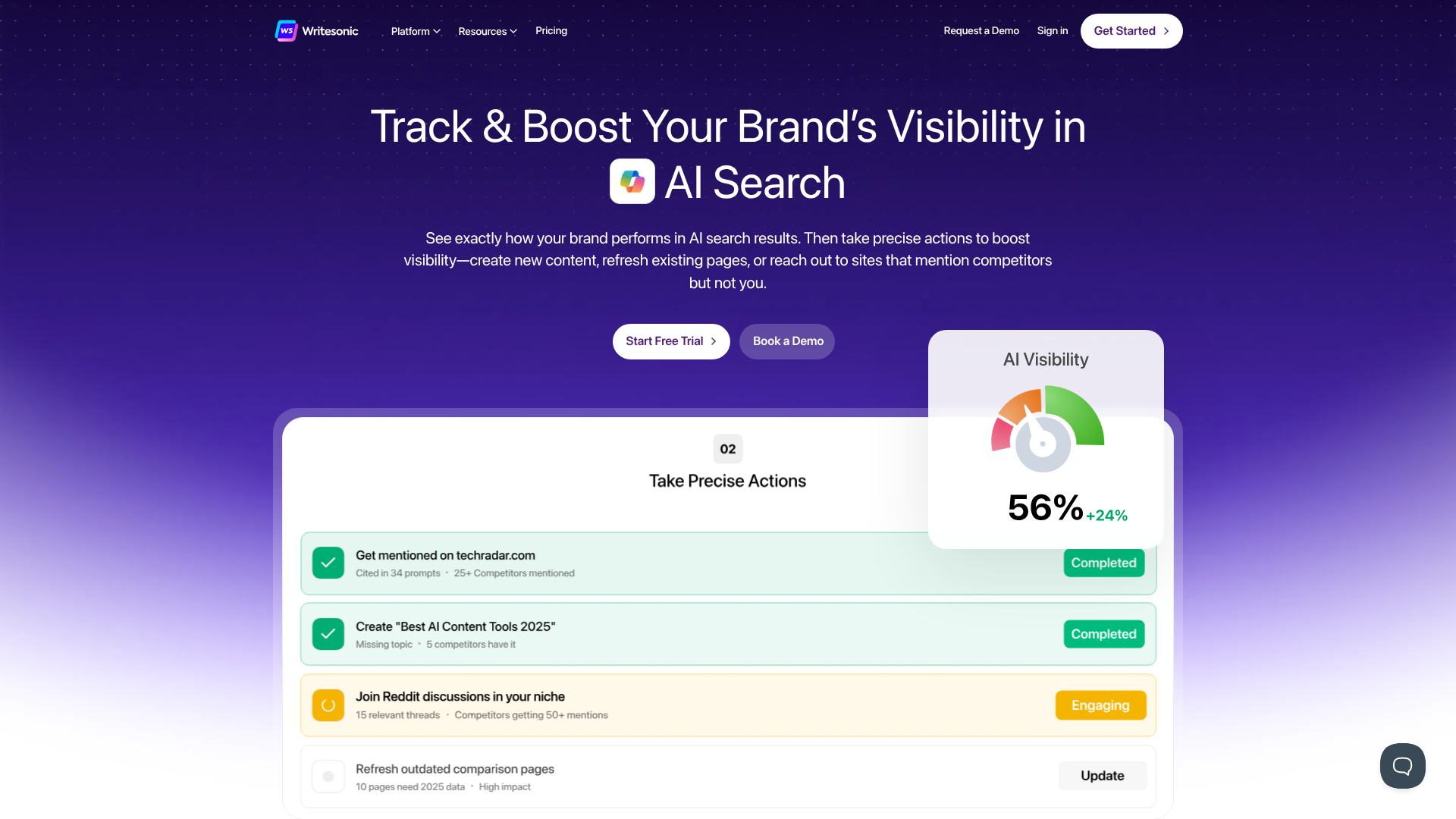
Writesonic positions itself as an all-in-one content creation platform. It goes beyond just text generation, offering tools for creating AI art (Photosonic) and voiceovers (Audiosonic), making it a versatile choice for creators who work with multiple media formats.
Pros
- Versatile Feature Set: The inclusion of AI image and audio generation makes it a comprehensive solution for content creators.
- Factual & SEO-Focused Content: Writesonic has features designed to create factually accurate articles that are optimised for search engines, pulling data from Google Search.
- Generous Free Trial: It offers a good free trial that allows users to test its full range of features before committing.
Cons
- Interface Can Be Overwhelming: With so many features and templates, new users might find the dashboard a bit cluttered at first.
- Word Credits System: The pricing is based on word credits, which can sometimes be confusing to manage depending on the quality level you choose.
For those who need more than just a writing tool, Writesonic provides a powerful suite of creative AI tools in one place.
3. QuillBot
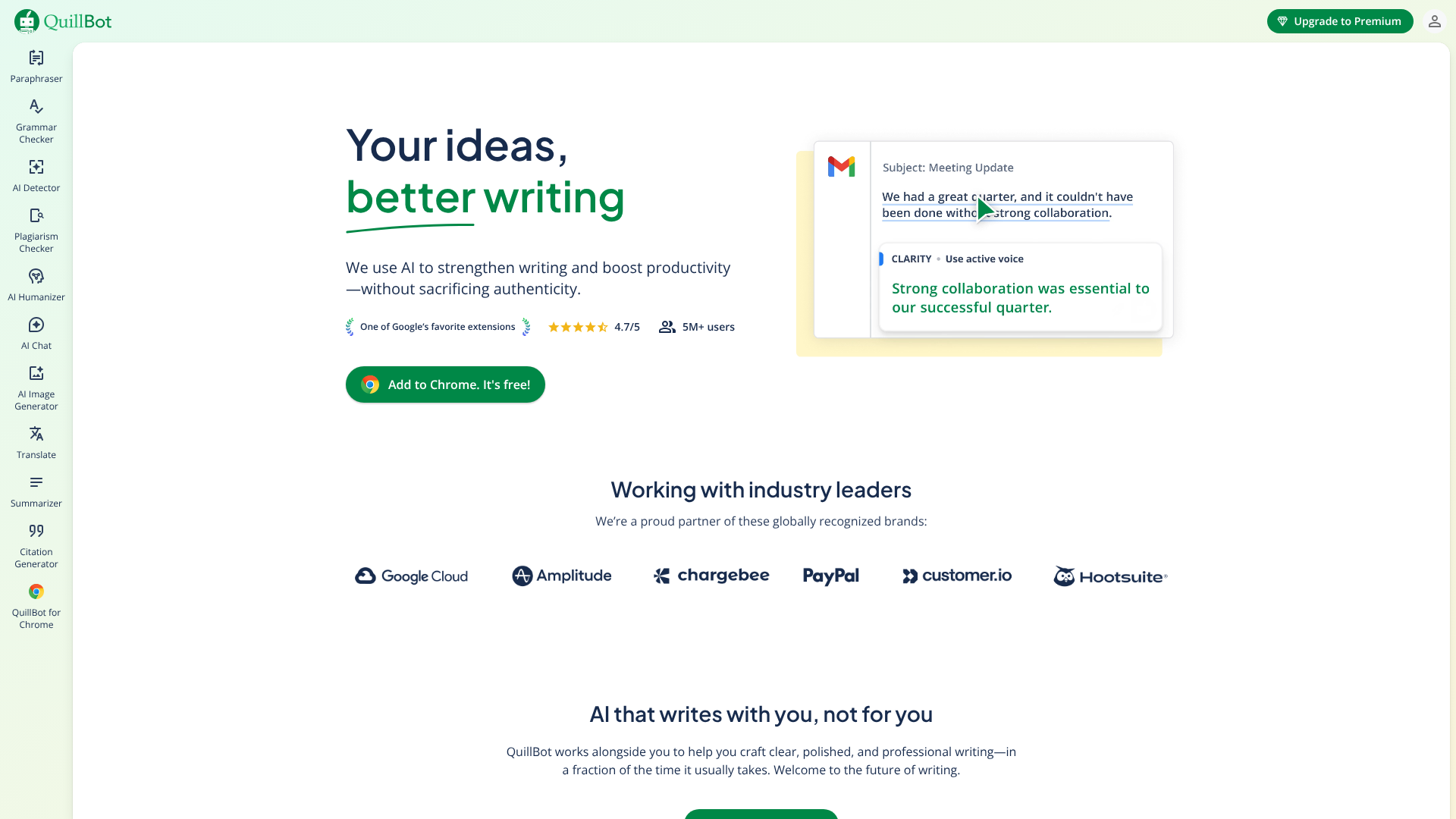
QuillBot started as a paraphrasing tool but has evolved into a comprehensive writing assistant. It excels at helping users rephrase sentences, summarise articles, and improve the clarity of their writing. It's particularly popular among students and academics.
Pros
- Best-in-Class Paraphraser: Its core strength is its ability to rewrite text in different ways without losing the original meaning.
- Useful Additional Tools: Features like the Grammar Checker, Summarizer, and Citation Generator make it a valuable academic tool.
- Good Free Version: The free version is quite capable for basic paraphrasing and grammar checks, making it accessible to everyone.
Cons
- Less Suited for Long-Form Generation: While it has a "Co-Writer" feature, it's not as powerful for generating entire articles from scratch compared to Jasper or Writesonic.
- Character Limits on Free Plan: The free plan has limitations on how much text you can process at once.
If your primary need is to improve and rephrase existing text, QuillBot is an excellent and affordable choice.
4. Grammarly
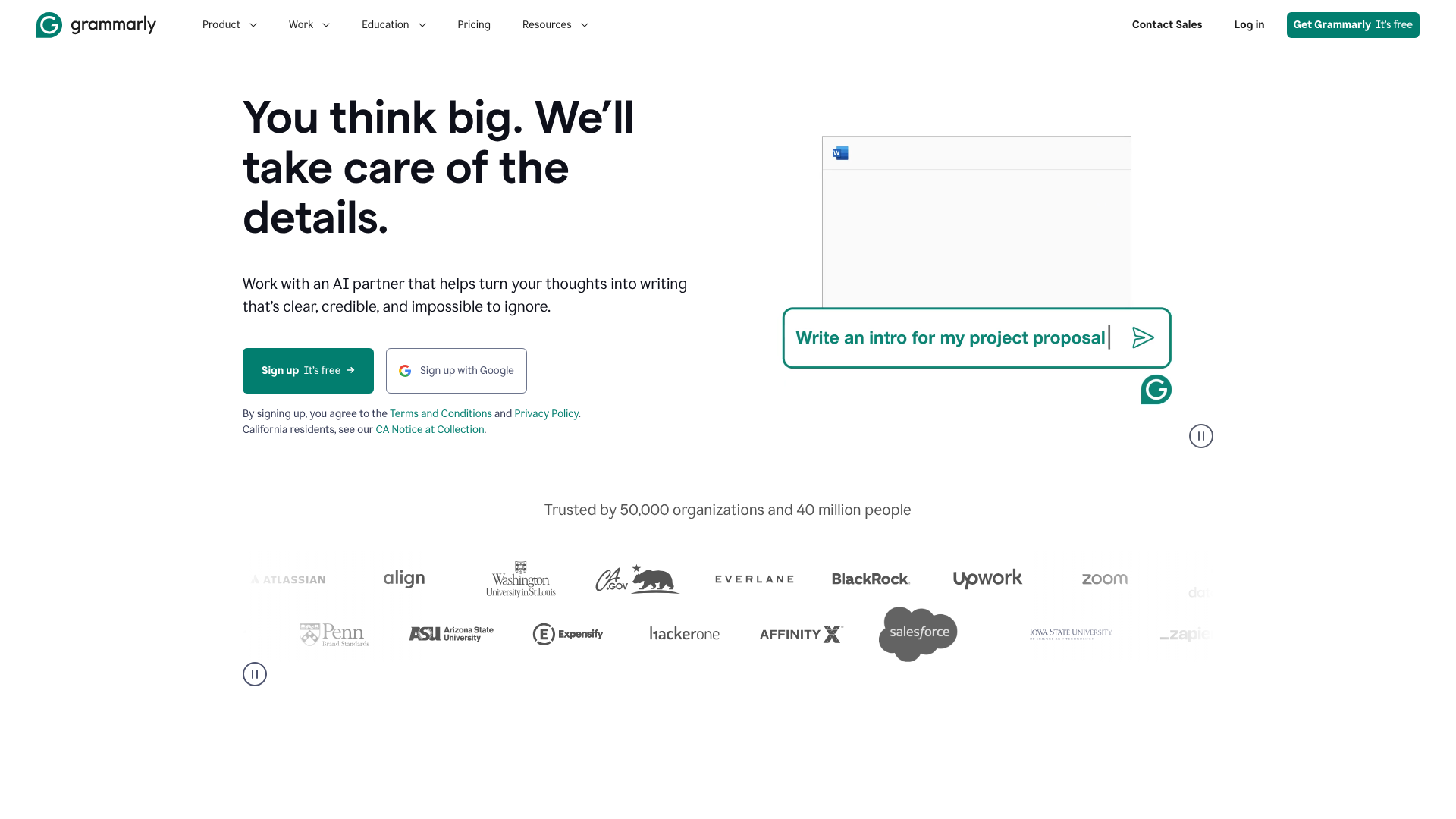
While known primarily as a grammar and spelling checker, Grammarly has expanded its offering with GrammarlyGO, an integrated AI writing generator. It helps users compose and ideate directly within the apps they already use, like Gmail, Google Docs, and Microsoft Word.
Pros
- Seamless Integration: It works where you work, providing AI assistance without needing to switch to a different application.
- Focus on Improving Your Writing: Grammarly's AI is designed to not just write for you, but to help you improve your own writing with suggestions on tone, clarity, and style.
- Trusted Brand: Grammarly is a well-established and trusted tool used by millions, making its AI features a natural extension for existing users.
Cons
- AI Generation is a Newer Feature: Its generative capabilities are not as extensive as dedicated tools like Jasper.
- Prompt Limits on Free Plan: The number of AI prompts you can use on the free plan is limited each month.
For users who want an AI assistant that enhances their existing writing workflow, Grammarly offers a convenient and powerful solution.
The Shifting Landscape: Impact on Content Creation
The rise of the AI writing generator is fundamentally changing the process of content creation and the role of the content creator. It's not about replacing humans but augmenting their abilities. The modern writer's job is shifting from being solely a creator of words to more of a strategist, editor, and creative director.
Instead of spending hours on a first draft, a writer can now generate one in minutes and dedicate their valuable time to higher-level tasks. This includes refining the AI's output, fact-checking information, adding unique insights and personal anecdotes, and ensuring the content aligns with brand strategy and audience needs. The focus moves from production to curation and quality control.
Furthermore, this technology empowers individuals who aren't professional writers to create decent content. A small business owner can now draft a blog post or a social media campaign without needing to hire a dedicated copywriter. This democratises content creation, but it also raises the bar for quality. With so much content being produced, the pieces that will stand out are those with a strong human element: creativity, empathy, and genuine expertise.
The Elephant in the Room: Ethical Considerations
Using an AI for writing brings up important ethical questions that every user must consider. Navigating these issues responsibly is crucial for maintaining trust with your audience and upholding professional integrity.
One of the primary concerns is plagiarism and authenticity. While AI generators create statistically unique sentences, their output is based on existing content. There's a risk that the generated text could be too similar to its source material. It's the user's responsibility to check for plagiarism and ensure the final piece is original.
Another key issue is transparency. Should you disclose when content has been created with the help of AI. While there are no firm rules yet, many believe in being transparent with audiences. A simple disclaimer can build trust and manage expectations.
This is especially important in fields like journalism or academic writing, where authorship and originality are paramount.
Finally, there's the potential for misuse. Automated writing software can be used to generate spam, fake reviews, or misinformation at an unprecedented scale. As users of this technology, we have a responsibility to use it for positive and constructive purposes and to be vigilant about the spread of harmful AI-generated content.
Pro Tip: Always treat AI-generated text as a first draft. Use it as a foundation, but layer your own expertise, voice, and fact-checking on top. The final product should be a collaboration between human intelligence and artificial assistance, with the human having the final say.
What's Next? Future Trends in AI Writing Technology
The field of generative AI is evolving at a breathtaking pace. The AI writing generator of today will look primitive in just a few years. Several key trends are shaping the future of this technology.
First is multimodality. Future AI tools will not be limited to just text. They will be able to seamlessly generate and integrate text, images, audio, and video from a single prompt. Imagine asking an AI to "create a short video about our new product," and it generates the script, visuals, and a voiceover.
Tools like Synthesia for AI video and Murf AI for voice generation are early examples of this trend.
Second is hyper-personalisation. AI will be able to tailor content to individual users in real-time. An e-commerce website could use an AI to dynamically rewrite product descriptions based on a visitor's browsing history and preferences, making the content more relevant and persuasive for each person.
Third is improved reasoning and factuality. Researchers are working hard to solve the "hallucination" problem. Future models will have more advanced reasoning capabilities and better mechanisms for verifying information against reliable sources, making their output more trustworthy and reducing the need for intensive fact-checking.
The Importance of User Experience and Interface Design
For an AI writing generator to be truly useful, it needs to be accessible and easy to use. The user experience (UX) and user interface (UI) design of these tools play a critical role in their adoption. A powerful AI model is useless if the average person can't figure out how to interact with it effectively.
Good AI writing tools feature a clean, intuitive interface that makes the process of generating content straightforward. They often provide a library of pre-built templates for common use cases, such as blog posts, emails, or social media ads. These templates guide the user by asking for specific inputs, which helps in crafting a better prompt without requiring the user to be an expert in "prompt engineering."
Furthermore, the best platforms offer robust editing tools within the same interface. After generating text, users should be able to easily edit, reformat, and check it for plagiarism or grammar errors without needing to copy and paste it into another application. A seamless workflow from generation to final polish is a hallmark of a well-designed writing AI tool.
Case Studies: AI Writing Generators in Action
To understand the practical impact, let's look at a couple of hypothetical scenarios where an automated writing software can make a real difference.
Scenario 1: A Small E-commerce Business
A small online shop sells handmade jewellery. The owner, Sarah, needs to write unique, SEO-optimised descriptions for 100 different products. Doing this manually would take weeks. Instead, she uses an AI writing generator.
She creates a template prompt that includes the product's materials, style, and target keywords. The AI generates a unique description for each product in seconds. Sarah then spends a few hours reviewing and tweaking each one to add her brand's personal touch. The entire process is completed in a single afternoon.
Scenario 2: A Digital Marketing Agency
A marketing agency needs to produce four blog posts per month for a client in the financial services industry. The topics are complex and require thorough research. The agency's content strategist uses an AI tool to generate detailed outlines and first drafts for each post. This saves the expert writer on their team from doing the initial structural work.
The writer can then focus their time on adding in-depth analysis, expert insights, and relevant case studies, resulting in higher-quality content produced in less time.
Frequently Asked Questions
Can Google detect AI-generated content?
Yes, there are tools and algorithms that can detect patterns typical of AI-generated text with a certain degree of accuracy. However, Google's official stance is that they reward high-quality content, regardless of how it's produced. Content that is helpful, reliable, and created for people is what matters, not whether AI was involved in the process. Low-quality, spammy AI content will perform poorly, just like low-quality human-written content.
Will using an AI writing generator hurt my SEO?
Using an AI writing generator will not inherently hurt your SEO, provided you use it as a tool to create high-quality, original, and helpful content. If you simply copy and paste the AI's output without editing, fact-checking, or adding value, the content may be generic and perform poorly. The key is to use AI to enhance your content creation process, not to replace human oversight and expertise. Tools like Semrush even incorporate AI writing features to help create SEO-friendly content.
What is the best free AI writing generator?
Many top-tier AI writing tools offer free plans or trials, but they usually come with limitations on word count or features. For users looking for completely free options, the AI writers integrated into platforms like Grammarly or QuillBot offer excellent value for improving existing text and generating short-form content. The best choice depends on your specific needs, whether it's paraphrasing, grammar checking, or drafting new content.
Can an AI text generator truly replace human writers?
No, an AI text generator is unlikely to replace skilled human writers. It is a tool that changes their role. AI excels at speed, data processing, and generating drafts, but it lacks genuine creativity, emotional intelligence, critical thinking, and real-world experience. The future of writing is a collaboration where humans use AI to handle repetitive tasks, allowing them to focus on strategy, editing, and adding the unique insights that only a human can provide.
Final Thoughts
The AI writing generator is more than just a passing trend; it's a fundamental shift in how we create and interact with written content. These powerful tools offer incredible potential to boost productivity, spark creativity, and scale content production in ways that were previously unimaginable. By handling the initial drafting and brainstorming, they free up human writers to focus on what they do best: providing strategic insight, emotional depth, and authentic expertise.
However, it's crucial to approach this technology with a clear understanding of its limitations. AI-generated content requires careful human review for accuracy, tone, and originality. The most successful outcomes will come from a partnership between human and machine, where the AI serves as a capable assistant and the human acts as the final editor and creative director.
If you're looking to explore how an AI writing tool can fit into your workflow, consider trying out a platform like Jasper for its high-quality marketing copy or Writesonic for its all-in-one creative suite. Experimenting with these tools is the best way to discover how they can help you create better content, faster.