




Keyword Research for SEO: A 2025 Beginner's Guide to Getting Started
Effective search engine optimisation (SEO) starts with understanding what your audience is searching for. Performing thorough keyword research for your SEO strategy is the foundational step that informs every other action you take, from creating content to building links. Without knowing the exact phrases people type into Google, you're essentially creating content in the dark, hoping someone stumbles upon it. This guide will walk you through the entire process, from basic concepts to advanced strategies, ensuring your content connects with the right audience.
- What You'll Learn
- Why SEO Keyword Research is the Bedrock of Your Strategy
- Understanding the Building Blocks: Types of Keywords
- Decoding User Needs: The Power of Search Intent
- The Best SEO Keyword Tools for Beginners
- 1. Mangools (KWFinder): Best for Beginners
- 2. Semrush: Best All-in-One Platform
- 3. Ahrefs: Best for Competitive Analysis
- How to Do Keyword Research for SEO: A Step-by-Step Process
- Step 1: Brainstorm Your "Seed" Keywords
- Step 2: Expand Your List with Keyword Tools
- Step 3: Analyse and Prioritise Keywords
- Step 4: Assess the Competition (SERP Analysis)
- Gauging the Battlefield: How to Analyse Keyword Competition
- Putting Keywords to Work: A Content Integration Strategy
- Hyper-Local Targeting: Keyword Strategies for Local SEO
- Tracking Your Success: Monitoring Keyword Performance
- Common Pitfalls: Keyword Research Mistakes to Avoid
- The Future is Here: AI and the Evolution of Keyword Research
- Frequently Asked Questions
- How do I research keywords for SEO?
- What is the 80/20 rule for SEO?
- What are the 3 C's of SEO?
- Can I use ChatGPT for keyword research?
- Final Thoughts
This isn't just about finding words with high search volumes; it's about understanding the intent behind those searches. By mastering keyword analysis for SEO, you can create content that directly answers your audience's questions, solves their problems, and guides them toward your products or services. Whether you're a small business owner, a blogger, or a marketing professional, this guide provides the framework you need to get started and succeed.
What You'll Learn
- The Foundation of SEO: Keyword research is the most critical first step in any SEO campaign. It dictates your content strategy and helps you understand your target market's needs and language.
- Intent is Everything: Understanding whether a user wants to learn, buy, or find a specific website (search intent) is more important than just search volume. Aligning content with intent is key to ranking.
- Tools are Essential: You can't do effective keyword research without the right tools. While free options exist, paid SEO keyword tools like Mangools or Semrush provide the competitive data needed to make informed decisions.
- Competition Matters: High-volume keywords are often highly competitive. A smart strategy involves finding a balance between search volume and keyword difficulty, targeting achievable terms first.
- Keywords are Not a One-Time Task: SEO is an ongoing process. You must continuously monitor your keyword performance, track rankings, and adapt your strategy as market trends and search behaviours change.
Why SEO Keyword Research is the Bedrock of Your Strategy
Before you write a single blog post or design a landing page, you need a plan. In the world of digital marketing, that plan begins with SEO keyword research. It’s the process of identifying the words and phrases your potential customers use when searching for information, products, or services related to your business. Think of it as market research for the 21st century.
It provides direct insight into the collective mind of your target audience.
Ignoring this step is like building a house without a blueprint. You might end up with something that looks okay, but it won't be structurally sound or serve its intended purpose. When you skip keyword research, you create content based on assumptions. You might think you know what your audience wants, but the data often tells a different story.
This leads to wasted time and resources on content that nobody finds, because it doesn't align with any actual search queries.
Ultimately, the goal of SEO is to drive relevant, organic traffic to your website. Proper keyword research ensures the traffic you attract is composed of people who are genuinely interested in what you offer. It helps you create content that resonates, ranks, and converts. It's the difference between shouting into the void and having a meaningful conversation with potential customers who are actively looking for a solution you provide.
Understanding the Building Blocks: Types of Keywords

Not all keywords are created equal. Understanding their different classifications is crucial for building a well-rounded SEO strategy. The most common distinction is between short-tail and long-tail keywords, but there are other important types to consider as well.
Short-Tail vs. Long-Tail Keywords
Short-tail keywords, also known as "head terms," are broad search queries consisting of one or two words. Examples include "coffee," "SEO," or "marketing software." These terms typically have very high search volumes, which can be tempting. However, they are also incredibly competitive, making them difficult to rank for. Furthermore, the search intent behind them is often vague.
Someone searching for "coffee" could be looking for beans, a local café, or the history of the drink.
Long-tail keywords are longer, more specific search phrases, usually containing three or more words. An example would be "best whole bean coffee for french press" or "how to do keyword research for a new website." These queries have lower search volumes individually, but they are far less competitive. More importantly, their intent is crystal clear. Someone using a long-tail search knows exactly what they want, and if you can provide the answer, you have a much higher chance of converting them into a customer or a loyal reader.
A successful strategy uses both. Short-tail keywords can be your long-term goals for high-level pages, while long-tail keywords are perfect for blog posts and specific service pages. Collectively, the traffic from many long-tail keywords can far exceed the traffic from a single, highly competitive short-tail term.

Decoding User Needs: The Power of Search Intent
Modern SEO has moved beyond simply matching keywords. Google's primary goal is to satisfy the user's need. This is where search intent comes in. Search intent is the why behind a search query.
Understanding this is arguably more important than any other metric, as it allows you to create content that perfectly aligns with what the user wants to accomplish.
There are four main types of search intent:
Informational Intent: The user is looking for information. They want an answer to a question, a definition, or a guide on how to do something. Queries often start with "how to," "what is," or "why." An example is "how to brew pour-over coffee." To satisfy this intent, you should create comprehensive blog posts, guides, or videos.
Navigational Intent: The user wants to go to a specific website or webpage. They already know where they want to go and are using the search engine as a shortcut. Examples include "Facebook login" or "Ahrefs blog." You generally don't target these keywords unless they are for your own brand.
Commercial Investigation Intent: The user is in the research phase before making a purchase. They are comparing products, looking for reviews, or seeking the "best" option. Queries often include words like "best," "review," "comparison," or "vs." An example is "best SEO keyword tools for beginners." This intent is best served with detailed reviews, comparison articles, and top-10 lists.
Transactional Intent: The user is ready to buy. They are looking to make a purchase or take a specific action. These queries often include words like "buy," "discount," "coupon," or a specific product name. An example is "buy Semrush pro subscription." Product pages, pricing pages, and sign-up forms are the ideal content for this intent.
Before targeting any keyword, ask yourself: "What does the person searching this phrase really want?" Analysing the current top-ranking pages for that keyword will give you clear clues about the dominant search intent Google has identified.
The Best SEO Keyword Tools for Beginners
Manual keyword research is nearly impossible in today's competitive landscape. You need powerful tools to gather data on search volume, competition, and related terms. While there are dozens of options available, they generally fall into two camps: all-in-one suites and specialised tools. Here are a few of the best options for those getting started.
1. Mangools (KWFinder): Best for Beginners
-c8067db3-f241-493c-949b-9e26ee57bfba-1766739888363-rs39n7.png "Keyword Research for SEO: A 2025 Beginner's Guide to Getting Started 4")
If you're new to SEO, the sheer amount of data in advanced tools can be overwhelming. Mangools offers a suite of five tools, with KWFinder being its star keyword research product. It's designed for simplicity and clarity without sacrificing essential data.
KWFinder excels at making complex data easy to understand. Its most celebrated feature is the Keyword Difficulty (KD) score, a single number from 0-100 that tells you how hard it will be to rank for a keyword. This is incredibly useful for beginners who need a clear, actionable metric to guide their choices.
Pros
- Extremely user-friendly interface.
- The Keyword Difficulty score is one of the most accurate and intuitive in the industry.
- Provides excellent keyword suggestions and SERP analysis within the same dashboard.
- More affordable than the larger all-in-one suites.
Cons
- The keyword database is smaller than that of giants like Ahrefs or Semrush.
- Usage limits on lower-tier plans can be restrictive for heavy users or agencies.
2. Semrush: Best All-in-One Platform
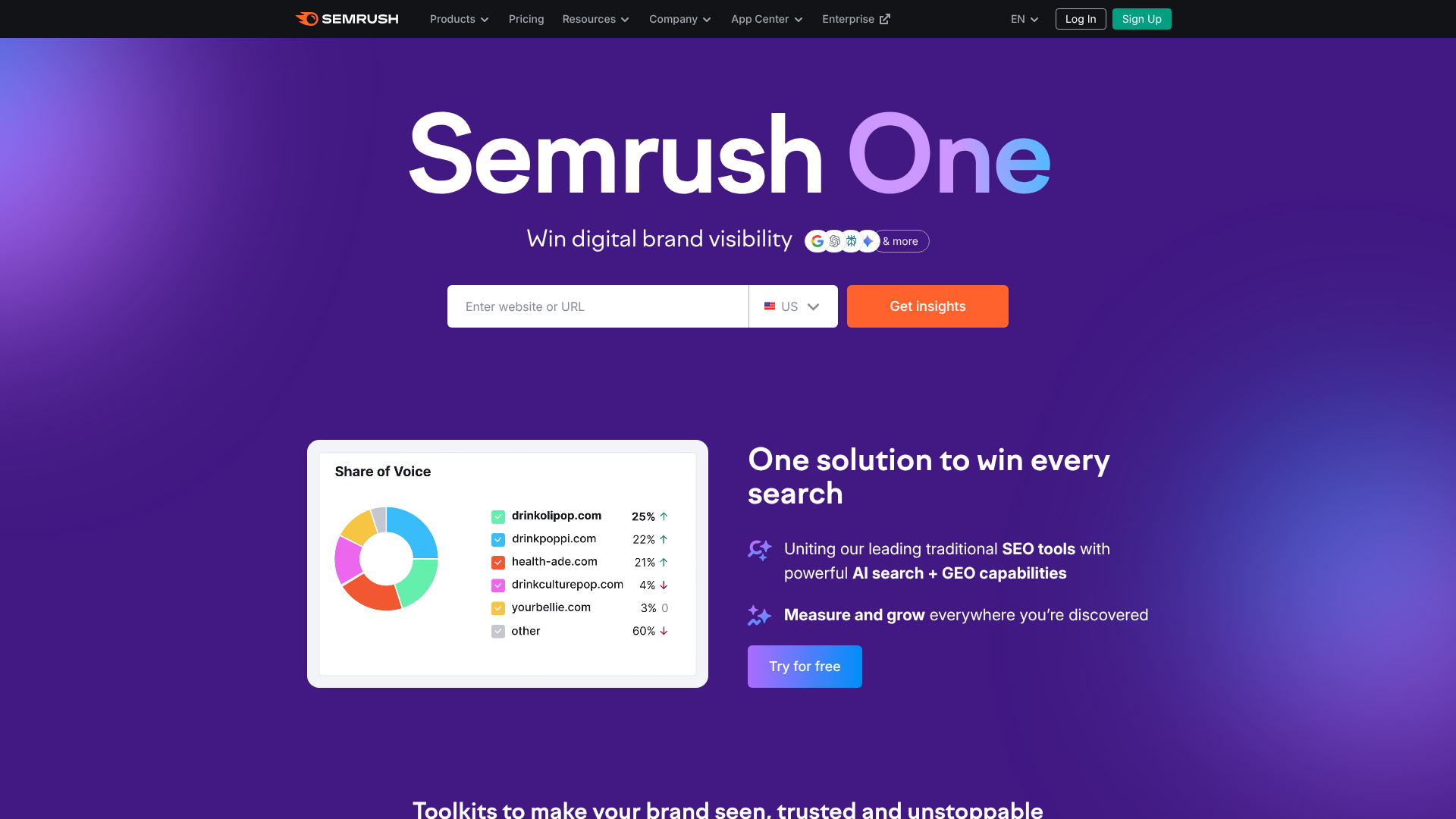
Semrush is more than just a keyword tool; it's a complete digital marketing toolkit. Its Keyword Magic Tool gives you access to a massive database of over 26 billion keywords. You can filter by search intent, question type, volume, difficulty, and more.
What makes Semrush powerful is its integration. You can find keywords, analyse competitors' keyword strategies, track your rankings for those keywords, and even get on-page SEO suggestions for them, all within one platform. It's an excellent choice for businesses that are serious about scaling their SEO efforts.
Pros
- Huge keyword database and comprehensive competitive analysis features.
- An all-in-one solution that covers almost every aspect of SEO.
- Powerful filtering options to narrow down keyword lists.
- Excellent for uncovering competitors' top-performing keywords.
Cons
- Can be complex and overwhelming for absolute beginners.
- The pricing is a significant step up from more specialised tools.
3. Ahrefs: Best for Competitive Analysis

Ahrefs is another industry-leading all-in-one SEO platform, renowned for its best-in-class backlink index. Its Keywords Explorer tool is incredibly robust, providing in-depth data that goes beyond the basics. A unique feature is the "Clicks" metric, which tells you how many of the searches for a keyword actually result in a click—essential in an age of zero-click searches.
Ahrefs also shows you the "Parent Topic" for a keyword, which helps you understand if you can rank for a more specific term by creating a page about the broader topic. It's a favourite among professional SEOs for its data accuracy and deep analytical capabilities.
Pros
- Unmatched backlink data, which is crucial for assessing keyword difficulty.
- Provides unique metrics like Clicks and Parent Topic.
- Excellent for content gap analysis (finding keywords competitors rank for that you don't).
- Constantly updated with new features.
Cons
- Steeper learning curve compared to Mangools.
- Higher price point, similar to Semrush.
How to Do Keyword Research for SEO: A Step-by-Step Process
Now that you understand the concepts and have some tools in mind, let's walk through a practical, step-by-step process for conducting keyword research.
Step 1: Brainstorm Your "Seed" Keywords
Start by thinking like your customer. Forget about search volume and difficulty for a moment. Write down all the topics and terms related to your business. What problems do you solve.
What products or services do you offer.
These initial terms are your "seed" keywords. For example, if you're a wedding photographer in London, your seed keywords might be:
- London wedding photographer
- wedding photos
- engagement photography
- wedding venues London
This list doesn't need to be perfect. It's just a starting point to feed into your keyword research tools.
Step 2: Expand Your List with Keyword Tools
Take your seed keywords and plug them into a tool like KWFinder or Semrush's Keyword Magic Tool. These tools will generate thousands of related ideas based on your initial list. You'll get long-tail variations, questions people ask, and other semantically related terms.
For "London wedding photographer," a tool might suggest:
- affordable wedding photographer London
- documentary wedding photographer London
- best London wedding photographers
- how much does a wedding photographer cost in London
Your goal in this step is to build a large, master list of potential keywords. Don't filter too heavily yet; just gather all the possibilities.
Step 3: Analyse and Prioritise Keywords
With your master list, it's time to analyse the key metrics to decide which keywords are worth targeting. The three most important metrics are:
- Search Volume: How many times per month, on average, is this keyword searched? Higher is generally better, but don't ignore low-volume, high-intent keywords.
- Keyword Difficulty (KD): How hard will it be to rank on the first page of Google for this term? This metric (often a score out of 100) is calculated by tools based on the authority of the pages currently ranking.
- Relevance: How relevant is this keyword to your business goals? A high-volume, low-difficulty keyword is useless if it doesn't attract the right audience.
Your sweet spot, especially when starting out, is keywords with decent search volume, low keyword difficulty, and high relevance. This is where you'll find the quickest wins.
Step 4: Assess the Competition (SERP Analysis)
Metrics from tools are great, but you must also manually check the Search Engine Results Page (SERP) for your top keyword candidates. Type the keyword into Google and look at the top 10 results. Ask yourself:
- What kind of content is ranking? (Blog posts, product pages, videos?)
- What is the search intent? (Informational, commercial?)
- How authoritative are the ranking websites? (Are they huge brands like Wikipedia or smaller blogs?)
If the first page is dominated by massive, high-authority sites, you might struggle to rank, even if the KD score seems low. If you see smaller blogs, forums, or Q&A sites ranking, it's a good sign that you have a chance to break in.
Gauging the Battlefield: How to Analyse Keyword Competition
Keyword difficulty scores are a great starting point, but a true keyword analysis for SEO requires a deeper look at the competitive landscape. This involves manually inspecting the SERP to understand what you're up against and how you can create something better.
First, look at the Domain Authority (DA) or Domain Rating (DR) of the top-ranking sites. These are third-party metrics from Moz and Ahrefs, respectively, that estimate a website's overall authority. If the top results all have DRs of 80+ and your site has a DR of 20, it will be an uphill battle. Conversely, if you see sites with similar or lower authority than yours, it's a green light.
Next, analyse the content itself. How thorough are the top-ranking articles. What is their word count. Do they use images, videos, or infographics.
Look for weaknesses. Perhaps the top article is outdated, poorly written, or doesn't fully answer the user's question. This is your opportunity. Your goal is to create a piece of content that is significantly better—more comprehensive, more up-to-date, and more helpful—than anything currently ranking.
This is often called the "Skyscraper Technique.".
Finally, check the backlink profiles of the top pages using a tool like Ahrefs or Semrush. How many websites are linking to them? High-quality backlinks are a major ranking factor. If the top pages have hundreds of links from authoritative sites, it will be very difficult to compete without a solid link-building strategy of your own.
Pro Tip: Look for "content gaps." Use a tool like Ahrefs' Content Gap feature to find keywords that your competitors are ranking for, but you aren't. This is a quick way to find proven topics that are relevant to your audience and that you've overlooked.
Putting Keywords to Work: A Content Integration Strategy
Finding the right keywords is only half the battle. The next step is to integrate them naturally into your content. The days of "keyword stuffing"—repeating a keyword over and over again—are long gone. Today, it's about creating high-quality, readable content that uses your target keyword and related terms in a natural, contextually relevant way.
Here’s where to place your primary keyword for maximum impact:
- Page Title (Title Tag): This is one of the most important on-page SEO factors. Try to include your keyword at the beginning of the title.
- URL: A short, descriptive URL that includes your keyword is ideal (e.g.,
yourdomain.com/keyword-research-for-seo). - H1 Heading: Your main page heading should contain your primary keyword.
- First 100 Words: Mention your keyword early in your introductory paragraph to signal to Google and readers what the page is about.
- Subheadings (H2, H3): Use your primary keyword or variations in some of your subheadings.
- Image Alt Text: Describe your images for visually impaired users and search engines, and include the keyword where it makes sense.
Beyond the primary keyword, you should also sprinkle in LSI (Latent Semantic Indexing) keywords—synonyms and related terms that Google associates with your topic. For "keyword research," LSI terms might include "search volume," "keyword difficulty," "long-tail keywords," and "search intent." Using these terms helps Google understand the topic of your page more deeply.
Tools like Surfer SEO can help with this process. They analyse the top-ranking content for your target keyword and provide data-driven suggestions on which related terms to include and how often, helping you create perfectly optimised content.
Hyper-Local Targeting: Keyword Strategies for Local SEO
For businesses that serve a specific geographic area, such as plumbers, restaurants, or dentists, local SEO is critical. The principles of keyword research are the same, but with an added geographic component. Your goal is to capture users searching for your services "near me" or in a specific city or neighbourhood.
Your local keyword research should focus on terms that include location modifiers. Instead of just "emergency plumber," you would target "emergency plumber in Manchester" or "plumber near Ancoats." These are the terms local customers are actually using.
Here are some strategies for local keyword research:
- Combine Services with Locations: Create a list of all your services and combine them with all the locations you serve (cities, postcodes, neighbourhoods). This will give you a large list of specific, high-intent local keywords.
- Use Google's Autocomplete: Start typing your service and location into Google and see what suggestions appear. These are based on popular searches and can give you great ideas for long-tail keywords.
- Look for "Near Me" Keywords: While you can't optimise for every user's exact location, creating location-specific pages (e.g., a page for each major neighbourhood you serve) helps you appear in these valuable searches.
Local SEO is often less competitive than national SEO, so thorough keyword research can give you a significant advantage over local competitors who may be neglecting this crucial step.
Tracking Your Success: Monitoring Keyword Performance
Keyword research isn't a one-and-done task. Once you've created and published your optimised content, you need to track its performance to see if your strategy is working. Monitoring your keyword rankings is essential for understanding what's effective, identifying opportunities, and diagnosing problems.
Google Search Console is a free tool from Google that is indispensable for this. It shows you the actual queries your website is appearing for in search results, along with your average position, impressions, and clicks for each query. This data is invaluable for discovering new keyword opportunities and understanding how users are finding you.
For more precise and proactive tracking, a dedicated rank tracking tool is necessary. Tools like AccuRanker or the rank tracking features within Ahrefs and Semrush allow you to monitor your position for specific keywords over time. You can track your rankings daily, see how you stack up against competitors, and receive alerts when your rankings change significantly.
Monitoring performance allows you to make data-driven decisions. If a page is stuck on page two for a target keyword, you might need to improve the content or build more backlinks. If you're ranking well but not getting clicks, you may need to rewrite your title tag and meta description to be more compelling. Consistent monitoring turns SEO from a guessing game into a measurable science.
Common Pitfalls: Keyword Research Mistakes to Avoid
As with any complex process, there are common mistakes that beginners often make. Being aware of these pitfalls can save you a lot of time and frustration.
Targeting Keywords That Are Too Competitive: It's exciting to see a keyword with 50,000 monthly searches, but if your new website has no authority, you have virtually no chance of ranking for it. Start with low-competition, long-tail keywords to build initial traffic and authority.
Ignoring Search Intent: Focusing only on search volume and creating content that doesn't match the user's intent is a recipe for failure. If Google sees that users are clicking on your page and immediately leaving (a high bounce rate), it will quickly de-rank your content.
Forgetting to Analyse the SERP: Relying solely on the data from a tool without looking at the actual search results is a huge mistake. The SERP tells you the real story about the competition and the type of content you need to create.
Keyword Cannibalisation: This happens when you have multiple pages on your website targeting the same keyword. This confuses search engines, forcing them to choose which page is more relevant, which can dilute the authority of both pages. Each page should have a unique primary keyword target.
The Future is Here: AI and the Evolution of Keyword Research
The world of SEO is constantly evolving, and keyword research is no exception. The rise of artificial intelligence (AI) and large language models (LLMs) like ChatGPT is changing how we approach the process.
AI can be a powerful assistant for keyword research. You can use tools like ChatGPT to brainstorm seed keywords, generate long-tail variations, classify keywords by intent, and even cluster them into topic groups. For example, you could give ChatGPT a seed keyword like "email marketing" and ask it to generate 50 related questions that a small business owner might ask. This can dramatically speed up the initial brainstorming phase.
However, it's crucial to remember that AI tools do not have access to real-time search volume or keyword difficulty data. They are generating ideas based on the vast amount of text they were trained on, not live search data. As a user on a popular Reddit discussion noted, you must still validate these ideas using a dedicated SEO tool.
The future of keyword research will likely be a hybrid approach. SEO professionals will use their strategic knowledge and experience, augmented by the speed and scale of AI for idea generation, and validated by the hard data from traditional SEO keyword tools. The core principles of understanding user intent and analysing competition will remain as important as ever.
Frequently Asked Questions
How do I research keywords for SEO?
The process involves several key steps. First, brainstorm a list of "seed" topics relevant to your business. Second, use an SEO keyword tool like Mangools KWFinder or Semrush to expand that list with related terms, long-tail variations, and questions. Third, analyse the keywords based on metrics like search volume, keyword difficulty, and relevance.
Finally, manually analyse the search results page (SERP) for your top choices to understand the competition and search intent before creating your content.
What is the 80/20 rule for SEO?
The 80/20 rule, or Pareto Principle, suggests that 80% of your results will come from 20% of your efforts. In SEO, this often means that a small number of your pages (the top 20%) will generate the vast majority (80%) of your organic traffic. When applied to keyword research, it encourages you to focus your energy on the 20% of keywords that have the highest potential to drive significant, relevant traffic, rather than trying to target every possible keyword.
What are the 3 C's of SEO?
The 3 C's of SEO is a simple framework for remembering the core components of a successful strategy. They are Content, Code, and Credibility. Content refers to the high-quality, relevant information on your pages that is optimised for specific keywords. Code refers to the technical aspects of your website, ensuring it's fast, mobile-friendly, and easy for search engines to crawl and index.
Credibility (or authority) is primarily built through high-quality backlinks from other reputable websites, signalling to search engines that your site is a trustworthy source of information.
Can I use ChatGPT for keyword research?
Yes, you can use ChatGPT as a powerful assistant for keyword research, but it should not be your only tool. ChatGPT is excellent for brainstorming ideas, generating long-tail keyword variations, clustering keywords into topics, and identifying potential user questions. However, it cannot provide crucial metrics like monthly search volume or keyword difficulty, as it doesn't have access to live search data. The best approach is to use ChatGPT for idea generation and then validate those ideas with a dedicated SEO tool like Ahrefs, Semrush, or KWFinder.
Final Thoughts
Keyword research for SEO is not just a technical task; it's the art and science of understanding your audience on a deeper level. It's the foundation upon which your entire digital marketing strategy is built. By moving beyond simple search volume and focusing on user intent, competition, and relevance, you can create a content strategy that doesn't just attract visitors, but attracts the right visitors.
Getting started can feel daunting, but the process is logical and scalable. Begin with low-competition, long-tail keywords to build momentum. As your website's authority grows, you can start targeting more competitive terms. Remember to use the right tools to guide your decisions, but never forget to manually analyse the search results to understand the true context.
If you're ready to start finding the keywords that will drive your business forward, a user-friendly tool is the best place to begin. For those new to SEO, Mangools (KWFinder) offers an intuitive platform to get started without a steep learning curve. For those looking for a more comprehensive, all-in-one solution, Semrush provides an entire suite of tools to manage and scale your SEO efforts.