

How to Write a Cold Email That Books Meetings: A 7-Step Guide for Sales Reps
Sending an email to a complete stranger and asking for their time can feel like shouting into the void. Most cold emails are deleted within seconds, ignored, or worse, marked as spam. But when done correctly, mastering how to write a cold email is one of the most powerful skills for generating leads, building networks, and growing a business. It’s a direct line to decision-makers you’d otherwise never reach.
- Quick Summary
- What is a Cold Email and Why is it Still Powerful in 2026?
- The Core Components of a High-Converting Cold Email
- The Subject Line: Your First Impression
- The Opening Line: The Personalised Hook
- The Body Copy: The Value Proposition
- The Call-to-Action (CTA): The Clear Next Step
- The Signature: The Professional Close
- Pre-Writing Essentials: The Research and Strategy Phase
- The Step-by-Step Cold Email Guide: Writing an Email That Gets Replies
- Step 1: Craft a Compelling, Un-ignorable Subject Line
- Step 2: Write a Hyper-Personalised Opening Line
- Step 3: Clearly State Your Value Proposition
- Step 4: Make a Clear, Low-Friction Ask (The CTA)
- Step 5: Create a Professional Signature
- Step 6: Proofread and Refine
- Step 7: The Follow-Up Sequence
- Choosing Your Outreach Tools: Software to Scale Your Efforts
- The Pros and Cons of Cold Email Outreach
- Frequently Asked Questions (FAQ) about Writing Cold Emails
- How do you write a good cold email?
- What is the 60/40 rule in email?
- What are the 5 C's of email?
- Is cold emailing illegal in the US?
- What is the 30/30/50 rule for cold emails?
- Has cold emailing ever worked?
- Is B2B cold email legal?
- Final Thoughts: Turning Cold Emails into Warm Conversations
This isn't about blasting a generic template to thousands of people. That's spamming, and it doesn't work. This is a guide to strategic, thoughtful outreach. We'll break down the entire process, from pre-send research to crafting the perfect follow-up sequence, turning a cold contact into a warm conversation and, ultimately, a booked meeting.
Quick Summary
- Personalisation is Non-Negotiable: Generic emails fail. Research your prospect and reference something specific to them—a recent company achievement, a blog post they wrote, or a shared connection—to show you've done your homework.
- Brevity Wins: Your email should be short, scannable, and focused. Aim for under 150 words. Respect the recipient's time by getting straight to the point and making your message easy to digest on a mobile phone.
- One Email, One Goal: Every email should have a single, clear call-to-action (CTA). Don't ask to book a meeting and for feedback on your website. Make the next step obvious and low-friction.
- The Subject Line's Only Job is to Get Opened: Craft short, intriguing, and relevant subject lines. Avoid salesy language or clickbait. A simple, personalised subject line often performs best.
- Systematic Follow-ups are Crucial: Most replies come from follow-ups, not the initial email. Plan a sequence of 3-5 polite, value-added follow-ups to stay on their radar without being a nuisance.
What is a Cold Email and Why is it Still Powerful in 2026?
A cold email is an unsolicited email sent to a recipient with whom you have no prior relationship. It’s the digital equivalent of a cold call, but with the potential to be far less intrusive and more scalable. The primary goal is to initiate a conversation with a potential customer, business partner, or valuable connection.
It’s crucial to distinguish effective cold emailing from spam. Spam is generic, sent in bulk to an untargeted list, and offers no real value. A strategic cold email, on the other hand, is highly targeted, personalised, and aims to solve a specific problem for the recipient. It’s a tool for starting professional relationships, not just a numbers game.
Despite claims that it's an outdated tactic, cold emailing remains one of the most effective B2B outreach channels. It provides direct access to busy executives who shield their time from cold calls. It’s measurable, allowing you to track open rates, click-through rates, and reply rates to continuously refine your approach. And when compared to paid advertising or content marketing, it can be an incredibly cost-effective way to build a sales pipeline from scratch.
The Core Components of a High-Converting Cold Email

Every successful cold email is built on a foundation of several key elements. Understanding and optimising each part is essential for getting your message read and acted upon. Think of it as an assembly line where each component must be perfect for the final product to work.
The Subject Line: Your First Impression
This is the gatekeeper. A bad subject line guarantees your email will never be read. The goal isn't to be clever or overly salesy; it's to be intriguing and relevant. Good subject lines are often short (3-5 words), personalised, and create a bit of curiosity. For example, instead of "Revolutionary Software Solution," try "Question about [Their Company's recent project]".
The Opening Line: The Personalised Hook
Your first sentence must prove this isn't a mass email. It should be 100% about them, not you. This is where your pre-send research shines. Reference a recent LinkedIn post they shared, congratulate them on a company funding announcement, or mention a common connection. This immediately builds rapport and shows you value them as an individual.
The Body Copy: The Value Proposition
This is where you connect their problem to your solution. Don't list features. Instead, describe a pain point relevant to their role or industry and hint at how you help solve it. Use social proof if possible, like mentioning a similar company you've helped. Keep your paragraphs to one or two sentences to make it highly scannable.
The Call-to-Action (CTA): The Clear Next Step
Your email needs a purpose. The CTA tells the reader exactly what you want them to do next. The best CTAs are low-friction and easy to say yes to. Instead of a high-commitment ask like "Can we schedule a 30-minute demo?", try an interest-based CTA like, "Would you be open to learning more about how we achieved this for [Similar Company]?"
The Signature: The Professional Close
Keep your signature clean and simple. It should include your name, title, company, and a link to your LinkedIn profile or company website. Avoid adding large images, inspirational quotes, or too many social media links, as they can look cluttered and trigger spam filters.

Pre-Writing Essentials: The Research and Strategy Phase
Great cold emails are won or lost before you even type a single word. The preparation phase is what separates professional outreach from amateur spam. Skipping this step is the most common reason campaigns fail, as it leads to generic messaging sent to the wrong people.
First, you must have a crystal-clear Ideal Customer Profile (ICP). This is a detailed description of the company you're targeting. It includes industry, company size, geographical location, and specific technologies they might use. Without a defined ICP, your targeting will be too broad, and your messaging will be too vague to resonate with anyone.
Once you know the type of company, you need to identify the right person within that company—your buyer persona. Are you selling to a Head of Sales, a CTO, or a Marketing Manager? Each role has different pain points, priorities, and language. Your email must speak directly to their specific challenges.
With your target in mind, the real research begins. Spend 5-10 minutes on each high-value prospect. Look at their LinkedIn profile for recent activity, check their company's news page for recent announcements, and see if they've been quoted in any industry articles. This is where you find the golden nuggets for your personalised opening line.
Tools like Apollo.io can be invaluable here, as they provide a rich database of company and contact information, including funding news and technologies used.
Finally, you need to find and verify their email address. A high bounce rate can destroy your sender reputation and land your future emails in the spam folder. Use a reliable tool like Hunter Campaigns (Hunter.io) to find email addresses and, more importantly, verify them before sending. This simple step ensures your carefully crafted message has the best possible chance of reaching the inbox.
The Step-by-Step Cold Email Guide: Writing an Email That Gets Replies
Now that the strategic foundation is laid, it's time to put pen to paper (or fingers to keyboard). This seven-step process will guide you through crafting a message that is compelling, professional, and optimised for a positive response. This is the core of any effective cold email guide.
Step 1: Craft a Compelling, Un-ignorable Subject Line
Your subject line is an advertisement for the email itself. Its only purpose is to get the open. Forget generic phrases like "Quick Question" or "Introductory Email". Instead, try one of these proven formulas:
- Personalised Curiosity: "[Their Company Name] + [Your Company Name]" (e.g., "Acme Corp + Outreach Solutions")
- Reference a Connection: "[Mutual Connection's Name] suggested I reach out"
- Relevant Question: "Idea for [Their recent project/goal]"
Keep it lowercase to feel more personal and less like a marketing blast. Aim for under 40 characters so it doesn't get cut off on mobile devices.
Step 2: Write a Hyper-Personalised Opening Line
This is your moment to prove you're not a robot. Your opening line must be unique to the recipient. Here are a few templates:
- "Saw your recent post on LinkedIn about [Topic]—completely agree with your point on [Specific Insight]."
- "Congratulations on your recent promotion to [New Role]! It's impressive how you've grown with [Company Name]."
- "I was reading the article you were featured in on [Publication Name] and was struck by your comments on [Quote]."
Step 3: Clearly State Your Value Proposition
Connect your personalised opener to the problem you solve. This should be a smooth transition that makes sense in the context of your research. Frame it around them, not you.
For example: "Given your focus on expanding into the European market, I thought you might be interested in how we helped [Similar Company] navigate the complexities of GDPR compliance, reducing their legal risks by 40%."
Step 4: Make a Clear, Low-Friction Ask (The CTA)
Don't ask for a 30-minute meeting right away. That's too big of a commitment from a stranger. Instead, use an interest-based CTA that is easy to respond to:
- "Are you open to exploring how this might apply to [Their Company Name]?"
- "Is this a priority for you at the moment?"
- "Would it be helpful if I sent over a brief case study on this?"
This gauges their interest without putting them on the spot.
Step 5: Create a Professional Signature
As mentioned before, keep it simple. Your name, title, company, and a single link (either to your website or LinkedIn) is all you need. A clean signature ensures your email looks professional and improves deliverability.
Pro Tip: Read your email out loud before sending. This helps you catch awkward phrasing, typos, and a tone that might come across as too aggressive or salesy. If it doesn't sound like something you'd say to a person in a real conversation, rewrite it.
Step 6: Proofread and Refine
Typos and grammatical errors are instant credibility killers. Use a tool like Grammarly to check your writing, but also do a manual read-through. Check for clarity, conciseness, and overall flow. Is the email under 150 words? Is there only one CTA? Is the value proposition crystal clear?
Step 7: The Follow-Up Sequence
This is arguably the most important step. Most responses—over 80% by some estimates—come from a follow-up, not the initial email. People are busy, and your first email can easily get buried. A polite and persistent follow-up strategy is essential.
Plan a sequence of 3-5 emails sent over a few weeks. Each follow-up should be a gentle nudge, not a demanding repeat of your first message. Try to add new value in each one, perhaps by sharing a relevant article, a short tip, or a different angle on your value proposition. Automating this process with a sales engagement platform like Reply.io is a must for anyone serious about cold outreach, as it ensures no prospect falls through the cracks.
Choosing Your Outreach Tools: Software to Scale Your Efforts
While you can technically send cold emails from a standard Gmail or Outlook account, it's not practical or effective if you want to scale your outreach. Dedicated cold emailing software provides the features you need to manage campaigns, automate follow-ups, track performance, and most importantly, protect your email deliverability.
These platforms are designed to send emails in a way that mimics human behaviour, which helps you avoid spam filters. They also offer essential features like A/B testing, email verification, and detailed analytics. Here are some of the top recommendations for managing and scaling your cold email campaigns.
Top Cold Email Software Recommendations
| Feature | Reply.io | Instantly.ai | Apollo.io | Hunter Campaigns |
|---|---|---|---|---|
| Best For | All-in-one sales engagement | High-volume sending & deliverability | Prospecting & outreach combined | Simplicity & email finding |
| Key Feature | Multi-channel sequences (email, LI, calls) | Unlimited email warm-up | B2B database of 275M+ contacts | Integrated email finder |
| Pricing | Visit website for current pricing | Starts with a free plan | Starts with a free plan | Starts with a free plan |
| Follow-up Automation | Advanced | Yes | Yes | Basic |
1. Reply.io
Reply.io is a comprehensive sales engagement platform that goes beyond just email. It allows you to build multi-channel sequences that can include email, LinkedIn interactions, phone calls, and SMS messages. Its AI-powered features can help you write and refine your email copy, and its detailed analytics give you deep insights into what's working.
- Pros: Powerful multi-channel capabilities, robust AI features, great for sales teams.
- Cons: Can be more complex than simpler tools, pricing is higher tier.
2. Instantly.ai
Instantly.ai has quickly become a favourite in the cold email world, primarily for its focus on deliverability. It offers unlimited email account connections and an unlimited warm-up service, which are critical for maintaining a good sender reputation when sending at scale. Its straightforward interface makes it easy to launch and manage large campaigns.
- Pros: Excellent for deliverability, unlimited warm-up, cost-effective for high volume.
- Cons: Primarily focused on email, fewer multi-channel features than competitors.
3. Apollo.io
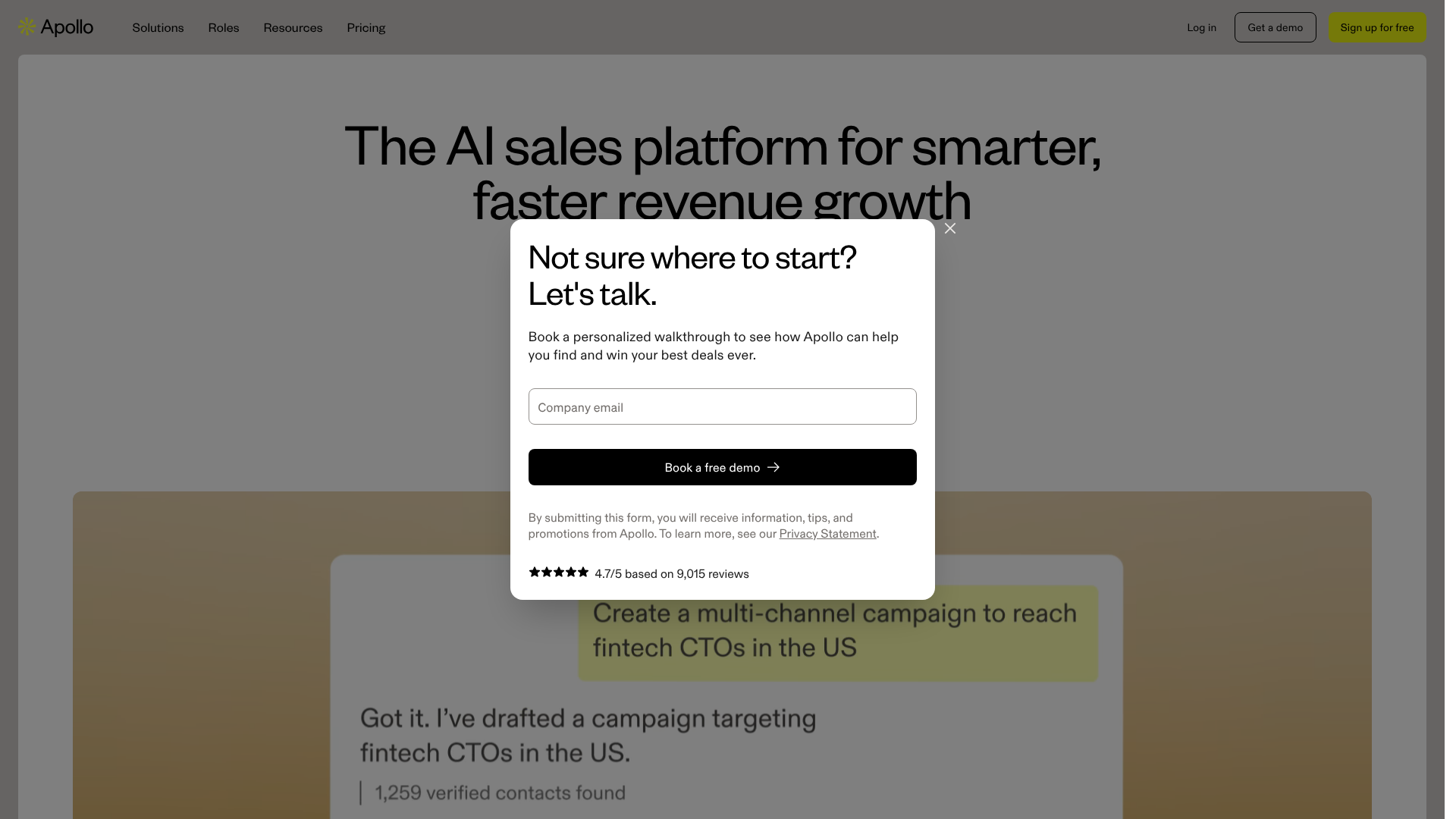
Apollo.io is a powerhouse that combines a massive B2B contact database with a full-featured sequencing tool. You can find prospects, verify their contact information, and enroll them in an outreach campaign all within one platform. This integration saves a significant amount of time and streamlines the entire prospecting workflow.
- Pros: All-in-one prospecting and outreach, huge and accurate database, generous free plan.
- Cons: The interface can feel overwhelming for new users due to the sheer number of features.
Once you start generating leads, you'll need a place to manage them. This is where a Customer Relationship Management (CRM) system becomes essential. A free and powerful option like HubSpot CRM can help you track your conversations, manage your sales pipeline, and ensure every lead is nurtured effectively.
The Pros and Cons of Cold Email Outreach
Like any business strategy, cold emailing has its distinct advantages and potential pitfalls. Understanding both sides is key to setting realistic expectations and implementing a strategy that mitigates risks while maximising rewards. It's not a magic bullet, but a powerful tool when used correctly.
The Advantages
- Direct Access: Cold email cuts through the noise and lands directly in the inbox of key decision-makers, people you might never reach through other channels.
- Scalability: Once you find a message and audience that works, you can scale your outreach efforts significantly with the help of automation tools, allowing you to reach hundreds of targeted prospects per week.
- Cost-Effectiveness: Compared to the high costs of paid advertising, trade shows, or hiring a large sales team, cold email offers an exceptionally high return on investment.
- Measurability: Every aspect of a cold email campaign can be tracked. You get clear data on what subject lines, body copy, and CTAs are performing best, allowing for continuous data-driven improvement.
The Disadvantages
- Low Response Rates (If Done Poorly): A generic, untargeted approach will yield abysmal results and can be a waste of time and resources. Success is entirely dependent on the quality of your strategy.
- Risk to Sender Reputation: If too many recipients mark your emails as spam, your domain's reputation can be damaged. This can cause all future emails from your company (even regular business communications) to land in the spam folder.
- Time-Consuming Personalisation: Crafting truly personalised emails for each prospect takes significant time and effort. It's a trade-off between quality and quantity that every team must balance.
- Legal and Compliance Hurdles: You must be aware of regulations like CAN-SPAM in the US and GDPR in Europe. Failure to comply can result in fines and legal trouble.
Frequently Asked Questions (FAQ) about Writing Cold Emails
Navigating the world of cold email can bring up a lot of questions, from legal concerns to specific writing techniques. Here are detailed answers to some of the most common queries.
How do you write a good cold email?
A good cold email is short, personalised, and focused on the recipient's needs. It starts with a unique opening line that proves you've done your research. The body clearly explains the value you offer by focusing on a problem you can solve, and it ends with a single, low-friction call-to-action. Always proofread it carefully and plan to follow up multiple times.
What is the 60/40 rule in email?
The 60/40 rule is a guideline for content marketing and email newsletters, suggesting that 60% of your content should be valuable, educational, or entertaining, while only 40% should be promotional. While not a direct rule for one-to-one cold emails, the principle is the same: lead with value. Your email should be 100% focused on the recipient's potential problem or interest before you ever introduce your product or service.
What are the 5 C's of email?
The 5 C's are a set of principles for effective business communication. They are: Clear (easy to understand), Concise (brief and to the point), Correct (free of errors), Courteous (polite and professional), and Complete (contains all necessary information). Applying these to your cold emails will make them more professional and effective.
Is cold emailing illegal in the US?
No, cold emailing is not illegal in the United States, provided you comply with the CAN-SPAM Act. Key requirements for B2B emails include not using deceptive subject lines, providing a clear way for recipients to opt-out of future emails, and including your physical address. It's always best to consult with a legal professional, but compliant B2B outreach is generally permissible.
What is the 30/30/50 rule for cold emails?
This is a guideline for allocating your writing effort. It suggests spending 30% of your time on the subject line, 30% on the opening line, and the remaining 50% on the body, CTA, and signature. This rule highlights the immense importance of the first two elements, as your email will be deleted unread if they don't capture the recipient's attention immediately.
Has cold emailing ever worked?
Absolutely. Cold email is responsible for building countless multi-million dollar businesses, especially in the B2B and SaaS sectors. Companies have used it to land their first major clients, secure crucial partnerships, and build their entire sales pipeline. The key is that successful cold emailing is a targeted, strategic discipline, not a lazy mass-messaging tactic.
Is B2B cold email legal?
Yes, B2B cold emailing is legal in most regions, including the US and Europe, as long as you follow specific regulations. In the US, this means complying with the CAN-SPAM Act. In Europe, you must have a "legitimate interest" under GDPR to process someone's data for marketing purposes. This generally means your offer must be relevant to their professional role. Always include an opt-out link.
Final Thoughts: Turning Cold Emails into Warm Conversations
Learning how to write a cold email is less about finding a magic template and more about adopting a mindset of genuine, value-driven communication. The most successful cold emails don't feel cold at all; they feel like the start of a helpful, relevant conversation. They show the recipient that you've taken the time to understand their world before asking for a moment of their time.
Remember that the goal of the first email is not to close a sale. It's to get a reply and start a dialogue. By focusing on personalisation, providing value, and being politely persistent with your follow-ups, you can transform this often-dreaded task into one of your most reliable channels for business growth.
If you're ready to move beyond manual sending and scale your outreach with powerful automation and deliverability features, exploring a dedicated platform is the logical next step. Tools like Reply.io for all-in-one engagement or Instantly.ai for high-volume campaigns can provide the foundation you need to turn these principles into a predictable pipeline of new opportunities.