


What Makes a Good Landing Page Experience? A Marketer's Guide
When you ask, "which attribute describes a good landing page experience?", the answer isn't a single, magic-bullet feature. Instead, a great experience is a careful combination of several user-focused elements working in harmony. It’s the seamless journey a visitor takes from clicking your ad or link to completing a desired action, feeling understood and confident every step of the way. This experience is the critical bridge between attracting a visitor and converting them into a customer, and getting it right directly impacts your campaign's success, ad spend efficiency, and overall return on investment.
- What You'll Learn
- Unpacking the Landing Page Experience: What Does It Really Mean?
- The Core Attributes of Effective Landing Pages
- 1. Unwavering Relevance and Message Match
- 2. A Crystal-Clear and Compelling Call-to-Action (CTA)
- 3. Simplicity and Ease of Navigation
- 4. Lightning-Fast Page Speed
- 5. Flawless Mobile Responsiveness
- 6. Trust and Credibility Signals
- 7. Persuasive Copy and Engaging Visuals
- How to Evaluate and Improve Your Landing Page Experience
- Top Landing Page Builders to Streamline Your Success
- Leadpages: Best for Simplicity and Speed
- Unbounce: Best for AI-Powered Optimisation
- ClickFunnels: Best for Sales Funnels
- Comparison of Key Features and Pricing
- The Pros and Cons of Prioritising Landing Page Experience
- Frequently Asked Questions
- What makes a good landing page?
- What is a key characteristic of an effective landing page?
- What best describes a landing page?
- How long should a landing page be?
- Final Thoughts
Understanding these attributes is the first step towards transforming your landing pages from simple web pages into powerful conversion machines. Whether you're aiming to generate leads, sell a product, or grow your email list, mastering the art of the landing page experience is non-negotiable for modern marketers. This guide breaks down every crucial component, providing a clear roadmap to creating pages that not only look good but perform exceptionally well.
What You'll Learn
- The Core Definition: A good landing page experience is a blend of relevance, clarity, speed, and trustworthiness that guides a user towards a single conversion goal without friction.
- Key Attributes: The most important landing page experience factors include perfect message match with the ad, a crystal-clear call-to-action (CTA), lightning-fast load times, and a mobile-first design.
- The 'Why' Behind It: Optimising this experience leads to higher conversion rates, a better Google Ads Quality Score (which can lower your costs), and increased brand credibility.
- Essential Tools: Dedicated landing page builders like Leadpages, Unbounce, and ClickFunnels are designed to help you implement these best practices efficiently, even without technical skills.
Unpacking the Landing Page Experience: What Does It Really Mean?
A landing page experience is the overall impression and feeling a visitor has while interacting with your landing page. It encompasses everything from the moment the page starts to load to the second they decide to either convert or leave. It's not just about aesthetics; it's about functionality, clarity, and how effectively the page meets the visitor's expectations, which were set by the ad or link they clicked to get there.
From a user's perspective, a good experience feels intuitive and effortless. The page loads quickly, the information they were promised is front and centre, and they know exactly what to do next. There are no confusing navigation menus, distracting pop-ups, or walls of text to sift through. The entire page is singularly focused on helping them achieve a goal, which in turn helps you achieve yours.
For search engines and ad platforms like Google Ads, the landing page experience is a critical ranking factor. Google assesses your page for relevance, originality, and ease of navigation to determine its Quality Score. A high-quality experience tells Google that you're providing value to users, which can result in lower ad costs and better ad positions. In essence, Google rewards you for treating its users well.
The Core Attributes of Effective Landing Pages

Achieving a superior landing page experience requires a deliberate focus on several key components. These are not just suggestions; they are the foundational pillars that support high-converting pages. By mastering these good landing page traits, you create a frictionless path for your visitors.
1. Unwavering Relevance and Message Match
Message match is arguably the most critical attribute. It’s the practice of ensuring the language on your landing page directly reflects the language in the ad or link that brought the visitor there. When a user clicks an ad promising a "50% Discount on Winter Coats," the landing page headline must echo that exact offer. Any disconnect creates confusion and erodes trust instantly, causing visitors to bounce.
Think of it as a conversation. The ad makes a promise, and the landing page fulfils it. This consistency reassures visitors they are in the right place. For example, if your ad targets the keyword "emergency plumbing service," your landing page headline should be something like "Reliable Emergency Plumbing Service, 24/7" not a generic "Welcome to ABC Plumbing." This alignment confirms you can solve their immediate problem, building the confidence needed for them to take the next step.
2. A Crystal-Clear and Compelling Call-to-Action (CTA)
Your landing page should have one goal, and therefore, one primary Call-to-Action (CTA). The CTA is the button or link that prompts the user to take your desired action, such as "Download the Guide," "Start Your Free Trial," or "Book a Consultation." An effective CTA is impossible to miss and easy to understand.
Several factors contribute to a strong CTA. The design should use a contrasting colour that makes it pop from the rest of the page. The copy should be action-oriented, starting with a strong verb that tells the user exactly what will happen when they click. Vague phrases like "Submit" or "Click Here" are far less effective than specific ones like "Get Your Free Quote." The placement is also crucial; it should be visible above the fold (without scrolling) and repeated further down the page if the content is long.
3. Simplicity and Ease of Navigation
Great landing pages are ruthlessly focused. They eliminate all potential distractions that could pull a visitor away from the conversion goal. This often means removing the main website navigation menu, footer links, and social media icons. The more choices you give a visitor, the less likely they are to make the one choice you want them to make.
This principle is known as attention ratio—the ratio of links on a page to the number of conversion goals. On a typical website homepage, the attention ratio might be 50:1 or higher. On an optimised landing page, the attention ratio should be 1:1. Every element on the page, from the headline to the images, should support that single goal.
A clean, uncluttered layout with plenty of white space helps guide the user's eye directly to the most important information and the CTA.
4. Lightning-Fast Page Speed
In 2026, user patience is measured in milliseconds. A slow-loading page is one of the fastest ways to lose a potential customer. Research consistently shows that as page load time increases, the probability of a visitor bouncing skyrockets. Even a one-second delay can lead to a significant drop in conversions.
Your page must be optimised for speed across all devices. This involves compressing images, minifying code (CSS, JavaScript), and using a fast web host. You can use free tools like Google's PageSpeed Insights to analyse your page's performance and get specific recommendations for improvement. Many modern landing page builders, like Leadpages, are built on infrastructure optimised for speed, taking much of this technical work off your plate.
5. Flawless Mobile Responsiveness
A significant portion of web traffic comes from mobile phones. Your landing page must provide an excellent experience on a small screen. Mobile responsiveness isn't just about your page shrinking to fit; it's about the content reformatting itself for optimal usability on a mobile device.
This means text should be large and readable without pinching or zooming. Forms should be easy to fill out with a thumb, and buttons should be large enough to tap accurately. The layout should be single-column, making it easy to scroll through the content. Always test your landing page on a real mobile device, not just a desktop simulator, to ensure the experience is truly seamless.
6. Trust and Credibility Signals
Before a visitor gives you their email address or credit card information, they need to trust you. Trust signals are elements on your page that build credibility and reduce anxiety. These are essential for convincing sceptical visitors that you are a legitimate and trustworthy business.
Common trust signals include:
- Testimonials and Reviews: Quotes or star ratings from happy customers provide powerful social proof.
- Trust Badges: Logos of well-known clients, security seals (like Norton or McAfee), or industry awards.
- Data and Statistics: Specific numbers that back up your claims (e.g., "Trusted by over 10,000 businesses").
- Privacy Policy: A clear link to your privacy policy assures visitors you handle their data responsibly.
7. Persuasive Copy and Engaging Visuals
Your words and images must work together to tell a compelling story. The headline is the most important piece of copy, as it's the first thing most people read. It must grab their attention and clearly state the primary benefit of your offer.
The body copy should expand on this benefit, focusing on how your offer solves the visitor's problem rather than just listing features. Use bullet points to make key benefits easy to scan. High-quality images or a short video can help visitors visualise the product or outcome, making the offer more tangible and desirable. Ensure your visuals are relevant and professional, as poor-quality images can harm credibility.
How to Evaluate and Improve Your Landing Page Experience

Knowing the attributes of effective landing pages is one thing; implementing and refining them is another. Continuous improvement is key to maximising your conversion rates. This involves a cycle of auditing, testing, and analysing your pages to identify and fix points of friction.
Conducting a Landing Page Audit
Start by performing a simple audit of your existing landing pages. Go through the page from the perspective of a first-time visitor and ask yourself these questions:
- Message Match: Does the headline perfectly match the ad I would have clicked?
- Clarity: Is the offer and its value immediately obvious within 5 seconds?
- CTA: Is there a single, clear call-to-action? Is it easy to find and understand?
- Distractions: Are there any unnecessary links or elements that could pull me away from the goal?
- Mobile Experience: How does this page look and function on my mobile phone? Is it easy to use?
- Trust: Are there elements on the page that make me feel confident and secure?
- Speed: Does the page load almost instantly?
This simple checklist will quickly reveal the most glaring issues that need to be addressed. Be honest in your assessment; small friction points that you might overlook can be major roadblocks for new visitors.
Pro Tip: Use a tool like Hotjar or Crazy Egg to create heatmaps of your landing pages. Heatmaps visually show where users are clicking, moving their mouse, and scrolling. This can provide invaluable insights into which parts of your page are getting attention and which are being ignored.
The Power of A/B Testing
You should never assume you know what will work best. A/B testing, or split testing, is the process of creating two versions of your landing page (a control 'A' version and a variation 'B' version) and showing them to different segments of your audience to see which one performs better. This data-driven approach removes guesswork from optimisation.
Even small changes can have a big impact. Some of the most effective elements to A/B test include:
Headlines: Test a benefit-driven headline against a more direct, feature-focused one. * CTA Button Copy: Test "Get Your Free Ebook" vs. "Download Now."
CTA Button Colour: Test a green button against an orange one.
Images: Test a photo of a person against a product image. * Form Length: Test a form with five fields against one with only two.
Tools like Unbounce have built-in A/B testing capabilities that make it incredibly easy to set up and run experiments. The key is to only test one element at a time so you can accurately attribute any change in performance to that specific modification.
Top Landing Page Builders to Streamline Your Success
Creating a high-performing landing page from scratch can be a technical challenge. Fortunately, a range of powerful landing page builders exist to help marketers create, test, and publish optimised pages without needing to write a single line of code. These platforms are designed with conversion best practices in mind.
Leadpages: Best for Simplicity and Speed
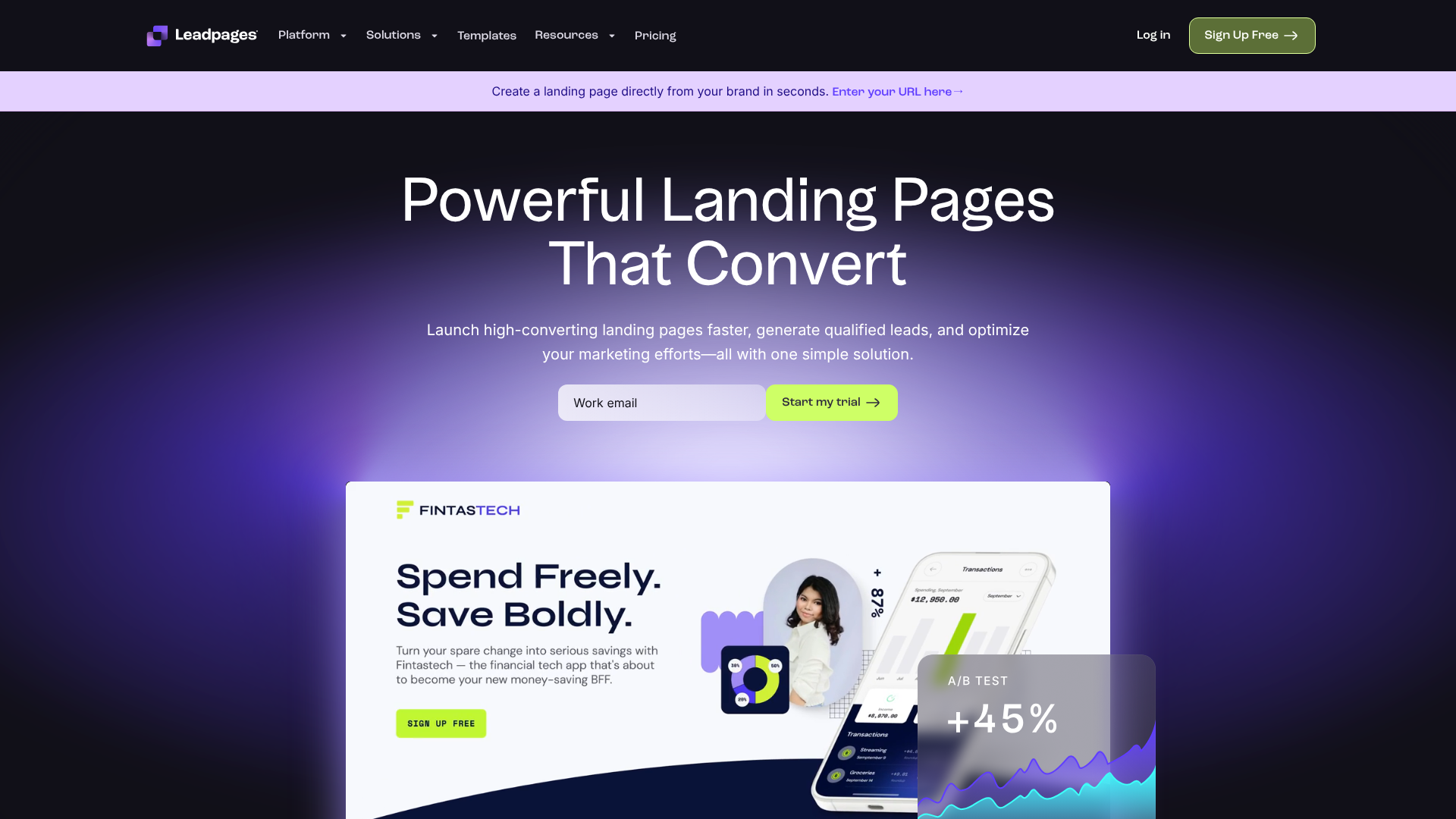
Leadpages is a fantastic option for small businesses, entrepreneurs, and marketers who value speed and ease of use. It offers a vast library of mobile-responsive templates that are sorted by conversion rate, giving you a head start. Its drag-and-drop editor is intuitive, allowing you to customise pages quickly.
One of its standout features is its focus on page load speed. Leadpages hosts your pages on its optimised infrastructure, ensuring they are consistently fast. It also includes built-in features like pop-ups and alert bars to help you capture even more leads. It's an all-around solid choice for getting professional landing pages live in minutes.
Unbounce: Best for AI-Powered Optimisation
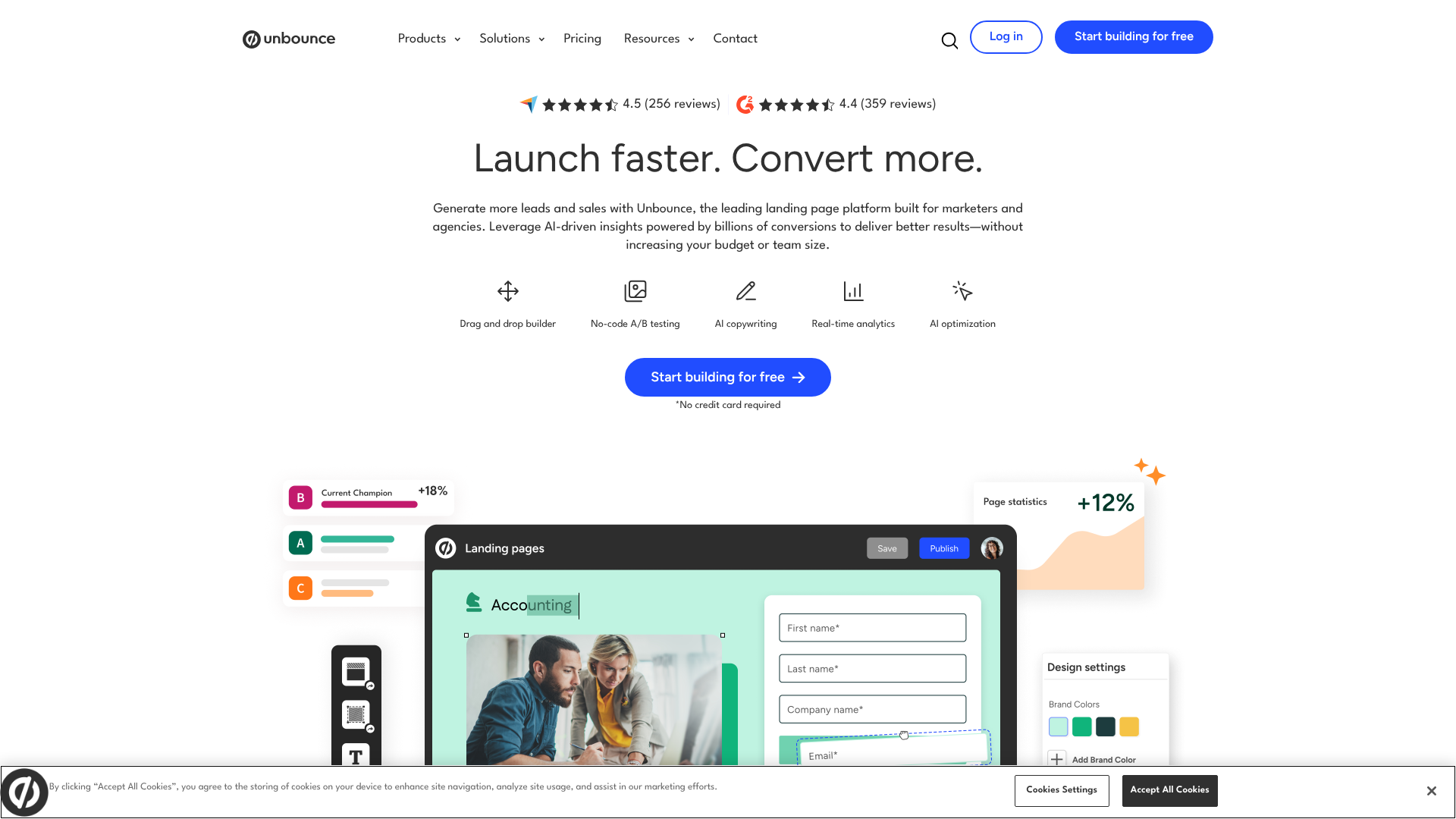
Unbounce is geared towards more data-driven marketers and agencies who want powerful optimisation and testing tools. While it also has a user-friendly drag-and-drop builder, its strength lies in its advanced features. The Smart Traffic tool, for example, uses AI to automatically direct visitors to the landing page variant they are most likely to convert on.
This AI-powered approach can significantly accelerate your testing and learning process. Unbounce also offers excellent flexibility for customisation, integrations with popular marketing tools, and features like Dynamic Text Replacement, which personalises page copy based on the user's search query. It's a robust platform for serious optimisation.
ClickFunnels: Best for Sales Funnels
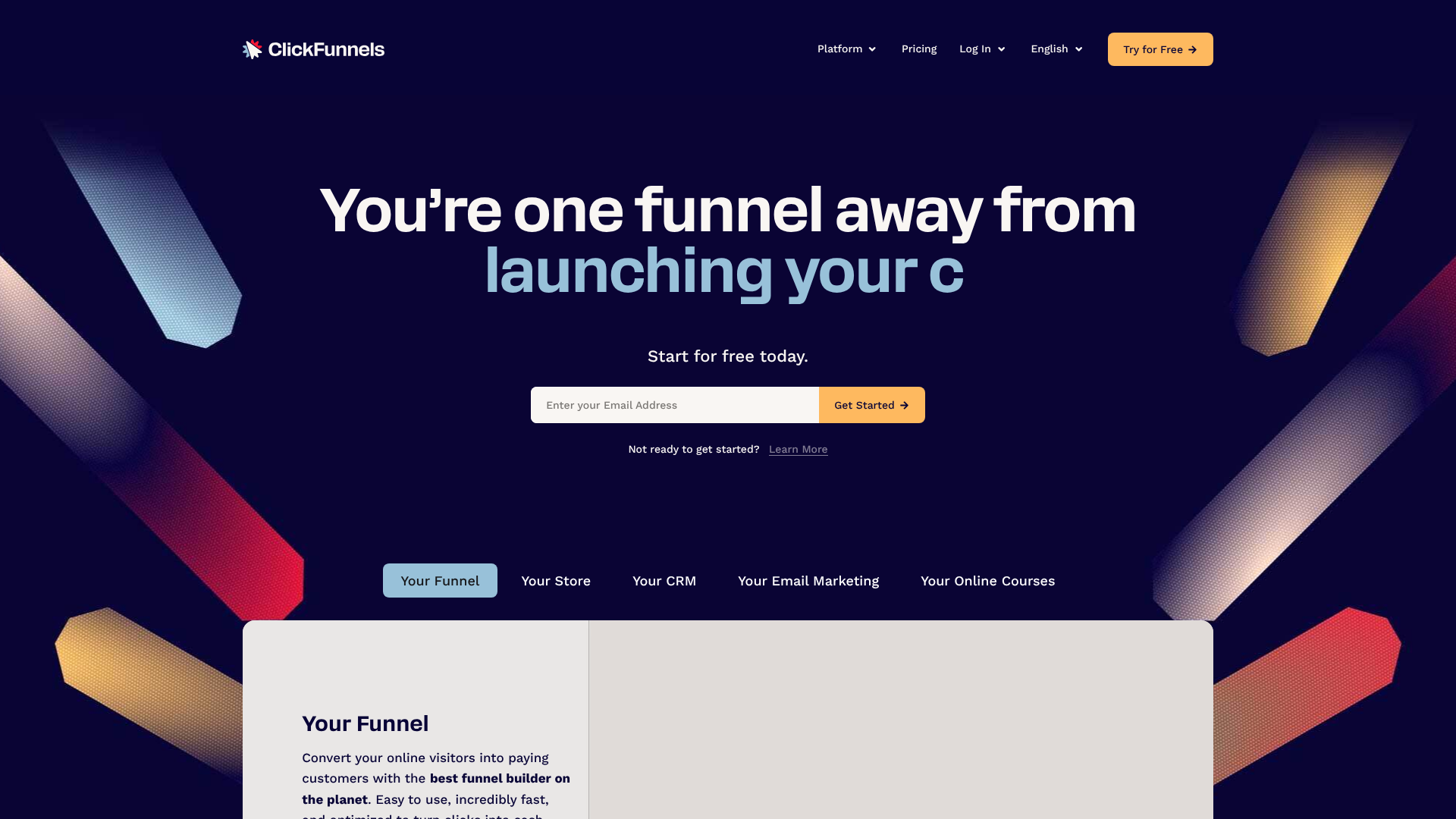
ClickFunnels is more than just a landing page builder; it's a platform for creating entire sales funnels. It's designed for entrepreneurs, course creators, and businesses that sell products or services online. Instead of creating a single page, you build a series of pages (e.g., landing page, order form, upsell page) that guide a customer through a complete purchasing journey.
It provides numerous pre-built funnel templates for different goals, such as lead generation, webinar registrations, or product sales. While it might be overkill if you only need a simple landing page, it is an incredibly powerful tool for those looking to build and automate a complete online sales process. If that sounds like a good fit for your business, you might want to explore what ClickFunnels has to offer.
Comparison of Key Features and Pricing
Choosing the right tool depends on your specific needs, technical comfort level, and budget. Here’s a quick overview to help you compare.
| Feature | Leadpages | Unbounce | ClickFunnels |
|---|---|---|---|
| Best For | Small Businesses, Beginners | Data-Driven Marketers, Agencies | Entrepreneurs, Funnel Building |
| Ease of Use | Very High | High | Medium |
| A/B Testing | Standard | Advanced (with AI) | Yes |
| Templates | Large Library | Large Library | Funnel-Specific Templates |
| Unique Feature | Conversion-Sorted Templates | AI Smart Traffic | Full Funnel Builder |
| Pricing Model | Tiered monthly/annual plans | Tiered monthly/annual plans | Two main tiers |
For the most up-to-date pricing information, it is always best to visit the official websites of each platform as plans and features can change.
The Pros and Cons of Prioritising Landing Page Experience
Investing time and resources into optimising your landing pages comes with significant advantages, but it's also important to be aware of the potential challenges. Understanding both sides helps you allocate your efforts effectively.
The Upside: Key Benefits of a Great Experience
Focusing on the landing page experience factors yields substantial rewards that ripple across your entire marketing efforts. The benefits are clear and measurable.
- Higher Conversion Rates: This is the most direct benefit. By removing friction and building trust, you make it easier for visitors to say "yes" to your offer, leading to more leads, sales, and sign-ups.
- Lower Advertising Costs: On platforms like Google Ads, a better landing page experience contributes to a higher Quality Score. A higher Quality Score can lead to lower costs per click (CPC) and better ad placements, stretching your budget further.
- Improved Brand Perception: A professional, fast, and easy-to-use landing page reflects positively on your brand. It communicates competence and a customer-centric approach, building long-term brand equity.
- Higher Quality Leads: A clear and relevant landing page ensures that the people who convert truly understand your offer. This means the leads you generate are more likely to be qualified and interested in what you have to sell.
The Downside: Potential Challenges
While the benefits are compelling, creating a top-tier experience requires commitment. It's not a "set it and forget it" task.
- Time Investment: Proper optimisation requires ongoing effort. You need to consistently audit pages, develop hypotheses, run A/B tests, and analyse the results. This can be a time-consuming process.
- Resource Allocation: You may need to invest in landing page builder software, analytics tools, or even professional design and copywriting services to achieve the best results.
- Technical Knowledge: While builders simplify the process, some aspects of optimisation, like improving page speed, can still have a technical component. You might need to learn new skills or hire help.
- Risk of Over-Optimisation: It's possible to get so caught up in testing tiny details that you lose sight of the bigger picture. Sometimes, a radical redesign is needed, not just changing a button colour.
Frequently Asked Questions
Here are answers to some of the most common questions people have about landing pages and their effectiveness.
What makes a good landing page?
A good landing page excels at one thing: converting visitors for a specific goal. It achieves this through a combination of key attributes: it has a single, compelling call-to-action (CTA), its message perfectly matches the ad that brought the visitor, it loads quickly, it's easy to use on a mobile device, and it removes all distractions like site navigation. It also uses trust signals like testimonials to build credibility and make visitors feel confident in taking action.
What is a key characteristic of an effective landing page?
If you had to choose just one, the most critical characteristic is relevance, often referred to as message match. An effective landing page immediately confirms to the visitor that they are in the right place by presenting a headline and offer that directly corresponds to the ad or link they clicked. This seamless transition from promise to fulfilment is the foundation upon which all other conversion elements are built. Without it, even the best-designed page will fail.
What best describes a landing page?
A landing page is best described as a standalone web page, distinct from a company's main website, that has been designed for a single, focused objective. It's the destination a visitor "lands" on after clicking a link in an email, a social media post, or an online advertisement. Unlike a homepage, which has many goals and links, a landing page is built with a 1:1 attention ratio, meaning its sole purpose is to get a visitor to complete one specific action.
How long should a landing page be?
The ideal length of a landing page depends entirely on the complexity of the offer and the level of commitment you are asking for. For a simple, low-commitment offer like a free ebook download, a short, concise page that gets straight to the point is usually best. For a high-commitment, expensive product or service, a longer page may be necessary to provide enough information, address potential objections, and build sufficient trust to persuade the visitor to convert.
Final Thoughts
Ultimately, the answer to "which attribute describes a good landing page experience?" is that there isn't just one. A successful experience is a holistic blend of relevance, clarity, speed, design, and trust. It's about seeing your page through your visitors' eyes and removing every possible obstacle that stands between them and the conversion goal.
By focusing on the core attributes of effective landing pages outlined in this guide, you can move beyond simply having a page online to creating a strategic asset that consistently drives results for your business. The process is one of continuous improvement, where auditing, testing, and listening to user data become your most valuable marketing activities.
If you're ready to build high-converting pages without the technical headache, using a dedicated platform is the most efficient path forward. Tools like Leadpages for its simplicity, Unbounce for its AI power, and ClickFunnels for complete sales funnels are all excellent starting points for putting these principles into practice.