

Key Attributes of a Good Landing Page Experience: A Marketer's Guide
You've spent time and money crafting the perfect ad. The copy is sharp, the creative is compelling, and the targeting is precise. A user clicks, filled with intent and expectation, only to land on a page that’s slow, confusing, or irrelevant. That click, which you paid for, is now a wasted opportunity.
- Essential Points
- What Exactly Defines a Good Landing Page Experience?
- The Core Attributes of Effective Landing Pages That Drive Conversions
- 1. Unwavering Relevance and Message Match
- 2. A Crystal-Clear and Compelling Value Proposition
- 3. A Singular, Unmistakable Call-to-Action (CTA)
- 4. Lightning-Fast Page Load Speed
- 5. Flawless Mobile Responsiveness
- 6. Trust Signals and Social Proof
- 7. Distraction-Free Design and Navigation
- Choosing the Right Tools to Build High-Converting Landing Pages
- Top Landing Page Builder Recommendations for 2026
- Leadpages: Best for Small Businesses and Solopreneurs
- Unbounce: Best for Performance Marketers and Agencies
- Instapage: Best for Enterprise Teams and Personalisation
- ClickFunnels: Best for Sales Funnels and Digital Products
- Landing Page Builder Pricing and Cost Comparison
- The Pros and Cons of a Focused Landing Page Strategy
- Frequently Asked Questions (FAQ)
- What are the three main characteristics of a good website page?
- What is the difference between a landing page and a homepage?
- How many links should be on a landing page?
- What makes a landing page stand out?
- Final Thoughts: Putting It All Together
This scenario highlights why understanding the attributes of a good landing page experience is not just a best practice; it's fundamental to the success of any digital marketing campaign. It’s the critical link between attracting a visitor and converting them into a customer.
A great landing page experience is a carefully orchestrated blend of design, psychology, and technical performance. It’s about fulfilling the promise you made in your ad and guiding the user to a single, desired action without friction. Getting this right means higher conversion rates, a better return on ad spend (ROAS), and more valuable data to inform your future strategies. Neglecting it is like inviting guests to a party but locking the front door.
This guide breaks down the essential landing page experience factors that separate high-converting pages from those that leak money. We will explore each attribute in detail, from message match and page speed to the psychology behind a powerful call-to-action, giving you a clear roadmap to building pages that work.
Essential Points
- Relevance is Paramount: A good landing page experience begins with a perfect match between the ad and the page content. This 'message match' confirms the user is in the right place and immediately builds trust.
- Clarity and Focus Win: The most effective landing pages have one single, clear goal. They eliminate distractions like site navigation to guide the user towards a specific call-to-action (CTA).
- Speed is a Conversion Factor: Every second of loading time drastically increases your bounce rate. A fast, responsive page, especially on mobile, is a non-negotiable attribute for success.
- Trust is the Foundation: Visitors won't convert if they don't trust you. Key traits like social proof (testimonials, reviews), security badges, and professional design are essential for building credibility.
What Exactly Defines a Good Landing Page Experience?
A common misconception is that a good landing page is simply one that looks visually appealing. While aesthetics play a role, the true definition goes much deeper. A good landing page experience is the measure of how effectively a standalone web page meets the expectations of a visitor who arrived from a specific marketing source, like a Google Ad, a social media post, or an email campaign.
Think of it as a focused conversation. Your ad starts the conversation by making a promise or sparking curiosity. The landing page must continue that exact conversation seamlessly. If your ad promises a "50% Discount on Running Shoes," the landing page shouldn't talk generally about your sports shop; it must prominently feature that 50% discount and make it easy for the user to claim it.
This alignment between the ad's promise and the page's delivery is the cornerstone of a positive experience.
Ultimately, the experience is judged by its ability to guide a user toward a single conversion goal with minimal cognitive load. This means the user shouldn't have to think hard about what to do next. The value proposition should be obvious, the benefits clear, and the call-to-action unmissable. It's a strategic exercise in removing friction and building momentum towards a single, valuable outcome.
The Core Attributes of Effective Landing Pages That Drive Conversions

While there isn't one single attribute that defines a good landing page, a successful page is a combination of several critical elements working in harmony. Mastering these core attributes is what transforms a simple page into a powerful conversion machine. Each one addresses a specific psychological or practical need of the user, guiding them smoothly from click to conversion.
1. Unwavering Relevance and Message Match
Message match is the principle of keeping your messaging consistent from the ad creative to the landing page. The headline on your page should directly reflect the headline of the ad the user clicked. The imagery, language, and offer must all align perfectly. This is arguably the most important of all landing page experience factors.
When a user clicks your ad, they have a specific expectation in mind. Message match confirms that they've arrived at the right destination to fulfil that expectation. A disconnect, such as a different headline or a missing offer, creates immediate confusion and distrust, causing most users to hit the 'back' button within seconds. This increases your bounce rate and tells advertising platforms like Google that your page isn't relevant, which can negatively impact your Ad Quality Score and increase your costs.
To achieve a strong message match, meticulously align your ad copy, keywords, and landing page content. If your ad targets the keyword "emergency plumbing services in Manchester," your landing page headline must be something like "Reliable Emergency Plumber in Manchester," not a generic "Welcome to ABC Plumbing." This direct confirmation reassures the user and keeps them engaged.
2. A Crystal-Clear and Compelling Value Proposition
When a visitor lands on your page, you have about three to five seconds to answer their most important question: "What's in it for me?" Your value proposition, communicated primarily through the headline and sub-headline, must provide a clear and concise answer. It should explain the benefit of your offer and what makes you different from competitors.
A weak or confusing value proposition is a primary reason for high bounce rates. If a user can't immediately understand what you're offering and why it matters to them, they won't invest the time to figure it out. They'll simply leave and find a competitor whose message is clearer.
To craft a compelling value proposition, focus on the outcome for the user. Instead of a feature-based headline like "Our Software Has AI Integration," use a benefit-driven one like "Automate Your Reporting in 60 Seconds with AI." Be specific, use the language of your target audience, and ensure it's the most prominent element a visitor sees when the page loads.
3. A Singular, Unmistakable Call-to-Action (CTA)
One of the most crucial good landing page traits is having a single conversion goal. A landing page is not a website homepage with dozens of links and options. Its purpose is to drive one specific action, whether that's downloading an ebook, signing up for a webinar, or purchasing a product.
Presenting visitors with too many choices leads to decision paralysis. When a user has to decide between reading your blog, following you on social media, or signing up for your offer, they often choose to do nothing at all. By removing all other distractions, such as the main website navigation menu and unnecessary footer links, you create a focused environment that channels all the user's attention towards the CTA.
Your CTA button should be visually distinct, using a contrasting colour that makes it pop from the rest of the page. The copy on the button should be action-oriented and specific. Instead of generic words like "Submit" or "Click Here," use descriptive text that reinforces the value, such as "Get Your Free Quote Now" or "Download My Ebook."
Pro Tip: Place your CTA button above the fold (visible without scrolling) and consider repeating it further down the page for longer landing pages. This ensures the user always has a clear next step, no matter where they are on the page.
4. Lightning-Fast Page Load Speed
In the modern digital world, user patience is incredibly thin. Research consistently shows that as page load time goes from one second to three seconds, the probability of a user bouncing increases by over 30%. For mobile users, the expectation for speed is even higher. A slow-loading page is a direct barrier to conversion and a primary attribute of a poor user experience.
Slow speeds frustrate users and can make your brand appear unprofessional or untrustworthy. Furthermore, page speed is a confirmed ranking factor for Google Search and a component of the Ad Quality Score for Google Ads. A faster page can lead to better organic visibility and lower advertising costs, making it a critical technical SEO consideration.
To improve your page speed, focus on optimising all images by compressing them without losing quality. You should also minimise the use of heavy scripts, use browser caching, and choose a high-quality hosting provider. You can use free tools like Google's PageSpeed Insights to analyse your page and get specific recommendations for improvement.
5. Flawless Mobile Responsiveness
With the majority of web traffic now coming from mobile devices, a mobile-first design is no longer optional—it's essential. A landing page that is not optimised for mobile is effectively ignoring a huge portion of its potential audience. A non-responsive design forces users to pinch and zoom to read text or click buttons, creating a frustrating experience that leads to immediate abandonment.
The attributes of a good mobile landing page experience include large, easily tappable buttons, legible font sizes without zooming, and forms that are simple to fill out on a small screen. The layout should be a single column that is easy to scroll through, with the most important information presented first.
Always test your landing pages on actual mobile devices, not just in a desktop browser emulator. This helps you understand the real-world user experience and identify any friction points. Building your pages with a responsive design framework or using a landing page builder with mobile-optimised templates is the most effective way to ensure a seamless experience across all devices.
6. Trust Signals and Social Proof
Before a visitor will give you their email address or credit card information, they need to trust you. Trust signals are elements on your page that build credibility and reduce the perceived risk of taking action. Without them, even the most compelling offer can fail to convert.
Social proof is one of the most powerful types of trust signals. This includes customer testimonials, user reviews, star ratings, case studies, and logos of well-known clients you've worked with. When visitors see that others have used and benefited from your product or service, it validates their decision and makes them feel more confident.
Other important trust signals include security badges (like SSL certificates, indicated by the padlock in the browser), privacy policy links, and clear contact information. These elements show that you are a legitimate and transparent business that values user security and privacy. Strategically place these trust signals near your CTA to reassure users at the critical moment of decision.
7. Distraction-Free Design and Navigation
An effective landing page is a closed loop. The goal is to guide the user from the ad to the conversion with as few exit points as possible. This is why one of the most common attributes of effective landing pages is the removal of the main website navigation menu.
Every link on your page that doesn't lead to the conversion goal is a potential leak in your funnel. A link to your "About Us" page or your blog gives the user an excuse to wander off and forget why they came to the landing page in the first place. By creating a focused, minimalist design, you keep the user's attention squarely on the value proposition and the call-to-action.
This principle extends to the overall design. Use plenty of white space to make the content easy to read and digest. Avoid cluttered layouts, competing visual elements, or auto-playing videos that can distract or annoy the user. The entire design should work to support the primary goal: getting the user to click the CTA.
Choosing the Right Tools to Build High-Converting Landing Pages
Understanding the theory behind a good landing page experience is one thing; implementing it is another. While it's possible to code landing pages from scratch, this approach can be slow, expensive, and difficult to scale, especially when you need to run A/B tests and create multiple variations for different campaigns.
This is where dedicated landing page builders come in. These software platforms are specifically designed to help marketers create, test, and optimise landing pages quickly and efficiently, without needing to write a single line of code. They provide the framework to easily implement all the key attributes we've discussed.
Modern landing page builders offer a suite of features that are essential for performance marketing. These include vast libraries of professionally designed, mobile-responsive templates that are already optimised for conversions. They also feature intuitive drag-and-drop editors, built-in A/B testing capabilities, and seamless integrations with email marketing and CRM platforms. Using one of these tools is often the fastest path to launching pages that deliver results.
Top Landing Page Builder Recommendations for 2026
Selecting the right landing page builder depends on your budget, technical skill, and specific marketing goals. Here are some of the top recommendations that cater to different needs, from solo entrepreneurs to large enterprise teams.
Leadpages: Best for Small Businesses and Solopreneurs
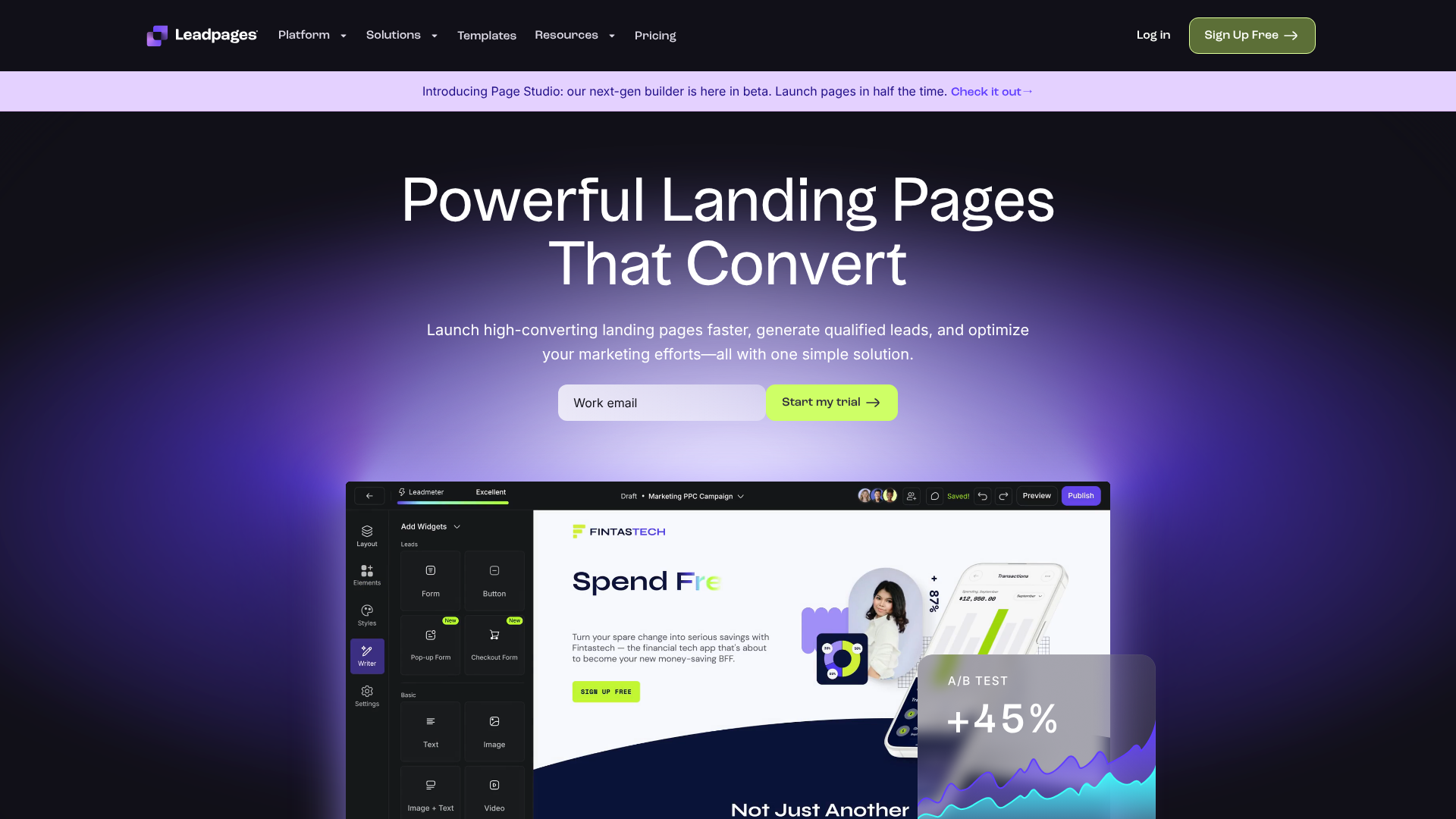
Leadpages is renowned for its ease of use and affordability, making it an excellent choice for small businesses, consultants, and entrepreneurs who need to get effective pages live quickly. It offers a huge selection of high-converting templates for various industries and goals, from webinar registrations to ebook downloads.
One of its standout features is the Leadmeter, a real-time optimisation tool that provides suggestions to improve your page's conversion potential as you build it. It also includes features like pop-ups and alert bars to help capture leads across your entire website, not just on dedicated landing pages.
Pros
- Extremely user-friendly drag-and-drop builder.
- Large library of mobile-responsive templates.
- Affordable pricing plans with unlimited traffic.
Cons
- A/B testing is not available on the most basic plan.
- Customisation options can be more limited compared to more advanced builders.
Unbounce: Best for Performance Marketers and Agencies
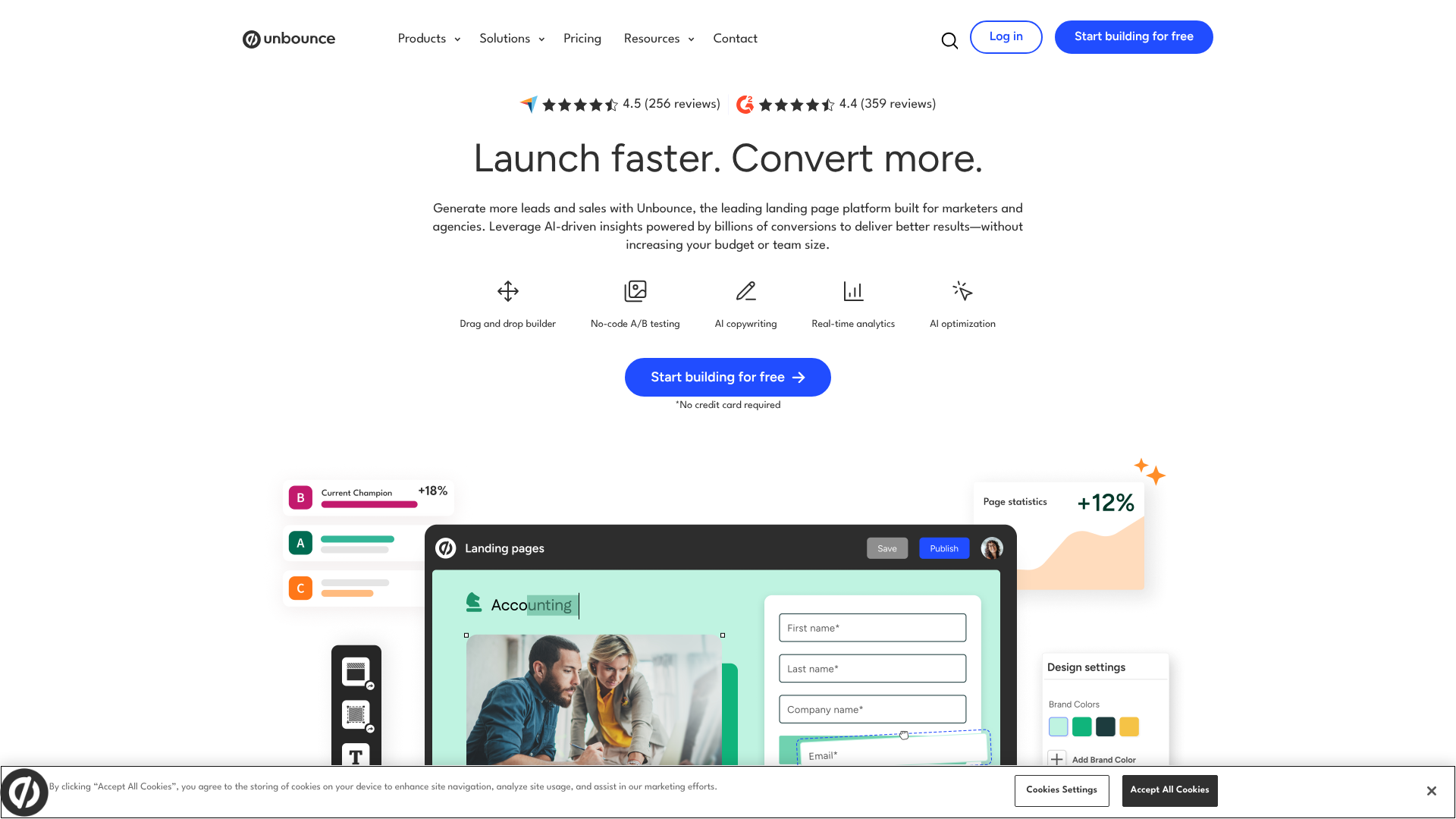
Unbounce is a powerful and flexible platform built for marketers who are serious about data-driven optimisation. It offers robust A/B testing capabilities and advanced features designed to maximise conversion rates for paid ad campaigns.
Its most impressive feature is Smart Traffic, an AI-powered tool that automatically analyses a visitor's attributes (like their location and device) and sends them to the landing page variant most likely to convert for them. Unbounce also offers Dynamic Text Replacement, which automatically matches the copy on your landing page to the user's search query, ensuring perfect message match.
Pros
- Advanced A/B testing and AI-powered optimisation tools.
- High degree of design flexibility and customisation.
- Powerful integrations with a wide range of marketing tools.
Cons
- Steeper learning curve compared to simpler tools.
- Higher price point, making it more suitable for businesses with a significant ad budget.
Instapage: Best for Enterprise Teams and Personalisation
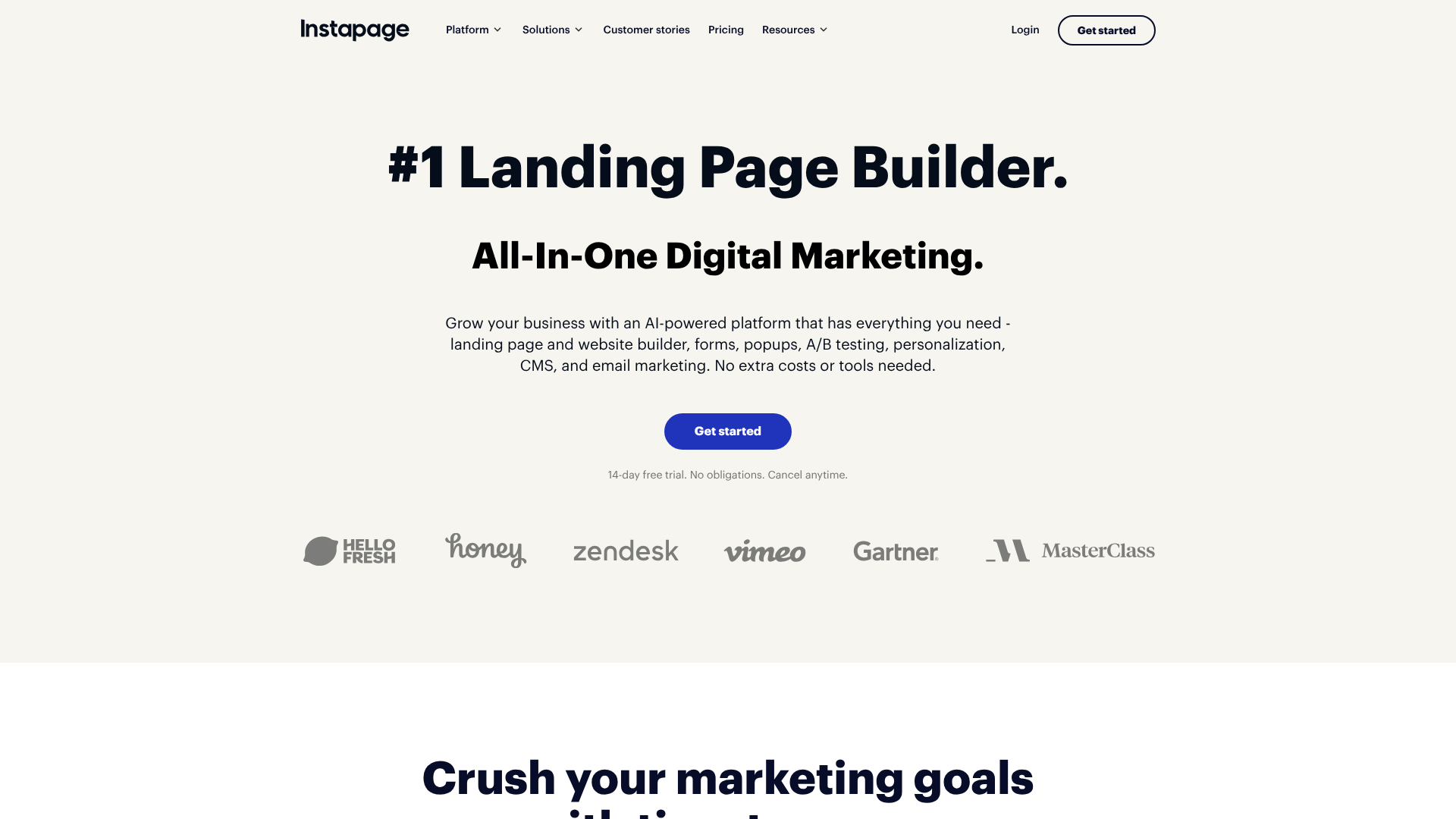
Instapage is a premium landing page platform that excels at providing personalisation at scale, making it ideal for large marketing teams and enterprise clients. Its core strength lies in its ability to create unique, 1:1 ad-to-page experiences for different audience segments.
The platform's AdMap feature allows you to visualise your ad campaigns and easily connect each ad group to a unique, relevant landing page experience. Instapage also offers robust collaboration tools for teams, heatmaps to analyse user behaviour, and guaranteed fast page load speeds through its Thor Render Engine technology.
Pros
- Unmatched personalisation and scalability features.
- Excellent collaboration tools for large teams.
- Built-in heatmaps and analytics.
Cons
- The most expensive option on this list.
- May be overly complex for small businesses or simple campaigns.
ClickFunnels: Best for Sales Funnels and Digital Products
ClickFunnels is more than just a landing page builder; it's an all-in-one platform for creating entire marketing and sales funnels. It's particularly popular among entrepreneurs, course creators, and coaches who sell digital products and services online.
The platform allows you to guide a visitor through a multi-step process, from an initial landing page to an order form, upsells, and a final thank you page. It includes a built-in shopping cart, email autoresponder, and affiliate management tools, providing a complete solution for selling online. If your goal is not just to capture a lead but to guide a customer through a complete sales journey, ClickFunnels is a powerful choice.
Pros
- Excellent for building complete sales funnels from start to finish.
- All-in-one platform includes shopping cart and email marketing.
- Strong focus on direct-response marketing principles.
Cons
- Can be less flexible for creating simple, standalone landing pages.
- The user interface can feel less modern compared to other builders.
Landing Page Builder Pricing and Cost Comparison
Investing in a landing page builder is an investment in higher conversion rates. While pricing varies, the return on investment often comes quickly through improved campaign performance. Here’s a brief overview of how these platforms compare.
| Tool | Best For | Starting Price | Key Feature |
|---|---|---|---|
| Leadpages | Small Businesses | Visit website for current pricing | Ease of use & Leadmeter |
| Unbounce | Performance Marketers | Visit website for current pricing | AI Smart Traffic & A/B Testing |
| Instapage | Enterprise Teams | Visit website for current pricing | 1:1 Ad-to-Page Personalisation |
| ClickFunnels | Sales Funnels | Visit website for current pricing | All-in-one funnel building |
It's important to evaluate these tools not just on price, but on the value they provide for your specific needs. A more expensive tool with advanced optimisation features might deliver a far better ROI for a high-traffic campaign than a cheaper, more basic option.
The Pros and Cons of a Focused Landing Page Strategy
Adopting a dedicated landing page strategy for your marketing campaigns offers significant advantages, but it's also important to be aware of the potential challenges. Understanding both sides can help you allocate resources effectively.
The Advantages
- Higher Conversion Rates: This is the primary benefit. By providing a focused, distraction-free experience that is highly relevant to the user's intent, you dramatically increase the likelihood of them taking your desired action.
- Improved Ad Campaign ROI: Platforms like Google Ads reward relevance. A good landing page experience leads to a higher Quality Score, which can result in lower cost-per-click (CPC) and better ad positions, directly improving your return on investment.
- Clearer Data and Insights: Because landing pages are focused on a single goal, they are perfect for A/B testing. You can easily test different headlines, images, or CTAs to gather clear, actionable data on what resonates with your audience.
- Enhanced Audience Segmentation: You can create unique landing pages for different audience segments, customer personas, or stages of the buyer's journey. This allows you to deliver highly personalised messaging that speaks directly to the needs of each group.
The Potential Downsides
- Resource Intensive: Creating, managing, and optimising unique landing pages for every campaign or ad group requires time and effort. This can be a challenge for small teams with limited resources.
- Potential Cost: While there are free tools available, the most powerful landing page builders come with a monthly subscription fee. This cost needs to be factored into your marketing budget.
- Risk of Over-Simplification: In the quest to remove distractions, it's possible to remove too much information. If a user needs more details to make an informed decision about a complex product, an overly simplistic page might fail to convert.
Pro Tip: Start small. You don't need a unique landing page for every single keyword. Begin by creating dedicated pages for your highest-traffic ad groups and expand your strategy as you gather data and see results.
Frequently Asked Questions (FAQ)
What are the three main characteristics of a good website page?
While landing pages are unique, three universal characteristics of any good web page are clarity, user-centricity, and value. First, the page must have a clear purpose that is immediately obvious to the visitor. Second, it must be designed with the user in mind, meaning it's easy to navigate, fast-loading, and mobile-friendly. Finally, it must provide genuine value to the user, whether through information, entertainment, or a solution to their problem.
What is the difference between a landing page and a homepage?
The primary difference is focus. A homepage is like the lobby of a building; it has many doors and is designed to direct different types of visitors to various sections of the website (e.g., blog, products, about us). A landing page, in contrast, is like a single room with only one door—the call-to-action. It is designed for a specific marketing campaign with a single conversion goal and typically has no site navigation to distract the user.
How many links should be on a landing page?
Ideally, as few as possible. The goal is to minimise 'leaks' from your conversion funnel. The most important link should be your call-to-action button. Beyond that, you should only include links that are legally required or essential for building trust, such as a link to your Privacy Policy or Terms of Service, which are often placed discreetly in the footer.
Every other link is a potential distraction.
What makes a landing page stand out?
A landing page stands out when it combines a powerful and unique value proposition with compelling design and undeniable social proof. It's not just about one element, but how they work together. A page that clearly articulates a unique benefit, presents it in a visually engaging way, and backs up its claims with glowing customer testimonials will always perform better than a generic page that simply lists features.
Final Thoughts: Putting It All Together
There is no single magic attribute that describes a good landing page experience. Instead, it is the thoughtful integration of multiple factors: the perfect relevance of message match, the persuasive power of a clear value proposition, the urgency of a singular CTA, the seamlessness of fast and mobile-friendly design, and the reassuring comfort of trust signals.
Building pages that convert is a process of continuous improvement. It requires understanding your audience, testing your assumptions, and relentlessly removing friction from the user's journey. By focusing on the core attributes discussed in this guide, you move from simply buying traffic to creating valuable conversion assets.
If you're ready to stop wasting ad spend and start building pages that deliver measurable results, consider exploring a dedicated tool. For marketers looking to build complete sales funnels, ClickFunnels is a powerful option, while platforms like Leadpages and Unbounce offer excellent features for creating and optimising focused campaign pages.