
What Attributes Describe a Good Landing Page Experience? A Marketer's Guide
Your landing page is the digital handshake between your brand and a potential customer. It’s a focused, purpose-built page designed to achieve one specific goal: conversion. But getting a visitor to click your ad is only half the battle. The real challenge lies in providing an experience so smooth, relevant, and trustworthy that they are compelled to take action.
- What You'll Learn
- The Need for Speed: Why Page Load Time is Non-Negotiable
- Mobile-First by Design: The Critical Role of Responsiveness
- A Picture is Worth a Thousand Clicks: Using Visuals Effectively
- Message Match: The Power of Clear and Relevant Content
- The All-Important Ask: Mastering Your Call-to-Action (CTA)
- Decoding Visitor Intent: The Foundation of a Great Experience
- Less is More: Minimising Distractions for Maximum Focus
- Building Instant Trust with Social Proof and Testimonials
- Never Guess: Optimising with A/B Testing
- Beyond the Click: Analysing Metrics to Refine Performance
- Frequently Asked Questions
- What are the elements of a good landing page?
- Which of the following best describes a landing page?
- What is the landing page experience?
- What is the main purpose of a landing page?
- What are common landing page mistakes?
- Final Thoughts
Understanding what attributes describe a good landing page experience is not just a marketing exercise; it's the fundamental difference between a campaign that thrives and one that fails, ensuring your ad spend delivers a tangible return.
This isn't about flashy design or clever tricks. A high-converting landing page is a carefully constructed environment that respects the user's time, matches their expectations, and guides them effortlessly toward a single, clear objective. From the moment the page begins to load to the final click of the call-to-action button, every element must work in harmony. Neglecting even one of these core attributes can lead to high bounce rates, wasted budget, and lost opportunities, making it crucial for marketers to master these principles.
What You'll Learn
- Speed is Paramount: A good landing page loads in under three seconds. Anything slower dramatically increases the chance a visitor will leave before ever seeing your offer.
- Content Must Match Intent: The most effective landing pages deliver content that is directly relevant to the ad the user clicked, creating a seamless and logical journey.
- A Clear Call-to-Action is Essential: Visitors should know exactly what you want them to do next, thanks to a prominent, well-designed, and persuasively written call-to-action (CTA).
- Mobile-First is Non-Negotiable: With the majority of traffic coming from mobile devices, your landing page must provide a flawless experience on smaller screens.
- Trust is the Currency of Conversion: Elements like social proof, testimonials, and security badges are critical for building the credibility needed to persuade visitors to act.
The Need for Speed: Why Page Load Time is Non-Negotiable
In the digital world, patience is a scarce resource. One of the most critical landing page experience factors is, without a doubt, its loading speed. If a visitor clicks on your ad and is met with a blank screen for more than a few seconds, their initial excitement quickly turns to frustration. Data consistently shows a direct correlation between page load time and bounce rates.
According to Google, the probability of a user bouncing increases by 32% as page load time goes from 1 second to 3 seconds.
This isn't just about user experience; it's also a key signal for search engines and ad platforms. Google's Core Web Vitals are now a significant ranking factor, and ad platforms like Google Ads use landing page experience as part of their Quality Score calculation. A slow page can lead to lower ad rankings and higher costs per click, directly impacting your campaign's profitability. A fast-loading page, conversely, signals quality and professionalism, starting the user's journey on a positive note.
To ensure your landing page is lightning-fast, focus on a few technical optimisations. Compress all images before uploading them to reduce their file size without sacrificing too much quality. Use modern image formats like WebP where possible. Enable browser caching so that repeat visitors don't have to reload the entire page.
Finally, consider using a Content Delivery Network (CDN) to store copies of your page on servers around the world, ensuring it loads quickly for users regardless of their geographical location.
Mobile-First by Design: The Critical Role of Responsiveness
We no longer live in a desktop-first world. The majority of internet traffic, and likely the majority of clicks on your ads, comes from mobile phones. This makes mobile responsiveness one of the most important attributes of effective landing pages. A page that looks great on a large monitor but is a jumbled, unreadable mess on a smartphone is destined to fail.
Users will not pinch, zoom, and struggle to fill out a form; they will simply leave.
Mobile responsiveness means your landing page automatically adjusts its layout, text size, and image dimensions to fit any screen size perfectly. Buttons should be large enough to be easily tapped with a thumb, forms should be simple to complete, and text should be legible without needing to zoom in. The entire experience should feel native to the device it's being viewed on, providing a smooth and intuitive path to conversion.
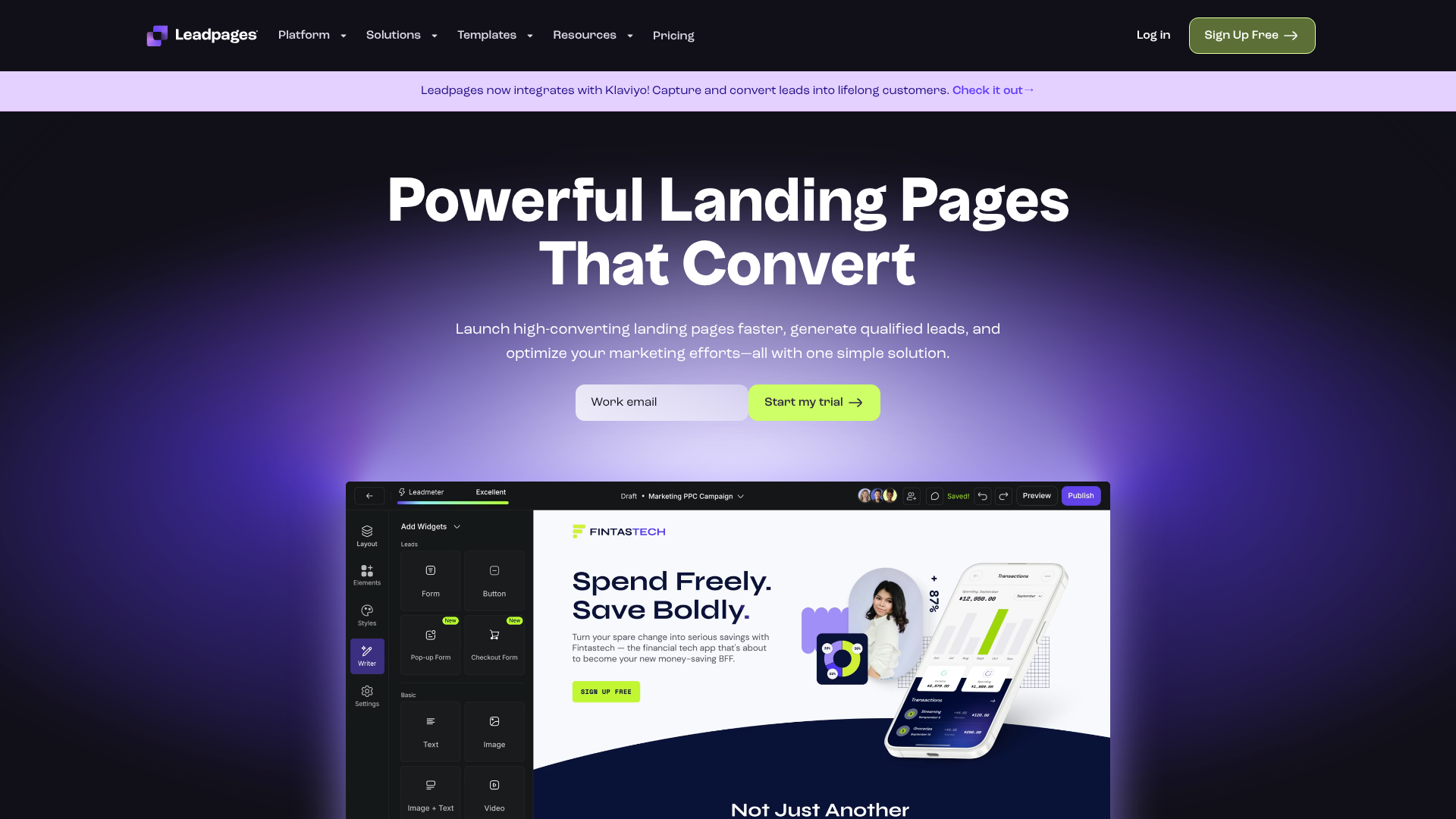
Fortunately, creating a fully responsive page is easier than ever. Modern landing page builders are designed with a mobile-first philosophy. Platforms like Leadpages and Unbounce provide templates that are inherently responsive, often including a mobile-specific editor. This allows you to preview and fine-tune the experience for phone and tablet users, ensuring that elements like your headline and call-to-action are perfectly positioned and easy to interact with on any device.
This isn't just a feature; it's a fundamental requirement for any successful campaign in 2026.
A Picture is Worth a Thousand Clicks: Using Visuals Effectively
Visual elements are the first thing a visitor notices when they arrive on your landing page. They set the tone, convey your brand's personality, and can communicate complex ideas much faster than text alone. Effective use of visuals is one of the core good landing page features, guiding the user's eye towards the most important parts of your page, such as the headline and the call-to-action.
A high-quality 'hero shot'—a primary image or video that showcases your product, service, or the desired outcome—can instantly capture attention and create an emotional connection. If you're selling software, a clean screenshot of the interface in action can be very effective. If you're promoting a service, an image of a happy customer achieving their goals can build aspiration. Video, in particular, can be a powerful tool for explaining your offer in a dynamic and engaging way, often leading to higher conversion rates.
Beyond the hero shot, the overall visual design matters. Use your brand's colours and fonts consistently to build recognition and trust. Make strategic use of white space to avoid a cluttered look and help key elements stand out. Directional cues, such as arrows or images of people looking towards your CTA button, can subconsciously guide the visitor's attention right where you want it.
The goal is to create a visually pleasing and intuitive layout that supports your message, not distracts from it.
Message Match: The Power of Clear and Relevant Content
Imagine clicking an ad for "50% off running shoes" only to land on a page showcasing hiking boots. You'd feel confused and misled, and you'd leave immediately. This disconnect is a classic example of poor message match, and it's a guaranteed conversion killer. The principle of message match dictates that the headline, copy, and imagery on your landing page must directly reflect the promise made in the ad that brought the visitor there.
This consistency is a fundamental attribute of a good landing page experience because it reassures the user that they are in the right place. The headline is the most critical element for achieving this. It should be the first thing a visitor reads and should instantly confirm they've arrived at the correct destination. For example, if your ad says "Download Our Free SEO Checklist," your landing page headline should be something very similar, like "Get Your Free SEO Checklist Now."
Beyond the headline, the rest of the content must be clear, concise, and focused on the user's needs. Use subheadings and bullet points to break up text and make it easy to scan. Focus on the benefits of your offer, not just the features. Instead of saying "Our software has a 128-bit encryption feature," say "Keep your data safe and secure with military-grade encryption." This user-centric language, combined with a perfect message match, creates a powerful and persuasive experience that builds trust and encourages action.
Pro Tip: Use a tool like Mangools (KWFinder) to understand the exact phrases and questions your audience is searching for. Aligning your landing page copy with this search intent ensures your message resonates deeply and feels highly relevant.
-dea96d2d-70c9-4332-8c14-0011c4a69e48-1767864257433-mxti3a.png "What Attributes Describe a Good Landing Page Experience? A Marketer's Guide 4")
The All-Important Ask: Mastering Your Call-to-Action (CTA)
Your entire landing page is built to lead the visitor to one single moment: the click of the call-to-action (CTA) button. This is where the conversion happens. The design, placement, and copy of your CTA are therefore among the most important attributes of effective landing pages. An effective CTA is unmissable, understandable, and compelling.
First, consider its design and placement. Your CTA button should stand out from the rest of the page using a contrasting colour that draws the eye. Its size should be large enough to be prominent without being obnoxious. Ideally, it should be placed "above the fold," meaning it's visible without the user having to scroll, but it's also good practice to repeat the CTA further down the page for longer landing pages.
Second, the copy on the button itself is crucial. Avoid generic words like "Submit" or "Click Here." Instead, use action-oriented language that clearly communicates the value the user will receive. For example, "Get Your Free Ebook," "Start My 14-Day Trial," or "Book a Demo Now" are all far more persuasive because they tell the user exactly what will happen next. The surrounding copy should support the CTA, reinforcing the benefits and reducing any last-minute hesitation.
Finally, keep the associated form as simple as possible. Only ask for the information you absolutely need. Each additional field you require a user to fill out increases friction and reduces the likelihood of conversion. For more complex information gathering, a multi-step form, easily created with tools like Jotform, can break the process into manageable chunks and feel less intimidating to the user.
Decoding Visitor Intent: The Foundation of a Great Experience
Why did the visitor click your ad in the first place. What problem are they trying to solve. Answering these questions is the key to understanding user intent, which is the bedrock of a good landing page experience. A page that perfectly aligns with a visitor's intent feels helpful and intuitive, while a page that misses the mark feels irrelevant and frustrating.
You cannot create a relevant experience without first knowing what the user wants to achieve.
User intent generally falls into a few categories. Informational intent means the user is looking for information ("how to improve email open rates"). Transactional intent means they are ready to buy or take a specific action ("buy email marketing software"). Commercial investigation means they are comparing options before making a decision ("GetResponse vs.
Mailchimp"). Your landing page must be tailored to the specific intent behind the keywords you are targeting.
For example, if someone searches for "best landing page builders," they are in a comparison mindset. A landing page that forces them to sign up for a demo immediately might be too aggressive. A better approach would be a page that compares features, showcases customer reviews, and offers a free trial, catering to their need for information before committing. Conversely, a search for "buy Unbounce subscription" signals strong transactional intent, and the landing page should make it as easy as possible to choose a plan and pay.
Aligning your offer, copy, and CTA with the user's intent is essential for creating a page that converts.
Less is More: Minimising Distractions for Maximum Focus
One of the defining characteristics of a landing page, as opposed to a regular website page, is its singular focus. The primary goal is to guide the visitor towards one specific action. Any element on the page that does not contribute to this goal is a potential distraction that can lower your conversion rate. This principle of simplicity is one of the most powerful landing page experience factors.
One of the most common and effective ways to minimise distractions is to remove the main site navigation menu. On your homepage, a navigation bar is helpful for exploration. On a landing page, it offers dozens of tempting escape routes, pulling the visitor away from the conversion goal. By removing it, you create a focused environment where the only clear path forward is the one you've designed, leading directly to the CTA.
This minimalist approach should extend to the entire page. Avoid cluttering the layout with unnecessary links, sidebars, social media feeds, or multiple competing offers. Every word, image, and element should serve a purpose and support the primary goal. This is the philosophy behind many successful funnel-building tools like ClickFunnels, which are designed to create highly focused, linear user journeys.
A clean, simple, and focused design respects the user's attention and makes the desired action the easiest and most logical next step.
Building Instant Trust with Social Proof and Testimonials
When a visitor lands on your page for the first time, they are often sceptical. They don't know your brand, and they're wary of marketing promises. To overcome this hesitation, you need to build trust, and you need to do it quickly. This is where social proof comes in.
Social proof is the psychological phenomenon where people assume the actions of others reflect correct behaviour for a given situation. In marketing, it's powerful evidence that your offer is legitimate and valuable.
There are many forms of social proof you can use on your landing page. Customer testimonials, complete with a name, company, and photo, are one of the most effective types. They provide a relatable human element and offer third-party validation of your claims. Short, benefit-driven quotes work best.
For B2B offers, case studies or the logos of well-known companies you've worked with can add significant credibility.
Other trust signals include security badges (especially near payment or personal information fields), industry awards, and data points like "Trusted by 50,000+ users." These elements work together to reduce perceived risk and make the visitor feel more comfortable taking the next step. By showing that other people—just like them—have trusted you and had a positive experience, you make the decision to convert feel much safer and smarter.
Never Guess: Optimising with A/B Testing
Even with a deep understanding of all the attributes of a good landing page, you can't be certain what will work best for your specific audience without testing. A/B testing, also known as split testing, is the process of creating two or more versions of your landing page to see which one performs better. It's a data-driven approach to optimisation that replaces guesswork with evidence.
The process is simple. You create a variation of your page (Version B) where you change a single element, such as the headline, the hero image, the CTA button colour, or the form length. You then direct a portion of your traffic to the original page (Version A) and the rest to the variation. By tracking which version achieves a higher conversion rate, you can definitively identify what resonates most with your audience.
This continuous improvement cycle is vital for maximising your return on investment. Many modern landing page platforms, including Instapage and Unbounce, have powerful, user-friendly A/B testing features built-in. They handle the traffic splitting and results tracking for you, making it easy to test hypotheses and steadily improve your page's performance over time. The most successful marketers don't just launch a page and hope for the best; they test, learn, and iterate their way to success.
Pro Tip: When starting with A/B testing, focus on high-impact elements first. Your headline and your call-to-action often have the biggest influence on conversion rates. A small change in wording here can lead to a significant uplift in performance.
Beyond the Click: Analysing Metrics to Refine Performance
Launching your landing page is not the end of the process; it's the beginning. To truly understand and improve the user experience, you must track and analyse its performance. The data you collect provides invaluable insights into what's working and, more importantly, what isn't. This analytical approach allows you to make informed decisions and systematically enhance your page over time.
Several key metrics are essential for evaluating landing page performance. The most obvious is the conversion rate, which is the percentage of visitors who complete the desired action. This is your ultimate measure of success. However, other metrics provide crucial context.
The bounce rate tells you how many visitors leave after viewing only one page, which can indicate a disconnect in message match or a poor user experience. Time on page can suggest how engaged visitors are with your content.
For deeper insights, you can use tools like heatmaps and session recordings. Heatmaps visually show where users are clicking, moving their mouse, and how far they scroll, revealing which parts of your page are getting the most attention. Session recordings let you watch anonymised videos of real user interactions, helping you identify points of friction or confusion. By combining this qualitative data with your quantitative metrics, you can form strong hypotheses for your next A/B test and create a cycle of continuous, data-driven improvement.
Frequently Asked Questions
What are the elements of a good landing page?
A good landing page is composed of several key elements working together towards a single goal. This includes a compelling, benefit-driven headline that matches the ad creative, persuasive and scannable copy, high-quality visuals like a hero image or video, and prominent trust signals such as customer testimonials or security badges. The most critical element is a clear, contrasting, and action-oriented call-to-action (CTA) that guides the user on what to do next.
Which of the following best describes a landing page?
A landing page is best described as a standalone web page, distinct from a website's homepage or other pages, that is designed with a single, focused objective. This objective is typically to capture a lead or generate a sale. It's the page a visitor "lands" on after clicking a link from an email, an advertisement, or another digital location. Its defining characteristic is its simplicity and the absence of distractions, like site navigation, that could divert the visitor from the conversion goal.
What is the landing page experience?
The landing page experience refers to the overall quality of a user's interaction with your landing page, from the moment it starts loading to the point they either convert or leave. It encompasses factors like page load speed, mobile-friendliness, the relevance and clarity of the content, ease of navigation (or lack thereof), and the trustworthiness of the page. Google and other ad platforms measure this experience to determine the quality and relevance of your ads, which can impact your ad rank and cost-per-click.
What is the main purpose of a landing page?
The main purpose of a landing page is to facilitate a conversion for a specific marketing campaign. Unlike a homepage, which is designed for exploration, a landing page is built for action. Whether that action is signing up for a webinar, downloading an ebook, starting a free trial, or making a purchase, the entire page is optimised to persuade the visitor to complete that one specific goal. This singular focus is what makes landing pages so effective for lead generation and sales.
What are common landing page mistakes?
Common mistakes include slow page load times, which cause users to abandon the page before it even loads, and a design that is not mobile-friendly. Another frequent error is a message mismatch, where the promise in the ad doesn't align with the content on the page. Other mistakes are having a weak or unclear call-to-action, asking for too much information in a form, including distracting navigation links, and failing to include trust signals like social proof, which can make visitors hesitant to convert.
Final Thoughts
Mastering the art of the landing page is about more than just design; it's about empathy. The attributes that describe a good landing page experience all centre on a single idea: respecting the visitor. You respect their time with a fast-loading page, you respect their expectations with relevant content, and you respect their intelligence by providing a clear, trustworthy, and focused path to the solution they were seeking.
By focusing on these core principles—lightning-fast speed, flawless mobile responsiveness, clear and relevant messaging, a compelling call-to-action, and undeniable trust signals—you move beyond simply building pages and start engineering experiences. Each element, from the headline to the footer, should be deliberately chosen to reduce friction and build momentum toward your conversion goal.
Ultimately, the most successful marketers are those who are relentless testers and analysers. Use these attributes as your starting checklist, but let data be your ultimate guide. If you're looking to implement these principles without needing to code, platforms like Leadpages and Unbounce provide the tools to build, test, and optimise high-converting landing pages, turning clicks into valuable customers.