



Semrush Competitive Analysis: A Marketer's Guide to Outranking Rivals
Understanding your competition is no longer optional; it's the foundation of any successful digital marketing strategy. To truly get ahead, you need to move beyond guesswork and base your decisions on hard data. This is where conducting a thorough semrush competitive analysis becomes essential, providing a clear roadmap of your rivals' strengths, weaknesses, and the opportunities they've left wide open for you to capture.
- What You'll Learn
- What is Semrush and Why Use It for Competitive Analysis?
- The Core Semrush Analysis Tools for Competitor Research
- How to Conduct a Complete Competitor Analysis with Semrush (Step-by-Step)
- Step 1: Identify Your True Digital Competitors
- Step 2: Benchmark Overall Performance
- Step 3: Analyse Their Traffic Acquisition Strategy
- Step 4: Uncover Their Top Organic Keywords and Pages
- Step 5: Find Your Keyword Gaps
- Step 6: Deconstruct Their Backlink Profile
- Interpreting the Data: From Numbers to Actionable Insights
- Advanced Tactics: Using Semrush for Market and Gap Analysis
- Uncovering "Untapped" Keywords with the Keyword Gap Tool
- Analysing Backlink Gaps for Link-Building Opportunities
- Identifying New Content Formats and Topics
- Streamlining Your Workflow: Custom Reports and Dashboards
- Real-World Example: A Successful Competitive Analysis with Semrush
- Best Practices for Ongoing Semrush Competitor Research
- Schedule Regular Check-ins
- Monitor Keyword Position Changes
- Watch for New Content and Backlinks
- Focus on Trends, Not Daily Fluctuations
- Frequently Asked Questions (FAQ)
- Does Semrush do competitor analysis?
- Which tool is best for competitor analysis?
- How to carry out a competitor analysis?
- What are the common mistakes in competitive analysis?
- Final Thoughts: Turning Analysis into a Competitive Advantage
Semrush is an all-in-one digital marketing suite that offers a powerful set of tools designed specifically for this purpose. It allows you to peer behind the curtain of your competitors' online presence, revealing everything from their top-performing keywords and traffic sources to their backlink strategies and paid advertising campaigns. By using this data, you can benchmark your performance, refine your own strategy, and ultimately make smarter, faster decisions that lead to growth.
This guide will walk you through the entire process, from identifying your true digital rivals to uncovering actionable insights that give you a definitive edge. We'll explore the key tools, step-by-step methods, and best practices to turn competitive data into your most valuable marketing asset.
What You'll Learn
- Identify True Competitors: Learn how to use Semrush's Market Explorer and Organic Research reports to pinpoint who you're actually competing with in search results, which may differ from your direct business rivals.
- Master the Step-by-Step Process: Follow a detailed workflow for analysing competitor traffic, organic keywords, content performance, and backlink profiles to get a 360-degree view of their strategy.
- Uncover Hidden Opportunities: Discover how to use tools like Keyword Gap and Backlink Gap to find valuable keywords and link-building prospects that your competitors are missing.
- Implement Ongoing Analysis: Understand the best practices for creating custom reports and setting up a sustainable schedule for monitoring competitors to stay ahead of market shifts.
What is Semrush and Why Use It for Competitive Analysis?
Semrush is a comprehensive SaaS platform designed for SEO, content marketing, competitor research, PPC, and social media marketing professionals. At its core, it's a massive database of internet data, tracking billions of keywords across hundreds of global markets, analysing trillions of backlinks, and monitoring website traffic trends. This immense data pool is what makes it such a formidable tool for competitive intelligence.
When you perform a competitive analysis with semrush, you're not just getting a surface-level overview. You're accessing granular data that answers critical strategic questions. For example, instead of guessing which keywords your competitors are targeting, Semrush shows you the exact queries they rank for, the estimated traffic those keywords drive, and their ranking position over time. This transforms your strategy from reactive to proactive.
The primary advantage of using Semrush is its ability to centralise your research. Instead of patching together information from multiple, often unreliable sources, you have a single source of truth. This saves an incredible amount of time and ensures the data you're using to make important business decisions is consistent and cross-referenced within one ecosystem. It allows you to benchmark your own performance directly against others, providing context that is impossible to get from your own analytics alone.
The Core Semrush Analysis Tools for Competitor Research
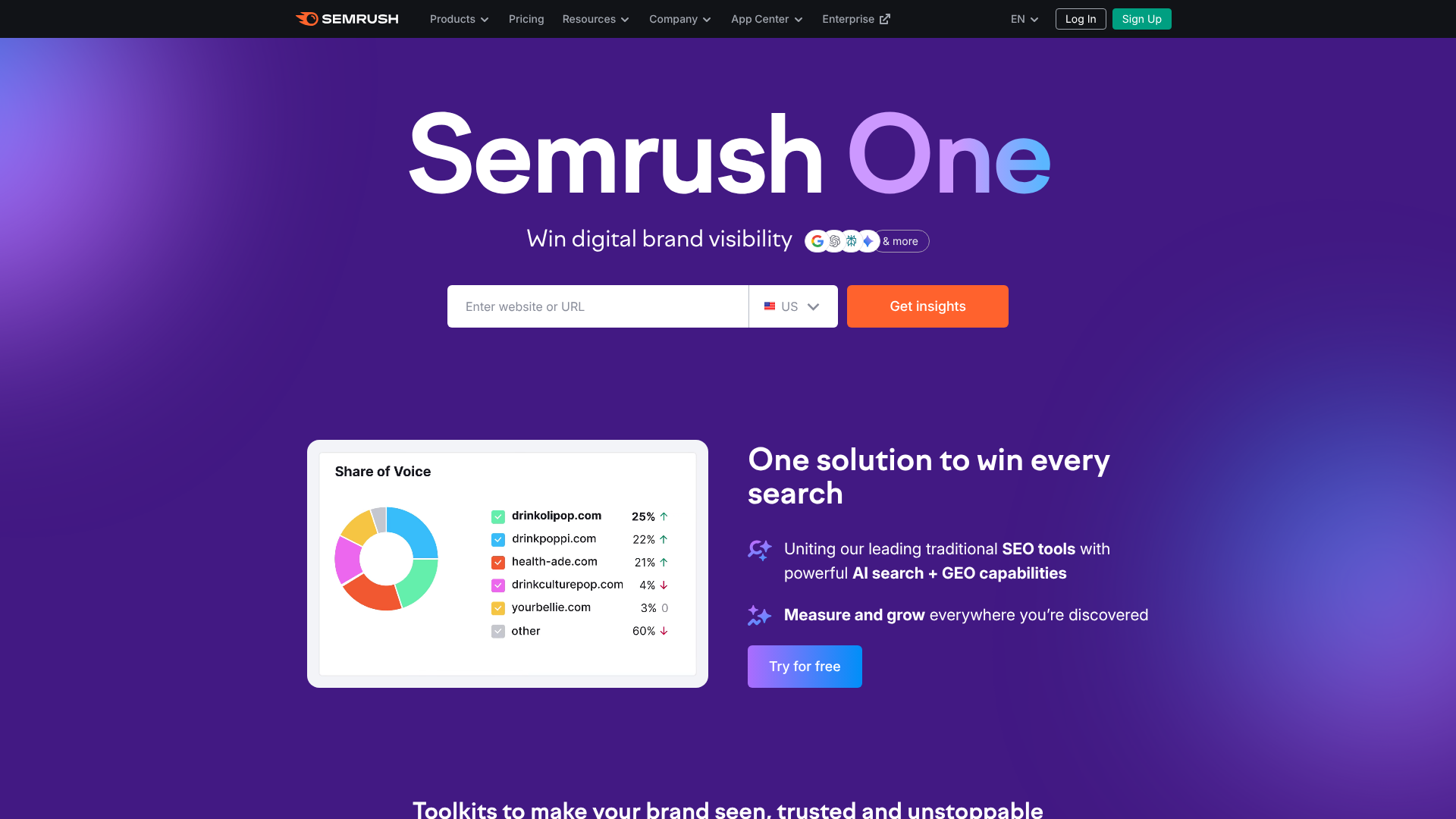
Semrush offers a suite of specialised tools, each designed to dissect a different aspect of a competitor's digital strategy. Understanding these core semrush analysis tools is the first step to mastering competitor research.
Domain Overview
Think of the Domain Overview report as your mission control centre. You enter a competitor's domain, and it instantly provides a high-level dashboard of their online health. Key metrics include the Authority Score (Semrush's metric for a domain's overall quality and SEO performance), estimated monthly organic and paid search traffic, and the total number of backlinks. It's the perfect starting point to get a quick, comparative snapshot of any website in your market.
Traffic Analytics
While Domain Overview estimates search traffic, Traffic Analytics provides a broader view of a website's entire traffic profile. It estimates total monthly visits and breaks them down by source: Direct, Referral, Search, Social, and Paid. This is incredibly valuable for understanding a competitor's overall marketing mix. For instance, if a rival has high direct traffic, it suggests strong brand recognition.
If they have significant referral traffic, you can dig in to see which websites are sending them visitors.
Organic Research
The Organic Research tool is the heart of SEO competitive analysis. It reveals every keyword a domain ranks for in Google's top 100 organic results. You can see their ranking position for each keyword, the search volume for that keyword, and the estimated traffic it generates for their site. The 'Pages' tab within this report is also a goldmine, showing you which of their URLs attract the most organic traffic, effectively highlighting their most successful content pieces.
Keyword Gap
The Keyword Gap tool is where strategy is born. It allows you to compare the keyword profiles of up to five domains simultaneously. You can instantly see which keywords your competitors rank for that you don't ('Untapped' keywords), where they outrank you ('Weak' keywords), and where you have an advantage ('Strong' keywords). This is one of the fastest ways to identify content gaps and build a data-driven content plan.
Backlink Analytics & Backlink Gap
Backlinks remain a crucial ranking factor, and these tools let you reverse-engineer a competitor's link-building success. Backlink Analytics provides a complete list of a competitor's backlinks, the authority of the referring domains, and the anchor text used. The Backlink Gap tool works similarly to the Keyword Gap, showing you which websites link to your competitors but not to you. This creates an instant, high-quality list of link-building targets.

How to Conduct a Complete Competitor Analysis with Semrush (Step-by-Step)
Armed with an understanding of the tools, you can now follow a structured process to conduct a comprehensive analysis. This step-by-step method ensures you cover all the essential areas and extract actionable insights.
Step 1: Identify Your True Digital Competitors
Your business competitors aren't always your search competitors. A local shop might compete with a national chain in person, but online they compete with blogs, review sites, and niche publications for search engine visibility. Start by entering your own domain into the Organic Research tool and navigating to the 'Competitors' tab. Semrush will generate a list of domains that rank for a similar set of keywords, giving you a data-backed list of your true online rivals.
Step 2: Benchmark Overall Performance
Once you have a list of 3-5 key competitors, use the Domain Overview tool to create a baseline. Enter your domain and your competitors' domains to compare metrics side-by-side. Pay close attention to Authority Score, organic traffic estimates, and the number of referring domains. This gives you a high-level understanding of where you stand in the market landscape.
Are you a new player against established giants, or are you on a relatively level playing field.
Step 3: Analyse Their Traffic Acquisition Strategy
Next, use the Traffic Analytics tool for each competitor. Look at the 'Traffic Journey' and 'Traffic Sources' charts. This reveals their marketing mix. Is their traffic dominated by organic search, indicating a strong SEO and content strategy.
Or do they rely heavily on paid ads. A high percentage of referral traffic might point to a robust PR or affiliate programme. This analysis helps you understand their priorities and where they are investing their resources.
Step 4: Uncover Their Top Organic Keywords and Pages
Dive deep into the Organic Research tool for each competitor. The default 'Positions' report shows you their top keywords by traffic. Filter this list to identify high-intent commercial keywords (e.g., containing terms like 'best', 'review', 'alternative') versus informational keywords (e.g., 'how to', 'what is'). Then, switch to the 'Pages' tab.
This lists their top-performing content. Analyse these pages to understand what topics resonate with your shared audience and what content formats (e.g., blog posts, guides, tools) are working for them.
Step 5: Find Your Keyword Gaps
This is a critical step for finding opportunities. Open the Keyword Gap tool and enter your domain along with your top competitors. Use the filters at the top to view 'Untapped' keywords—these are queries your competitors rank for, but you don't. This is your low-hanging fruit.
Export this list; it becomes the foundation of your next content creation cycle. You can also look at 'Weak' keywords, where competitors outrank you, to identify existing content that needs optimisation.
Pro Tip: When using the Keyword Gap tool, use the advanced filters to narrow down the results. For example, you can filter for keywords with a specific search volume range (e.g., over 500 searches per month), a lower keyword difficulty score, or those that trigger a featured snippet. This helps you prioritise the most valuable and attainable opportunities first.
Step 6: Deconstruct Their Backlink Profile
Go to the Backlink Analytics tool and analyse each competitor's profile. Look beyond the total number of backlinks. Check the number of unique referring domains, as this is a better indicator of authority. Review the 'Anchors' report to see the most common anchor text they use.
A high percentage of branded anchors is natural, but look for the non-branded keywords they are building links for. Finally, use the Backlink Gap tool to find websites linking to them but not you, creating a prioritised outreach list.
Interpreting the Data: From Numbers to Actionable Insights
Collecting data is only half the battle; the real value lies in interpreting it correctly to inform your strategy. A list of keywords or a traffic chart is meaningless without context and an understanding of what the numbers imply.
Understanding Traffic Sources
Analysing the traffic source distribution tells a story about a competitor's marketing strategy and brand health. A competitor with over 50% organic search traffic has likely invested heavily in SEO and content marketing over a long period. This indicates a sustainable, long-term strategy. In contrast, a site with high paid traffic might be aggressive in its customer acquisition but could be vulnerable to changes in ad costs.
High direct traffic is often a sign of strong brand equity and customer loyalty, as people are typing their URL directly into the browser. Significant referral traffic suggests a strong network of partners, affiliates, or positive press mentions. By understanding this mix, you can identify which channels are working in your industry and decide whether to compete on their strong channels or focus on a channel they are neglecting.
Analysing Keyword Intent
Don't just look at keyword volume; focus on intent. Semrush allows you to see the keywords driving traffic, and you should categorise them. Are they primarily informational (e.g., 'how to fix a leaky tap'), navigational (e.g., 'B&Q opening times'), commercial (e.g., 'best power drills'), or transactional (e.g., 'buy DeWalt drill')?
A competitor ranking for many informational keywords is likely running a content marketing strategy designed to attract users at the top of the funnel. A competitor focused on commercial and transactional terms is targeting bottom-of-the-funnel users ready to buy. This insight helps you understand their sales cycle and where you can intercept their customers with better content or offers.
Branded vs. Non-Branded Search
Within the Organic Research report, you can filter keywords to see the split between branded (containing their brand name) and non-branded traffic. A high ratio of branded search traffic is a sign of a powerful brand that people seek out by name. While this is a good position for them, it also means their non-branded SEO might be an area of weakness you can exploit.
Conversely, if a competitor gets most of its traffic from non-branded keywords, it shows they have a very effective SEO strategy. Your goal should be to build a healthy balance of both. Strong non-branded rankings attract new customers who don't know you yet, while branded search captures demand from those who do.
Advanced Tactics: Using Semrush for Market and Gap Analysis

Once you've mastered the basics of semrush competitor research, you can move on to more advanced tactics that uncover deeper strategic opportunities. This is where you can find significant competitive advantages.
Uncovering "Untapped" Keywords with the Keyword Gap Tool
This feature deserves a deeper look. The 'Untapped' filter in the Keyword Gap tool is your secret weapon for content strategy. It shows you keywords for which at least one of your entered competitors ranks, but your site has no ranking at all. This is essentially a market-validated list of topics your audience is searching for that you haven't yet addressed.
To make this even more powerful, apply filters for commercial intent (e.g., keywords containing 'vs', 'review', 'pricing') to find bottom-of-the-funnel topics. Alternatively, filter for question-based keywords ('what', 'how', 'why') to find top-of-funnel content ideas that can attract new users. Creating content around these untapped keywords allows you to enter the conversation without directly competing on your rivals' strongest terms.
Analysing Backlink Gaps for Link-Building Opportunities
Building a strong backlink profile is often the most challenging part of SEO. The Backlink Gap tool simplifies this by providing a ready-made list of prospects. By entering your domain and your competitors', the tool generates a list of websites that link to your rivals but not to you. This is incredibly valuable because these sites have already demonstrated a willingness to link to businesses in your niche.
When you export this list, sort it by Authority Score to prioritise the most valuable domains first. Visit these websites to understand why they linked to your competitor. Did they cite a statistic, review a product, or feature them in an expert roundup? This context allows you to craft a highly relevant outreach pitch, suggesting they link to your superior resource or include your business in a future article.
Identifying New Content Formats and Topics
Your competitors' most successful content provides a blueprint for what works in your market. In the Organic Research tool, go to the 'Pages' report and sort by traffic. Look beyond just the topics. Analyse the format of their top pages.
Are they long-form guides, short blog posts, video-embedded pages, or free online tools. If all your top competitors are having success with video content and you're only producing text, that's a significant content format gap you should consider filling.
Streamlining Your Workflow: Custom Reports and Dashboards
Competitive analysis shouldn't be a chaotic, one-off task. Semrush allows you to streamline the process and integrate it into your regular marketing activities through its reporting features.
Creating Custom Competitor Reports
The 'My Reports' feature in Semrush is a powerful tool for consolidating your findings. You can build a custom report from scratch or use a template, dragging and dropping widgets from any of the analysis tools. For example, you can create a monthly competitor report that includes a side-by-side Domain Overview comparison, a traffic source breakdown from Traffic Analytics, and a list of new keywords a competitor started ranking for.
This is perfect for sharing insights with stakeholders who don't need to log into the tool itself. You can add your own text boxes to provide commentary and explain what the data means, turning raw numbers into a strategic narrative. This elevates your role from a data puller to a strategic analyst.
Pro Tip: Create different reports for different audiences. For a C-level executive, build a high-level dashboard showing top-line traffic trends and market share. For your content team, create a detailed report focused on keyword gaps and top-performing competitor pages. Customising the report ensures the information is relevant and actionable for its audience.
Automating and Scheduling
One of the best features of My Reports is the ability to schedule them. You can set up your custom competitor analysis report to be automatically generated and emailed to you and your team on a weekly or monthly basis. This automation ensures that competitive analysis becomes a consistent habit rather than an afterthought.
Regular, automated reporting helps you spot trends over time. A sudden spike in a competitor's paid traffic might indicate a new product launch. A steady decline in their organic traffic could signal a Google penalty or a shift in their strategy. Without consistent monitoring, these crucial insights are easy to miss.
Real-World Example: A Successful Competitive Analysis with Semrush
Let's consider a hypothetical but realistic case study to see how this works in practice. Imagine a new startup, 'CodeAssist', that offers an AI coding assistant tool. Their primary, well-established competitor is 'CodeMaster'.
The Challenge: CodeMaster dominates the search results for broad, high-volume keywords like "AI coding tool" and "coding assistant". Competing directly on these terms would be incredibly expensive and time-consuming for the new startup, CodeAssist.
The Analysis: The marketing manager at CodeAssist uses Semrush for a competitive analysis. Using the Keyword Gap tool, they compare their domain to CodeMaster's. They discover that while CodeMaster ranks for broad terms, they have very little content targeting specific programming languages or frameworks. They find dozens of 'Untapped' keywords like "AI python code debugger", "javascript code completion tool", and "react component generator AI".
The Action: Based on this data, CodeAssist decides to pursue a niche content strategy. Instead of writing a generic blog post about "AI coding tools", they create a series of in-depth tutorials and landing pages, each focused on how their tool helps with a specific language or framework. They create content for Python, JavaScript, React, and more, directly targeting the keyword gaps they found.
The Result: Within a few months, CodeAssist begins to rank on the first page for these valuable long-tail keywords. While the search volume for each individual keyword is lower, the combined traffic is significant. More importantly, the traffic is highly qualified—a developer searching for a "React component generator" is a much better lead than someone searching for a generic "AI tool". This data-driven niche strategy allows them to gain a foothold in a competitive market without a massive budget.
Best Practices for Ongoing Semrush Competitor Research
Competitive analysis is not a 'set it and forget it' activity. The digital landscape is constantly changing, with competitors launching new campaigns, Google updating its algorithm, and new players entering the market. Adopting a mindset of continuous monitoring is key to long-term success.
Schedule Regular Check-ins
Discipline is crucial. Block out time in your calendar—whether it's an hour every Friday or the first Monday of every month—to run through your core competitor analysis workflow. A consistent schedule ensures you stay on top of market dynamics and can react quickly to threats and opportunities. Automated reports can feed you the data, but manual check-ins are where you'll find the deeper strategic insights.
Monitor Keyword Position Changes
Use the Semrush Position Tracking tool to monitor a specific set of high-value keywords. Add your competitors to the campaign so you can see how your rankings stack up against theirs day-to-day. Set up alerts to be notified of significant ranking changes—both yours and your competitors'. If a competitor suddenly jumps to the first page for a keyword you're targeting, you need to analyse why.
Did they publish a new piece of content. Did they acquire a powerful backlink.
Watch for New Content and Backlinks
Regularly check the 'New' and 'Lost' tabs in the Organic Research and Backlink Analytics reports. This can give you early warnings about a competitor's strategic shifts. A flurry of new keywords might indicate a new content push around a specific topic. A sudden influx of backlinks from high-authority news sites could mean they've launched a successful digital PR campaign that you need to be aware of.
Focus on Trends, Not Daily Fluctuations
Finally, don't get lost in the noise of daily ranking fluctuations. SEO is a long-term game. Instead of reacting to minor dips and spikes, look for sustained trends over weeks and months. Is a competitor's organic traffic consistently trending upwards.
Is their Authority Score steadily climbing. These are the trends that signal a successful underlying strategy that is worth investigating more deeply.
Frequently Asked Questions (FAQ)
Does Semrush do competitor analysis?
Yes, competitor analysis is one of the core functions and greatest strengths of the Semrush platform. It provides a comprehensive suite of tools, including Domain Overview, Organic Research, Traffic Analytics, and Keyword Gap, specifically designed to research and analyse competitors' digital marketing strategies in detail.
Which tool is best for competitor analysis?
While several excellent tools exist, Semrush is widely regarded as one of the best all-in-one solutions for competitor analysis. Its key advantage is the sheer breadth and depth of its data, covering SEO, PPC, content, and social media within a single platform. This allows for a more holistic view of a competitor's strategy compared to using multiple niche tools.
How to carry out a competitor analysis?
A standard competitor analysis process involves several key steps. First, identify your true search competitors. Second, benchmark their overall performance (traffic, authority). Third, analyse their traffic sources and keyword strategy.
Fourth, identify gaps in their keyword and backlink profiles. Finally, use these insights to inform and refine your own marketing strategy.
What are the common mistakes in competitive analysis?
Common mistakes include focusing only on known business rivals instead of actual search competitors, getting overwhelmed by data without extracting actionable insights, and treating it as a one-time project instead of an ongoing process. Another major mistake is simply copying competitors instead of using the data to find unique angles and opportunities they have missed.
Final Thoughts: Turning Analysis into a Competitive Advantage
Conducting a semrush competitive analysis provides you with a powerful lens through which to view your market. It moves you from making assumptions to making data-driven decisions. The tools within Semrush can uncover a wealth of information about your rivals' strategies, from the keywords that bring them traffic to the content that resonates most with their audience.
However, the data itself is just the starting point. The real competitive advantage comes from your ability to interpret that data, identify patterns, and translate those insights into concrete actions. Whether it's discovering an untapped niche of keywords, identifying a content format your rivals are ignoring, or finding high-authority websites for your next link-building campaign, the opportunities are there for those willing to look.
By integrating regular competitor research into your marketing rhythm, you ensure your strategy remains agile, relevant, and always one step ahead. If you're ready to stop guessing what your competitors are doing and start knowing, then it's time to explore what a tool like Semrush can do for your business.