




How to Master Blog Content Generation: A Step-by-Step Guide for Marketers
Consistently publishing high-quality blog posts is one of the biggest challenges for marketers and business owners. The pressure to create fresh, engaging, and SEO-optimised articles can lead to burnout and inconsistent results. A structured approach to blog content generation transforms this daunting task into a manageable and scalable process. By combining strategic planning with powerful modern tools, you can create a content engine that drives traffic, engages readers, and builds authority in your niche.
- What You'll Learn
- What Exactly is Blog Content Generation?
- The Core Benefits of a Streamlined Content Creation Process
- Boosts Consistency and Publishing Frequency
- Improves SEO and Organic Traffic
- Saves Significant Time and Resources
- Enhances Content Quality and Audience Engagement
- A Step-by-Step Guide to Generating High-Quality Blog Content
- Step 1: Foundational Keyword Research and Ideation
- Step 2: Creating a Detailed, SEO-Friendly Outline
- Step 3: Drafting the Content (The AI-Assisted Approach)
- Step 4: Editing, Fact-Checking, and Humanising
- Step 5: Optimisation and Repurposing
- Choosing the Right Blog Content Generation Tools
- Top AI Tools for Blog Writing and Content Generation
- 1. Jasper (formerly Jarvis): Best for Versatility and Quality
- 2. Writesonic: Best for Guided Workflows and SEO Articles
- 3. QuillBot: Best for Paraphrasing and Summarising
- Comparing Pricing and Value
- The Pros and Cons of Using AI for Content Generation
- Frequently Asked Questions about Blog Content Generation
- Can AI completely replace human blog writers?
- How do you generate blog content for free?
- Is AI-generated content good for SEO?
- How long should a blog post be?
- What is the fastest way to generate blog content?
- Final Thoughts: The Future of Blog Writing
This guide breaks down the entire content creation workflow, from initial idea to final publication. We'll cover a step-by-step process that leverages both human expertise and artificial intelligence to help you produce better content, faster. Whether you're a solo blogger or part of a larger marketing team, mastering this process is key to achieving your content marketing goals.
What You'll Learn
- A Full-Cycle Process: Blog content generation is more than just writing. It involves a complete workflow including ideation, research, creation, optimisation, and promotion.
- Human-AI Collaboration is Key: AI tools like Jasper and Writesonic can dramatically speed up drafting and outlining, but human oversight is essential for ensuring quality, accuracy, and authenticity.
- Strategy Over Speed: A successful content strategy combines data-driven research with AI assistance, always prioritising the needs of your audience and core SEO principles.
- Choosing the Right Tools: The best tool for you depends on your specific needs, including budget, required features like SEO integration or plagiarism checking, and your team's size.
What Exactly is Blog Content Generation?
Blog content generation refers to the complete, end-to-end process of creating articles for a blog. It's a common misconception to think of this as just the act of writing. In reality, writing is only one piece of a much larger puzzle. A comprehensive content generation strategy encompasses every stage required to take an idea from a simple concept to a fully published, optimised, and promoted piece of content.
This lifecycle includes several distinct phases:
- Ideation: Brainstorming and identifying topics that are relevant to your audience and aligned with your business goals.
- Research: Gathering information, statistics, and competitor insights to ensure your content is accurate, thorough, and competitive.
- Outlining: Structuring the article with clear headings and subheadings to create a logical flow and improve readability.
- Drafting: The actual writing of the content, whether done manually or with the assistance of AI tools.
- Editing & Proofreading: Refining the draft for clarity, grammar, tone, and style, as well as fact-checking all claims.
- Optimisation: Implementing on-page SEO best practices, such as keyword placement, internal linking, and meta descriptions.
- Publishing & Promotion: Uploading the final article to your CMS and distributing it across various channels to reach your target audience.
Traditionally, this entire process was manual and time-consuming. However, the rise of AI has introduced a new paradigm. Modern content generation often involves a hybrid approach, where marketers use AI tools to accelerate research, outlining, and drafting, while focusing their human efforts on strategy, editing, and adding unique insights. This systematic approach is far more effective and scalable than relying on sporadic bursts of inspiration.
The Core Benefits of a Streamlined Content Creation Process

A well-organised system for content creation does more than just help you publish more articles. It provides a framework that delivers compounding benefits across your entire marketing strategy. By moving from a chaotic, last-minute approach to a structured workflow, you can unlock significant improvements in efficiency, performance, and overall impact.
Boosts Consistency and Publishing Frequency
Consistency is the cornerstone of successful content marketing. Search engines favour websites that regularly publish fresh, high-quality content, and audiences are more likely to follow and trust a brand that provides a steady stream of valuable information. A streamlined process removes the guesswork and writer's block, making it easier to stick to a content calendar and maintain a consistent publishing schedule. This predictability builds momentum and keeps your brand top-of-mind.
Improves SEO and Organic Traffic
A systematic approach to content generation ensures that SEO is baked into the process from the very beginning, not tacked on as an afterthought. It starts with data-driven keyword research to target topics with real search demand. It continues with creating detailed, SEO-friendly outlines that cover a topic comprehensively, increasing your chances of ranking for a wide range of related queries. This strategic focus on SEO leads directly to higher rankings, increased organic traffic, and greater visibility.
Saves Significant Time and Resources
The most immediate benefit of a structured workflow is a dramatic increase in efficiency. By defining clear steps and using the right tools, you can eliminate wasted time and reduce the manual effort required for each article. AI writing assistants, for example, can generate a first draft in minutes, freeing up hours for you to focus on higher-value tasks like strategy, editing, and adding unique expert insights. This allows you to produce more content with the same or fewer resources, maximising your return on investment.
Enhances Content Quality and Audience Engagement
When you're not constantly rushing to meet deadlines, you have more time to focus on quality. A streamlined process allows for more thorough research, better-structured articles, and more rigorous editing. This leads to content that is more accurate, insightful, and genuinely helpful to your audience. High-quality content not only performs better in search but also builds trust with your readers, encouraging more shares, comments, and repeat visits.
A Step-by-Step Guide to Generating High-Quality Blog Content
Creating exceptional blog content is a repeatable process. By following a structured, step-by-step method, you can ensure every article you publish is well-researched, well-written, and optimised for success. This workflow integrates modern tools to enhance efficiency without sacrificing the human touch that makes content truly great.
Step 1: Foundational Keyword Research and Ideation
Every successful blog post begins with a great idea rooted in what your audience is actually searching for. Don't rely on guesswork. Use data to guide your topic selection.
Start by brainstorming broad themes related to your niche. Then, use a powerful SEO tool like Semrush to dive deeper. Input your themes to discover specific long-tail keywords, analyse their search volume and difficulty, and see what questions people are asking. Look for keywords with a good balance of search volume and achievable ranking difficulty.
This ensures you're creating content that people want and that you have a realistic chance of ranking for.
Understanding search intent is crucial here. Is the user looking for information (a "what is" query), a guide (a "how to" query), or a product comparison (a "best x for y" query)? Your content must directly address this intent to satisfy the user and rank well. As you research, you'll uncover a wealth of content ideas that can fill your calendar for months.
Step 2: Creating a Detailed, SEO-Friendly Outline
An outline is the skeleton of your article. A strong outline ensures a logical flow, comprehensive coverage, and makes the writing process significantly easier. It's your roadmap to creating a piece that satisfies both readers and search engines.
Start by analysing the top-ranking articles for your target keyword. What subtopics do they cover. What headings (H2s and H3s) do they use. Identify common themes and look for content gaps you can fill.
Your goal is to create an outline that is more comprehensive and valuable than the existing competition.
AI tools can be incredibly helpful at this stage. You can use a tool like Jasper to generate potential outline structures based on your keyword. Feed it your topic and ask for a blog post outline, then refine it based on your own research. A good outline should include your main H2 headings, the key points or H3s you'll cover under each, and any specific data points or examples you plan to include.
Step 3: Drafting the Content (The AI-Assisted Approach)
With a solid outline in place, it's time to write the first draft. This is where AI writing assistants truly shine, helping you move from a blank page to a full draft in a fraction of the time it would take manually.
The key is to treat the AI as a collaborator, not a magic button. Provide it with clear, specific instructions for each section of your outline. Instead of a vague command like "write about content marketing," give it a detailed prompt: "Write a 300-word section explaining the benefits of content marketing for small businesses. Mention SEO, brand authority, and lead generation.
Write in an informative and encouraging tone.".
Work through your outline section by section, guiding the AI to generate the content. This method, often called the "human-in-the-loop" approach, ensures the output stays on track and aligns with your article's goals. The result is a solid first draft that forms the foundation for the crucial next step: editing and refinement.
Step 4: Editing, Fact-Checking, and Humanising
An AI-generated draft is never a finished product. This step is non-negotiable and is what separates mediocre, robotic content from high-quality, trustworthy articles. Your expertise, voice, and critical eye are essential here.
First, edit for clarity, flow, and grammar. Restructure sentences that sound awkward and ensure smooth transitions between paragraphs. Use a tool like Grammarly to catch spelling and grammatical errors. Next, rigorously fact-check every claim, statistic, or data point.
AI models can sometimes "hallucinate" or present outdated information, so verifying facts is critical for maintaining credibility.
Most importantly, inject your unique human perspective. Add personal anecdotes, case studies, or expert opinions that an AI cannot replicate. This is where you build E-E-A-T (Experience, Expertise, Authoritativeness, Trustworthiness). As one user on a Reddit discussion about AI workflows noted, the real value comes from using AI for the heavy lifting of drafting, which frees up mental energy to add the creative and strategic layers that make the content unique.
Pro Tip: Read your article out loud during the editing process. This helps you catch awkward phrasing, unnatural sentences, and sections where the tone feels off. If it doesn't sound like something a human would say, it needs rewriting.
Step 5: Optimisation and Repurposing
Before you hit publish, perform a final on-page SEO check. Ensure your primary keyword is in the title, meta description, and the first paragraph. Check that your headings are structured logically and that you've included relevant internal links to other content on your site.
But don't stop at publishing. Maximise the value of your efforts by repurposing your blog post into other content formats. A well-researched article is a goldmine of information that can be adapted for different platforms and audiences. For example, you can use a tool like Pictory to quickly transform the key points of your article into an engaging social media video.
For a more polished presentation, you could use Synthesia to create a professional video with an AI avatar narrating a summary of your post. This multi-format approach extends the reach of your content and caters to different consumption preferences.
Choosing the Right Blog Content Generation Tools

With so many AI-powered tools available, selecting the right one can feel overwhelming. The best choice depends entirely on your specific needs, workflow, and budget. Instead of looking for a single "best" tool, focus on finding the platform that best fits your content creation process.
Key Features to Look For
When evaluating different options, consider these critical features:
- AI Writing Quality: How natural, coherent, and accurate is the generated text? Test different tools to see which one produces output that requires the least amount of editing.
- SEO Integration: Does the tool offer features to help with SEO? Some platforms, like Jasper with its Surfer SEO integration, can analyse SERPs and provide optimisation suggestions directly within the editor.
- Templates and Workflows: Look for pre-built templates for different content types (e.g., blog posts, social media captions, emails). Guided workflows that walk you through the process of creating a full article can be especially helpful.
- Plagiarism Checker: A built-in plagiarism checker is essential for ensuring the originality of your content and avoiding potential penalties.
- Brand Voice and Tone: Advanced tools allow you to define a specific brand voice or tone, ensuring the AI-generated content remains consistent with your brand identity.
- Team Collaboration: If you work with a team, look for features like shared workspaces, user permissions, and collaborative editing capabilities.
Understanding Your Needs
Before you commit to a subscription, take a moment to assess your own situation.
A solo blogger on a tight budget might prioritise a tool with a generous free plan or strong paraphrasing capabilities, like QuillBot. A large marketing team, on the other hand, might need the advanced collaboration features and brand voice controls offered by a platform like Jasper. If your primary focus is creating long-form, SEO-optimised articles, a tool with a dedicated article writer workflow, such as Writesonic, could be the most efficient choice. By matching the features to your needs, you can ensure you're investing in a tool that will genuinely improve your content generation process.
Top AI Tools for Blog Writing and Content Generation
Navigating the landscape of AI writing tools can be complex. To simplify your search, we've highlighted three of the top contenders in the market, each with its own unique strengths. These platforms are excellent starting points for anyone looking to integrate AI into their blog writing workflow.
1. Jasper (formerly Jarvis): Best for Versatility and Quality

Jasper is one of the most well-known and respected names in AI content generation. It's renowned for producing high-quality, natural-sounding text across a vast range of formats. Its long-form document editor, combined with powerful commands, gives you a high degree of control over the output.
One of Jasper's standout features is its deep integration with Surfer SEO, which allows you to optimise your content for target keywords in real-time. It also offers a "Brand Voice" feature where you can upload documents or provide a URL, and Jasper will learn your style to generate content that sounds like you. This makes it a powerful choice for businesses and creators who need to maintain a consistent tone.
Pros
- Excellent output quality that often requires minimal editing.
- Powerful Brand Voice and Knowledge Base features for customised content.
- Direct integration with Surfer SEO for streamlined optimisation.
- Over 50 templates for various content needs.
Cons
- Can be more expensive than some other options, especially for teams.
- The sheer number of features can have a slight learning curve for new users.
If you're looking for a versatile, high-powered tool that excels at creating polished long-form content, Jasper is a top-tier option.
2. Writesonic: Best for Guided Workflows and SEO Articles

Writesonic is designed to make the process of creating long-form blog posts as simple and efficient as possible. Its flagship feature, the AI Article Writer 5.0, provides a step-by-step guided workflow that takes you from idea to a fully-fledged, 1500+ word article in minutes.
This tool is particularly strong for users focused on SEO. It helps you find keywords, analyses top-ranking competitors, and generates an outline and draft based on that data. Writesonic also includes Photosonic, an AI image generator, allowing you to create unique visuals for your articles directly within the platform. Its straightforward interface makes it very accessible for beginners.
Pros
- Excellent guided workflow for creating SEO-optimised articles quickly.
- Built-in AI image generator (Photosonic).
- Factual accuracy is enhanced by integration with Google Search data.
- Generally more affordable pricing plans compared to Jasper.
Cons
- The output, while good, may sometimes require more editing for style and flow than Jasper.
- Some advanced features are only available on higher-tier plans.
For marketers and bloggers who want a fast, guided experience for producing SEO content, Writesonic offers an impressive and user-friendly solution.
3. QuillBot: Best for Paraphrasing and Summarising
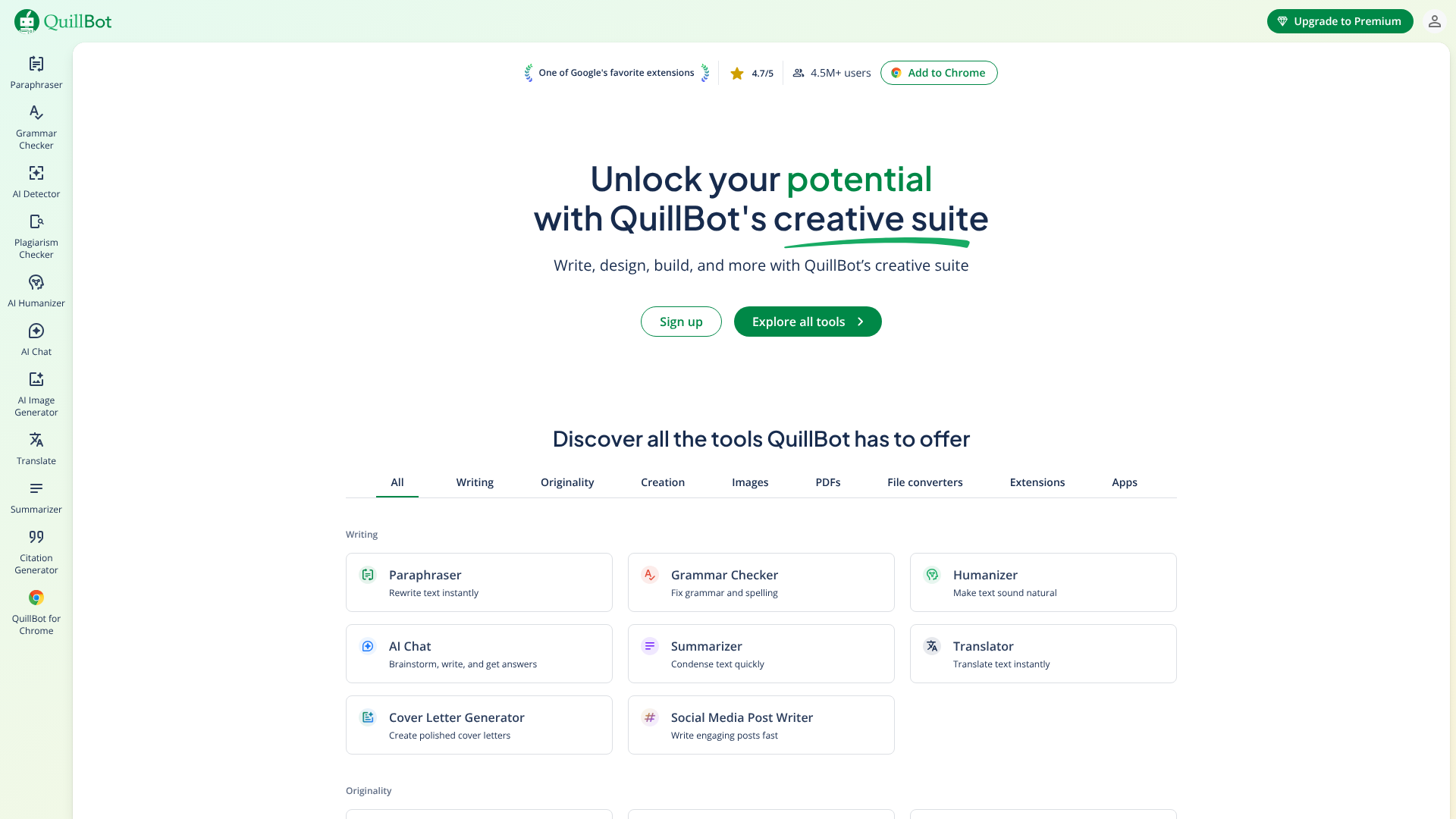
While often known for its powerful paraphrasing tool, QuillBot has evolved into a comprehensive writing suite with its Co-Writer feature. The Co-Writer combines a grammar checker, paraphraser, summariser, and AI-powered content generation into a single editor, making it a fantastic tool for students, academics, and bloggers who are more focused on refining existing text.
QuillBot's strength lies in its ability to help you rephrase sentences, improve clarity, and overcome writer's block by suggesting different ways to express your ideas. While its long-form generation capabilities aren't as advanced as dedicated tools like Jasper or Writesonic, its suite of editing and rewriting tools is second to none. It's an excellent assistant for the editing and polishing stages of content creation.
Pros
- Best-in-class paraphrasing tool with multiple modes for tone and style.
- The Co-Writer provides an all-in-one environment for writing and editing.
- Very affordable, with a robust free version available.
- Simple, clean interface that is easy to use.
Cons
- Not designed for generating entire long-form articles from scratch.
- Lacks the advanced SEO features and templates of its competitors.
If your main goal is to improve, rewrite, and polish your writing, QuillBot is an invaluable and budget-friendly assistant.
Comparing Pricing and Value
Choosing an AI writing tool also comes down to budget and value. Pricing models can vary significantly, from word-based credits to user seats and feature tiers. Here’s a quick comparison to help you understand the different value propositions.
| Feature | Jasper | Writesonic | QuillBot |
|---|---|---|---|
| Best For | Versatility & Quality | Guided SEO Workflows | Editing & Paraphrasing |
| Key Feature | Brand Voice & Surfer SEO | AI Article Writer 5.0 | Advanced Paraphraser |
| Pricing Model | Per user, per month | Word credits & user seats | Per user, per month |
| Free Trial | Yes, 7-day trial | Yes, with free credits | Yes, free version available |
When evaluating cost, think about return on investment (ROI). A more expensive tool like Jasper might be worthwhile if its quality output saves you hours of editing time each week. A more affordable tool like Writesonic could provide the best value if you need to produce a high volume of SEO articles quickly. QuillBot offers incredible value for those whose primary need is refining and rewriting text.
Always take advantage of free trials to see which tool's workflow and output quality best justify the cost for your specific use case. Remember to visit each website for the most current pricing information, as plans and features can change.
Pro Tip: Many AI tools offer significant discounts for annual billing. If you've tested a tool and are confident it's the right fit for your long-term strategy, opting for an annual plan can save you 20-30% over the course of a year.
The Pros and Cons of Using AI for Content Generation
Integrating AI into your blog writing process can be transformative, but it's important to have a balanced perspective. Understanding both the advantages and the potential pitfalls will help you use these tools effectively and responsibly.
Advantages of AI-Powered Blog Writing
- Unmatched Speed and Efficiency: The most significant benefit is the ability to produce content at a scale that is impossible for humans alone. AI can generate outlines and first drafts in minutes, drastically reducing the time it takes to go from idea to publication.
- Overcoming Writer's Block: Staring at a blank page can be intimidating. AI tools provide an excellent starting point, generating ideas and initial paragraphs that can help you break through creative blocks and get the words flowing.
- Scaling Content Production: For businesses that need to produce a high volume of content, AI is a necessity. It enables marketing teams to scale their output without a proportional increase in headcount or budget.
- Enhanced Idea Generation: AI can analyse vast amounts of data to suggest blog topics, questions, and angles you might not have considered, helping to keep your content strategy fresh and relevant.
Potential Drawbacks and How to Mitigate Them
- Risk of Generic Content: If used without proper guidance, AI can produce content that is bland, repetitive, and lacks a distinct voice. Mitigation: Always use detailed prompts, define a brand voice, and heavily edit the output to inject your unique personality and insights.
- Factual Inaccuracies: AI models are not infallible and can sometimes generate incorrect information or "hallucinate" facts. Mitigation: Never trust AI-generated facts blindly. Implement a rigorous fact-checking process for every single article before publication.
- Lack of Genuine E-E-A-T: AI cannot replicate genuine human experience or expertise. Content that relies solely on AI will lack the depth and authority that Google and readers value. Mitigation: Use AI for the draft, but ensure the final version is enriched with your personal experiences, expert analysis, and unique perspectives.
- Over-optimisation: Some AI tools can be too aggressive with keyword placement, resulting in text that sounds unnatural. Mitigation: Use SEO suggestions as a guide, not a rule. Prioritise creating a positive user experience and a natural reading flow over hitting exact keyword density targets.
Frequently Asked Questions about Blog Content Generation
Here are answers to some of the most common questions marketers have about generating blog content, especially with the help of AI.
Can AI completely replace human blog writers?
No, AI cannot completely replace human writers, and it's unlikely to do so anytime soon. While AI is exceptionally good at research, outlining, and drafting, it lacks the critical thinking, creativity, and genuine experience that human writers bring. The best approach is a collaborative one, where AI handles the repetitive, time-consuming tasks, freeing up human writers to focus on strategy, editing, and adding the unique insights that make content truly valuable.
How do you generate blog content for free?
Generating blog content for free is possible but requires more manual effort. You can use free tools like Google Keyword Planner for research and Google Trends for ideation. Many premium AI writers, like Writesonic and QuillBot, offer free plans with limited credits or features, which can be sufficient for generating a few articles per month. You can also use the free versions of large language models like ChatGPT or Google Gemini to help with brainstorming and outlining, but you will need to do all the writing and heavy editing yourself.
Is AI-generated content good for SEO?
AI-generated content can be good for SEO if it is used correctly. Google's official stance is that it rewards high-quality content, regardless of how it's produced. The key is to use AI as a tool to create helpful, reliable, people-first content. Low-quality, unedited AI content created solely to manipulate search rankings will perform poorly.
High-quality content that has been carefully drafted with AI and then thoroughly edited, fact-checked, and enhanced by a human expert can rank very well.
How long should a blog post be?
The ideal length of a blog post depends on the topic, search intent, and what your competitors are doing. There is no magic number. A good practice is to analyse the top-ranking articles for your target keyword. If they are all comprehensive guides over 2,500 words, a short 500-word post is unlikely to compete.
Your goal should be to cover the topic more comprehensively and helpfully than the competition, whatever word count that requires. Focus on quality and depth over an arbitrary length.
What is the fastest way to generate blog content?
The fastest way to generate blog content is by using an AI-powered guided workflow. Tools like Writesonic's AI Article Writer are designed for speed. They streamline the process by combining keyword research, competitor analysis, outlining, and drafting into a few simple steps. This can produce a solid first draft of a long-form article in under 15 minutes.
However, remember that this speed comes with a trade-off; you must still invest time in editing and fact-checking to ensure the final product meets quality standards.
Final Thoughts: The Future of Blog Writing
The landscape of blog content generation has fundamentally changed. What was once a purely manual and often arduous task has been transformed by the power of artificial intelligence. However, the core principles of what makes a great blog post remain the same: value, authenticity, and a deep understanding of the reader's needs.
The most successful content creators of tomorrow will not be those who let AI do all the work, nor those who reject it entirely. They will be the ones who master the art of human-AI collaboration. They will use AI to accelerate their workflow, eliminate writer's block, and scale their production, while dedicating their uniquely human skills to strategy, creativity, and building a genuine connection with their audience.
Ultimately, these tools are amplifiers for your own expertise. By embracing a structured process and leveraging the right technology, you can create a powerful content engine that not only ranks well but also builds lasting trust and authority. If you're ready to speed up your workflow, consider exploring tools like Jasper or Writesonic to see how they can fit into your process and help you achieve your content goals.