
AI-Powered Content Generation: A Marketer's Guide to Scaling Content in 2026
The demand for high-quality content has never been greater, yet resources and time remain finite. Marketers and creators are constantly under pressure to produce more blog posts, social media updates, videos, and emails to engage their audience. This is where ai-powered content generation steps in, not as a replacement for human creativity, but as a powerful collaborator that helps you scale your efforts, break through creative blocks, and deliver value to your audience faster than ever before.
- In a Nutshell
- What Exactly is AI-Powered Content Generation?
- The Core Benefits: Why AI Content Creation is Essential
- Key Features to Look For in AI Generation Tools
- How to Choose the Right AI Content Platform for Your Needs
- 1. Define Your Primary Use Case
- 2. Evaluate the Content Quality and Customisation
- 3. Consider Ease of Use and Learning Curve
- 4. Check for Integrations
- Top AI-Powered Content Generation Tools for 2026
- 1. Jasper (formerly Jarvis): Best for Advanced Content Marketing
- 2. Writesonic: Best All-in-One Content Platform
- 3. Pictory: Best for Turning Text into Video
- 4. Synthesia: Best for AI Avatar Videos
- Understanding Pricing Models and Costs
- The Pros and Cons of Automated Content Generation
- Frequently Asked Questions About AI-Driven Writing
- Is AI-generated content penalised by Google?
- Can AI replace human writers and content creators?
- How can I ensure the originality of AI-generated content?
- What is the best way to write a prompt for an AI tool?
- Final Thoughts: The Future of Content is Collaborative
This technology uses artificial intelligence, specifically large language models (LLMs), to create text, images, audio, and video from simple text prompts. It's a fundamental shift in how we approach the creative process, moving from manual drafting to a more strategic role of directing, refining, and curating AI-generated outputs. By understanding how to use these tools effectively, you can transform your content workflow and achieve your marketing goals with greater efficiency.
In a Nutshell
- What It Is: AI-powered content generation uses artificial intelligence models to create various types of content, including text, images, and video, based on user prompts. It automates parts of the creative process to increase efficiency.
- Core Benefits: The primary advantages are a massive increase in speed and scalability. It also helps maintain brand consistency, reduces costs associated with content production, and provides a starting point to overcome writer's block.
- Human Oversight is Crucial: AI is a tool, not an author. The best results come from a 'human-in-the-loop' approach, where creators guide the AI, fact-check its output, and edit for tone, accuracy, and originality.
- Choosing the Right Tool: Your choice of platform should depend on your specific needs, such as the type of content you create (text, video, audio), your budget, and the technical features you require, like SEO integrations or brand voice customisation.
What Exactly is AI-Powered Content Generation?
AI-powered content generation refers to the use of artificial intelligence, particularly generative AI models, to produce original content. Unlike simple automation that might fill in a template, these systems can write articles, design images, compose emails, and even generate video scripts from a brief set of instructions, known as a 'prompt'. The technology behind this is built on Large Language Models (LLMs), which are trained on vast datasets of text and images from the internet.
Think of an LLM like an incredibly well-read apprentice. It has consumed billions of documents, articles, and images, allowing it to understand patterns, context, grammar, and style. When you give it a prompt, such as "Write a blog post introduction about the benefits of indoor plants," it doesn't just copy and paste existing text. Instead, it predicts the most likely sequence of words to form coherent, relevant sentences that fulfil your request, based on the patterns it has learned.
This process of automated content generation extends beyond just text. Text-to-image models like DALL-E or Midjourney can create stunning visuals from a descriptive sentence. Text-to-video platforms can turn a script into an animated video with an AI presenter, and text-to-speech tools can generate realistic voiceovers. The common thread is the transformation of a simple human instruction into a complex piece of creative work.
It's important to distinguish between AI-assisted writing and fully autonomous generation. Most professional use cases today involve a collaborative approach. The AI generates a first draft, provides ideas, or summarises research, and a human writer or editor then refines, fact-checks, and adds the unique perspective and nuance that only a person can provide. This partnership is the key to using AI content tools effectively and ethically.

The Core Benefits: Why AI Content Creation is Essential
The adoption of AI content creation tools is growing rapidly, and for good reason. Businesses and individual creators are discovering significant advantages that directly impact their productivity and bottom line. These benefits go beyond simply writing faster; they reshape the entire content workflow.
First and foremost is the dramatic increase in speed and efficiency. A human writer might take several hours or even days to research and write a comprehensive blog post. An AI tool can generate a well-structured draft in minutes. This acceleration allows content teams to move from producing one or two articles a week to potentially dozens, freeing up valuable time for strategy, promotion, and more creative tasks.
This leads directly to the second major benefit: scalability. For businesses looking to expand their digital footprint, AI makes it possible to produce content at a scale that would be impossible with a human team alone. You can generate product descriptions for thousands of e-commerce items, create unique social media posts for different platforms daily, or localise marketing copy for various regions without a proportional increase in headcount or cost.
Cost-effectiveness is another compelling advantage. While professional AI tools come with a subscription fee, this cost is often significantly lower than hiring additional writers, designers, or video producers. For startups and small businesses with limited budgets, AI-driven writing and visual creation tools democratise access to high-quality content production, levelling the playing field against larger competitors.
Finally, AI is a powerful antidote to creative burnout and writer's block. Staring at a blank page can be daunting for even the most experienced creators. AI tools can serve as an inexhaustible brainstorming partner, suggesting blog post titles, outlining article structures, or generating initial paragraphs to get the creative process started. This removes a major friction point in content creation, ensuring a more consistent and less stressful workflow.
Key Features to Look For in AI Generation Tools
With a flood of AI content tools on the market, it can be difficult to know which ones offer genuine value. While the core function of generating content is standard, certain key features separate the most useful platforms from the basic ones. When evaluating your options, look for a toolset that aligns with your specific workflow and quality standards.
One of the most important features is a robust library of templates and pre-built workflows. A good platform won't just offer a generic text box. It will have specific templates for different content types, such as 'Blog Post Intro', 'YouTube Video Script', 'Facebook Ad Copy', or 'Product Description'. These templates are designed with optimised structures and prompt guides, helping you get better results with less effort.
Tools like Jasper (formerly Jarvis) and Writesonic excel in this area, offering hundreds of specialised templates.
Customisation and control over the output are also critical. Look for features that allow you to set the tone of voice (e.g., 'professional', 'witty', 'empathetic'), specify a target audience, and input brand-specific information. The most advanced tools can learn your brand's unique style from existing content, ensuring that everything it generates sounds authentic to your business. This moves beyond generic content and towards true AI-driven writing that reflects your identity.
For those focused on written content, SEO and integration features are essential. Some platforms integrate with SEO tools like Semrush to help you optimise your content for specific keywords as you write. Others include built-in plagiarism checkers to ensure the originality of the generated text. These features streamline the process of creating content that is not only well-written but also designed to perform well in search engines.
Finally, consider the variety of content formats the tool supports. While some tools specialise in text, many are becoming multi-modal platforms. They might offer text generation, AI image creation, and even audio or video features within a single subscription. If your strategy involves multiple content types, an all-in-one solution can be more cost-effective and efficient than juggling several different tools.
How to Choose the Right AI Content Platform for Your Needs
Selecting the right AI content tool is a strategic decision that can significantly impact your team's productivity and content quality. The best platform isn't necessarily the one with the most features, but the one that best fits your unique goals, workflow, and budget. Following a structured approach can help you make an informed choice.
1. Define Your Primary Use Case
Start by identifying what you need the tool to do. Are you a blogger looking to write long-form articles faster. A social media manager needing to generate dozens of posts per week. Or a video marketer who wants to turn articles into engaging videos.
Your primary goal will determine the type of tool you need. For example, a writer would prioritise a tool like Jasper, while a video creator would look at Pictory or Synthesia.
2. Evaluate the Content Quality and Customisation
Most platforms offer a free trial or a freemium plan. Use this opportunity to test the quality of the output. Give the same prompt to a few different tools and compare the results. Assess the coherence, accuracy, and creativity of the generated content.
Also, check the level of control you have. Can you easily adjust the tone, style, and length. The more you can guide the AI, the less editing you'll have to do later.
3. Consider Ease of Use and Learning Curve
The most powerful tool is useless if your team finds it too complicated to use. Look for a platform with a clean, intuitive interface. A good tool should feel like a helpful assistant, not another complex piece of software to master. Watch tutorials and read user reviews to get a sense of the user experience.
A shorter learning curve means your team can start benefiting from the tool almost immediately.
4. Check for Integrations
To maximise efficiency, choose a tool that integrates with your existing software stack. For example, if you use WordPress, a direct integration can save you from endless copying and pasting. If your workflow involves SEO, a connection with tools like Semrush is a huge plus. Integrations reduce friction and help make automated content generation a seamless part of your daily operations.
Pro Tip: When testing a tool, try giving it a niche or complex topic from your industry. This is a great way to test its true capabilities. A good AI model should be able to handle specialised subjects with reasonable accuracy, whereas a weaker one will produce generic or nonsensical content.
Top AI-Powered Content Generation Tools for 2026
Navigating the landscape of AI tools can be overwhelming. To help you get started, we've selected some of the top platforms across different content categories, from writing to video and audio. Each of these tools excels in its specific area and is trusted by thousands of creators.
1. Jasper (formerly Jarvis): Best for Advanced Content Marketing
Jasper is one of the most well-known names in AI-driven writing, and for good reason. It's designed specifically for marketers and content teams who need high-quality, on-brand content at scale. Its standout feature is 'Brand Voice', which allows you to upload documents or scan your website to teach Jasper your specific style, tone, and product knowledge. This results in content that requires far less editing to sound authentic.
With over 50 templates for everything from blog posts to ad copy and a powerful long-form document editor, Jasper is a versatile workhorse for any text-based content needs. It also includes features for campaign creation, allowing you to generate a suite of related assets (e.g., blog post, social media captions, email newsletter) from a single brief.
Pros
- Excellent 'Brand Voice' feature for on-brand content.
- High-quality output for long-form articles and marketing copy.
- Extensive library of specialised templates and workflows.
Cons
- Can be more expensive than some competitors.
- The sheer number of features might be overwhelming for absolute beginners.
If your primary focus is creating polished, brand-aligned written content for marketing campaigns, Jasper (formerly Jarvis) is an excellent investment.
2. Writesonic: Best All-in-One Content Platform
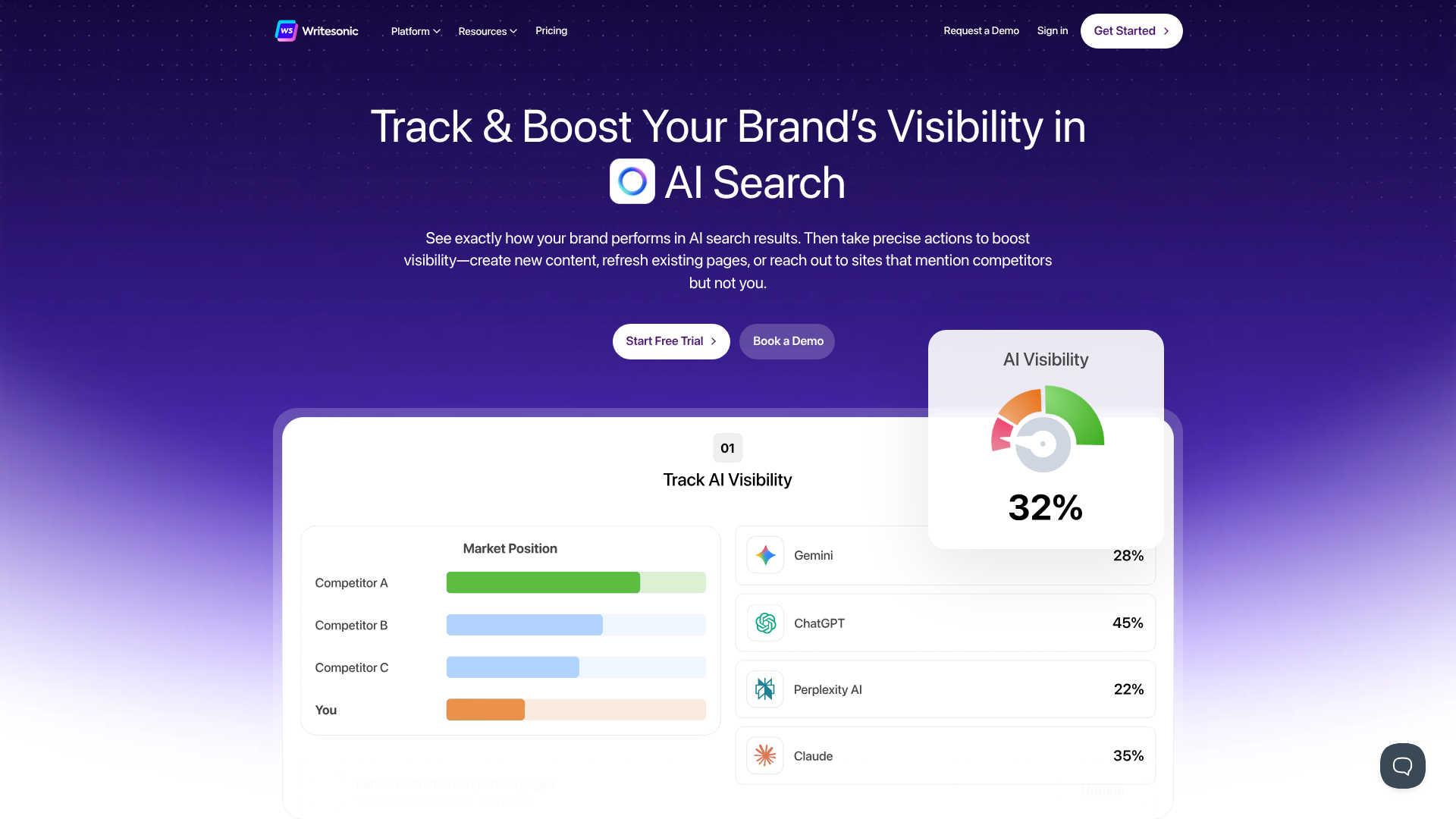
Writesonic positions itself as an all-in-one solution for content creation, and it largely delivers on that promise. It combines a powerful AI writer with an AI art generator (Photosonic), a chatbot (Chatsonic) that can pull real-time data from Google, and SEO optimisation tools. This makes it an incredibly versatile platform for creators who need to produce both text and visuals.
Its AI Article Writer 5.0 is particularly impressive, capable of generating 1,500-word, fact-checked, and SEO-optimised articles from a single prompt. For businesses that need a high volume of blog content without sacrificing quality, this feature alone is a huge time-saver. The interface is clean and user-friendly, making it accessible even for those new to AI content creation.
Pros
- All-in-one platform for text, images, and SEO.
- Chatsonic feature provides up-to-date, factual information.
- Generally more affordable than other premium competitors.
Cons
- The quality of AI-generated images can be less consistent than specialised image tools.
- Some advanced features may require higher-tier plans.
For creators and small businesses looking for a single tool to handle the majority of their content needs, Writesonic offers exceptional value.
3. Pictory: Best for Turning Text into Video
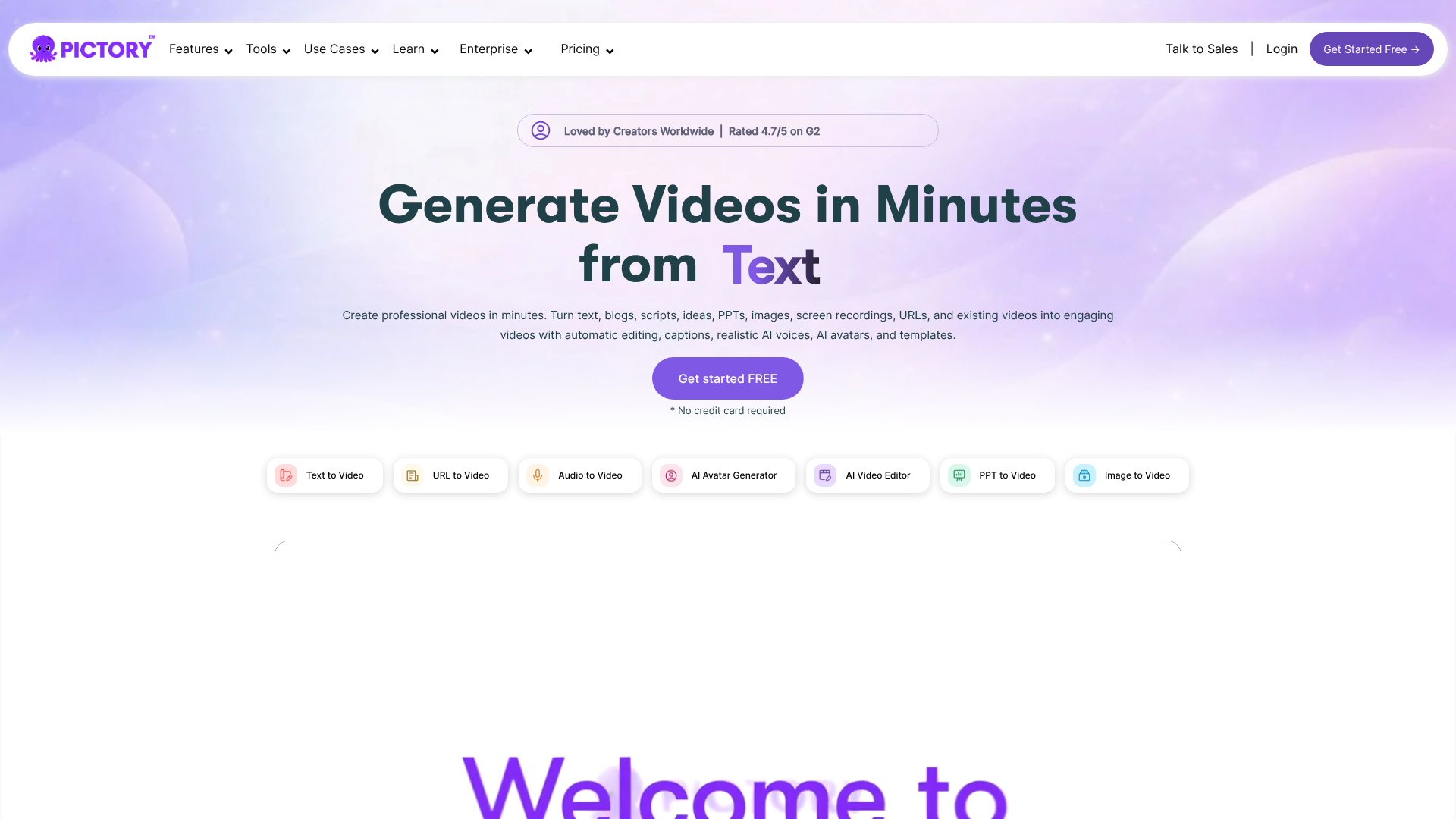
Pictory is a specialised AI tool that excels at one thing: creating videos from text. It's the perfect solution for repurposing existing content, such as blog posts, scripts, or press releases, into engaging videos for social media or your website. You simply paste your text, and Pictory's AI selects relevant stock video clips, images, and music to match your content.
The platform also automatically adds captions—a crucial feature for social media videos—and allows you to add a realistic AI voiceover or record your own. The process is incredibly fast, turning what would normally be hours of video editing into a task that takes just a few minutes. It's an ideal tool for marketers who want to tap into the power of video without a steep learning curve or expensive software.
Pros
- Incredibly fast and easy way to create videos from text.
- Large library of royalty-free video clips, images, and music.
- Automatically generates accurate captions.
Cons
- The AI's choice of visuals sometimes needs manual adjustment.
- Less customisation available compared to traditional video editing software.
If you want to maximise the reach of your written content by turning it into video, Pictory is an indispensable tool.
4. Synthesia: Best for AI Avatar Videos
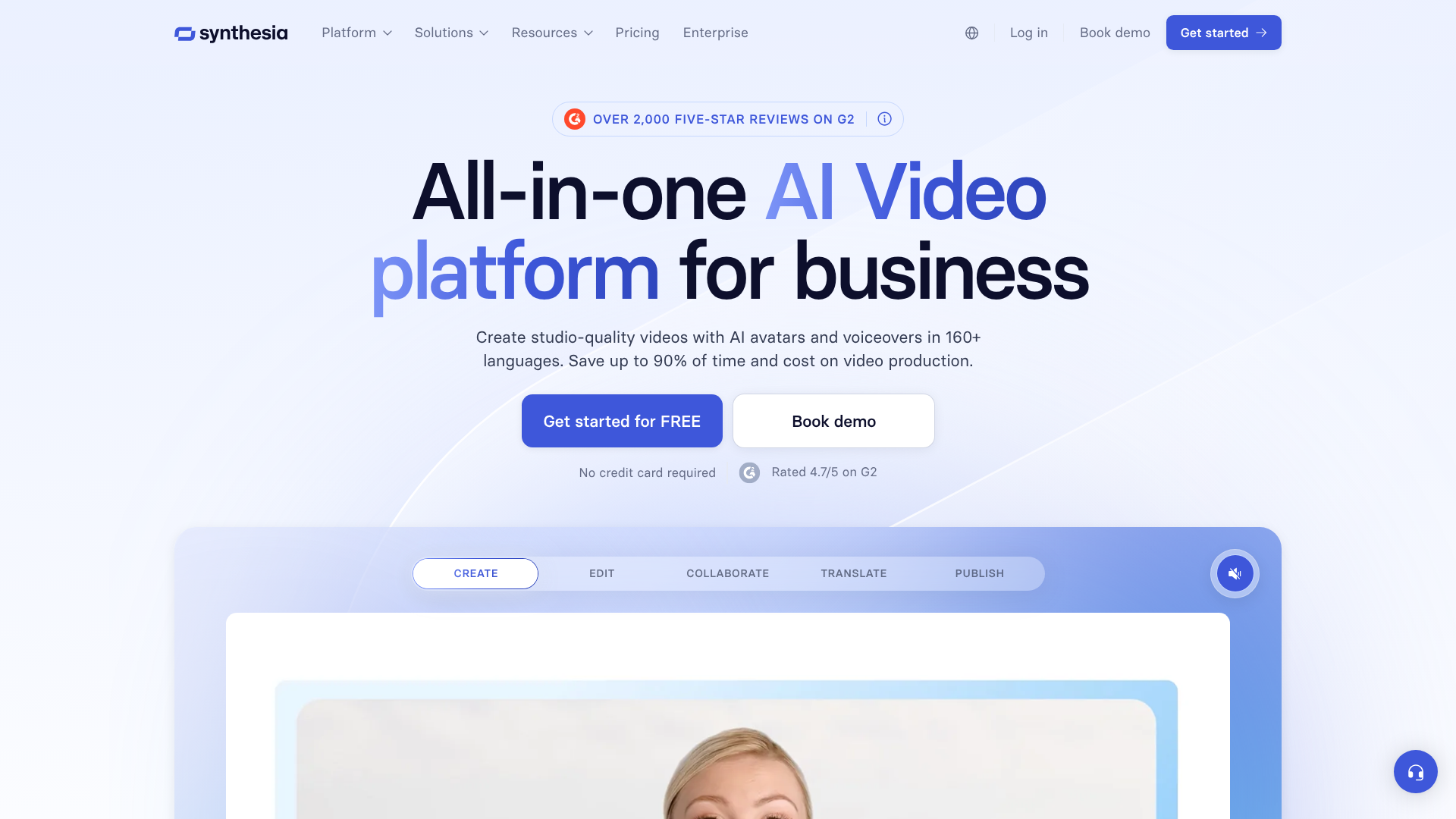
Synthesia takes AI video generation to the next level by allowing you to create videos featuring hyper-realistic AI avatars. You can choose from over 140 diverse avatars, type your script, and the AI will generate a video of the avatar speaking your text in one of over 120 languages. This is particularly useful for creating corporate training videos, product tutorials, and marketing presentations without the need for cameras, actors, or studios.
The platform is remarkably easy to use, with a simple drag-and-drop interface for adding text, images, and shapes to your video. You can even create a custom avatar of yourself. For businesses that need to produce professional-looking spokesperson videos consistently and affordably, Synthesia is a powerful solution.
Pros
- Creates high-quality, professional videos with realistic AI avatars.
- Huge selection of languages and accents for global audiences.
- Eliminates the cost and logistics of traditional video shoots.
Cons
- The technology, while impressive, may not be suitable for content requiring deep emotional connection.
- Custom avatars are a premium feature.
For scalable and professional training and explainer videos, Synthesia offers a unique and powerful platform.
Understanding Pricing Models and Costs
The cost of ai-powered content generation tools can vary widely, and understanding the different pricing structures is key to choosing a plan that fits your budget and usage patterns. Most platforms have moved away from simple one-size-fits-all pricing, offering a range of models to suit different types of users.
The most common model is the tiered subscription. Platforms typically offer several plans (e.g., Starter, Pro, Business) at different monthly or annual price points. Each tier comes with a specific word or credit limit, as well as access to different features. For example, a starter plan might give you 20,000 words per month and basic templates, while a pro plan offers unlimited words, advanced features like brand voice, and priority support.
This model is ideal for users with predictable, consistent content needs.
Another popular structure is the credit-based system. Instead of a word count, you purchase or are allotted a certain number of credits each month. Different actions consume a different number of credits; generating a short paragraph might cost one credit, while creating a full-length article could cost 20. This model offers more flexibility, as you can use your credits across different features, such as text generation and image creation.
It's a good fit for users whose needs vary from month to month.
Here’s a general comparison of what to expect from different pricing tiers:
| Tier | Typical Price Range (Monthly) | Best For | Common Features |
|---|---|---|---|
| Free/Freemium | £0 | Individuals testing the platform | Limited word/credit count, basic features, watermarks on images/videos. |
| Starter/Basic | £15 – £40 | Freelancers, small bloggers | Generous word count (20k-100k), access to most templates, single user. |
| Pro/Business | £40 – £100+ | Marketing teams, agencies | Unlimited or very high word count, advanced features (brand voice, SEO), collaboration tools. |
| Enterprise | Custom Pricing | Large organisations | Custom features, dedicated support, enhanced security and compliance. |
Before committing, always take advantage of free trials to gauge how quickly you use up words or credits. This will give you a much clearer idea of which plan is the most cost-effective for your specific workflow. For the most up-to-date information, it's always best to visit the tool's official website for their latest pricing.
The Pros and Cons of Automated Content Generation
Like any transformative technology, automated content generation comes with a set of advantages and potential drawbacks. A balanced understanding is crucial for integrating these tools into your workflow responsibly and effectively. The goal is to maximise the benefits while mitigating the risks.
The Pros
- Unmatched Speed: The ability to generate drafts, outlines, and ideas in seconds is the single biggest advantage. This drastically shortens the content creation lifecycle.
- Massive Scalability: AI allows you to produce a volume of content that is simply not feasible for human teams alone, enabling you to target more keywords and platforms.
- Cost Reduction: It can significantly lower the cost per piece of content by reducing the human hours required for drafting and research.
- Consistency in Tone and Style: Once configured with a brand voice, AI can maintain a consistent tone across all content, which is difficult to achieve with multiple human writers.
- Overcoming Creative Blocks: AI serves as an excellent brainstorming partner, providing angles, headlines, and starting points when you're feeling stuck.
The Cons
- Potential for Inaccuracy: AI models can 'hallucinate' or generate plausible-sounding but incorrect information. Fact-checking by a human expert is non-negotiable, especially for topics requiring accuracy.
- Lack of True Creativity and Nuance: While AI can mimic human writing, it cannot replicate genuine human experience, emotion, or deep critical thinking. The output can sometimes feel generic or soulless without human editing.
- Risk of Plagiarism: Although rare with high-quality tools, there is a small risk that the AI might generate text that is too similar to its training data. Using a built-in or third-party plagiarism checker is a wise precaution.
- SEO and Google's Stance: Google has stated that high-quality, helpful AI-generated content is acceptable. However, low-quality, spammy content created solely to manipulate search rankings will be penalised. The emphasis is on quality and usefulness, regardless of how it's created.
Pro Tip: Create a clear editorial checklist for all AI-generated content. It should include steps for fact-checking all claims, editing for brand voice and tone, checking for originality, and adding unique human insights or personal stories to make the content stand out.
Frequently Asked Questions About AI-Driven Writing
As AI-driven writing becomes more mainstream, many questions and concerns naturally arise. Here are answers to some of the most common queries.
Is AI-generated content penalised by Google?
No, Google does not inherently penalise content simply because it was created with the help of AI. Google's primary concern is the quality and helpfulness of the content for the user. Their official guidance states that high-quality content is rewarded, regardless of whether it's produced by a human, AI, or a combination of both.
However, they do penalise low-quality, spammy content created at scale purely to manipulate search rankings. The key is to use AI as a tool to create genuinely useful and well-written content, which is then reviewed and enhanced by a human editor. Focus on creating value for the reader, and you will align with Google's guidelines.
Can AI replace human writers and content creators?
It is highly unlikely that AI will replace human writers entirely. Instead, it is changing their role. The future of content creation is collaborative, where AI handles the more repetitive tasks like drafting, research summarisation, and data analysis, freeing up human creators to focus on higher-level tasks.
These tasks include strategy, critical thinking, injecting unique perspectives, storytelling, and ensuring factual accuracy and ethical considerations. AI is a powerful assistant, but it lacks the life experience, emotional intelligence, and true creativity that are the hallmarks of great content.
How can I ensure the originality of AI-generated content?
Ensuring originality is a critical step in the AI content workflow. First, use reputable, high-quality AI writing tools, as they are designed to generate unique text rather than copying from their training data. Most premium platforms, like Writesonic, include a built-in plagiarism checker.
For an extra layer of security, you can run the final text through a third-party plagiarism tool like Grammarly's checker or Copyscape. Most importantly, the process of human editing—where you rephrase sentences, add your own examples, and inject your unique voice—is the best way to make the content truly your own and ensure it is 100% original.
What is the best way to write a prompt for an AI tool?
Writing an effective prompt is a skill, often called 'prompt engineering'. The key is to be specific, provide context, and clearly define the desired output. Instead of a vague prompt like "write about marketing," a much better prompt would be: "Act as an expert content marketer. Write a 500-word blog post introduction for a beginner audience explaining the concept of a marketing funnel.
Use a friendly and encouraging tone and include an analogy to make it easy to understand.".
This better prompt specifies the persona (expert marketer), the format (blog post intro), the length (500 words), the target audience (beginners), the topic (marketing funnel), the tone (friendly), and a specific instruction (use an analogy). The more detail you provide, the better and more relevant the AI's output will be.
Final Thoughts: The Future of Content is Collaborative
AI-powered content generation is not a passing trend; it's a fundamental evolution in the way we create. The tools and technologies are advancing at an incredible pace, offering unprecedented opportunities for efficiency, scale, and creativity. From drafting articles in minutes with Jasper to producing professional videos without a camera using Synthesia, AI is empowering creators to do more than ever before.
However, the most important takeaway is that technology is at its best when it augments human skill, not when it attempts to replace it. The future of content isn't fully automated; it's collaborative. The most successful marketers and creators will be those who master the art of working with AI, using it as a co-pilot to handle the heavy lifting while they provide the strategic direction, the creative spark, and the essential human touch.
By embracing a human-in-the-loop approach—guiding, editing, and refining AI output—you can unlock the full potential of these powerful tools. You can scale your content, engage your audience more effectively, and free up your most valuable resource: your own time to think, strategise, and create.