



Synthesia AI Voice Generator Explained: A Guide for Businesses
Creating professional video content traditionally required expensive recording equipment, voice actors, and hours of editing. The Synthesia AI voice generator changes this by allowing businesses to create realistic, studio-quality voiceovers from simple text. This tool is part of a larger AI video creation platform, designed to streamline the production of training materials, marketing videos, and internal communications, making content creation faster and more scalable than ever before.
- In a Nutshell
- What is the Synthesia AI Voice Generator?
- The Core Features That Define the Synthesia Voice Tool
- Extensive Voice Library (1000+ Voices)
- Custom Voice Cloning
- Emotional Range and Speech Styles
- Pronunciation and SSML Control
- How Does Voice Synthesis AI in Synthesia Actually Work?
- Practical Use Cases for Businesses and Creators
- Corporate Training and Onboarding Videos
- Marketing and Product Demonstration Videos
- Localised Content for Global Audiences
- Internal Communications and Announcements
- Synthesia vs. Other AI Voice Generators: A Comparison
- Key Benefits of Using Synthesia for Voice Generation
- A Step-by-Step Guide to Using the Synthesia Voice Tool
- See How It Works
- 1. Scripting Your Content
- 2. Choosing Your AI Avatar and Voice
- 3. Inputting and Generating the Voiceover
- 4. Fine-Tuning with Pauses and Pronunciation
- 5. Generating and Exporting Your Video
- Understanding the Limitations and Challenges
- The Future of AI Voice Generation Technology
- Ethical Considerations and Responsible Use
- Frequently Asked Questions
- What is the most realistic AI voice generator?
- Is AI voice cloning illegal?
- Can I use my own voice on Synthesia?
- How much does Synthesia cost per month?
- Is there anything better than Synthesia?
- Final Thoughts
At its core, the platform uses advanced voice synthesis AI to convert your written script into a natural-sounding narration. You can choose from a vast library of stock voices or even create a digital clone of your own voice. This guide explains exactly how the Synthesia voice tool works, its key features, practical applications, and how it compares to other solutions on the market.
In a Nutshell
- Integrated Platform: Synthesia's voice generator is not a standalone tool; it's fully integrated into its AI video creation suite, combining voiceovers with customisable AI avatars.
- Extensive Voice Library: The platform offers over 1000 voices across more than 140 languages and accents, allowing for easy content localisation for global audiences.
- Custom Voice Cloning: A key feature is the ability to create a high-quality digital replica of your own voice, ensuring brand consistency and a personal touch in your videos.
- Cost and Time Efficiency: By eliminating the need for voice actors and recording studios, the synthesia voice tool dramatically reduces the time and cost associated with producing narrated video content.
- Ethical Framework: Synthesia operates with a strong ethical framework, requiring explicit consent for voice cloning and actively working to prevent misuse of its technology.
What is the Synthesia AI Voice Generator?
The Synthesia AI voice generator is a sophisticated text-to-speech (TTS) system built into the Synthesia video creation platform. Unlike basic TTS tools that often sound robotic, Synthesia uses advanced deep learning models to produce narrations that are rich in tone, inflection, and nuance, closely mimicking human speech. It's designed to be the audio component of a comprehensive video solution, where the generated voice is synchronised with a digital AI avatar.
This integration is what sets it apart. While other services might offer an AI voice generator as a standalone product for creating audio files, Synthesia's approach is holistic. The goal isn't just to create an MP3 file; it's to produce a complete, ready-to-share video. Users type a script, select an avatar, choose a voice, and the platform generates a video of that avatar speaking the script with the selected voice.
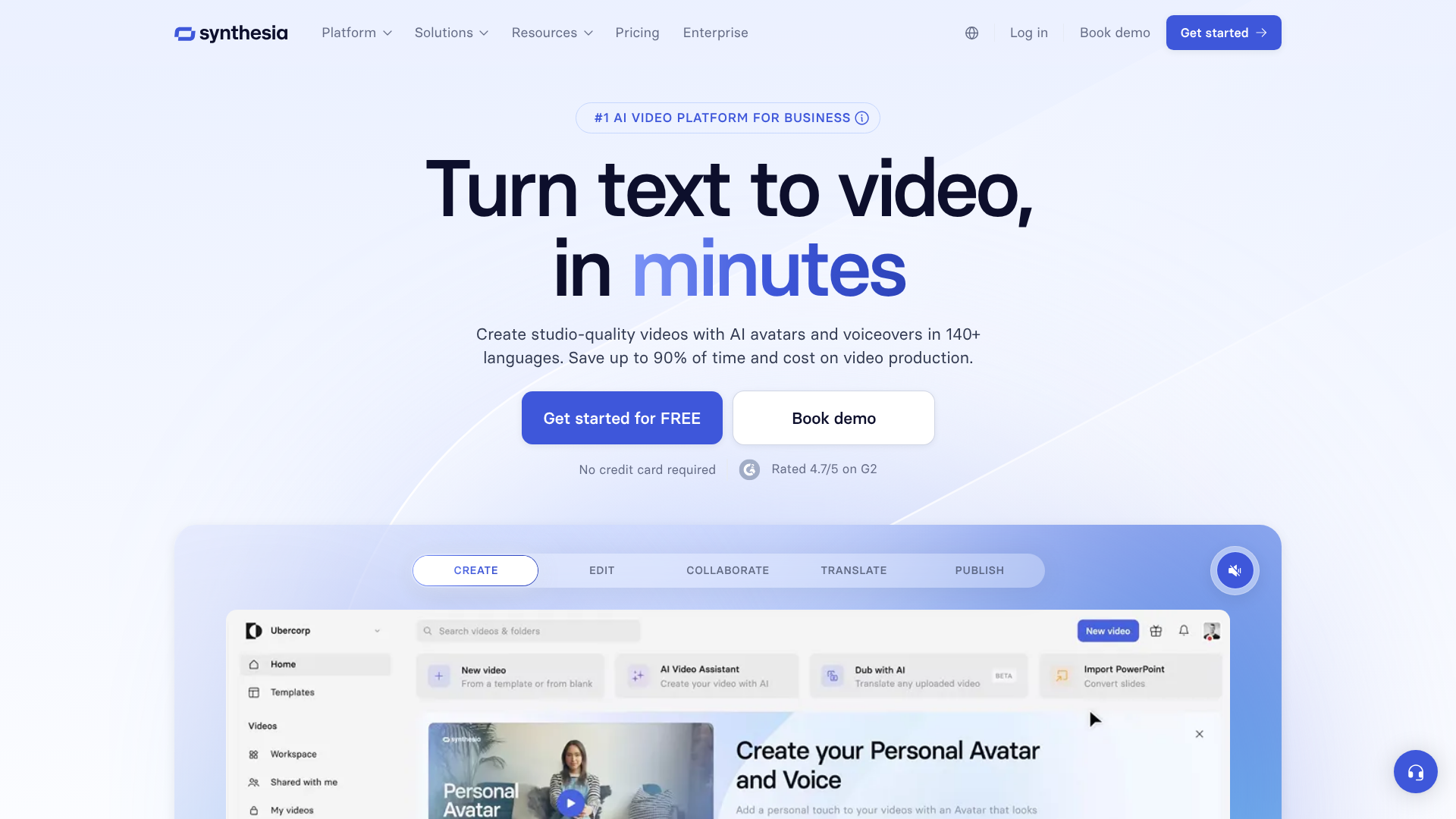
The technology is built for business use cases. It allows teams to quickly create, update, and localise video content without the logistical challenges of traditional video production. If a script needs updating, you simply edit the text and regenerate the video in minutes, a process that would typically require re-booking a voice actor and a studio.
The Core Features That Define the Synthesia Voice Tool
Synthesia's effectiveness comes from a powerful set of features designed for flexibility, quality, and ease of use. These tools empower users to create professional-grade audio without any technical expertise.

Extensive Voice Library (1000+ Voices)
One of the platform's most significant assets is its vast library of stock voices. As of 2026, Synthesia provides access to over 1000 distinct voices. This collection spans more than 140 languages and a wide variety of accents, from standard American English to regional British dialects and beyond.
This diversity is crucial for companies operating on a global scale. A business can create a single training video script and then generate versions for its teams in Japan, Germany, and Brazil, each with a native-sounding voiceover. This makes content localisation incredibly efficient, ensuring that messages are understood clearly and resonate with local audiences.
Custom Voice Cloning
For businesses seeking ultimate brand consistency, Synthesia offers a custom voice cloning feature. This allows you to create a unique AI voice based on a recording of a specific person, such as a company executive or a designated brand voice actor. The process involves recording a script provided by Synthesia, which their AI then uses to build a digital model of that voice.
Once created, this custom voice can be used by anyone on your team to generate new content. This ensures that all your company's videos have a consistent and recognisable sound. It's a powerful tool for building brand identity and adds a layer of authenticity that stock voices can't always match. Importantly, Synthesia has strict consent protocols; you can only clone a voice if you have the explicit permission of the individual.
Emotional Range and Speech Styles
Modern voice synthesis AI has moved beyond monotone delivery. Synthesia's voices can convey different emotions and styles. Depending on the voice selected, you can often choose a style such as 'conversational', 'newscaster', or 'enthusiastic' to better match the tone of your video.
This feature adds a critical layer of realism to the narration. A product announcement video can sound upbeat and exciting, while a technical training module can be delivered in a more formal and clear tone. This ability to modulate the delivery style helps keep viewers engaged and ensures the audio complements the visual message effectively.
Pronunciation and SSML Control
No AI is perfect, and sometimes it needs a little guidance. Synthesia includes tools to fine-tune pronunciation. If the AI mispronounces a company name, a technical term, or an acronym, you can use the pronunciation dictionary to teach it the correct way. You can spell out the word phonetically to ensure it's spoken correctly in all future videos.
For even more granular control, Synthesia supports Speech Synthesis Markup Language (SSML). This is a standardised markup language that allows you to control aspects of speech like pitch, rate, and volume, or add specific pauses. While most users won't need to dive this deep, it provides professional-level control for those who want to perfect every detail of their narration.
How Does Voice Synthesis AI in Synthesia Actually Work?
The technology behind the Synthesia AI voice generator is a field of artificial intelligence known as deep learning. Specifically, it uses complex neural networks that have been trained on enormous datasets of human speech. The process can be broken down into a few key stages.
First, the text you input is analysed by a Natural Language Processing (NLP) model. This model breaks down the sentences, identifies punctuation, and understands the linguistic structure. It converts the raw text into a more detailed phonetic representation, which includes information about phonemes (the basic units of sound) and prosody (the rhythm and intonation of speech).
Next, this phonetic information is fed into a neural network called a vocoder or waveform generator. This network has been trained by listening to thousands of hours of high-quality audio recordings from human voice actors. It has learned the incredibly complex patterns of human speech—how pitch changes, where pauses naturally occur, and the subtle inflections that convey meaning. The network uses these learned patterns to generate a digital audio waveform from the phonetic input.
For voice cloning, the process is similar but more specialised. The AI is trained on recordings from one specific person. It learns the unique characteristics of their voice—the pitch, timbre, and speaking style—and builds a predictive model. When you give it new text, it uses this model to generate audio that sounds as if that specific person were speaking it.
Practical Use Cases for Businesses and Creators
The applications for a high-quality AI voice generator integrated with a video platform are vast. It solves common bottlenecks in content production for various departments within an organisation.
Corporate Training and Onboarding Videos
Human resources and learning development teams are constantly creating and updating training materials. Using Synthesia, they can produce engaging onboarding modules, software tutorials, and compliance training videos quickly. If a policy or process changes, they can simply edit the script and regenerate the video in minutes, ensuring all training content is always up-to-date.
Marketing and Product Demonstration Videos
Marketing teams can use the synthesia voice tool to create compelling product demos, explainer videos, and social media ads. The ability to localise content into multiple languages allows them to run global campaigns efficiently. For example, a software company can create a demo video and then generate 20 different language versions for international markets in a single afternoon.
Localised Content for Global Audiences
One of the most powerful use cases is localisation. Traditionally, creating video content for different regions required hiring local voice actors for each language, a costly and time-consuming process. With an AI voice generator, you can translate a script and generate a native-sounding voiceover for dozens of languages almost instantly, making global communication seamless.
Internal Communications and Announcements
Company leaders can use the platform to deliver consistent messages to employees across the organisation. Instead of a simple email, a CEO can deliver a weekly update using their cloned voice paired with an AI avatar. This adds a more personal and engaging touch to internal communications, especially for remote and distributed teams.
Synthesia vs. Other AI Voice Generators: A Comparison
While Synthesia is a leader in AI video, the AI voice space has several strong players. The key difference often comes down to integration versus specialisation. Synthesia offers an all-in-one video solution, while others like Murf AI and ElevenLabs focus primarily on voice generation as a standalone service.
| Feature | Synthesia | Murf AI | ElevenLabs |
|---|---|---|---|
| Primary Function | Integrated AI Video & Voice Platform | Standalone AI Voice Generator | Standalone AI Voice Generator |
| Core Strength | All-in-one video creation with avatars | Versatile voice library with styles | Hyper-realistic voice cloning & quality |
| Voice Cloning | Yes, high-quality custom cloning | Yes, available on higher tiers | Yes, considered industry-leading |
| Languages | 140+ | 20+ | 29+ |
| Video Integration | Native and core to the product | Basic video editing features | None (API for integration) |
| Best For | Businesses needing a complete video solution | Podcasters, educators, content creators | Developers and users needing top-tier voice realism |
Synthesia's main advantage is its tight integration of voice and video. If your end goal is always a video with a talking head, it's the most efficient workflow. You don't need to generate an audio file in one tool and then import it into a video editor. It all happens in one place.
ElevenLabs, on the other hand, is widely recognised for the sheer realism of its voices and the quality of its voice cloning technology. In fact, Synthesia has partnered with ElevenLabs to bring some of their voices to the Synthesia platform. This highlights that for pure audio quality, specialised tools can sometimes have an edge. Murf AI strikes a balance, offering a strong voice generator with some added-on features for creating simple videos and presentations.
Choosing the right tool depends on your needs. If you need to produce complete videos at scale, Synthesia is likely the best choice. If you only need high-quality audio files for a podcast or to use in a separate video editor, a specialised AI voice generator might be a better fit.
Key Benefits of Using Synthesia for Voice Generation

Adopting a tool like Synthesia can have a transformative impact on a company's content production workflows, leading to tangible benefits.
Significant Cost and Time Savings
The most immediate benefit is the reduction in production costs. Hiring a professional voice actor can cost hundreds or even thousands of pounds per project. Add in studio rental and audio engineering fees, and the expenses quickly add up. Synthesia replaces these variable costs with a predictable subscription fee, often reducing voiceover costs by over 80%.
The time savings are just as dramatic. The process of casting, recording, and editing a human voiceover can take days or weeks. With Synthesia, a script can be turned into a finished voiceover in minutes. This speed allows teams to be more agile and responsive with their video content.
Unmatched Scalability and Consistency
Synthesia makes it easy to scale video production. A small team can produce a volume of content that would typically require a much larger production department. Whether you need to create one video or one hundred, the process remains the same.
It also ensures absolute consistency. A human voice actor's tone and energy can vary between recording sessions. An AI voice will deliver the script with the exact same pacing, tone, and pronunciation every single time. This is particularly valuable for series of training modules or branded content where consistency is key.
Ease of Updates and Edits
In a business environment, information changes constantly. Products get updated, policies are revised, and branding evolves. With traditional video, making a small change to the narration is a major hassle, often requiring a complete re-shoot or re-recording.
With the synthesia voice tool, updates are effortless. Need to change a sentence. Just edit the text in the script and click 'generate'. The video is updated with the new narration in minutes, without any loss in quality or consistency.
This agility is a massive advantage for any organisation that needs its content to remain current.
A Step-by-Step Guide to Using the Synthesia Voice Tool
Getting started with Synthesia is straightforward. The user interface is designed to be intuitive, allowing anyone to create a professional video without a steep learning curve.
See How It Works
This quick tutorial provides a great overview of the Synthesia Studio interface and workflow.
1. Scripting Your Content
Everything starts with your script. Write out what you want your avatar to say. For the best results, write in a clear, conversational style. Use punctuation like commas and full stops to guide the AI's pacing and pauses.
2. Choosing Your AI Avatar and Voice
Next, browse Synthesia's library of over 200 stock avatars and choose one that fits your brand and message. Then, navigate to the voice selection menu. You can filter by language, gender, and accent to find the perfect voice for your narration. If you have a custom cloned voice, you can select it here.
3. Inputting and Generating the Voiceover
Copy and paste your script into the script box. You can break your script into different scenes for longer videos. Once your text is in, click the play button to preview the audio. The AI will generate the voiceover, which usually takes just a few seconds.
4. Fine-Tuning with Pauses and Pronunciation
Listen to the generated audio. If the pacing feels off, you can add pauses. For example, typing will add a short pause. If a word is mispronounced, you can use the pronunciation feature to correct it.
This iterative process allows you to get the delivery just right.
Pro Tip: When correcting pronunciation, think phonetically. For a name like 'Siobhan', you might tell the AI to pronounce it as 'Shiv-awn'. This helps the model learn and apply the correction accurately.
5. Generating and Exporting Your Video
Once you're happy with the script and the voiceover, click the 'Generate video' button. Synthesia's servers will render the final video, synchronising the avatar's lip movements with the generated audio. This process typically takes a few minutes. Once it's done, you can download the video file and share it.
Understanding the Limitations and Challenges
While the technology is impressive, it's important to have realistic expectations. No AI voice generator is a perfect replacement for a talented human voice actor in every situation.
One challenge is conveying deep or complex emotions. While Synthesia's AI can deliver different styles like 'enthusiastic' or 'sad', it can struggle with the subtle emotional nuances that a human actor can bring to a dramatic or highly personal script. For content that relies heavily on emotional connection, a human voice may still be the better choice.
There's also the 'uncanny valley' to consider. The voices are incredibly realistic, but occasionally an odd inflection or unnatural-sounding phrase can remind the listener that they're hearing an AI. This is becoming less common as the technology improves, but it's still a possibility, especially with long and complex sentences.
Finally, the output is only as good as the input. A poorly written script with long, convoluted sentences will likely result in a voiceover that sounds unnatural. The best results come from scripts that are written clearly and concisely, as if for a real person to read.
The Future of AI Voice Generation Technology
The field of voice synthesis AI is advancing at an incredible pace. The quality we see today is just the beginning. In the coming years, we can expect to see several key developments.
Hyper-realism will continue to improve, to the point where it will be virtually impossible to distinguish AI voices from human recordings. This will be driven by more advanced neural network architectures and larger, more diverse training datasets.
We will also see more sophisticated emotional control. Instead of just selecting a general style, users might be able to direct the AI's performance on a word-by-word basis, specifying the exact tone and emotion they want to convey. Real-time voice conversion, where you can speak into a microphone and have your voice transformed into a different target voice instantly, will also become more common.
Ethical Considerations and Responsible Use
The power of realistic voice synthesis AI brings with it significant ethical responsibilities. The potential for misuse, such as creating fraudulent audio or 'deepfake' content, is a serious concern. Companies like Synthesia are aware of these risks and have put safeguards in place.
Consent is a cornerstone of their ethical framework. As mentioned, you cannot clone someone's voice without their explicit, recorded permission. Synthesia has a moderation process to review content and actively works to prevent the creation of harmful, deceptive, or abusive material. They do not allow the creation of political, sexual, or discriminatory content.
As a user, it's crucial to use this technology responsibly. This means being transparent about the use of AI-generated voices where appropriate and never using the tool to impersonate someone or create misleading content. The long-term health of this technology depends on a community of users committed to ethical creation.
Frequently Asked Questions
What is the most realistic AI voice generator?
Realism is subjective, but many industry experts consider ElevenLabs to be one of the most realistic standalone AI voice generators, particularly for its voice cloning capabilities. Synthesia, which integrates some ElevenLabs technology, also offers extremely high-quality and natural-sounding voices that are among the best available, especially within an integrated video platform.
Is AI voice cloning illegal?
AI voice cloning itself is not illegal, but how it's used can be. Using a cloned voice to defraud, harass, or defame someone is illegal. The key legal and ethical principle is consent. Reputable platforms like Synthesia require explicit permission from the individual before their voice can be cloned.
Using someone's voice without their consent can violate their right to publicity and lead to legal action.
Can I use my own voice on Synthesia?
Yes, you can. Synthesia's custom voice cloning feature is designed for this purpose. You provide a recording of your voice by reading a script, and Synthesia's AI will create a digital model of it. This custom voice can then be used in your account to generate voiceovers for any script you provide.
How much does Synthesia cost per month?
Synthesia offers several pricing tiers tailored to different needs, from individual creators to large enterprise teams. Pricing can change, so it's best to visit the official Synthesia website for the most current information on their plans and features. They typically have a personal plan and more comprehensive business plans with additional features like collaboration and custom branding.
Is there anything better than Synthesia?
'Better' depends on your specific needs. If you need an all-in-one platform to create videos with AI avatars and voiceovers at scale, Synthesia is arguably the market leader and the best solution. If your only need is to generate a standalone audio file with the absolute highest degree of realism, a specialised tool like ElevenLabs might be a better fit. For those on a tighter budget looking for voice generation with some basic video tools, Murf AI could be a good alternative.
Final Thoughts
The Synthesia AI voice generator is more than just a text-to-speech tool; it's a fundamental component of a new way to create video content. By integrating high-quality voice synthesis AI directly into a user-friendly video editor, Synthesia empowers businesses to produce professional, scalable, and easily updatable content without the traditional barriers of cost and time.
While the technology has its limitations, its advantages in efficiency, scalability, and consistency are undeniable. For corporate training, marketing, and internal communications, it provides a powerful solution to modern content challenges. As the AI continues to evolve, the line between human and synthetic voices will only become more blurred, opening up even more creative possibilities.
If your organisation is looking to streamline its video production workflow and create engaging content for a global audience, exploring a platform like Synthesia is a logical next step. It represents a significant shift in how we think about and create digital media.