

Top 5 AI Writing Tools for Marketers to Boost Content Output in 2025
In the world of digital content, speed and quality are everything. Creating high-quality articles, social media posts, and emails consistently can be a significant challenge. This is where using AI writing tools can transform your workflow, helping you produce more content faster without sacrificing quality. These powerful platforms act as intelligent assistants, capable of drafting text, brainstorming ideas, and refining your prose, allowing you to focus on strategy and creativity.
- What You'll Learn
- What Are AI Writing Tools? An Overview
- The Core Benefits of Using AI Writing Software
- The Best AI Writing Tools for Marketers and Creators in 2025
- 1. Jasper (formerly Jarvis)
- 2. Writesonic
- 3. Grammarly
- 4. QuillBot
- 5. HubSpot AI Content Assistant
- AI Writing Tools: Feature Comparison
- Beyond Automation: How Writing Tools AI Can Enhance Creativity
- The Engine Room: Natural Language Processing in Automated Writing Tools
- Common Features to Look For in AI Writing Software
- Navigating the Grey Areas: Ethics and Concerns of AI Writing
- What's Next? Future Trends in AI Writing Technology
- Real-World Impact: User Reviews and Case Studies
- Frequently Asked Questions About AI Writing Tools
- Which is the best AI tool for writing?
- Is it illegal to publish a book written by AI?
- Can I use ChatGPT as a writer?
- Is there a free AI writing tool?
- Can you tell if a book is written by AI?
- Final Thoughts: Choosing the Right AI Writing Partner
Whether you're a content marketer trying to scale your blog, a small business owner handling your own social media, or a student looking to improve your essays, the right AI writing software can make a substantial difference. This guide breaks down the best options available, explores the technology behind them, and addresses the important ethical questions to help you make an informed decision.
What You'll Learn
- AI as a Partner: AI writing tools are designed to augment human creativity and efficiency, not replace it. They are best used as a co-pilot for brainstorming, drafting, and refining content.
- Core Functionality: Most top-tier AI writing software includes features for text generation, paraphrasing, grammar correction, tone adjustment, and SEO optimisation to cover the entire content lifecycle.
- Choosing the Right Tool: The best tool for you depends entirely on your specific needs. A blogger's requirements will differ from a social media manager's or an academic's.
- Ethical Use is Key: It's crucial to understand the ethical implications, including the potential for factual inaccuracies (hallucinations), plagiarism, and inherent biases in AI-generated text.
- The Future is Integrated: The trend is moving towards AI features being built directly into the platforms you already use, from word processors to complete marketing suites.
What Are AI Writing Tools? An Overview
AI writing tools are software applications that use artificial intelligence, specifically large language models (LLMs), to generate, edit, and optimise human-like text. Think of them as incredibly advanced predictive text systems. You provide a prompt, a command, or a piece of existing text, and the AI analyses it to produce a relevant and coherent output based on the vast amount of data it was trained on.
These tools are not sentient beings with creative thoughts. Instead, they are masters of pattern recognition. They have processed billions of text examples from the internet, books, and articles, learning the intricate relationships between words, sentences, and ideas. This allows them to generate text that is grammatically correct, contextually appropriate, and often stylistically sophisticated.
At their core, these automated writing tools serve as assistants. They can kickstart a blog post when you're facing a blank page, rephrase a clunky paragraph for better clarity, or even generate ten different headlines for an article in seconds. Their purpose is to handle the heavy lifting of drafting and revision, freeing up human writers to concentrate on strategic thinking, original research, and adding a unique personal touch that AI cannot replicate.
The Core Benefits of Using AI Writing Software
Integrating AI writing software into your workflow offers a range of powerful benefits that go far beyond simply writing faster. These advantages can fundamentally change how individuals and teams approach content creation, leading to better outcomes and more efficient processes.
First and foremost is the dramatic increase in efficiency. An AI can produce a first draft of an article, a series of social media posts, or a marketing email in a fraction of the time it would take a human. This speed allows content teams to scale their output significantly, meeting tight deadlines and populating content calendars with ease. It effectively removes the initial barrier of the blank page, which is often the most time-consuming part of writing.
Another major benefit is overcoming writer's block. Every writer experiences moments where ideas just won't flow. Writing tools AI can act as a brainstorming partner, suggesting topic ideas, creating outlines, or generating introductory paragraphs to get the creative process moving. This collaborative approach helps maintain momentum and ensures that projects don't stall due to a lack of inspiration.
Furthermore, these tools can lead to a tangible improvement in content quality and consistency. Features like advanced grammar checking, style suggestions, and tone adjustment help ensure that all content is polished, professional, and aligned with a specific brand voice. This is particularly valuable for larger teams where multiple writers need to maintain a unified style across all communications.

The Best AI Writing Tools for Marketers and Creators in 2025
Choosing the right AI writing tool depends heavily on your specific goals, workflow, and budget. Some tools excel at long-form content, while others are built for snappy ad copy or academic precision. Here’s a breakdown of the top contenders in 2025.
1. Jasper (formerly Jarvis)
Jasper is one of the most established and feature-rich AI writing platforms on the market. It's designed for professional marketers, content teams, and businesses that need a powerful, all-in-one solution. Jasper excels at creating a wide variety of content, from blog posts and social media updates to website copy and video scripts.
Its standout feature is the 'Brand Voice' capability, which allows you to upload documents, paste text, or scan your website to teach the AI your specific style, tone, and product knowledge. This ensures that all generated content remains consistent with your brand identity. With a vast library of templates and a collaborative interface, it's built for serious content production.
Pros
- Excellent Brand Voice Feature: Creates highly on-brand content by learning your specific style.
- Vast Template Library: Over 50 templates for different content types, from ads to blog posts.
- Strong Community and Support: Offers extensive training resources and an active user community.
Cons
- Higher Price Point: Can be more expensive than other options, making it less accessible for individuals or small businesses.
- Learning Curve: The sheer number of features can be overwhelming for new users.
If Jasper's comprehensive feature set aligns with your team's needs, you can explore its capabilities here.
2. Writesonic
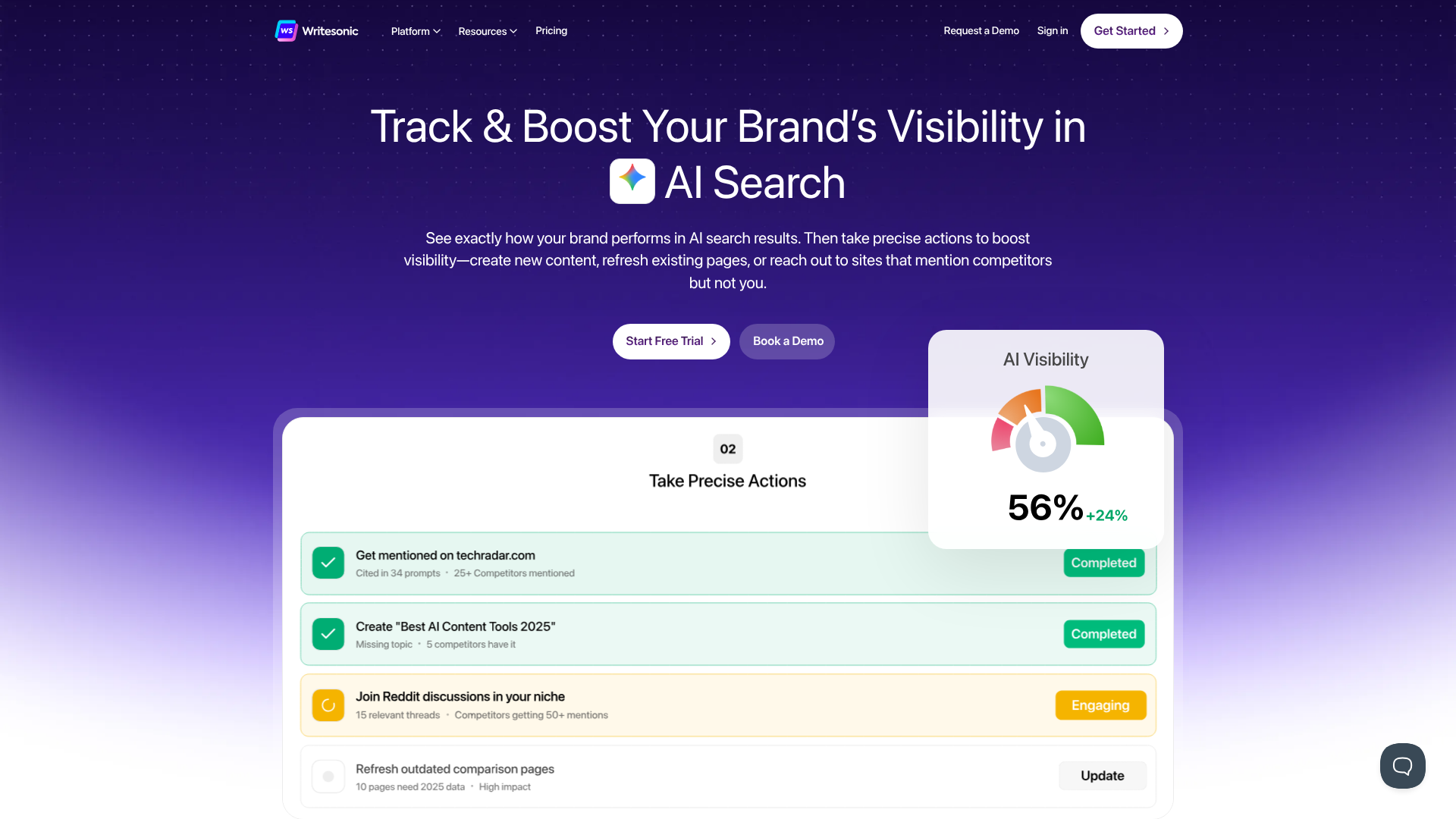
Writesonic positions itself as a powerful and versatile AI writer, particularly strong for creating SEO-optimised long-form content like articles and blog posts. It integrates factual data from Google and offers tools like Audiosonic for audio content creation and Photosonic for AI image generation, making it a comprehensive content suite.
One of its key differentiators is the ability to choose the quality of the underlying AI model (GPT-3.5 or GPT-4), allowing users to balance cost and performance. Its AI Article Writer 5.0 is designed to produce factually accurate, 1,500+ word articles that are optimised for search engines, making it a favourite among bloggers and SEO professionals.
Pros
- Strong SEO Features: Built-in tools for creating search-optimised content.
- Factual Accuracy: Can integrate real-time data from Google to reduce inaccuracies.
- Flexible Pricing: Offers a free trial and various tiers, including the option to choose AI model quality.
Cons
- Credit System Can Be Confusing: Usage is based on a word/credit system that can be complex to manage.
- Interface Can Feel Cluttered: With so many tools, the user experience can sometimes feel less streamlined than competitors.
For those focused on scaling their blog with SEO-driven content, Writesonic is worth exploring.
3. Grammarly

While many know Grammarly as a world-class grammar and spelling checker, its capabilities have expanded significantly with the introduction of GrammarlyGO, its generative AI feature. This makes it a unique hybrid tool that not only perfects your existing writing but also helps you create new text from scratch.
Grammarly's strength lies in its seamless integration. It works across almost every application and website you use, from your email client to your word processor. You can use it to compose, ideate, and rewrite text directly within your workflow. It can help you draft a quick reply to an email, generate ideas for a presentation, or adjust the tone of a paragraph to be more confident or empathetic.
Pros
- Excellent Integration: Works everywhere you write, making it incredibly convenient.
- Combines Proofreading and Generation: A single tool for both polishing and creating text.
- Strong Tone and Style Suggestions: Goes beyond grammar to improve the overall quality of your writing.
Cons
- Generative Features Are Less Advanced: Its text generation is not as powerful or specialised as dedicated tools like Jasper.
- Free Version is Limited: The most powerful AI features require a premium subscription.
4. QuillBot
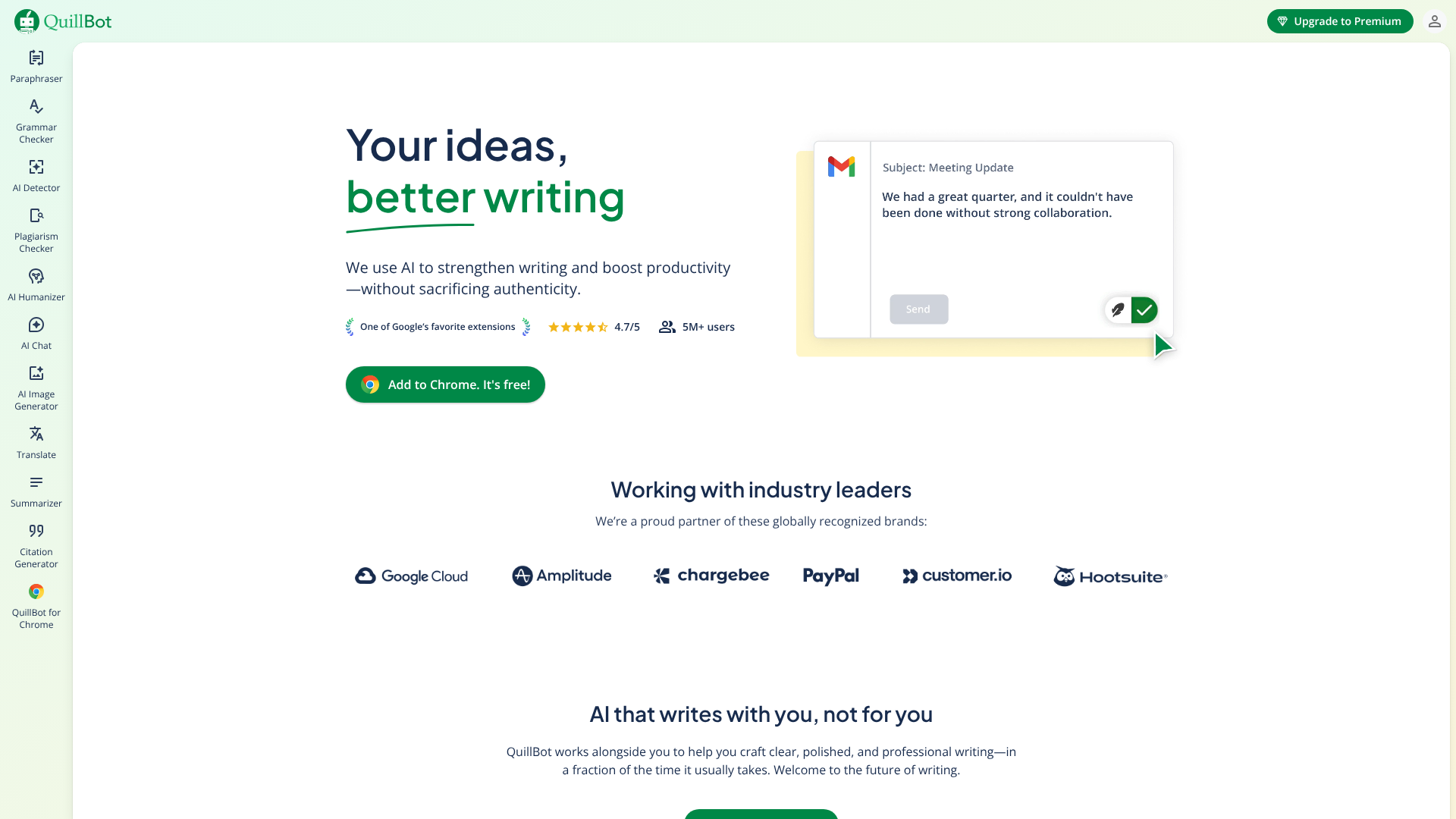
QuillBot has carved out a niche as the go-to tool for paraphrasing and academic writing. Its Paraphraser is exceptionally good at rewriting sentences and paragraphs to improve clarity, change tone, or avoid plagiarism, offering multiple modes like 'Formal', 'Simple', and 'Creative'.
Beyond paraphrasing, QuillBot offers a suite of tools including a Grammar Checker, Summarizer, and Citation Generator, making it invaluable for students, academics, and researchers. Its Co-Writer feature combines all these tools into a single interface, allowing users to research, write, and cite sources without switching tabs. It's less focused on generating entire articles from a single prompt and more on refining and restructuring existing text.
Pros
- Best-in-Class Paraphraser: Offers unparalleled control and quality for rewriting text.
- Excellent for Academic Use: The citation generator and research tools are a huge time-saver.
- Affordable Pricing: Offers a generous free plan and a reasonably priced premium version.
Cons
- Limited Long-Form Generation: Not designed to write full blog posts from a simple prompt.
- Can Encourage Over-Reliance: Users must be careful to use the paraphrasing tool ethically and not as a substitute for original thought.
5. HubSpot AI Content Assistant

For businesses already invested in the HubSpot ecosystem, the HubSpot AI Content Assistant is a natural choice. Built directly into tools like the Marketing Hub and CMS Hub, it allows users to generate and refine content without leaving the platform. This tight integration is its biggest selling point.
You can use it to draft blog post ideas, write marketing emails, create social media copy, and even generate landing page text. Because it's part of a larger marketing and sales platform, the AI can eventually use context from your CRM to create more personalised and effective content. It's a powerful tool for streamlining marketing operations.
Pros
- Seamless Integration: Works directly within the HubSpot platform for a smooth workflow.
- Free to Use: Included within HubSpot's existing products, including some free tools.
- Context-Aware: Can use data from your marketing and sales activities to inform content.
Cons
- Only for HubSpot Users: Its value is almost entirely dependent on you using the HubSpot platform.
- Less Feature-Rich than Standalone Tools: Lacks the advanced templates and specialised features of platforms like Jasper or Writesonic.
AI Writing Tools: Feature Comparison
To help you decide, here’s a quick comparison of the key features of our top picks.
| Feature | Jasper | Writesonic | Grammarly | QuillBot | HubSpot AI |
|---|---|---|---|---|---|
| Best For | Marketing Teams | SEO & Bloggers | Everyday Writing | Academics & Students | HubSpot Users |
| Long-Form Generation | Excellent | Excellent | Basic | Limited | Good |
| Paraphrasing | Good | Good | Good | Excellent | Basic |
| SEO Tools | Good | Excellent | No | No | Basic |
| Brand Voice | Yes | Yes | No | No | No |
| Free Plan | No (Trial only) | Yes (Limited) | Yes (Limited) | Yes (Limited) | Yes |
Pro Tip: Don't rely on a single tool for everything. Many professionals use a combination. For example, you might use Writesonic to draft a blog post, QuillBot to refine complex paragraphs, and Grammarly for a final polish before publishing.
Beyond Automation: How Writing Tools AI Can Enhance Creativity

A common misconception is that AI writing tools stifle creativity by automating the writing process. However, when used correctly, they can act as a powerful catalyst for creative thinking. Instead of seeing them as a machine that simply produces words, it's more productive to view them as a tireless brainstorming partner that can explore ideas from angles you might not have considered.
Imagine you're tasked with writing an article about sustainable gardening. You could ask an AI to generate ten different headlines, each with a unique perspective. One might focus on beginners, another on small spaces, and a third on the financial benefits. This instant variety can spark a new direction for your article that is far more engaging than your initial idea.
Furthermore, these tools can help break through creative barriers. By handling the initial, often tedious, task of getting words on the page, the AI frees up your mental energy to focus on higher-level creative work. You can spend more time on storytelling, structuring your argument, and adding personal anecdotes—the elements that truly resonate with readers. The AI provides the clay, but you are still the sculptor who shapes it into a finished piece of art.
The Engine Room: Natural Language Processing in Automated Writing Tools
To truly understand how automated writing tools work, it's essential to grasp the basics of the technology that powers them: Natural Language Processing (NLP). NLP is a field of artificial intelligence that focuses on enabling computers to understand, interpret, and generate human language in a way that is both meaningful and useful.
NLP can be broken down into two main components. The first is Natural Language Understanding (NLU). This is the 'input' part of the process. When you give a tool like Jasper a prompt, such as "Write a blog post intro about the benefits of remote work," NLU is what allows the AI to deconstruct your request.
It identifies the key entities (remote work), the intent (write an intro), and the desired format (blog post) to comprehend what you're asking for.
The second component is Natural Language Generation (NLG). This is the 'output' part. Once the AI understands your request, NLG is the process it uses to construct a coherent and grammatically correct response. It selects appropriate words, arranges them into sentences, and structures them into paragraphs that flow logically.
The sophistication of modern NLG is why the output from top-tier AI writers often feels remarkably human-like.
Common Features to Look For in AI Writing Software
When evaluating different AI writing platforms, you'll encounter a wide array of features. Understanding what they do will help you choose a tool that aligns with your needs.
- Text Generation: This is the core function. It includes generating both short-form copy (headlines, social media posts, product descriptions) and long-form content (articles, essays, reports).
- Paraphrasing & Rewriting: This feature allows you to rephrase existing text to improve clarity, change the tone, or avoid redundancy. Tools like QuillBot are specialists in this area.
- Summarisation: Ideal for condensing long documents, articles, or research papers into key bullet points or a concise summary. This saves time on research and review.
- Grammar & Style Checking: Beyond basic spell-checking, these features offer suggestions to improve sentence structure, word choice, and overall readability, as seen in Grammarly.
- Tone Adjustment: This allows you to rewrite text to fit a specific tone, such as professional, casual, friendly, or persuasive. It's perfect for tailoring a message to a specific audience.
- Plagiarism Detection: An essential feature for academic and professional writing, this scans the generated text against online sources to ensure originality.
- SEO Optimisation: Some tools, like Writesonic, include features to help you optimise content for search engines by suggesting keywords and analysing structure. For more advanced needs, a dedicated platform like Semrush provides a much deeper level of analysis and is often used alongside an AI writer.
Navigating the Grey Areas: Ethics and Concerns of AI Writing
The rapid rise of AI writing tools has brought a host of ethical questions and valid concerns to the forefront. While these tools are incredibly powerful, using them responsibly requires an awareness of their limitations and potential pitfalls.
One of the biggest concerns is factual accuracy. AI models can sometimes 'hallucinate'—that is, they invent facts, statistics, or sources that sound plausible but are entirely false. It is absolutely critical for users to fact-check any claims or data generated by an AI before publishing. The AI is a writing assistant, not a research expert.
Plagiarism and originality are also significant issues. While most tools are designed to produce original text, there's always a small risk that the output may too closely resemble its training data. Running content through a plagiarism checker is a crucial step. More importantly, the ethical approach is to use AI-generated text as a starting point, which you then heavily edit, restructure, and infuse with your own unique insights and voice.
Finally, bias in AI models is a well-documented problem. Because these models are trained on vast amounts of text from the internet, they can inherit and amplify existing societal biases related to gender, race, and culture. Users must be vigilant in reviewing AI-generated content to identify and correct any biased or stereotyped language.
What's Next? Future Trends in AI Writing Technology
The field of AI writing is evolving at a breakneck pace. The tools we use today are just a glimpse of what's to come. Several key trends are shaping the future of this technology, promising even more powerful and integrated capabilities.
Hyper-personalisation is a major frontier. Future AI writers will be able to adopt a user's unique writing style with incredible accuracy, analysing past work to replicate their specific vocabulary, sentence structure, and cadence. This will move beyond simple 'brand voice' features to create a true digital twin of a writer's style.
We are also seeing a move towards multimodal generation. Instead of just producing text, AI platforms will seamlessly create a combination of text, images, and even video from a single prompt. A command like "Create a social media campaign about our new product" could generate ad copy, corresponding images from a tool like OpenArt, and a short video script complete with a voiceover from a platform like Murf AI. This creates a fully integrated content workflow.
Finally, expect deeper integration into every digital tool you use. AI writing assistance won't be a separate application you open; it will be an ambient feature within your email, your CRM, your project management software, and your documents. This will make AI assistance a natural and almost invisible part of the digital work experience.
Real-World Impact: User Reviews and Case Studies
The true measure of any tool is the impact it has on its users. Across various industries, individuals and businesses are leveraging AI writing software to solve real-world problems and achieve their goals.
Case Study 1: The Small Business Blog
A small e-commerce business selling handmade soaps was struggling to produce regular blog content to drive traffic. By using Writesonic, the owner was able to generate outlines and first drafts for two articles per week in just a few hours. She then spent her time adding personal stories about her ingredients and production process, resulting in a 300% increase in organic traffic over six months.
Case Study 2: The Overwhelmed University Student
A university student working on their final-year dissertation used QuillBot to manage their research and writing. They used the Summarizer to quickly digest dense academic papers and the Paraphraser to rephrase complex ideas into their own words for their literature review. This helped them organise their thoughts more effectively and avoid accidental plagiarism, leading to a higher grade.
Case Study 3: The Busy Marketing Agency
A marketing agency managing social media for ten different clients used Jasper to streamline their content creation. They set up a unique 'Brand Voice' for each client, enabling them to quickly generate dozens of on-brand social media posts every week. This freed up their account managers to focus on strategy, community engagement, and analysing campaign performance.
Frequently Asked Questions About AI Writing Tools
Here are answers to some of the most common questions people have about using AI for writing.
Which is the best AI tool for writing?
There is no single 'best' tool for everyone. The best choice depends on your specific needs. For marketing teams and comprehensive content creation, Jasper is a top contender. For SEO-focused bloggers, Writesonic is excellent.
For academic writing and paraphrasing, QuillBot excels, and for everyday proofreading and light generation, Grammarly is unbeatable.
Is it illegal to publish a book written by AI?
It is not illegal to publish a book written or assisted by AI. However, copyright and authorship laws are still adapting to this technology. In the US, the Copyright Office has stated that works created solely by AI without human authorship are not eligible for copyright protection. Most platforms, including Amazon's Kindle Direct Publishing, require you to disclose the use of AI in the creation of your work.
The key is transparency with both the publisher and the reader.
Can I use ChatGPT as a writer?
Yes, you can use ChatGPT as a powerful writing assistant. It is excellent for brainstorming ideas, creating outlines, drafting sections of text, and rewriting paragraphs. However, it's a general-purpose model, so it lacks the specialised templates, workflows, and integrations found in dedicated AI writing software like Jasper or Writesonic. For professional content creation, a specialised tool often provides a more efficient and focused experience.
Is there a free AI writing tool?
Yes, many AI writing tools offer free plans or trials. Grammarly and QuillBot both have very capable free versions for grammar checking and paraphrasing. Writesonic and HubSpot also offer free tiers with certain usage limits. These free plans are a great way to test the capabilities of a platform before committing to a paid subscription.
Can you tell if a book is written by AI?
It is becoming increasingly difficult to tell if text was written by a sophisticated AI. However, there are sometimes subtle clues. AI-generated text can occasionally be repetitive, lack a consistent long-term narrative voice, or feel emotionally flat. It may also contain strange phrasing or factual errors.
Many companies are developing AI detection tools, but their accuracy varies, and they can sometimes produce false positives.
Final Thoughts: Choosing the Right AI Writing Partner
AI writing tools have firmly established themselves as essential assets for anyone involved in content creation. They are no longer a novelty but a practical solution for increasing efficiency, improving quality, and breaking through creative blocks. From drafting blog posts to polishing important emails, these platforms offer a wide range of capabilities to support your writing process.
The key to success is to view these tools not as replacements for human writers, but as collaborative partners. The best results come from a combination of AI-powered generation and human-driven strategy, creativity, and refinement. By handling the initial draft, the AI gives you the time and mental space to add the unique insights, stories, and voice that only you can provide.
If you're a marketing team looking for an all-in-one solution, Jasper is a powerful choice. If your focus is on scaling SEO content, Writesonic is built for the job. And for improving the clarity and correctness of every piece of text you write, Grammarly remains an indispensable tool. Explore the options, test their features, and find the AI partner that best fits your workflow.