

Bluehost vs SiteGround: Which Host is Right for Your Website in 2026?
Choosing the right web host is one of the most critical decisions you'll make for your website. It affects your site's speed, security, and overall user experience. In the crowded world of web hosting, two names that frequently appear are Bluehost and SiteGround. This detailed Bluehost vs SiteGround comparison will break down everything you need to know, from performance and pricing to customer support and ease of use, helping you make an informed decision.
- Quick Summary
- Bluehost and SiteGround: An Introduction to Two Hosting Giants
- Bluehost vs SiteGround: Head-to-Head Feature Comparison
- Performance and Speed: Who Loads Faster?
- Pricing and Value: A Detailed Cost Comparison
- Customer Support: Who Helps You When You're Stuck?
- Pros and Cons: A Quick Summary
- Who Should Choose Bluehost or SiteGround?
- Frequently Asked Questions (FAQ)
- Is SiteGround a Russian company?
- What is better than Bluehost?
- What's better than SiteGround?
- Is there an issue with Bluehost?
- Are SiteGround and Bluehost the same?
- Why is Bluehost so expensive?
- Final Verdict: Our Recommendation in the Bluehost vs SiteGround Debate
Both providers are giants in the industry, but they cater to slightly different audiences. Bluehost is often recommended for beginners due to its low entry price and official WordPress endorsement. In contrast, SiteGround has built a reputation for premium performance, top-tier security, and outstanding customer support, making it a favourite among business owners and developers who prioritise quality and reliability.
Quick Summary
- Performance and Speed: SiteGround consistently outperforms Bluehost with faster loading times, thanks to its use of Google Cloud infrastructure and advanced caching technologies.
- Pricing and Value: Bluehost offers significantly lower introductory prices, making it more budget-friendly to start. However, SiteGround provides more value in its plans, with features like free daily backups included.
- Customer Support: SiteGround is widely recognised for its superior customer support, offering fast, expert help 24/7. Bluehost's support is available but can be less consistent.
- Ease of Use: Both are beginner-friendly. Bluehost uses the traditional cPanel, while SiteGround offers a modern, custom-built control panel called Site Tools, which many find more intuitive.
- The Verdict: Choose Bluehost if you're a beginner on a tight budget. Choose SiteGround if performance, security, and excellent support are your top priorities for a business or growing website.
Bluehost and SiteGround: An Introduction to Two Hosting Giants
Before we dive into the technical details, it's helpful to understand who these companies are and who they aim to serve. Their company philosophies directly influence the services they offer, shaping everything from their server technology to their support team's training.
What is Bluehost?
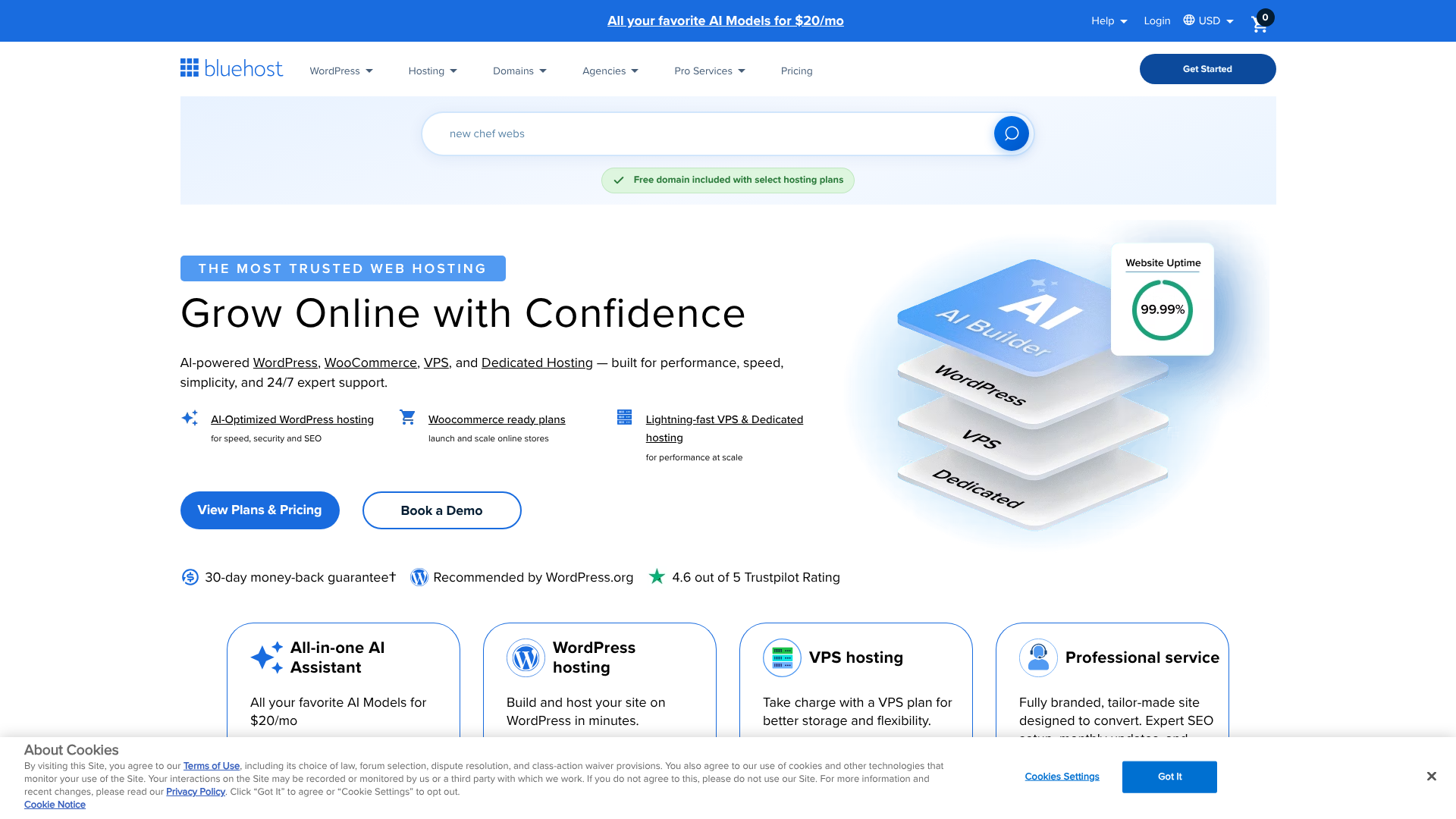
Bluehost is one of the oldest and largest web hosting companies in the world, founded in 2003. It's part of the Endurance International Group (EIG), a massive tech company that owns many other hosting brands. Bluehost's primary claim to fame is its long-standing official recommendation from WordPress.org, which it has held since 2005.
This endorsement makes Bluehost an incredibly popular choice for new bloggers and small business owners who are just starting with WordPress. Their marketing focuses heavily on affordability and ease of use, offering a straightforward path to getting a website online quickly. They provide a free domain name for the first year and a simple, guided WordPress installation process, which removes many of the initial technical hurdles for beginners.
Bluehost's infrastructure is built to serve the mass market, focusing on providing a reliable, low-cost service that meets the basic needs of most personal websites and small-scale projects. While they offer various hosting types, their shared hosting plans are by far their most popular product.
What is SiteGround?

Founded in 2004, SiteGround has carved out a niche as a more premium, performance-focused hosting provider. Unlike Bluehost, SiteGround is an independent company, which allows it to innovate and invest heavily in its own technology and infrastructure. They are known for being early adopters of new technologies that enhance speed and security.
SiteGround's key differentiator is its commitment to performance. They were one of the first major shared hosts to move their entire infrastructure to the Google Cloud Platform, giving their customers access to one of the fastest and most reliable networks available. They also develop their own in-house solutions, such as their SuperCacher technology and a custom control panel called Site Tools, to optimise the hosting environment.
This focus on quality attracts a different audience: small to medium-sized businesses, e-commerce stores, agencies, and developers who understand that a faster, more secure website translates to better business outcomes. While their prices are higher than Bluehost's, their customers are typically willing to pay for the superior performance, proactive security, and expert support that SiteGround provides.
Bluehost vs SiteGround: Head-to-Head Feature Comparison
Here’s a direct comparison of the key features offered by Bluehost and SiteGround. This table gives you a quick overview of what to expect from each provider's standard shared hosting plans.
| Feature | Bluehost | SiteGround |
|---|---|---|
| Performance | Standard | High (Google Cloud Platform) |
| Control Panel | cPanel | Site Tools (Custom) |
| Free Domain | Yes (1st year) | No |
| Free SSL | Yes (Let's Encrypt) | Yes (Let's Encrypt) |
| Free CDN | Yes (Cloudflare) | Yes (Cloudflare) |
| Daily Backups | Paid Add-on (CodeGuard) | Yes (Free on all plans) |
| Server Caching | Basic | Advanced (SuperCacher) |
| Staging Area | No on shared plans | Yes (GrowBig plan and up) |
| WordPress Rec. | Yes | Yes |
| Support | 24/7 Chat & Phone | 24/7 Chat, Phone, Tickets |
| Uptime Guarantee | No formal guarantee | 99.9% |
| Introductory Price | Lower | Higher |
Performance and Speed: Who Loads Faster?
Website speed is not just a technical metric; it directly impacts user experience, conversion rates, and SEO rankings. A slow website frustrates visitors and can cause them to leave before your page even loads. In the SiteGround vs Bluehost performance debate, there is a clear winner.
SiteGround's Performance Technology
SiteGround has built its entire brand around providing superior speed. They achieve this through a multi-layered technology stack designed for optimal performance. First, their entire platform runs on the Google Cloud Platform, which provides access to state-of-the-art infrastructure, SSD persistent storage, and an ultra-fast network.
On top of this solid foundation, SiteGround implements its own custom software. Their servers run on NGINX, a web server technology known for being faster than the traditional Apache servers used by many hosts, including Bluehost. They also have a proprietary caching solution called SuperCacher, which caches content at multiple levels to serve pages to visitors almost instantly. This system includes static caching, dynamic caching, and Memcached, which drastically reduces the time it takes for a page to load.
Furthermore, all SiteGround plans come with a free Content Delivery Network (CDN) integration through Cloudflare. A CDN stores copies of your website in multiple data centres around the world, so when a user visits your site, the content is delivered from the server closest to them, reducing latency and speeding up load times.
Bluehost's Performance Approach
Bluehost provides a reliable service that is perfectly adequate for websites with low to moderate traffic. They use industry-standard hardware and offer a free Cloudflare CDN to help improve global loading speeds. For most beginners starting a personal blog or a simple brochure website, the performance offered by Bluehost will be sufficient.
However, their infrastructure is not as optimised for speed as SiteGround's. They generally use Apache web servers and lack the advanced, multi-level caching systems that SiteGround has developed. As your website grows and attracts more traffic, you may find that Bluehost's shared hosting plans struggle to maintain fast loading times, especially during traffic spikes.
The Verdict on Speed
When it comes to raw performance, SiteGround is the undisputed winner. Their investment in premium infrastructure like Google Cloud and their development of custom optimisation tools like SuperCacher result in significantly faster and more stable websites. If speed is a critical factor for your website—and for most businesses, it should be—SiteGround is the better choice.
Pricing and Value: A Detailed Cost Comparison
Price is often the deciding factor for many people when choosing a web host. Both Bluehost and SiteGround use a promotional pricing model, which means you get a very low price for your initial term but pay a much higher rate upon renewal. Understanding this is key to evaluating the true cost.
Bluehost's Pricing Structure
Bluehost is famous for its incredibly low introductory prices, often starting at just a few pounds per month. This makes it extremely attractive for those on a tight budget. Their plans typically include a free domain name for the first year, a free SSL certificate, and unmetered bandwidth.
However, the low price comes with trade-offs. Essential features like daily backups and advanced security are often sold as paid add-ons. For example, their basic backup service is complimentary but not guaranteed, and for reliable daily backups, you need to purchase their CodeGuard add-on. The renewal rates for Bluehost plans are also significantly higher than the introductory price, which can be a surprise if you're not prepared for it.
For the latest pricing, it's always best to check their official website.
SiteGround's Pricing Structure
SiteGround has a higher starting price than Bluehost. They don't offer a free domain name, so that's an additional cost to consider. However, their plans are packed with premium features that you would have to pay extra for at Bluehost. Every SiteGround plan includes free daily backups, advanced SuperCacher technology, enhanced security, and free email hosting.
Their higher-tier plans, GrowBig and GoGeek, add even more value with features like on-demand backups, a staging environment (for testing changes before making them live), and priority support. Like Bluehost, SiteGround's renewal rates are much higher than their promotional prices. The key difference is that with SiteGround, you're paying for a premium service with more included features from the start.
Pro Tip: When comparing hosting costs, always look at the renewal rate and the total cost over a 2-3 year period. A low introductory offer might seem appealing, but a high renewal fee can make it more expensive in the long run.
Who Offers Better Value for Money?
This depends entirely on your priorities. If your main goal is to get a website online for the lowest possible initial cost, Bluehost offers better upfront value. Their low entry price and free domain make it very accessible for beginners.
However, if you look at the overall package, SiteGround often provides better long-term value, especially for serious websites. The inclusion of free daily backups alone can save you money compared to buying a third-party service. The superior performance and support can also be considered valuable assets that justify the higher cost, as they contribute to a better user experience and can save you time and frustration.
Customer Support: Who Helps You When You're Stuck?
Excellent customer support can be a lifesaver, especially when you encounter a technical issue that takes your website offline. Both Bluehost and SiteGround offer 24/7 support, but their approach and the quality of that support differ significantly.
Bluehost Support Channels
Bluehost provides support primarily through live chat and phone. Their support team is available around the clock to help with issues. For simple queries, their support is generally adequate. However, many users report mixed experiences, especially when dealing with more complex technical problems.
Because Bluehost is part of a large corporation serving millions of customers, their support can sometimes feel impersonal, with longer wait times and a tiered system that may require you to speak to several different agents before finding someone who can solve your problem. Their support staff are knowledgeable about basic issues, but for advanced troubleshooting, you may find the process slower than with a more specialised host.
SiteGround's Highly-Rated Support
Customer support is one of the areas where SiteGround truly shines. They have consistently won awards for their support team and have a stellar reputation within the industry. They offer 24/7 support via live chat, phone, and a ticketing system, and they are known for their incredibly fast response times.
What sets SiteGround's support apart is the expertise of their agents. They invest heavily in training their staff, and the person you connect with is often able to resolve your issue on the first contact, without needing to escalate it. Their support is friendly, patient, and highly technical. This level of service is invaluable for business owners who can't afford to have their website down for long.
The Support Winner
In the Bluehost or SiteGround support comparison, SiteGround is the clear winner. Their commitment to providing fast, expert, and friendly support is a major reason why many users choose them over cheaper alternatives. If you value peace of mind and knowing that expert help is just a few clicks away, SiteGround is the superior choice.
Pros and Cons: A Quick Summary
To help you decide, here is a straightforward breakdown of the advantages and disadvantages of each hosting provider.
Bluehost: The Good and The Bad
Pros
- Affordable Start: Very low introductory pricing makes it easy to get started on a budget.
- Free Domain Name: You get a free domain for the first year, saving you an extra cost upfront.
- WordPress Recommended: Being officially recommended by WordPress.org provides a level of trust.
- Beginner-Friendly: The guided setup and familiar cPanel make it easy for new users to navigate.
Cons
- Slower Performance: Generally slower than performance-focused hosts like SiteGround.
- High Renewal Rates: The price increases significantly after the initial promotional period.
- Upselling: There are frequent upsells for add-ons during the checkout process and within the dashboard.
- Basic Backups: Reliable daily backups are not included and must be purchased as an add-on.
SiteGround: The Good and The Bad
Pros
- Excellent Performance: Fast and reliable hosting built on the Google Cloud Platform.
- Top-Tier Support: Industry-leading customer support that is fast, knowledgeable, and available 24/7.
- Robust Security: Proactive security measures and a custom firewall to protect your site.
- Valuable Freebies: Free daily backups, advanced caching, and a staging environment are included.
Cons
- Higher Cost: Both the introductory and renewal prices are higher than Bluehost's.
- No Free Domain: You have to purchase your domain name separately.
- Resource Limits: The entry-level StartUp plan has stricter limits on storage space and traffic.
Who Should Choose Bluehost or SiteGround?
Ultimately, the right choice in the Bluehost vs SiteGround comparison comes down to your specific needs, budget, and priorities.
Choose Bluehost if…
You are a complete beginner creating your first website, such as a personal blog, a small portfolio, or a hobby site. Your primary concern is keeping initial costs as low as possible. You don't expect a large amount of traffic in the beginning and are comfortable with standard performance. The free domain name and extremely low entry price are the most important factors for you.
Choose SiteGround if…
Your website is for a business, an e-commerce store, or a professional blog where performance and reliability are crucial. You value fast loading speeds, minimal downtime, and the peace of mind that comes with excellent security and daily backups. You see web hosting as an investment in your online presence and are willing to pay a premium for superior quality and expert customer support. You plan to grow your website and need a host that can scale with you.
Frequently Asked Questions (FAQ)
Here are answers to some of the most common questions people ask when comparing these two hosting providers.
Is SiteGround a Russian company?
No, SiteGround is not a Russian company. It was founded in Sofia, Bulgaria, in 2004, and it remains a privately owned company with offices and data centres located around the world, including in the USA, UK, Europe, and Asia.
What is better than Bluehost?
For users seeking better performance, security, and customer support, SiteGround is widely considered a better alternative to Bluehost. Other providers that are often seen as a step up from Bluehost include managed WordPress hosts like WP Engine or Kinsta, though these come at a significantly higher price point.
What's better than SiteGround?
While SiteGround offers excellent performance for shared hosting, users with very high-traffic websites or specific technical needs might consider a managed WordPress host like Kinsta or WP Engine. These services offer even more powerful server environments and specialised WordPress expertise, but their pricing is substantially higher and often targets enterprise-level clients.
Is there an issue with Bluehost?
The most common criticisms of Bluehost relate to its performance on shared hosting plans, which can be slower compared to premium hosts, and its customer support, which can be inconsistent. The significant price jump upon renewal is also a frequent complaint from users who were initially attracted by the low promotional rates.
Are SiteGround and Bluehost the same?
No, they are completely separate and independent companies. Bluehost is owned by Endurance International Group (EIG), a large corporation that owns many hosting brands. SiteGround is an independent, privately-owned company known for its focus on technology and customer support.
Why is Bluehost so expensive?
While Bluehost's introductory prices are very low, their renewal prices are much higher and more in line with industry standards. This pricing strategy is designed to attract new customers. The perception of it being expensive often comes from this large, sometimes unexpected, increase in cost after the first term expires.
Final Verdict: Our Recommendation in the Bluehost vs SiteGround Debate
After a thorough comparison of performance, features, pricing, and support, it's clear that both Bluehost and SiteGround serve their target markets well. There is no single 'best' host, only the host that is best for you.
Bluehost remains a solid choice for beginners, hobbyists, and anyone on a very tight budget. Its low entry cost and free domain make it one of the most accessible ways to start a WordPress website. However, you must be prepared for the trade-offs in performance and the significant price increase at renewal.
For nearly everyone else, especially those building a website for a business or any project where performance and reliability matter, SiteGround is the superior choice. The investment in their service pays dividends in the form of faster page speeds, stronger security, automated daily backups, and access to some of the best customer support in the industry. These features provide a stable foundation for growth and a much better overall user experience, making SiteGround well worth the premium price.