

AI Writing Generator Explained: How to Write Better Content Faster
Facing a blank page can be one of the most daunting tasks for any writer, marketer, or business owner. The pressure to consistently produce high-quality content is immense, but what if you had an intelligent assistant to help you brainstorm, draft, and refine your work? This is precisely the role of a modern AI writing generator, a tool designed to augment human creativity and dramatically speed up the content creation process. These platforms are no longer a futuristic concept; they are practical solutions that help thousands of people overcome writer's block and scale their content output.
- What You'll Learn
- What Exactly is an AI Writing Generator?
- The Core Features of a Modern AI Text Generator
- The Real-World Benefits: Why Use an Automated Writing Tool?
- How to Choose the Right AI Writing Generator for Your Needs
- Top AI Writing Generators to Consider in 2026
- Understanding Pricing: How Much Do These Tools Cost?
- The Pros and Cons of Using an AI Content Creator
- Frequently Asked Questions About AI Writing Tools
- Can AI writing be detected?
- Will an AI writing generator replace human writers?
- Is the content generated by AI plagiarism-free?
- What is the best free AI writing generator?
- Final Thoughts: Integrating AI into Your Workflow
An AI-powered writing tool uses complex algorithms to understand your prompts and generate human-like text, from blog posts and emails to social media updates and ad copy. It acts as a co-pilot, handling the heavy lifting of drafting so you can focus on strategy, editing, and adding your unique human touch. Understanding how these tools work and which one is right for you is the first step towards transforming your content workflow.
What You'll Learn
- What an AI Writing Generator Is: We'll break down the technology behind these tools in simple terms, explaining how they turn a simple prompt into a fully-fledged article or piece of copy.
- Key Features to Look For: Discover the essential features that separate a basic tool from a powerful content creation platform, including templates, tone adjustment, and long-form editors.
- How to Choose the Right Tool: Learn a practical framework for selecting the best AI text generator based on your specific needs, from content type and quality requirements to budget and ease of use.
- Top Recommendations: We'll review some of the leading AI content creators on the market, highlighting their strengths, weaknesses, and ideal use cases to help you make an informed decision.
- The Pros and Cons: Get a balanced view of the advantages and potential drawbacks of integrating an automated writing tool into your workflow, including ethical considerations and quality control.
What Exactly is an AI Writing Generator?
At its core, an AI writing generator is a software application that uses artificial intelligence, specifically natural language processing (NLP) and natural language generation (NLG), to create written content. Think of it as a highly advanced predictive text system. It has been trained on a vast dataset of text from the internet, including books, articles, and websites, allowing it to learn the patterns, grammar, vocabulary, and nuances of human language.
The most common technology powering these tools is a Large Language Model (LLM), like OpenAI's GPT (Generative Pre-trained Transformer) series. When you provide a prompt—a command, question, or piece of information—the AI analyses it and predicts the most logical sequence of words to form a coherent and contextually relevant response. It's not 'thinking' in the human sense but rather making incredibly sophisticated statistical calculations to assemble text that matches the patterns it has learned.
An effective analogy is to imagine a master musician who has listened to every piece of music ever composed. If you ask them to create a new song in the style of Mozart, they can draw upon their vast knowledge of Mozart's patterns, chord progressions, and melodic structures to compose something entirely new, yet stylistically authentic. An AI content creator does something similar with language, generating new text that aligns with the style, tone, and topic you specify.
The Core Features of a Modern AI Text Generator
Not all AI writing tools are created equal. While the underlying technology might be similar, the features and user experience can vary significantly. When evaluating an AI text generator, there are several core features to look for that indicate a capable and versatile platform.
First, a comprehensive template library is essential. High-quality tools offer dozens, if not hundreds, of pre-built templates for specific use cases. These can range from blog post intros, social media captions, and YouTube video descriptions to more complex formats like AIDA (Attention, Interest, Desire, Action) marketing copy or PAS (Problem, Agitate, Solution) frameworks. This saves you from having to engineer the perfect prompt from scratch every time.
Second, look for robust tone and style controls. A good automated writing tool allows you to specify the desired tone of voice—whether it's professional, witty, casual, or empathetic. This ensures the generated content aligns with your brand's personality. Some advanced platforms, like Jasper, even let you train the AI on your own content to create a unique Brand Voice.
Finally, a powerful long-form editor is a key differentiator. While many tools can generate short snippets of text, the best ones provide a document-style editor where you can draft, edit, and collaborate with the AI on longer pieces like articles and reports. This often includes features like rephrasing, summarising, and the ability to issue commands directly within the document, creating a more fluid writing experience.


The Real-World Benefits: Why Use an Automated Writing Tool?
The adoption of AI writing generators is growing rapidly, and for good reason. They offer tangible benefits that address some of the biggest challenges in content creation. The most immediate advantage is a massive increase in speed and efficiency. An AI can produce a first draft of a 1,000-word article in minutes, a task that could take a human writer hours.
This frees up valuable time to focus on higher-level tasks like research, strategy, and editing.
Another significant benefit is overcoming writer's block. Staring at a blank cursor is a universal struggle, but an AI content creator can instantly provide ideas, outlines, or starting paragraphs to get the creative process moving. It serves as an inexhaustible brainstorming partner, helping you explore different angles and structures for your content without the mental fatigue.
These tools can also improve the overall quality and consistency of your writing. Many come with built-in grammar and style checkers, like the features found in Grammarly, ensuring your output is polished and error-free. Furthermore, by using templates and defined tones of voice, you can maintain a consistent brand message across all your marketing channels, regardless of who is creating the content.
For businesses, the ability to scale content production is a primary driver. An automated writing tool allows a small team—or even a single person—to produce the volume of content that would typically require multiple writers. This makes it possible to maintain an active blog, post frequently on social media, and run email marketing campaigns without a huge budget or headcount.
How to Choose the Right AI Writing Generator for Your Needs
With a growing number of options available, selecting the right AI writing generator can feel overwhelming. The best approach is to assess your specific needs and match them to the capabilities of the tool. Here’s a step-by-step framework to guide your decision.
Define Your Primary Use Case: What type of content will you be creating most often? If you need long-form blog posts, you'll want a tool with a strong document editor and SEO features. If your focus is on social media and ad copy, a tool with a wide variety of short-form templates is more important. For students or academics, a tool like QuillBot with its advanced paraphrasing and citation generator might be the best fit.
Evaluate the Quality of Output: The single most important factor is the quality of the generated text. Most reputable tools offer a free trial or a free plan. Use this opportunity to test the platform with real-world prompts relevant to your niche. Does the output sound natural? Is it factually accurate? How much editing does it require to be usable? High-quality output should be coherent, contextually aware, and closely match your desired tone.
Consider Ease of Use and Workflow Integration: The best tool is one you'll actually use. Look for a clean, intuitive interface that doesn't have a steep learning curve. Consider how it will fit into your existing workflow. Does it offer integrations with other software you use, such as SEO tools like Surfer or content management systems like WordPress? A seamless workflow is key to maximising productivity.
Assess Customisation and Control: How much control do you have over the output? Look for features that allow you to guide the AI, such as specifying keywords, adjusting the tone of voice, and providing background information or style guides. The more context you can give the AI, the better and more relevant the generated content will be.
Review Pricing and Scalability: AI writing tools typically use a subscription model, often based on the number of words generated per month. Evaluate the different pricing tiers and choose one that aligns with your expected usage. Check if the plans are flexible and can scale with you as your content needs grow. Some tools offer lifetime deals or more affordable plans, while premium options provide advanced features for teams and agencies.
Pro Tip: When testing an AI writer, be highly specific with your prompts. Instead of asking for a "blog post about coffee," try a more detailed prompt like: "Write a 500-word blog post introduction for coffee enthusiasts about the benefits of single-origin beans, with a friendly and educational tone."
Top AI Writing Generators to Consider in 2026
Navigating the market can be tough, so we've highlighted a few of the top AI writing generators that cater to different needs and budgets. These platforms are well-regarded for their quality, features, and user experience.
1. Jasper (formerly Jarvis)
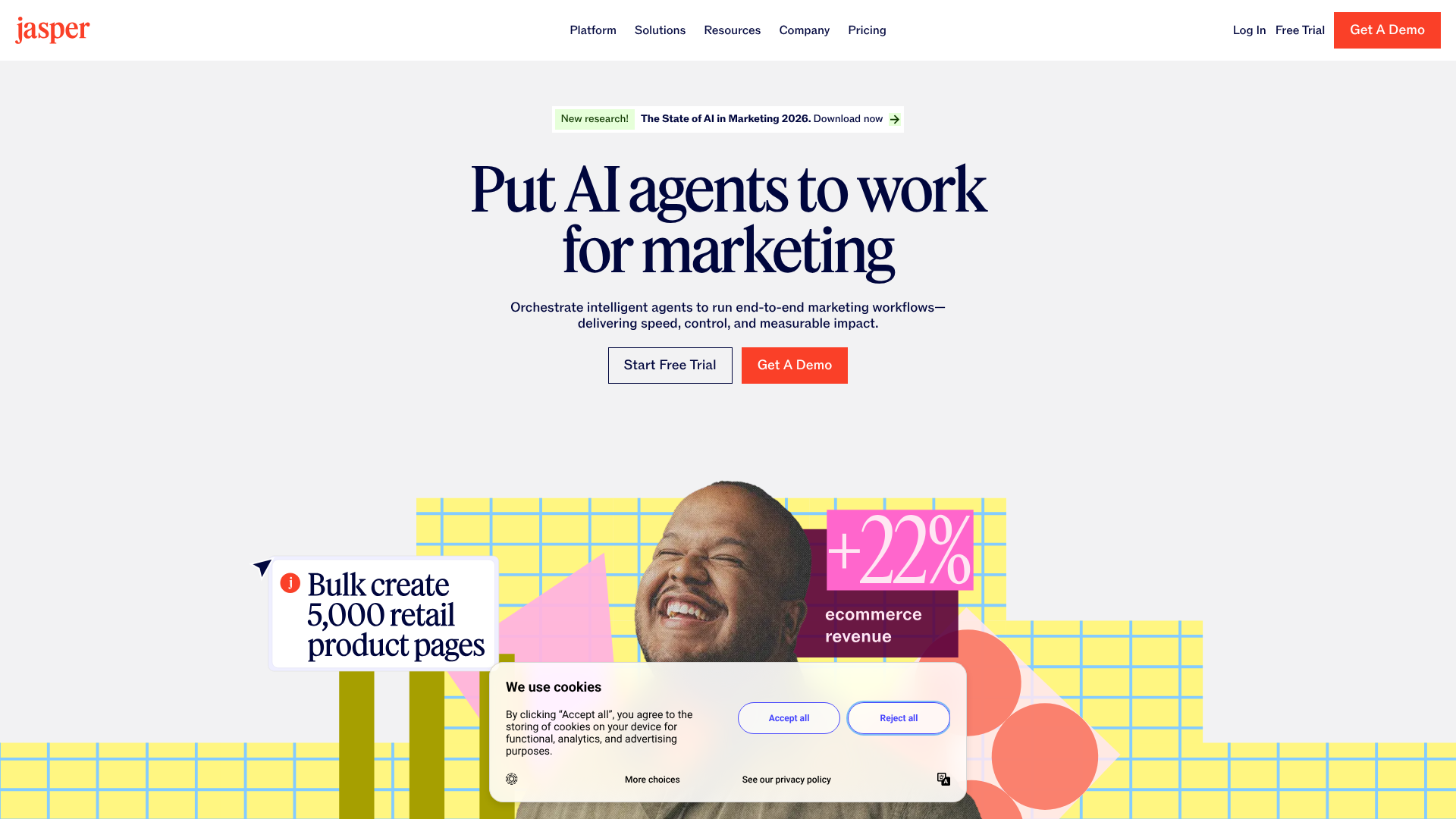
Jasper is often considered the premium choice in the AI writing space, particularly for marketing teams, agencies, and serious content creators. It excels at producing high-quality, nuanced content and offers a vast library of over 50 templates for everything from ad copy to video scripts.
Its standout feature is the long-form document editor, which provides a powerful environment for creating blog posts, articles, and even books. Jasper's 'Brand Voice' feature allows you to upload documents or scan your website to teach the AI your specific style and tone, ensuring brand consistency. It also offers powerful collaboration tools for teams.
Pros
- Excellent output quality that often requires minimal editing.
- Powerful 'Brand Voice' and 'Campaigns' features for cohesive marketing content.
- Intuitive user interface and a robust long-form editor.
Cons
- It's one of the more expensive options on the market.
- The credit system can be confusing for new users.
2. Writesonic
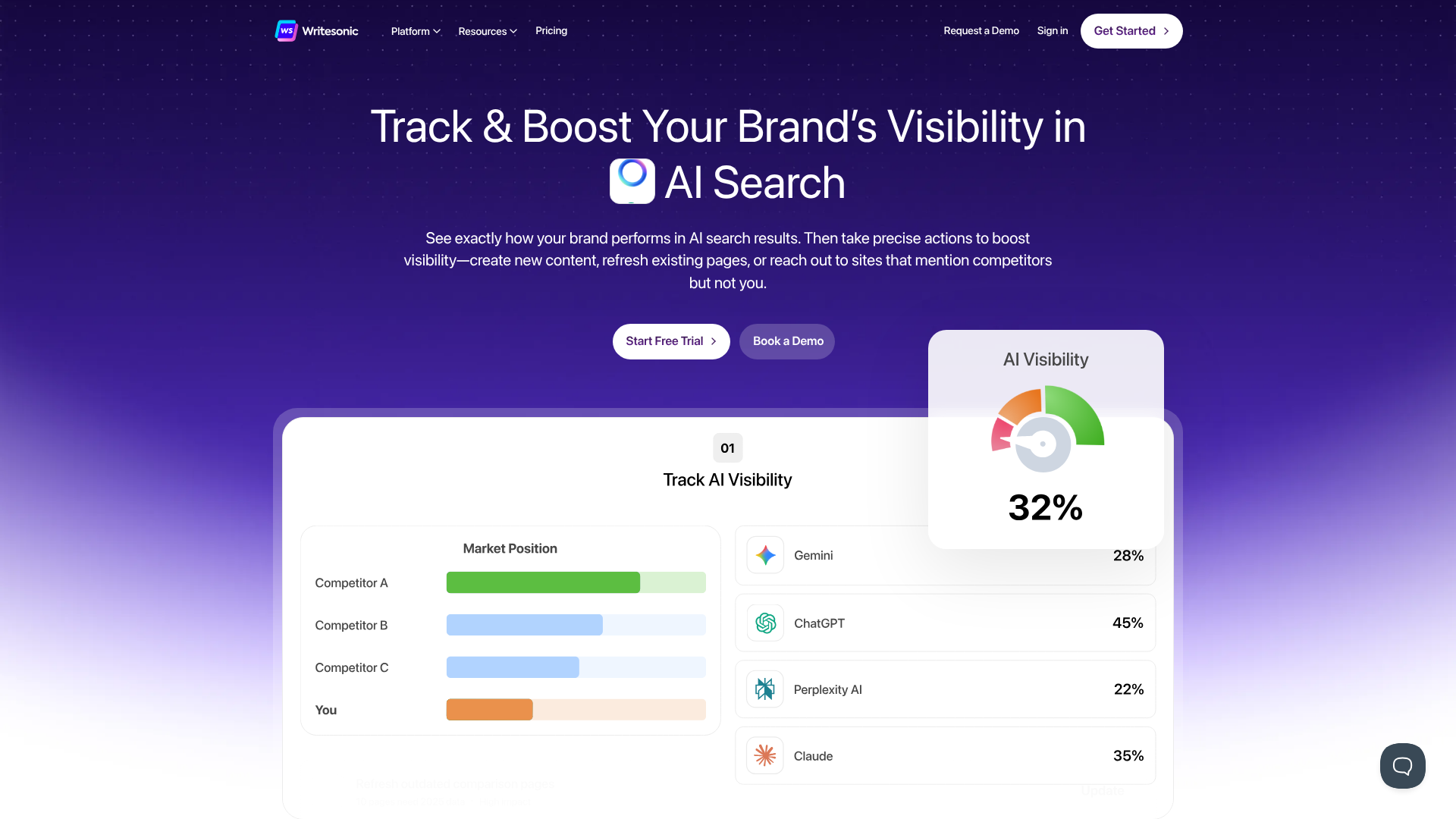
Writesonic is a highly versatile and user-friendly AI content creator that positions itself as an all-in-one solution for marketers. It offers a comprehensive suite of tools, including an AI article writer, a landing page generator, and even an AI art generator called Photosonic.
One of its key strengths is its focus on SEO-optimised content. Writesonic integrates with Surfer SEO, allowing you to create articles that are structured to rank well in search engines. It offers different quality levels for generated text, giving you control over your word usage and budget. Its interface is clean and straightforward, making it a great option for beginners and experienced users alike.
Pros
- Excellent value for money with a generous free trial and affordable plans.
- Strong focus on SEO with Surfer integration.
- Includes additional tools like an AI art generator and a chatbot builder (Chatsonic).
Cons
- The highest quality output is reserved for premium plans.
- The sheer number of features can be slightly overwhelming at first.
3. QuillBot
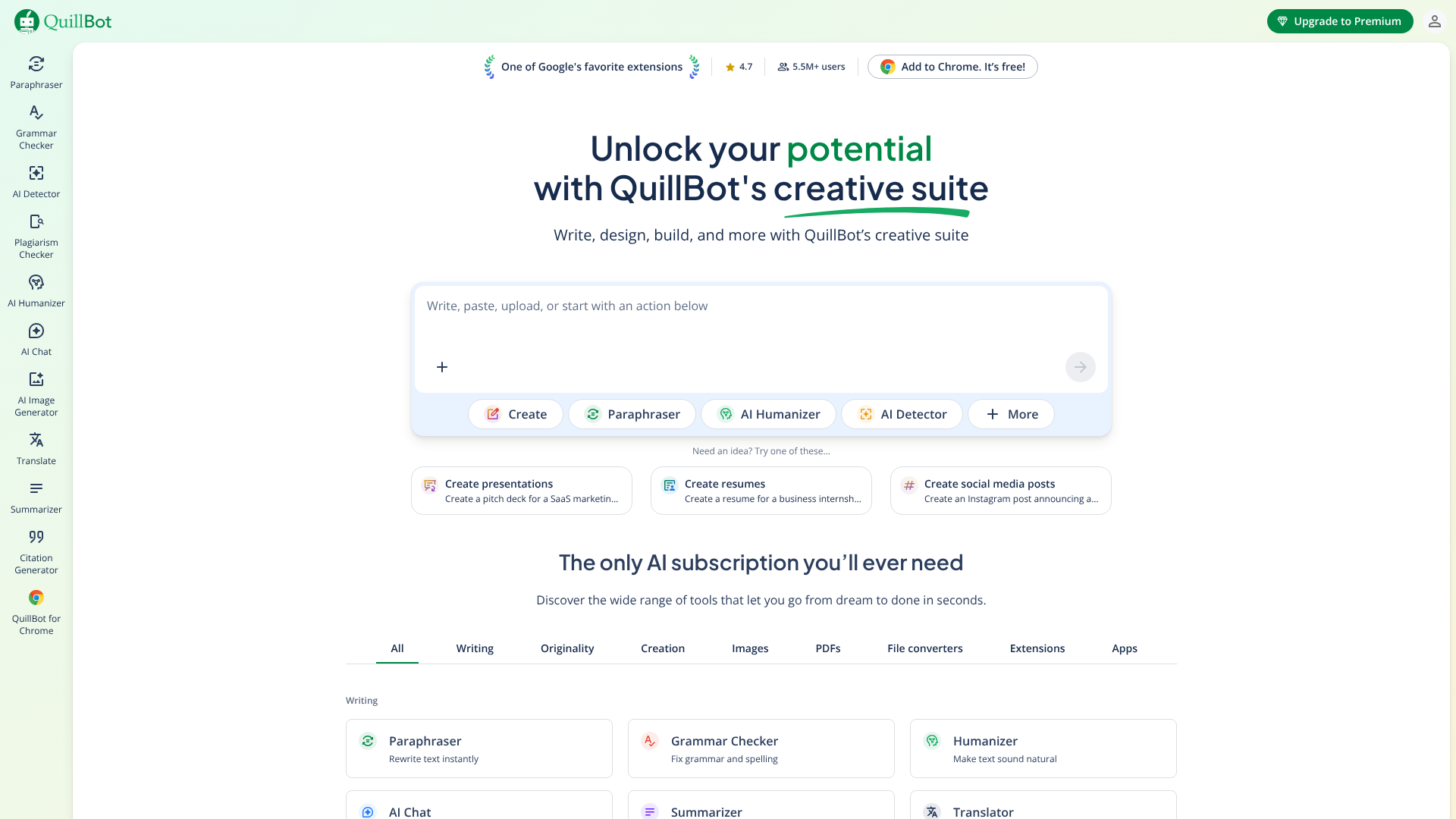
While many know QuillBot as a paraphrasing tool, it has evolved into a comprehensive AI writing suite. It's an excellent choice for students, academics, and writers who need help refining and restructuring existing text. Its core strengths lie in its Paraphraser, Summarizer, and Grammar Checker.
QuillBot's 'Co-Writer' tool combines all its features into a single interface, allowing you to research, write, and cite sources without leaving the document. It's less focused on generating content from scratch and more on augmenting the writing and editing process. Its simplicity and focus on core academic and professional writing tasks make it a highly practical and affordable tool.
Pros
- Best-in-class paraphrasing and summarising capabilities.
- Very affordable, with a functional free plan that is useful for many tasks.
- Simple, clean interface focused on improving existing text.
Cons
- Not as strong as competitors for generating long-form content from a simple prompt.
- Lacks the extensive template library found in marketing-focused tools.
Comparison of Top AI Writing Tools
| Feature | Jasper | Writesonic | QuillBot |
|---|---|---|---|
| Best For | Marketing Teams, Agencies | All-in-One Marketing, SEO | Students, Academics, Editors |
| Long-Form Editor | Excellent, with commands | Very Good, with SEO focus | Good, focused on co-writing |
| Template Library | 50+ | 100+ | Limited |
| Free Plan | Free trial available | Yes, with monthly words | Yes, with limitations |
| Starting Price | Premium | Affordable | Very Affordable |
Understanding Pricing: How Much Do These Tools Cost?
The cost of an AI writing generator can vary widely, from completely free tools with basic functionality to premium platforms costing hundreds of pounds per month. Most services operate on a Software-as-a-Service (SaaS) subscription model, typically billed monthly or annually.
The most common pricing structure is based on word count. A plan might offer you, for example, 50,000 words per month for a set fee. This is a straightforward model that allows you to choose a tier based on your expected content output. Some tools, like Writesonic, further refine this by offering different quality levels—using a higher-quality model consumes more of your word credits, giving you a trade-off between quality and quantity.
Another model is based on features and user seats. A basic plan might offer access to standard templates for a single user, while higher-priced tiers unlock advanced features like brand voice analysis, team collaboration tools, API access, and priority support. These plans are geared towards businesses and agencies that require more robust functionality.
Many platforms, including QuillBot and Writesonic, offer a 'freemium' model. This includes a free-forever plan with certain limitations, such as a lower monthly word count or access to only a subset of features. This is an excellent way to test the platform's capabilities and determine if it's a good fit before committing to a paid subscription. Always check the official websites for the most current pricing, as plans and features can change.
The Pros and Cons of Using an AI Content Creator
Like any technology, using an AI content creator comes with both significant advantages and potential drawbacks. A balanced understanding is crucial for integrating these tools into your workflow effectively and ethically.
The Advantages
- Unmatched Speed: The ability to generate drafts in seconds is the most significant pro. It drastically reduces the time spent on initial writing, allowing for faster project turnarounds.
- Idea Generation: AI is a powerful tool for brainstorming. It can provide outlines, headlines, and different angles on a topic, helping you break through creative blocks.
- Cost-Effectiveness: For many businesses, an AI subscription is far more affordable than hiring additional writers, making it possible to scale content production on a tight budget.
- Consistency: AI can maintain a consistent tone and style across hundreds of pieces of content, which is vital for brand building.
The Potential Drawbacks
- Factual Inaccuracies: AI models can 'hallucinate'—that is, invent facts, statistics, or sources that sound plausible but are incorrect. All AI-generated content must be fact-checked by a human.
- Lack of Originality and Emotion: While AI can mimic human writing, it cannot replicate genuine creativity, personal experience, or deep emotional nuance. The output can sometimes feel generic or soulless without human intervention.
- Risk of Over-Reliance: Relying too heavily on AI can weaken your own writing skills. It's essential to use it as a tool to assist, not replace, the human writing process.
- Ethical and SEO Concerns: Search engines like Google have clarified that high-quality, helpful AI-generated content is acceptable, but low-quality, spammy content created to manipulate rankings is not. The key is human oversight and adding unique value.
Frequently Asked Questions About AI Writing Tools
Here are answers to some of the most common questions people have about using an AI text generator.
Can AI writing be detected?
Yes, there are AI detection tools that analyse text for patterns characteristic of AI generation, such as perplexity and burstiness. However, these tools are not 100% accurate and can produce false positives. Well-edited content that has been significantly revised by a human is much harder to detect. The focus should be on creating quality content, not just avoiding detection.
Will an AI writing generator replace human writers?
It's unlikely. Most experts agree that AI is a tool to augment human writers, not replace them. AI excels at drafting, research assistance, and repetitive tasks, but it lacks the critical thinking, creativity, strategic insight, and emotional intelligence of a human writer. The future of writing will likely involve a collaboration between humans and AI, where the AI handles the grunt work and the human provides the final polish, strategy, and unique perspective.
Is the content generated by AI plagiarism-free?
Reputable AI writing generators are designed to create original content and not directly copy from their training data. Most high-quality tools produce content that passes plagiarism checks. However, because they learn from existing text, there's a small chance they might generate a sentence that is very similar to something already published. It's always a best practice to run the final content through a plagiarism checker like the one included in Grammarly for peace of mind.
What is the best free AI writing generator?
Many top-tier tools offer excellent free plans. For general writing assistance and paraphrasing, QuillBot's free version is incredibly useful. For generating short-form content like social media posts and product descriptions, the free plans from Writesonic or Copy.ai are strong contenders. The 'best' free tool ultimately depends on your specific needs, as each has different limitations on word count and features.
Final Thoughts: Integrating AI into Your Workflow
An AI writing generator is a powerful addition to any content creator's toolkit. It's not a magic button that creates perfect content instantly, but rather a sophisticated assistant that can handle the most time-consuming parts of the writing process. By taking on the initial drafting, brainstorming, and structuring, it frees you to focus on what humans do best: strategic thinking, creative storytelling, and connecting with an audience on an emotional level.
The key to success is to view it as a partnership. Use the AI to generate the raw materials, then apply your expertise to refine, fact-check, and infuse the content with your unique voice and perspective. This human-in-the-loop approach ensures the final product is not only well-written and efficient to produce but also authentic, valuable, and trustworthy.
If you're looking to boost your content output and overcome writer's block, exploring an AI writer is a logical next step. For marketing teams needing a premium, all-in-one solution, Jasper is a top-tier choice. For those seeking a versatile and affordable option with strong SEO capabilities, Writesonic is worth a look. And for students or professionals focused on refining their writing, QuillBot offers exceptional value.