

7 Best Free AI Writing Tools for Marketers & Bloggers (2026)
Finding the best free AI writing tools can feel like searching for a needle in a haystack. Many platforms promise powerful features at no cost, but often hide restrictive limits and underwhelming performance behind a 'free' label. The goal is to find a tool that genuinely enhances your workflow, helps you overcome writer's block, and produces quality content without requiring a credit card.
- Main Points
- What Exactly is Free AI Writing Software?
- Key Features to Look For in Top Free AI Writers
- How to Choose the Right Free AI Writing Tool for Your Needs
- The 7 Best Free AI Writing Tools in 2026 (Tested & Ranked)
- 1. Jasper (formerly Jarvis): Best for High-Quality Marketing Copy
- 2. Writesonic: Best All-in-One Platform for Content Creation
- 3. QuillBot: Best for Paraphrasing and Academic Writing
- 4. Grammarly: Best for Editing and Polishing Existing Text
- 5. ChatGPT (OpenAI): Best General-Purpose AI for Brainstorming & Drafting
- 6. Claude (Anthropic): Best for Natural-Sounding, Conversational Text
- 7. Rytr: Best for Short-Form Copy and Social Media
- Understanding the "Free" in Free AI Writing Software: A Cost Comparison
- The Pros and Cons of Using Free AI Writers
- Frequently Asked Questions (FAQ)
- What is the best AI for writing for free?
- Which AI tool is 100% free?
- Which free AI is better than ChatGPT?
- How to tell if someone used ChatGPT?
- Final Thoughts: Integrating AI into Your Writing Workflow
This guide cuts through the noise. We've tested and analysed dozens of options to bring you a clear, honest breakdown of the top free AI writers available today. We'll explore not just what they can do, but also the real-world limitations of their free plans, helping you choose the right assistant for your specific needs, whether you're drafting blog posts, creating ad copy, or polishing an academic paper.
Main Points
- Types of Tools: Free AI writers fall into three main categories: general-purpose chatbots for brainstorming (like ChatGPT), specialised tools for marketing copy (like Writesonic), and AI assistants for editing (like Grammarly).
- Understanding 'Free': Most free plans come with limitations, such as monthly word or character counts, credit systems, or restricted access to advanced features. It's crucial to understand these limits before committing to a tool.
- Task-Specific Choices: The best tool for you depends entirely on your primary task. A blogger's needs are different from a social media manager's or a student's. Match the tool's strengths to your goals.
- The Power of Combination: The most effective workflow often involves using multiple free tools together. You might use one AI for drafting an outline, another for writing the content, and a third for proofreading and polishing the final text.
What Exactly is Free AI Writing Software?
At its core, free AI writing software uses artificial intelligence, specifically large language models (LLMs), to generate, edit, and reorganise human-like text based on user prompts. Think of it as a highly advanced assistant that can understand context, mimic writing styles, and perform a wide range of language-based tasks. These tools are trained on vast datasets of text and code from the internet, allowing them to recognise patterns and create original content.
However, not all AI writers are created equal. They generally fit into a few distinct categories:
- General AI Chatbots: These are tools like ChatGPT and Claude. They are incredibly versatile and can handle almost any prompt you give them, from writing a poem to drafting a business plan. Their strength lies in their flexibility, making them excellent for brainstorming, outlining, and creating first drafts.
- Specialised Content Generators: Platforms like Jasper and Writesonic are built with specific marketing and content creation tasks in mind. They offer structured templates for things like blog posts, Google Ads, product descriptions, and social media updates. This targeted approach often produces more refined and relevant output for these specific use cases.
- AI Editing Assistants: Tools such as Grammarly and QuillBot focus on improving existing text rather than creating it from scratch. They can check for grammar and spelling errors, suggest better phrasing, adjust the tone, and even paraphrase entire paragraphs to improve clarity and flow.
Most of these platforms operate on a 'freemium' model. This means they offer a free tier with basic functionality and certain limitations, hoping that users who find value will eventually upgrade to a paid plan for more advanced features and higher usage caps.
Key Features to Look For in Top Free AI Writers

When evaluating different free AI writing tools, it's easy to get lost in a long list of features. To make an informed decision, focus on the elements that have the biggest impact on your daily work. Here are the key features to look for and, more importantly, why they matter.
- High-Quality and Coherent Output: This is the most critical feature. The generated text should be natural, readable, and logically consistent. A great tool produces content that requires minimal editing to sound human, avoiding awkward phrasing or nonsensical sentences that are common with less advanced models.
- Variety of Templates and Use Cases: A robust library of templates can be a massive time-saver. If you're a marketer, look for tools with specific templates for ad copy, email newsletters, and landing pages. For bloggers, features that assist with outlines and introductions are invaluable. The more specialised the templates, the less work you have to do with prompt engineering.
- Ease of Use and Intuitive Interface: You shouldn't need a degree in computer science to use an AI writer. The best platforms have a clean, straightforward interface that makes it easy to get started. A simple dashboard, clear instructions, and an uncluttered writing environment allow you to focus on creating content, not figuring out the software.
- Customisation and Tone Control: Generic content rarely connects with an audience. Look for tools that allow you to specify the tone of voice (e.g., professional, witty, casual), the target audience, and the desired output format. The ability to fine-tune these parameters gives you greater control and helps ensure the content aligns with your brand's personality.
- Language Support: If you or your audience operate in multiple languages, this is a non-negotiable feature. Check which languages the tool supports for both input and output. High-quality multilingual support can open up new markets and make your content more accessible to a global audience.

How to Choose the Right Free AI Writing Tool for Your Needs
Selecting the perfect free AI writing tool from a sea of options requires a strategic approach. It’s not about finding the single 'best' tool, but about finding the one that best fits your unique workflow and goals. Following a clear process can help you avoid wasting time on platforms that aren't a good match.
First, define your primary use case. What will you use the tool for 80% of the time. A student writing essays has different needs than a marketer creating social media campaigns. If you need long-form blog posts, a tool with a powerful document editor is essential.
If you need quick, catchy headlines, a tool with specialised ad copy templates is a better choice. Be specific about your main tasks.
Second, carefully assess the free plan's limitations. This is where the 'free' promise often breaks down. Look beyond the marketing claims and find the specific numbers. How many words or characters can you generate per month.
Do they use a credit system, and if so, how quickly do those credits get used. Are critical features, like plagiarism checkers or advanced templates, locked behind a paywall. A generous word count is useless if the core features you need are unavailable.
Third, test the output quality yourself. The only way to know if a tool's writing style works for you is to try it. Take the same prompt and run it through two or three different tools you're considering. Compare the results side-by-side.
Which one sounds more natural. Which one required less editing. This hands-on test will reveal more than any review ever could.
Finally, consider your future needs and the platform's scalability. While you might only need the free plan now, your needs could grow. Take a quick look at the pricing and features of the paid tiers. Is the upgrade path affordable.
Does the platform offer advanced features like team collaboration or API access that you might need down the line. Choosing a tool that can grow with you saves the hassle of migrating to a new platform later.
The 7 Best Free AI Writing Tools in 2026 (Tested & Ranked)
After extensive testing, we've compiled this list of the best free AI writing tools. Each one excels in a specific area, so the right choice depends on your primary needs. We've focused on the utility of the free plan, so you know exactly what you get without spending a penny.
1. Jasper (formerly Jarvis): Best for High-Quality Marketing Copy
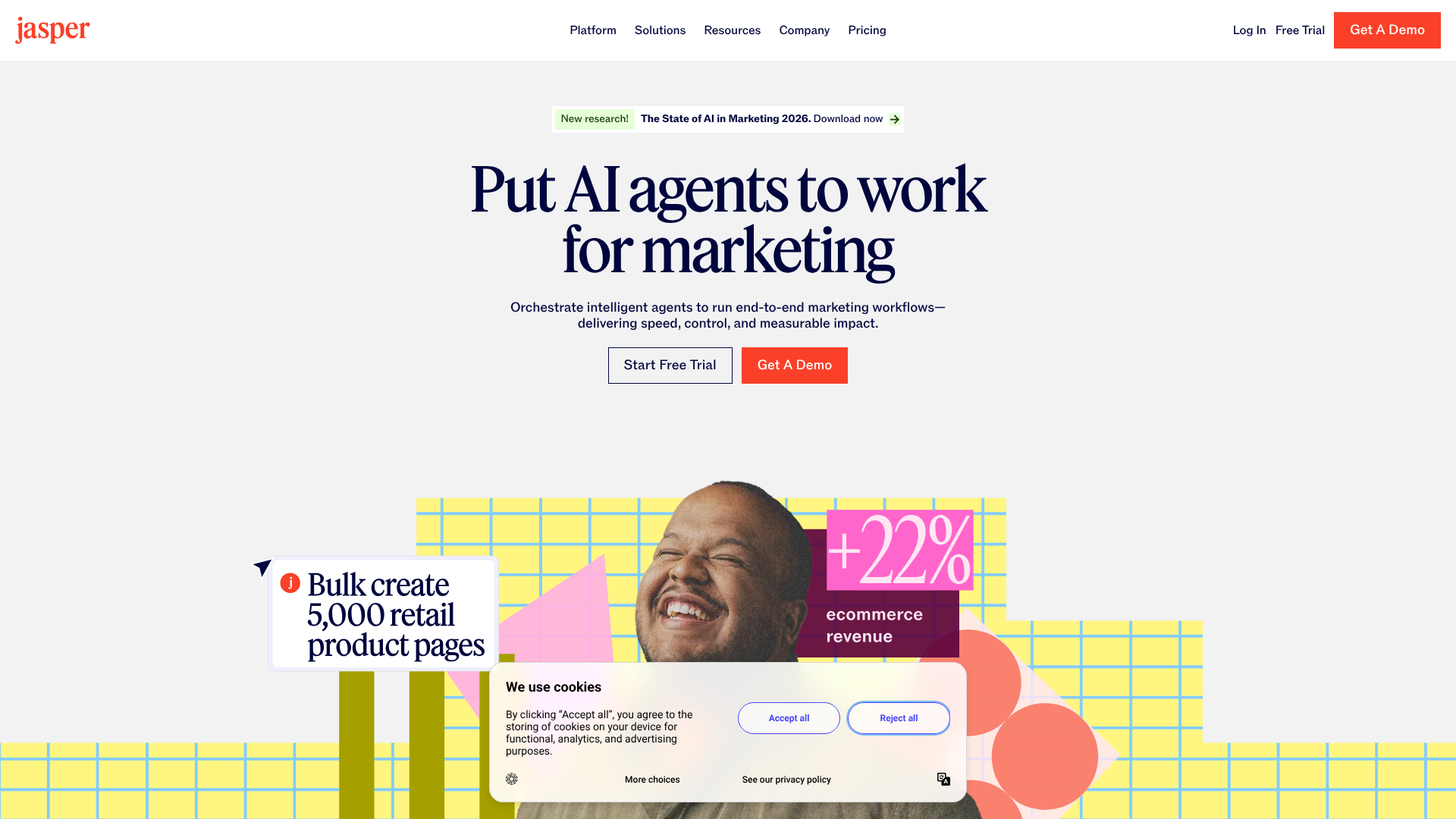
Jasper has long been a favourite among marketers for its ability to generate persuasive and on-brand copy. It offers a vast library of over 50 templates designed for specific marketing tasks, from writing compelling Facebook ad headlines to crafting engaging product descriptions. Its standout feature is the ability to learn your brand's voice, ensuring consistency across all generated content.
The interface is clean and user-friendly, guiding you through the process of creating content with helpful prompts and options. While its full power is in the paid plans, the free trial provides a solid opportunity to experience its premium features and generate a good amount of content before committing.
- Free Plan Details: Jasper typically offers a free trial that includes a generous number of credits (e.g., 10,000 words) for a limited time. This allows you to test nearly all its features. Check their website for the most current trial offer.
- Best For: Marketers, copywriters, and small business owners who need high-quality, conversion-focused text.
Pros
- Excellent output quality that often requires minimal editing.
- Extensive library of specialised templates for marketing and sales.
- Brand Voice feature helps maintain content consistency.
Cons
- The free offering is a time-limited trial, not a permanent free plan.
- Can be more expensive than competitors if you decide to upgrade.
If Jasper's focus on marketing copy sounds like a good fit, you can explore its features and current trial offer here.
2. Writesonic: Best All-in-One Platform for Content Creation
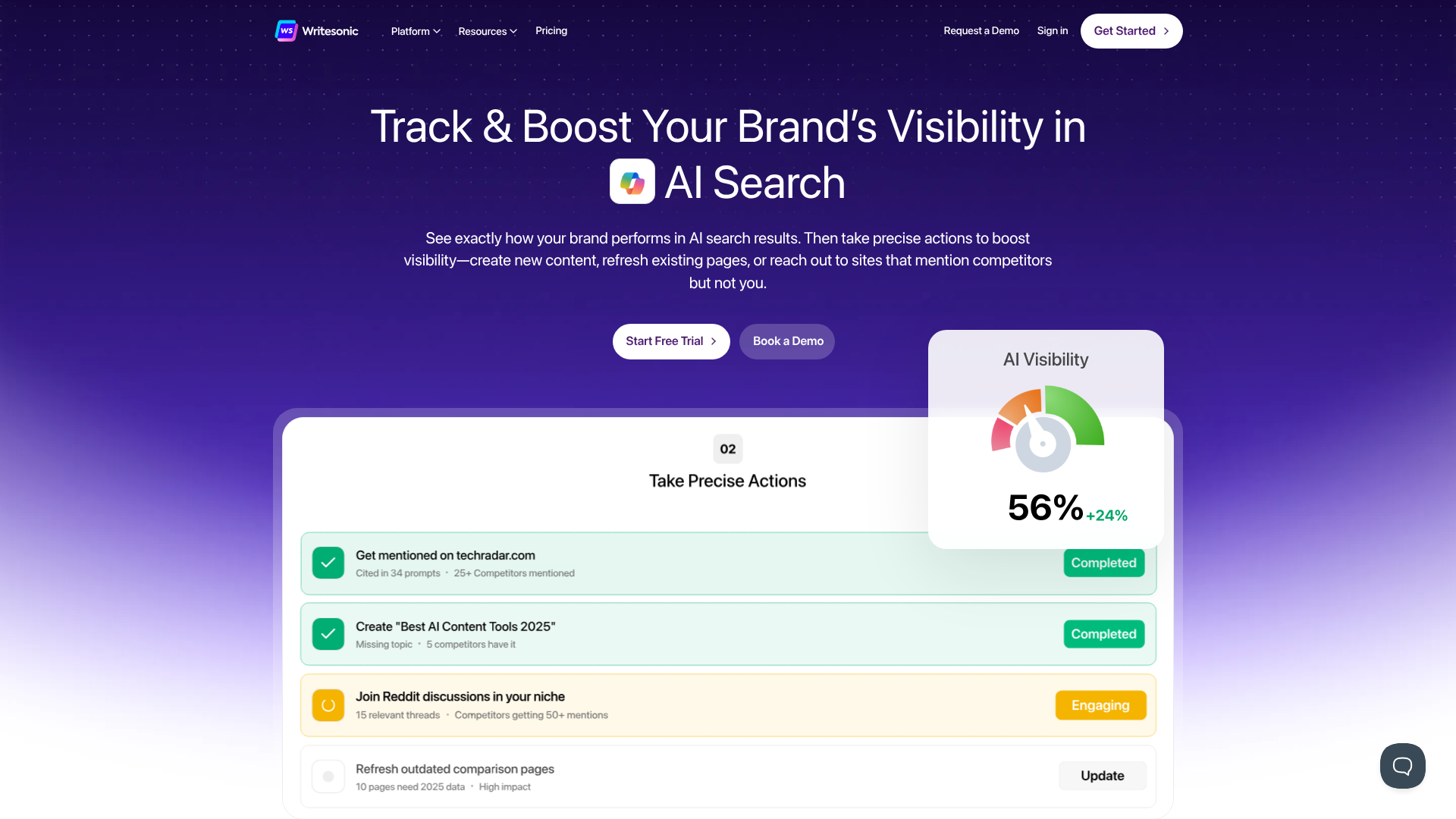
Writesonic positions itself as a comprehensive solution for almost any writing task. It offers a wide array of tools, including an AI article writer, a paraphrasing tool, a text expander, and numerous templates for ads, emails, and website copy. Its Sonic Editor, which functions like a super-powered Google Docs, allows you to draft, edit, and format long-form content with AI assistance every step of the way.
The platform is particularly strong for bloggers and content creators who need to produce a variety of content types. The free plan is quite generous, offering a recurring monthly word count that is sufficient for smaller projects or for thoroughly testing the platform's capabilities.
- Free Plan Details: The free plan typically includes a set number of words per month (often up to 10,000 words) that can be used across its various tools. This is a permanent free plan, not a trial.
- Best For: Bloggers, freelance writers, and all-around content creators who need a versatile tool.
Pros
- Generous permanent free plan with a monthly word allowance.
- Wide range of tools covering everything from articles to ad copy.
- Sonic Editor is excellent for writing and editing long-form content.
Cons
- The output quality can sometimes be inconsistent and may require more editing than Jasper.
- The interface can feel a bit cluttered with so many tools available.
3. QuillBot: Best for Paraphrasing and Academic Writing
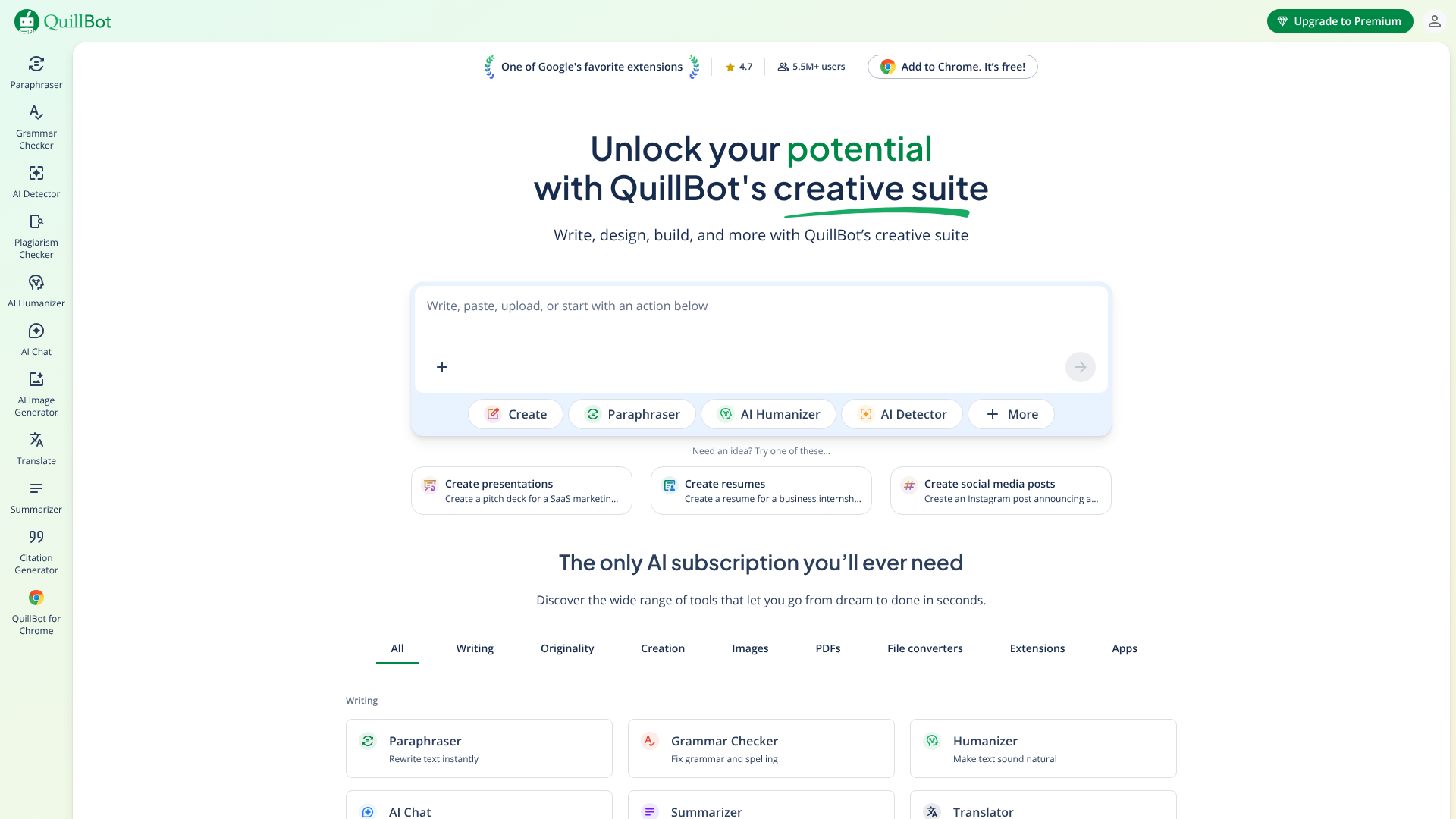
QuillBot shines in a different area: refining and restructuring existing text. Its core feature is a powerful paraphraser that can rewrite sentences, paragraphs, or entire documents in various modes, such as 'Standard' or 'Fluency'. This makes it an invaluable tool for students, academics, and writers looking to avoid plagiarism or simply find a better way to phrase their ideas.
Beyond paraphrasing, QuillBot's free plan also includes a grammar checker, a summariser, and a citation generator. While the free version has limitations on the number of words you can process at once and restricts access to more advanced paraphrasing modes, it remains incredibly useful for its core purpose.
- Free Plan Details: The free plan allows you to paraphrase up to 125 words at a time and use two paraphrasing modes. The summariser and grammar checker also have limitations.
- Best For: Students, academics, researchers, and anyone who needs to rewrite or improve existing text.
Pros
- Best-in-class paraphrasing tool for improving clarity and avoiding repetition.
- Includes several useful tools like a grammar checker and summariser.
- Simple, easy-to-use interface.
Cons
- Strict limitations on word count per use in the free version.
- Not designed for generating new content from scratch.
4. Grammarly: Best for Editing and Polishing Existing Text
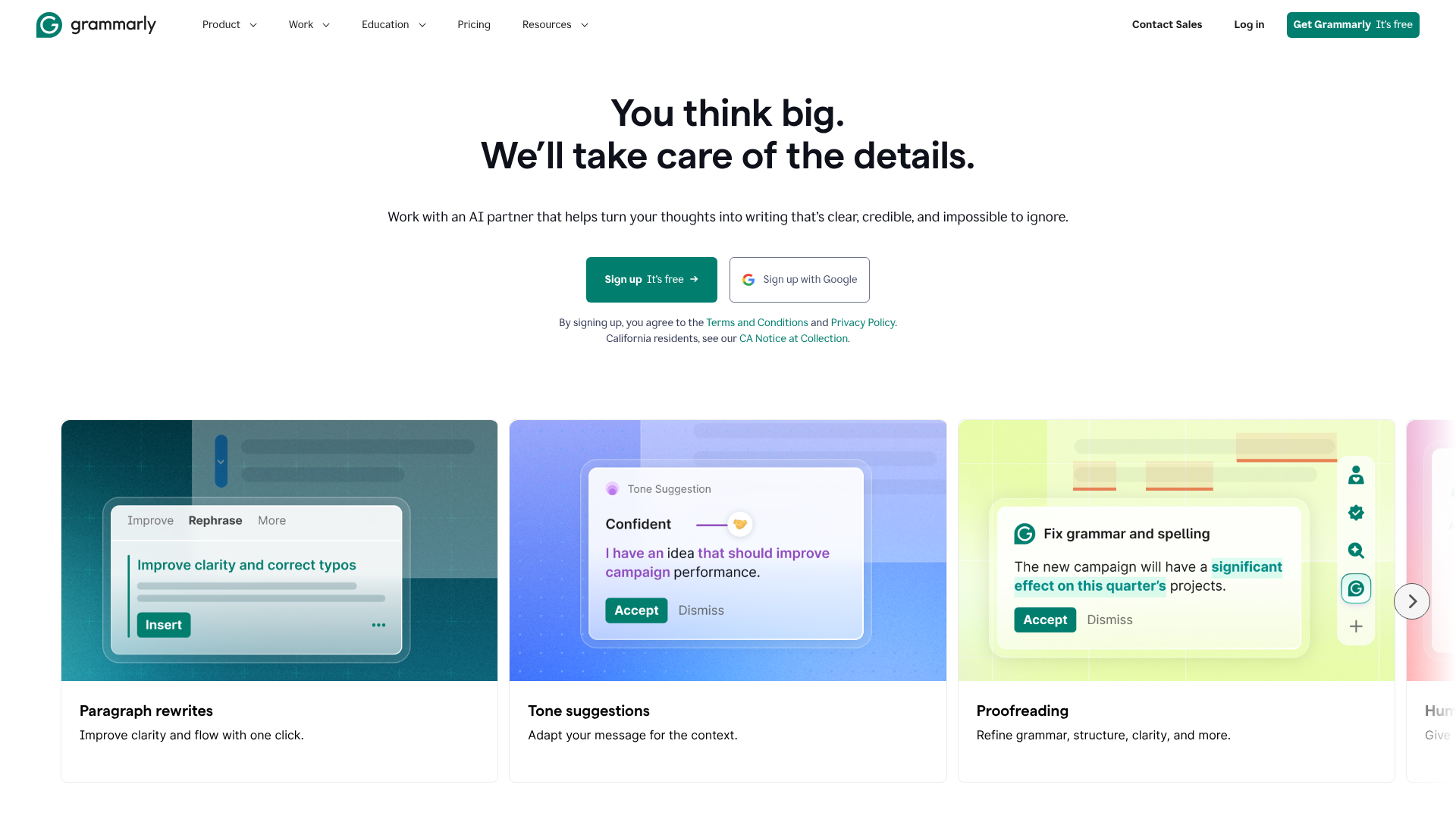
While many know Grammarly as a world-class grammar and spell checker, it has evolved into a powerful AI writing assistant. The free version goes far beyond basic corrections, offering suggestions on clarity, conciseness, and tone. It helps you polish your writing to make it more professional and effective.
Recently, Grammarly has integrated generative AI features into its free plan. You get a monthly allowance of prompts that you can use to rephrase sentences, adjust the tone, or brainstorm ideas directly within your document. It acts as an expert editor looking over your shoulder, making it an essential tool for ensuring your final draft is flawless.
- Free Plan Details: The free plan includes critical grammar, spelling, and punctuation checks, plus a limited number of generative AI prompts per month (e.g., 100 prompts).
- Best For: Everyone. It's a foundational tool for professionals, students, and writers who want to improve the quality of their writing.
Pros
- Excellent for catching errors and improving the overall quality of your writing.
- Generative AI features on the free plan are useful for quick edits.
- Integrates seamlessly with browsers, email clients, and word processors.
Cons
- The free plan's generative AI prompts are limited.
- Primarily an editor, not a content generator for first drafts.
5. ChatGPT (OpenAI): Best General-Purpose AI for Brainstorming & Drafting
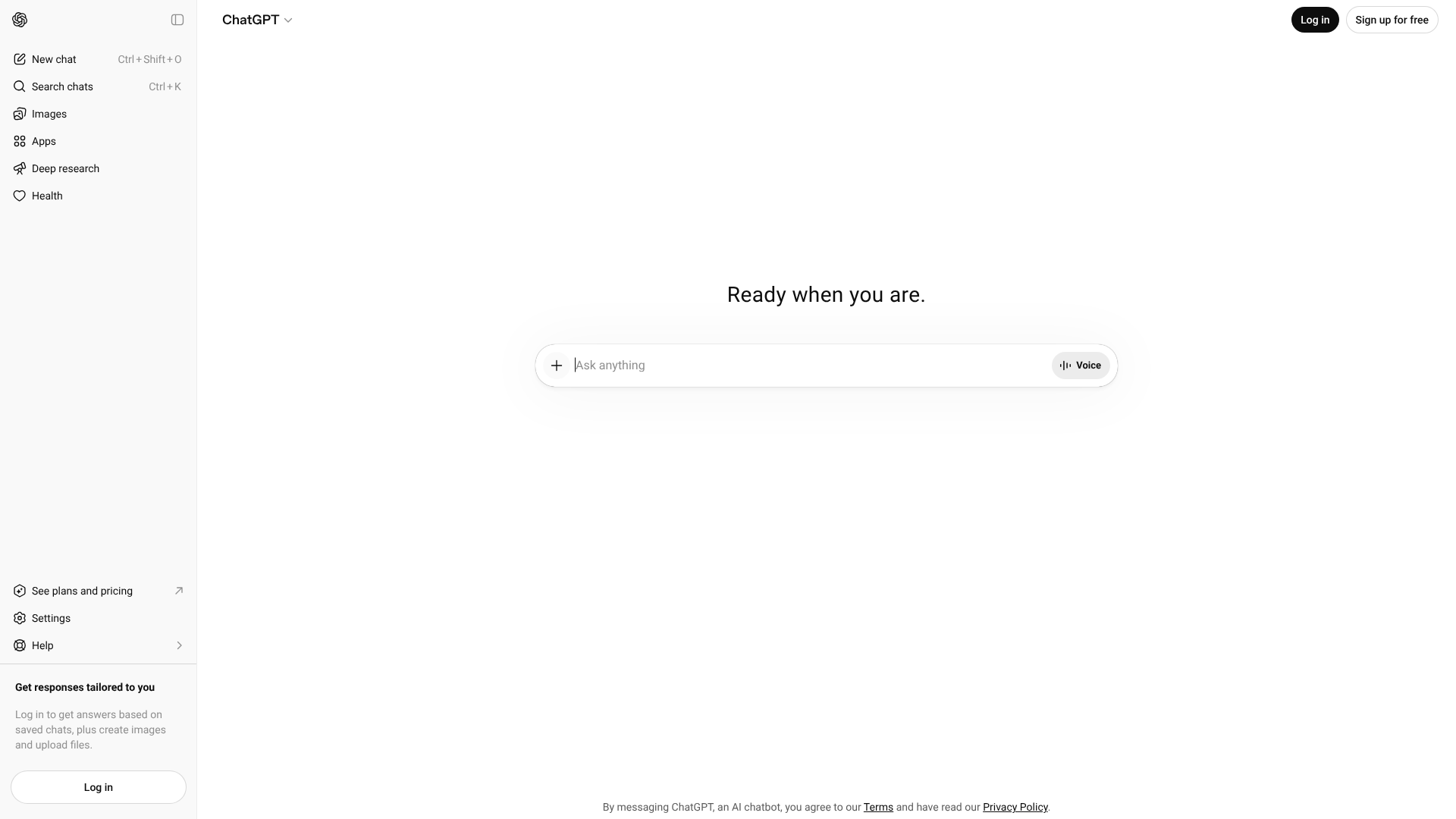
ChatGPT is the tool that brought AI writing into the mainstream, and its free version remains one of the most powerful and versatile options available. It can handle a vast range of requests, from generating blog post ideas and creating detailed outlines to writing code and answering complex questions. Its conversational interface makes it incredibly intuitive to use.
The free version now often provides access to OpenAI's more advanced models (like GPT-4o), which were previously exclusive to paid users. While there are usage caps, they are generally generous enough for most users' daily needs. It's the ultimate digital blank slate for any writing project.
- Free Plan Details: Access to a powerful language model with daily or hourly usage limits. When limits are reached, you may be switched to a less powerful model or have to wait.
- Best For: Brainstorming, outlining, creating first drafts, and general-purpose research.
Pros
- Extremely versatile and can handle almost any writing task.
- Conversational interface is easy and intuitive to use.
- Free access to very powerful language models.
Cons
- Output can be generic without highly specific prompting.
- Usage caps can be restrictive during peak times.
6. Claude (Anthropic): Best for Natural-Sounding, Conversational Text
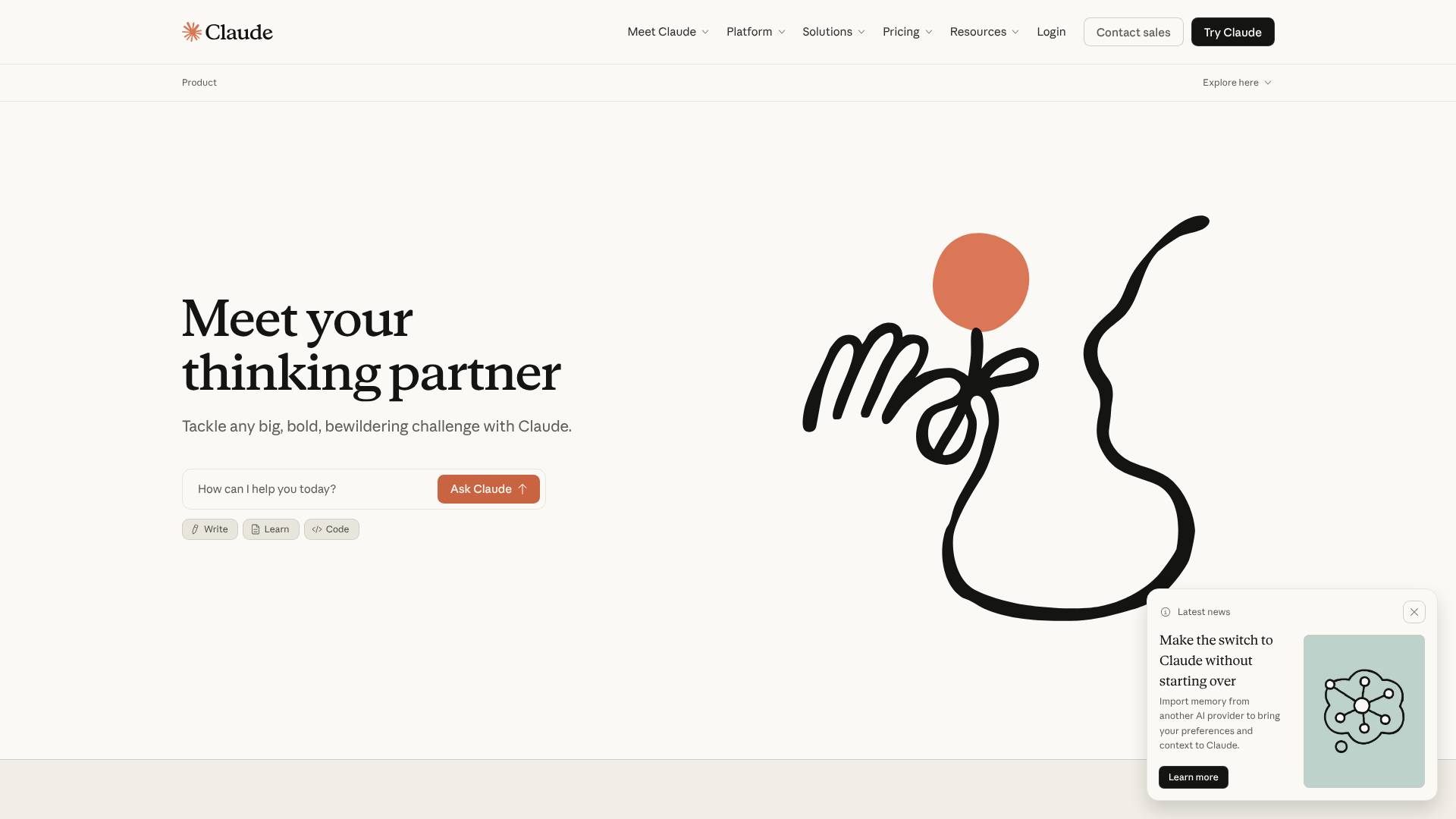
Claude is a direct competitor to ChatGPT and has gained a strong following for its ability to produce text that feels more natural and less robotic. It often excels at creative writing tasks and generating content with a specific, nuanced tone. Many users find that Claude's output requires less editing to sound human.
One of its key advantages is a larger 'context window', meaning it can remember more of your conversation and handle larger documents for tasks like summarisation or analysis. The free version is very capable, offering a similar experience to ChatGPT but with its own unique writing style.
- Free Plan Details: The free plan provides access to the Claude model with usage limits that reset every few hours. Heavy users may hit the cap quickly.
- Best For: Creative writers, content creators who prioritise a natural tone, and users who need to work with large documents.
Pros
- Often produces more natural and conversational-sounding text.
- Large context window is great for summarising long documents.
- Strong safety features to avoid generating harmful content.
Cons
- Usage limits on the free plan can be more restrictive than ChatGPT's.
- Fewer third-party integrations compared to OpenAI's ecosystem.
7. Rytr: Best for Short-Form Copy and Social Media
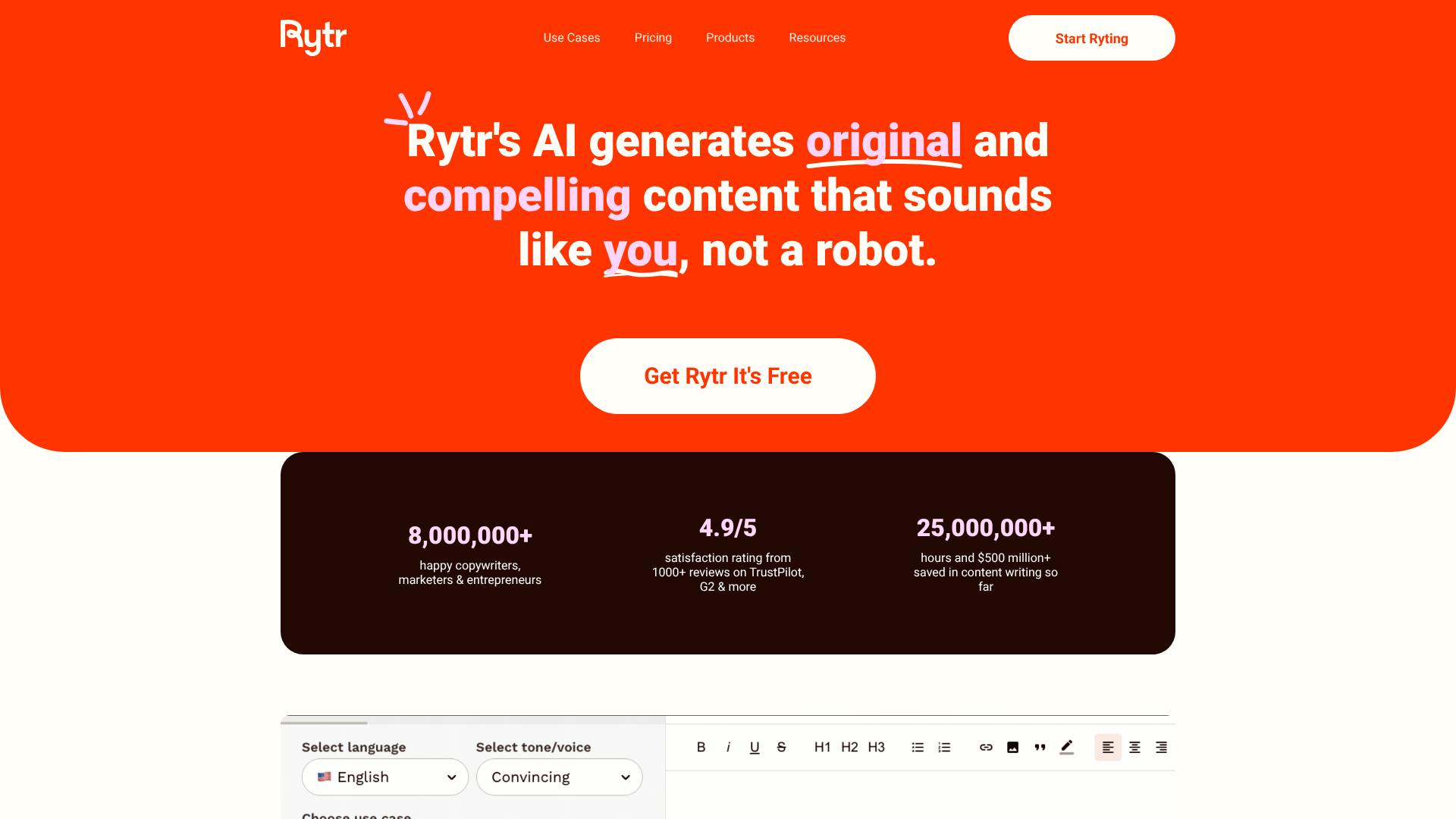
Rytr is designed for speed and simplicity, making it a fantastic choice for creating short-form content. It offers over 40 use cases, including social media posts, ad headlines, and product descriptions. Its interface is incredibly straightforward: you choose a use case, provide some context, and it generates several variations for you to choose from.
The free plan is a permanent offering with a monthly character limit. While this limit means it's not suitable for writing long articles, it's more than enough for generating a month's worth of social media content or a batch of ad copy.
- Free Plan Details: The free plan allows you to generate 10,000 characters per month and access all use cases.
- Best For: Social media managers, e-commerce store owners, and marketers who need quick, short-form copy.
Pros
- Extremely simple and fast to use.
- Generous character limit on the permanent free plan for short-form tasks.
- Built-in plagiarism checker is a nice bonus.
Cons
- Not suitable for long-form content like blog posts.
- Output quality is solid but can lack the sophistication of more advanced tools.
Understanding the "Free" in Free AI Writing Software: A Cost Comparison
Navigating the world of free AI writing tools requires understanding that 'free' rarely means 'unlimited'. Most companies use a freemium model to give you a taste of their product, hoping you'll upgrade. Here’s a breakdown of the common limitations and a comparison of our top picks.
| Tool | Free Plan Limit | Key Feature | Best For | Starting Price (Paid) |
|---|---|---|---|---|
| Jasper | Time-limited trial (e.g., 10k words) | Brand Voice & Marketing Templates | High-Quality Marketing Copy | Visit website for current pricing |
| Writesonic | 10,000 words/month | All-in-one Toolkit & Sonic Editor | Versatile Content Creation | Visit website for current pricing |
| QuillBot | 125 words/use (Paraphraser) | Advanced Paraphrasing | Academic & Text Rewriting | Visit website for current pricing |
| Grammarly | 100 generative AI prompts/month | Advanced Editing & Polishing | Improving Existing Writing | Visit website for current pricing |
| ChatGPT | Daily/hourly message caps | General-Purpose Versatility | Brainstorming & First Drafts | Visit website for current pricing |
| Claude | Message caps every 5 hours | Natural Tone & Large Context | Creative Writing & Summaries | Visit website for current pricing |
| Rytr | 10,000 characters/month | 40+ Short-Form Templates | Social Media & Ad Copy | Visit website for current pricing |
Pro Tip: To get the most out of these free plans, use them strategically. Draft your long-form article in ChatGPT, paraphrase tricky sections with QuillBot, and do your final proofread with Grammarly. This multi-tool approach lets you leverage each platform's strengths without hitting a paywall.
The Pros and Cons of Using Free AI Writers
While free AI writing software offers incredible potential, it's important to approach it with a balanced perspective. These tools are powerful assistants, but they come with their own set of advantages and disadvantages.
Pros
- Massive Speed and Efficiency Boost: The most significant benefit is the ability to generate content at a remarkable speed. AI can help you overcome writer's block by providing instant ideas, outlines, and drafts, turning hours of work into minutes.
- Significant Cost Savings: For freelancers, startups, and small businesses, gaining access to sophisticated AI technology without any financial investment is a huge advantage. It levels the playing field, allowing smaller players to produce content more consistently.
- Versatility Across Different Tasks: A single AI tool can act as a copywriter, a proofreader, a translator, and a brainstorming partner. This versatility allows you to handle a wide range of writing needs without having to switch between dozens of different applications.
- Excellent for Idea Generation: When you're stuck for ideas, AI can be an endless source of inspiration. You can ask it for blog post topics, different angles on a story, or creative ways to phrase a marketing message, kickstarting your creative process.
Cons
- Risk of Factual Inaccuracies: AI models can 'hallucinate'—that is, they can invent facts, statistics, and sources that sound plausible but are entirely false. It is absolutely essential to fact-check any information generated by an AI before publishing.
- Generic Output and Lack of Personal Voice: AI-generated content can often be generic and lack the unique voice, anecdotes, and personality that make human writing engaging. Heavy editing is required to inject your own style and expertise.
- Strict Usage Limitations: As we've seen, free plans are designed to be restrictive. Word counts, character limits, and feature gates can interrupt your workflow and limit the scope of what you can achieve without upgrading.
- Potential for Unintentional Plagiarism: While AIs create original text, they are trained on existing data. There's a small risk their output could be too similar to their training material. Always use a plagiarism checker as a final step to be safe.
Frequently Asked Questions (FAQ)
What is the best AI for writing for free?
There isn't a single 'best' one—it depends entirely on your task. For general-purpose writing, brainstorming, and drafting, ChatGPT is an excellent all-rounder due to its power and versatility. For improving and rephrasing existing text, especially for academic purposes, QuillBot is the top choice. For ensuring your final copy is grammatically perfect and polished, Grammarly's free plan is unbeatable.
Which AI tool is 100% free?
No major, high-quality AI writing tool is 100% free with unlimited usage and no restrictions. The development and maintenance of these powerful models are incredibly expensive. Most operate on a freemium model, providing a permanently free tier with limitations (like Writesonic or Rytr) or a time-limited free trial (like Jasper). Always check the specific limits of the free plan.
Which free AI is better than ChatGPT?
'Better' is subjective and depends on your needs. For certain tasks, other tools outperform ChatGPT. Claude is often considered better for producing more natural, conversational, and creative text. Specialised tools like Writesonic or Jasper are better for specific marketing tasks because their templates are fine-tuned to generate high-converting copy for ads, landing pages, and product descriptions, which can save a lot of time compared to writing a detailed prompt for ChatGPT.
How to tell if someone used ChatGPT?
While detection tools exist, they are notoriously unreliable. However, there are some common tells. AI-generated text often has a very uniform, slightly formal tone and perfect grammar. It may use repetitive sentence structures (e.g., starting many sentences with 'Additionally' or 'Moreover').
The content might also feel very general and lack personal stories, specific examples, or nuanced opinions, which are hallmarks of human writing.
Final Thoughts: Integrating AI into Your Writing Workflow
Free AI writing tools have democratised content creation, offering powerful capabilities to everyone from students to seasoned marketers. The key to success is viewing them not as replacements for human creativity but as powerful assistants that can handle the heavy lifting of drafting, brainstorming, and polishing.
By understanding the different types of tools and the specific limitations of their free plans, you can build a powerful, cost-effective writing toolkit. Start by identifying your primary need. If you need versatile content creation, the free plan from Writesonic is an excellent starting point. If your main goal is to perfect your existing writing, you can't go wrong with the essential checks offered by Grammarly.
The best approach is to experiment. Try a few options from this list, see which one fits your style, and start integrating it into your workflow. You'll likely find that the right AI partner can save you time, spark new ideas, and help you produce better content more consistently.