

How to Use Semrush for Keyword Research: A Step-by-Step Guide for 2026
Effective keyword research is the foundation of any successful SEO strategy. It’s the process of finding the terms and phrases people use in search engines, allowing you to create content that directly answers their questions. While many tools exist, using Semrush for keyword research provides a comprehensive suite of data and analytics that can give you a significant competitive edge. This guide will walk you through exactly how to harness its power.
- What You'll Learn
- What is Semrush and Why Use It for Keyword Research?
- The Core Semrush Keyword Tools: A Deep Dive
- A Step-by-Step Guide to Keyword Research with Semrush
- Step 1: Brainstorming Seed Keywords
- Step 2: Expanding Your List with the Keyword Magic Tool
- Step 3: Analysing Keyword Difficulty and Intent
- Step 4: Spying on Your Competitors with Keyword Gap
- Step 5: Finding Question-Based Keywords
- Step 6: Creating Your Master Keyword List
- Choosing the Right Semrush Plan for Your Needs
- The Pros and Cons of Using Semrush for Keywords
- Frequently Asked Questions (FAQ)
- Is Semrush used for keyword research?
- How accurate is Semrush for keywords?
- Is Semrush good for beginners?
- How to use Semrush for keyword research for free?
- Is Semrush better than Google Analytics?
- Can I use ChatGPT for keyword research?
- Final Thoughts: Is Semrush Worth It for Keyword Research?
This isn't just about finding keywords with high search volume. It's about understanding user intent, analysing your competition, and building a content strategy that drives targeted traffic. Whether you're a small business owner, a content marketer, or an SEO professional, mastering the Semrush keyword tool is essential for growth in 2026.
What You'll Learn
- Core Semrush Tools: You'll discover the key features within Semrush for keyword discovery, including the Keyword Magic Tool, Keyword Gap, and Topic Research.
- A Step-by-Step Process: This guide provides a clear, actionable workflow for conducting comprehensive keyword research, from initial brainstorming to competitor analysis.
- Interpreting Key Metrics: Learn what metrics like Keyword Difficulty (KD), Search Volume, and Intent actually mean and how to use them to choose the right keywords.
- Finding Untapped Opportunities: We'll show you how to uncover long-tail keywords and question-based queries that your competitors might be overlooking.
- Organising Your Strategy: Understand how to use the Keyword Manager to build, filter, and export your master keyword list for content planning.
What is Semrush and Why Use It for Keyword Research?
Semrush is an all-in-one digital marketing platform that offers tools for SEO, PPC, content marketing, social media, and competitive research. While it has over 50 different tools, its capabilities for keyword research are what make it a favourite among marketers worldwide. It’s not just a single tool but an entire ecosystem designed to guide your SEO decisions with data.
So, why is it so highly regarded? The primary reason is the sheer scale and quality of its data. Semrush maintains a massive database of over 25 billion keywords across more than 140 countries. This means when you search for a term, you're not just getting an estimate; you're accessing a vast repository of search behaviour, trends, and competitive insights.
Using Semrush for keywords goes beyond simple discovery. It helps you understand the entire search landscape for a given query. You can see who is ranking, what kind of content they are creating, and how difficult it will be to compete. This holistic view is crucial for making strategic decisions that save time and resources, ensuring you target keywords you can realistically rank for.
The Core Semrush Keyword Tools: A Deep Dive
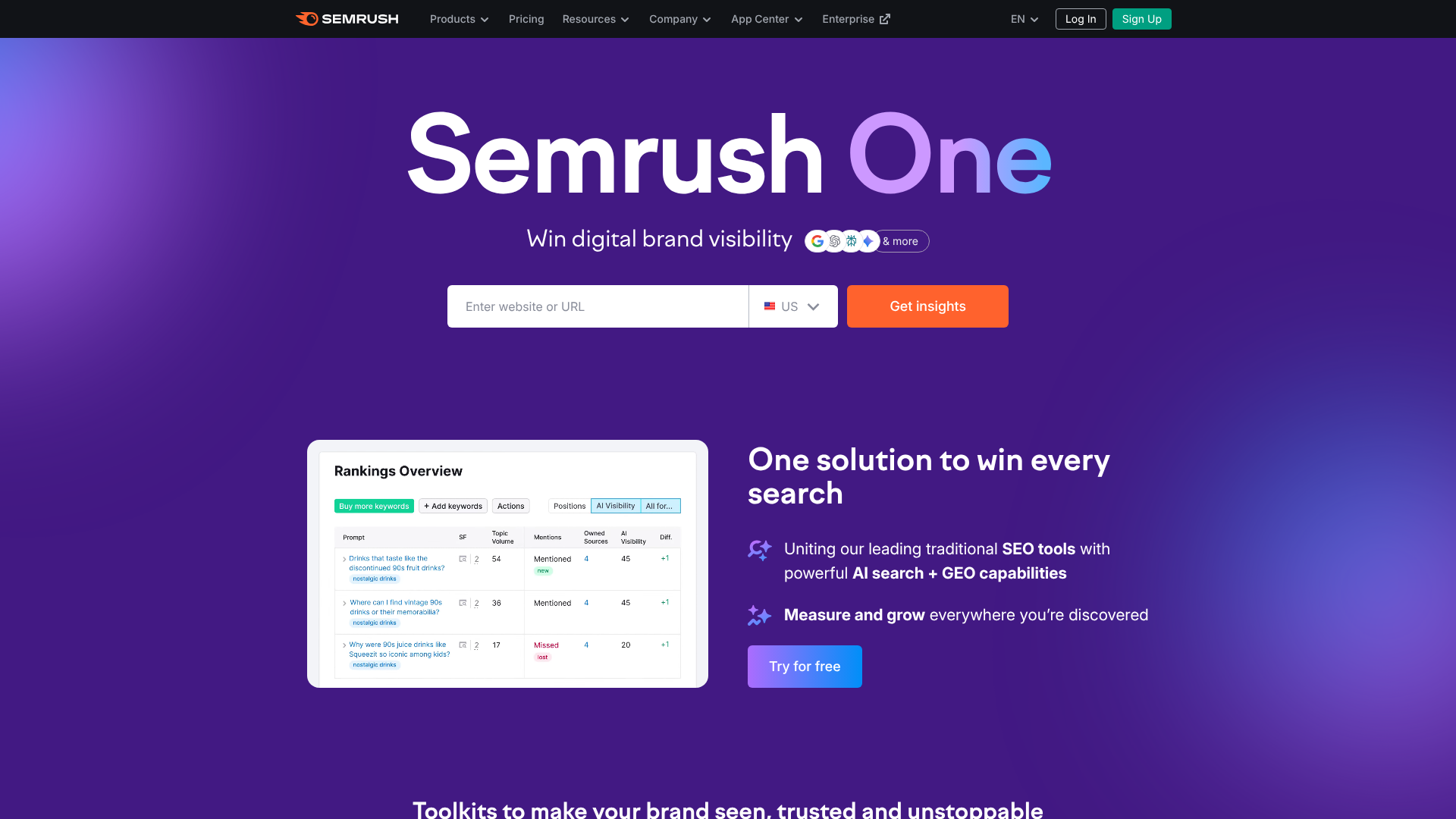
To master keyword research with Semrush, you need to understand its core components. Each tool serves a specific purpose in the research workflow, from broad ideation to granular analysis. Getting familiar with these will make your process faster and more effective.
Keyword Magic Tool
This is your primary engine for keyword discovery. You start by entering a single "seed" keyword, and the Keyword Magic Tool generates thousands of related terms, organised into topic-specific groups. This is incredibly useful for exploring niches and finding long-tail variations you might not have considered.
For example, if your seed keyword is "dog training," the tool will suggest groups like "dog training collar," "puppy dog training," and "free dog training tips." You can apply advanced filters to narrow the results by search volume, keyword difficulty, search intent, cost-per-click (CPC), and even the number of words in the phrase. This is where you'll spend most of your time building out your initial keyword lists.
Keyword Overview
Once you have a specific keyword you want to investigate, the Keyword Overview tool gives you a complete 360-degree view. Simply enter a keyword, and you'll get a dashboard with all its vital statistics. This includes its monthly search volume, keyword difficulty score (KD%), global volume, and search intent (Informational, Navigational, Commercial, or Transactional).
Beyond these core metrics, it also shows you keyword variations, a list of related questions people are asking, and the top-ranking pages in the SERP (Search Engine Results Page). This tool is perfect for quickly vetting a keyword's potential before you commit to creating content around it.
Topic Research Tool
Content marketing isn't just about individual keywords; it's about building topical authority. The Topic Research tool helps you do just that. Instead of just giving you a list of keywords, it generates a mind map of related subtopics, headlines, and common questions related to your main topic.
This is invaluable for planning comprehensive articles, blog posts, or pillar pages. It ensures you cover a topic in its entirety, which is a strong signal to search engines that your content is authoritative. It helps you think beyond a single keyword and build a content cluster that can rank for hundreds of related terms.
Keyword Gap Analysis
The Keyword Gap tool is your secret weapon for competitive analysis. It allows you to compare your website's keyword profile against up to four competitors. The tool shows you keywords that your competitors rank for but you don't (your "weak" or "missing" keywords).
This is one of the fastest ways to find proven, high-value keywords. If your top competitors are getting traffic from a specific term, it's likely relevant to your audience as well. You can also find "untapped" keywords that none of your direct competitors are targeting, giving you a unique opportunity to capture new traffic.
A Step-by-Step Guide to Keyword Research with Semrush
Now that you understand the tools, let's put them into practice. Here is a step-by-step workflow for conducting a thorough keyword research project using Semrush.
Step 1: Brainstorming Seed Keywords
Every keyword research project begins with a list of foundational topics, known as "seed keywords." These are broad terms that describe your business, products, or services. Think about what your customers are searching for. If you run an online plant shop, your seed keywords might be:
- indoor plants
- buy plants online
- low-light houseplants
- pet-friendly plants
Don't overthink this stage. The goal is to create a starting list of 5-10 core topics. You can also get ideas by looking at your existing service pages or talking to your sales team about the language customers use.
Step 2: Expanding Your List with the Keyword Magic Tool
Take your seed keywords and enter them one by one into the Semrush Keyword Magic Tool. This is where you'll turn your handful of ideas into thousands of potential targets. For our "indoor plants" example, the tool will generate a massive list of related terms.
Use the filters on the left to refine this list. A great starting point is to filter for "Questions" to find informational content ideas. You can also set a Keyword Difficulty (KD%) filter to find less competitive terms. For a new website, you might target keywords with a KD% of 0-30 (Easy to Very Easy).
As you find relevant keywords, tick the checkbox next to them and click the "Add to Keyword Manager" button. This will send them to a dedicated list where you can continue to refine and organise them later.
Step 3: Analysing Keyword Difficulty and Intent
Search volume isn't everything. A keyword with 10,000 monthly searches is useless if you can't rank for it or if it doesn't match the user's intent. As you browse the Keyword Magic Tool, pay close attention to two columns: Intent and KD%.
- Intent: This tells you why someone is searching. Semrush breaks it down into four types: Informational (I), Navigational (N), Commercial (C), and Transactional (T). Matching your content to the search intent is critical for ranking.
- KD% (Keyword Difficulty): This is a score from 0-100 that estimates how difficult it will be to rank on the first page of Google. A lower score means less competition. New sites should focus on lower KD keywords to build momentum.
Your goal is to find a balance: keywords with reasonable search volume, a manageable KD score, and an intent that aligns with your business goals.
Pro Tip: Use the "Advanced Filters" in the Keyword Magic Tool to include or exclude terms. For example, if you're a local business, you can include your city's name to find geo-targeted keywords. If you don't sell cheap products, you can exclude terms like "free" or "cheap."
Step 4: Spying on Your Competitors with Keyword Gap
Now it's time to see what's working for others. Navigate to the Keyword Gap tool. Enter your domain and the domains of 2-4 of your main competitors. The tool will generate a report showing you where your keyword profiles overlap and differ.
Focus on the "Missing" and "Weak" tabs. "Missing" shows keywords your competitors rank for in the top 100, but you don't. "Weak" shows keywords where your competitors outrank you. This is a goldmine of opportunities.
Export these lists and analyse them for high-priority targets to add to your Keyword Manager.
Step 5: Finding Question-Based Keywords
Question-based keywords are perfect for blog content and for capturing featured snippets in Google. These are queries that start with who, what, where, when, why, or how. They typically have a clear informational intent, making them ideal for top-of-funnel content that builds trust and authority.
In the Keyword Magic Tool, you can simply click the "Questions" filter to see only these types of queries. For our "indoor plants" example, this might reveal questions like "how to care for a monstera" or "what are the best low-light indoor plants." Answering these questions directly makes your content extremely valuable to users.
Step 6: Creating Your Master Keyword List
By now, you should have sent hundreds of potential keywords to the Keyword Manager. This is your central hub for finalising your strategy. Inside the Keyword Manager, you can create different lists for different campaigns or content clusters.
Click the "Update Metrics" button to get the latest search volume and KD% data. From here, you can apply filters, add tags (e.g., "blog post," "product page"), and sort your list to prioritise your targets. Once you're happy with your list, you can export it as a CSV or Excel file to share with your team and begin your content creation process.
Choosing the Right Semrush Plan for Your Needs

Semrush offers several pricing tiers, and choosing the right one depends on your specific needs, team size, and budget. The main differences between the plans relate to the number of projects you can run, the number of keywords you can track, and access to more advanced features.
Here’s a quick breakdown of the main plans:
Pro Plan: This is the entry-level plan, perfect for freelancers, startups, and in-house marketers with a limited budget. It provides access to all the core keyword research tools, competitor analysis, and site auditing features. However, it has limits on the number of reports you can pull per day and the amount of data you can analyse.
Guru Plan: This is the most popular plan and is ideal for small to medium-sized businesses and growing marketing agencies. It includes everything in the Pro plan but with higher limits. It also adds features like the Content Marketing Platform, historical data, and Looker Studio integration, which are essential for more advanced strategies.
Business Plan: Designed for large agencies, e-commerce stores, and enterprises, the Business plan offers the highest limits and most advanced features. This includes API access, Share of Voice metrics, and product listing ad analytics. It's built for teams that manage a large portfolio of clients or a complex digital marketing strategy.
| Feature | Pro Plan | Guru Plan | Business Plan |
|---|---|---|---|
| Best For | Freelancers & Startups | SMBs & Agencies | Large Enterprises |
| Projects | 5 | 15 | 40 |
| Keywords to Track | 500 | 1,500 | 5,000 |
| Reports Per Day | 3,000 | 5,000 | 10,000 |
| Content Marketing Platform | No | Yes | Yes |
| Historical Data | No | Yes | Yes |
For the most current pricing, it's always best to visit the Semrush pricing page directly, as plans and features can change. They often offer a free trial, which is a great way to test the platform's capabilities before committing to a subscription.
The Pros and Cons of Using Semrush for Keywords
No tool is perfect, and it's important to have a balanced view. While Semrush is an incredibly powerful platform for keyword research, it has both strengths and weaknesses that you should consider.
Advantages of Semrush
- Comprehensive Data: With a database of over 25 billion keywords, the depth and breadth of the data are second to none. This allows for highly detailed and accurate research.
- All-in-One Toolkit: Semrush isn't just a keyword tool. It integrates keyword research with rank tracking, site audits, backlink analysis, and content marketing tools, providing a single source of truth for your entire SEO strategy.
- Superior Competitor Analysis: Tools like Keyword Gap and Organic Research make it incredibly easy to deconstruct your competitors' strategies and find opportunities they've capitalised on.
- User-Friendly Interface: Despite its complexity, the platform is well-organised and relatively intuitive. The visual dashboards and clear metrics make it accessible even for those new to SEO.
Disadvantages of Semrush
- Cost: Semrush is a premium tool, and its subscription cost can be a significant investment, especially for individuals or small businesses just starting out.
- Learning Curve: While the basics are easy to grasp, mastering the full suite of advanced features can take time and practice. There is a definite learning curve to get the most out of the platform.
- Data Limits on Lower Plans: The entry-level Pro plan has limitations on the number of reports you can run and keywords you can track, which might be restrictive for users with larger needs.
Frequently Asked Questions (FAQ)
Here are answers to some of the most common questions people have about using the Semrush keyword tool.
Is Semrush used for keyword research?
Yes, absolutely. Keyword research is one of the primary and most powerful functions of the Semrush platform. It offers a suite of dedicated tools like the Keyword Magic Tool, Keyword Overview, and Keyword Gap analysis specifically designed for discovering, analysing, and organising keywords for SEO and PPC campaigns.
How accurate is Semrush for keywords?
Semrush is considered one of the most accurate keyword research tools on the market. It uses a combination of machine learning algorithms and data from third-party providers to process petabytes of search data collected from search engines. While no tool can provide 100% perfect search volume data (only Google has that), Semrush's estimates are highly reliable for strategic decision-making and are trusted by millions of marketers.
Is Semrush good for beginners?
Yes, Semrush is suitable for beginners, but with a caveat. The interface is clean and the core metrics are easy to understand, making it accessible for newcomers. However, the sheer number of tools and data points can feel overwhelming at first. Semrush offers an extensive knowledge base and free courses through the Semrush Academy to help new users get up to speed quickly.
How to use Semrush for keyword research for free?
You can use Semrush for keyword research for free, but with significant limitations. A free Semrush account allows you to perform 10 searches per day in tools like the Keyword Magic Tool or Keyword Overview. This is enough to get a feel for the platform or conduct very basic research, but for any serious project, you'll need a paid subscription. Many users start with the free trial to access full functionality for a limited time.
Is Semrush better than Google Analytics?
This is a common point of confusion. Semrush and Google Analytics are not direct competitors; they serve different purposes and are best used together. Google Analytics provides data on what happens on your website (e.g., user behaviour, traffic sources, conversion rates). Semrush provides data on what happens in the search engines (e.g., keyword rankings, competitor performance, search volumes).
You use Semrush to find keywords and optimise your content, and then you use Google Analytics to measure the results of that work.
Can I use ChatGPT for keyword research?
ChatGPT can be a helpful tool for brainstorming keyword ideas and generating related topics, but it is not a replacement for a data-driven tool like Semrush. ChatGPT can generate creative lists of potential keywords based on a prompt, but it cannot provide crucial metrics like search volume, keyword difficulty, or CPC data. The best approach is to use ChatGPT for initial ideation and then validate and expand upon those ideas using the real-world data in Semrush.
Final Thoughts: Is Semrush Worth It for Keyword Research?
For any business or individual serious about improving their search engine visibility, investing in a high-quality tool is non-negotiable. When it comes to keyword research, Semrush stands out as a market leader for its comprehensive data, powerful competitor analysis features, and integrated workflow.
The ability to move from broad ideation in the Topic Research tool to granular analysis in the Keyword Magic Tool, all while keeping an eye on competitors with Keyword Gap, provides a strategic advantage that is difficult to replicate with free or less sophisticated tools. It transforms keyword research from a guessing game into a data-driven science.
While the price may be a consideration for some, the return on investment from a well-executed SEO strategy built on solid keyword research often justifies the cost. If you're ready to take your content strategy to the next level and uncover the keywords that will drive meaningful traffic to your site, Semrush is an essential tool for your arsenal.