


Best Time to Send Email Campaigns: A Data-Backed Guide for Marketers
You've crafted the perfect subject line, written compelling copy, and designed a beautiful email. You hit 'send', but the results are underwhelming. The problem might not be your content, but your timing. Finding the best time to send email campaigns is one of the most critical factors for maximising your open rates, clicks, and conversions.
- What You'll Learn
- What is the Optimal Email Send Time and Why Does It Matter?
- The Key Benefits of Strategic Email Campaign Timing
- Benefit 1: Maximise Inbox Visibility and Open Rates
- Benefit 2: Boost Click-Through Rates and Engagement
- Benefit 3: Increase Conversions and ROI
- Benefit 4: Reduce Unsubscribes and Spam Complaints
- Industry Benchmarks: The Generally Accepted Best Times to Send Emails
- How to Find Your Unique Optimal Send Time
- Step 1: Deeply Understand Your Audience Persona
- Step 2: Analyse Your Past Campaign Data
- Step 3: A/B Test Your Send Times Relentlessly
- Step 4: Use Smart Sending Tools and Automation
- Top Tools for Mastering Email Campaign Timing
- Common Mistakes to Avoid in Email Campaign Timing
- Mistake 1: Ignoring Time Zones
- Mistake 2: The 'Set It and Forget It' Approach
- Mistake 3: Not Considering the Email's Content
- Mistake 4: Forgetting About Mobile Devices
- Frequently Asked Questions (FAQ)
- What is the 80/20 rule in email marketing?
- What is the rule of 7 in email marketing?
- What are the 4 P's of email marketing?
- What to avoid in email marketing?
- Final Thoughts
It's the difference between landing at the top of a fresh inbox and getting buried under a mountain of messages.
This guide moves beyond generic advice to give you a data-backed framework for determining the optimal send time for your unique audience. We'll explore the general industry benchmarks, the psychological reasons behind them, and most importantly, how to use data and tools to pinpoint the exact moments your subscribers are most likely to engage. Mastering your email campaign timing is a powerful way to improve your marketing ROI without changing a single word of your copy.
What You'll Learn
- The General Best Times: Industry data points to mid-week (Tuesday, Wednesday, Thursday) and specific time slots like 10 AM and 8 PM as strong starting points for most campaigns.
- Audience is Everything: The universal 'best time' doesn't exist. Your optimal email send time depends entirely on your specific audience's habits, industry (B2B vs. B2C), and time zone.
- Data and Testing are Key: The most accurate way to find your perfect send time is by analysing your past campaign performance and running strategic A/B tests to see what works for your list.
- Automation Tools Can Help: Modern email marketing platforms offer 'Send Time Optimisation' features that use AI to automatically send emails when individual subscribers are most likely to open them.
What is the Optimal Email Send Time and Why Does It Matter?
Finding the optimal email send time refers to identifying the precise day and hour when your target audience is most likely to open, read, and interact with your emails. It’s not about a single magic moment that works for everyone; it's a strategic decision based on audience behaviour, data analysis, and continuous testing. Hitting this sweet spot ensures your message arrives when subscribers are receptive, not distracted or overwhelmed.
Think about a typical professional's day. An email sent at 9 AM on a Tuesday might catch them as they settle in at their desk, ready to scan their inbox. In contrast, an email sent at 4 PM on a Friday is likely to be ignored as they rush to finish tasks before the weekend. The context in which your email is received has a massive impact on its performance.
Getting the timing right directly influences key metrics that define the success of your entire email marketing strategy.
When you nail your email campaign timing, you see a cascade of positive effects. Your open rates go up because your email is visible and relevant at that moment. Higher open rates lead to more people seeing your call-to-action, which boosts your click-through rate (CTR). Ultimately, this increased engagement drives more traffic to your website, generates more leads, and results in more sales.
It's one of the highest-leverage adjustments you can make to improve your campaign ROI.
The Key Benefits of Strategic Email Campaign Timing

Perfecting when you send your emails isn't just a minor tweak; it's a fundamental strategy that delivers tangible benefits. By moving beyond a 'send it and forget it' mentality, you can significantly improve your marketing outcomes. The core advantage is getting your message in front of more people when they are mentally prepared to engage with it.
Benefit 1: Maximise Inbox Visibility and Open Rates
The average office worker receives over 120 emails per day. Sending your campaign during peak hours means you're competing with dozens of other messages for attention. By identifying off-peak but high-engagement windows, you can land at the top of the inbox when it's less crowded. This increased visibility is the first and most crucial step to boosting your open rates.
An email that isn't seen can't be opened.
Benefit 2: Boost Click-Through Rates and Engagement
An open is great, but the real goal is action. The best time for email blasts is when your audience has the time and mindset to not just read, but also click. For example, a B2C email with a special offer sent on a Thursday evening might catch people as they relax and plan their weekend shopping. A B2B email with a case study sent mid-morning on a Wednesday aligns with their work-focused research mode.
Matching your send time to their daily rhythm encourages deeper engagement beyond the initial open.
Benefit 3: Increase Conversions and ROI
Ultimately, marketing efforts are measured by their return on investment. Every click that leads to a purchase, a sign-up, or a download contributes to your bottom line. By optimising your send times, you increase the volume of high-intent traffic reaching your landing pages. This direct correlation between timing, engagement, and action means you can generate more revenue from the same email list and campaign content, effectively making your entire strategy more profitable.
Benefit 4: Reduce Unsubscribes and Spam Complaints
Sending emails at inconvenient times can be perceived as intrusive. An email that arrives at 5 AM on a Saturday might trigger an immediate unsubscribe from someone who resents the notification. Consistently sending valuable content at a time when your audience welcomes it builds trust and strengthens your relationship with subscribers. This reduces list churn and protects your sender reputation, which is vital for long-term email deliverability.
Industry Benchmarks: The Generally Accepted Best Times to Send Emails
While the golden rule is to test for your specific audience, industry-wide data provides an excellent starting point. Decades of collective data from email service providers have revealed clear patterns in subscriber behaviour. These benchmarks are not absolute laws but are reliable guidelines to use for your initial campaigns or as a control group for your A/B tests.
The Best Days of the Week
Across most industries, the middle of the week reigns supreme for email engagement. This is when people are typically settled into their work routine but not yet checked out for the weekend.
- Tuesday: Often cited as the best day. The Monday morning inbox avalanche has been cleared, and people are focused and productive.
- Wednesday: A very strong contender, often showing similar or even higher engagement rates than Tuesday. It's the peak of the work week for many.
- Thursday: Another solid choice. People are starting to plan for the weekend but are still highly engaged with work-related content and B2C offers.
Why not Monday or Friday? Mondays are often spent catching up, leading to aggressive inbox clearing where your email might get deleted without a second thought. On Fridays, attention wanes as the weekend approaches, and open rates tend to drop off significantly in the afternoon.
The Best Times of the Day
Timing within the day is just as crucial. Subscriber behaviour typically follows a predictable pattern based on the standard workday and personal routines.
- Around 10:00 AM: This is often considered the top time slot. People have had their first coffee, cleared urgent messages, and are settling into their work. Sending at 10 AM local time often results in the highest open rates.
- Around 8:00 PM – Midnight: This window is surprisingly effective, especially for B2C brands. People are relaxing at home, browsing on their tablets or phones. This is when click-through rates can peak, as subscribers have more leisure time to explore offers.
- Around 2:00 PM: The post-lunch slump is a real phenomenon. Many people turn to their inboxes for a distraction, making this a good time to capture their attention.
- Around 6:00 AM: This can be effective for audiences who start their day by checking their phone from bed. It ensures your email is one of the first things they see.
Pro Tip: Don't send exactly on the hour (e.g., 10:00 AM). Many marketers schedule their campaigns for the top of the hour. By sending at a slightly off-time, like 10:05 AM or 9:57 AM, you can avoid the initial server rush and potentially land ahead of the competition.
How to Find Your Unique Optimal Send Time
General benchmarks are a great starting point, but the true path to email marketing success lies in understanding your own audience. Every email list is a unique ecosystem of individuals with different habits, schedules, and preferences. The process of discovering your brand's optimal email send time is a continuous cycle of analysis, testing, and refinement.
Step 1: Deeply Understand Your Audience Persona
Before you even look at data, think about who you're emailing. Your audience's lifestyle dictates their inbox behaviour.
- B2B vs. B2C: A B2B audience of office workers will likely be most active during business hours (9 AM – 5 PM, Tuesday-Thursday). A B2C audience of parents might be more active in the evening after the kids are in bed or early in the morning.
- Profession and Industry: An email to restaurant owners might perform best late at night when they're doing admin, while an email to teachers might do well in the late afternoon after school.
- Time Zones: If you have a global or national audience, sending a single blast at 10 AM EST means it arrives at 7 AM PST. It's crucial to segment your audience by time zone or use an email platform that offers time-zone-aware sending.
Step 2: Analyse Your Past Campaign Data
Your best source of truth is your own data. Dive into the analytics dashboard of your email service provider (Selzy, for example, provides clear reports). Look for patterns in your historical data.
- Open Rates by Time of Day: Most platforms provide a report showing when your emails were opened. Look for consistent peaks. Do you see a spike every Wednesday morning?
- Click-Through Rates by Day of the Week: Compare your daily CTRs. You might find that while open rates are high on Tuesday, your click rates are actually better on Thursday evenings.
- Device Usage: Check if your audience opens more on mobile or desktop. Mobile opens are common throughout the day (commutes, breaks), while desktop opens are concentrated during work hours. This can inform your timing and content strategy.
Step 3: A/B Test Your Send Times Relentlessly
Data analysis gives you hypotheses; A/B testing proves them. A send time A/B test is a simple but powerful way to get definitive answers.
- Form a Hypothesis: Based on your data, create a theory. For example: "I believe sending at 8 PM will get more clicks than sending at 10 AM."
- Split Your List: Divide a segment of your email list into two equal, random groups (Group A and Group B).
- Send the Same Email at Different Times: Send the exact same email to both groups, but send it to Group A at 10 AM and Group B at 8 PM.
- Measure and Compare: After 24-48 hours, compare the open rates and click-through rates for both groups. The time that produced the better results is your winner for that audience segment.
- Repeat: Continue testing different days and times to constantly refine your approach.
Step 4: Use Smart Sending Tools and Automation
Manually optimising for every subscriber is impossible. This is where modern email marketing platforms become invaluable. Many services now offer AI-powered features that take the guesswork out of timing.
Features to look for include:
- Send Time Optimisation (STO): This feature tracks the individual open history of each subscriber on your list. When you send a campaign, the platform automatically delivers the email at the time that specific user is most likely to engage, based on their past behaviour.
- Predictive Sending: A more advanced version of STO that uses machine learning to predict future behaviour and optimise send times for maximum engagement.
Platforms like ActiveCampaign and GetResponse have robust versions of these features. While they are typically part of paid plans, the lift in engagement and ROI they provide can easily justify the cost, especially for businesses with large or diverse email lists.
Top Tools for Mastering Email Campaign Timing
Choosing the right email marketing platform is crucial for implementing a sophisticated timing strategy. While most services allow for basic scheduling, the best tools provide advanced analytics and AI-driven features that automate the optimisation process. Here are a few top recommendations that excel in this area.
1. ActiveCampaign
ActiveCampaign is a leader in marketing automation, and its approach to timing is no exception. It's best suited for businesses that want to go beyond simple blasts and create highly personalised customer journeys.
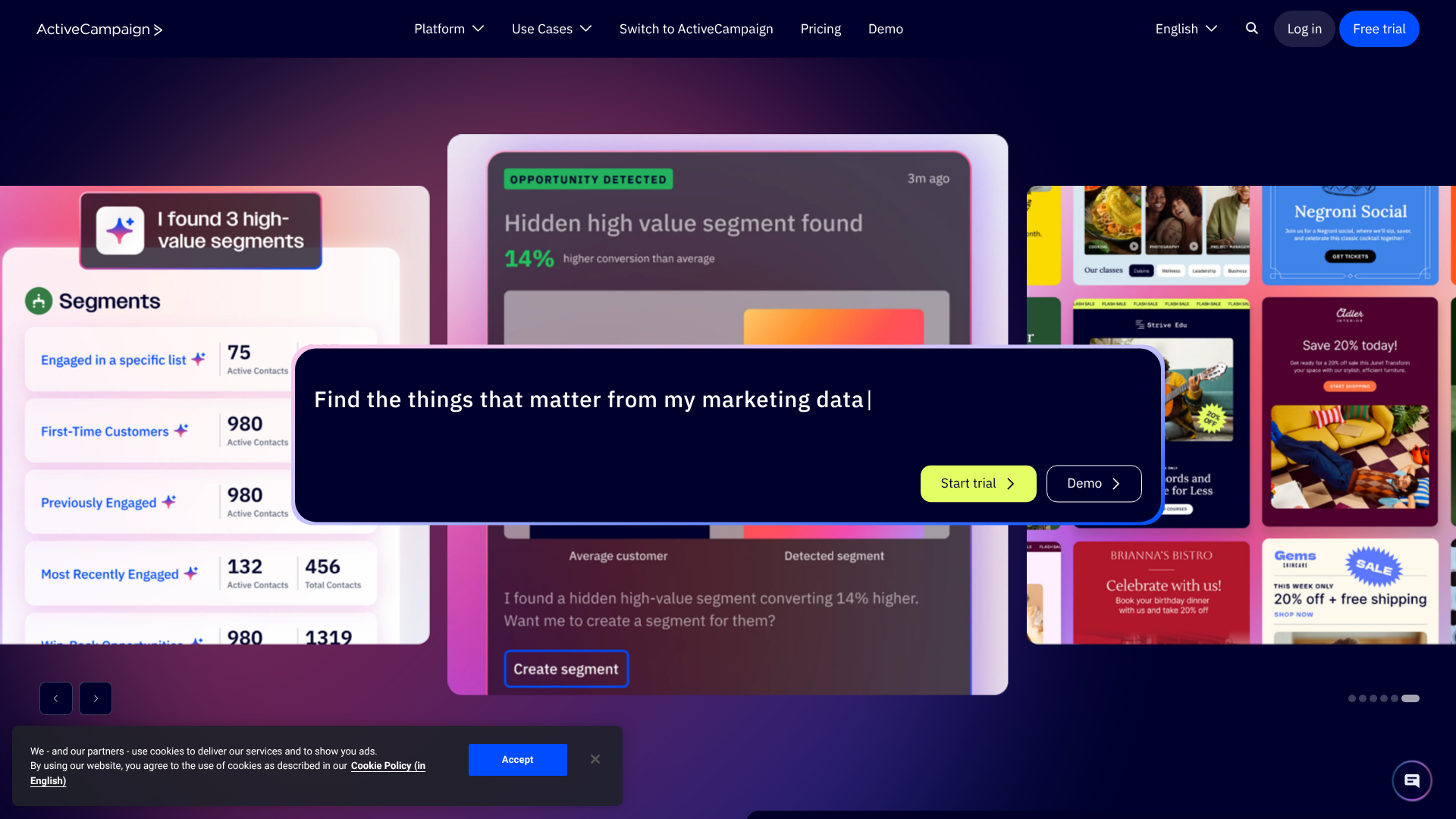
Key Timing Feature: Predictive Sending
ActiveCampaign's Predictive Sending feature uses machine learning to determine the optimal send time for each individual contact. Instead of picking one time for everyone, it analyses past engagement data and delivers your email at the precise moment each person is most likely to open it. This level of personalisation can lead to significant lifts in open rates.
Pros
- Extremely powerful and flexible automation builder.
- Advanced segmentation and personalisation capabilities.
- Predictive Sending offers true one-to-one optimisation.
- Integrates with hundreds of other business tools.
Cons
- Can have a steeper learning curve for complete beginners.
- Pricing can become expensive for businesses with very large contact lists.
Pricing: ActiveCampaign offers tiered pricing based on features and contacts. Visit their website for the latest pricing information.
2. GetResponse
GetResponse is an all-in-one marketing platform that is particularly user-friendly, making it a great choice for small to medium-sized businesses. It offers a solid set of features without being overwhelming.
Key Timing Feature: Perfect Timing
Similar to ActiveCampaign's offering, GetResponse's "Perfect Timing" feature delivers emails to subscribers based on their historical click data. It automatically sends your message at the optimal time for each contact over a 24-hour period, aiming to maximise clicks and overall engagement.
Pros
- Intuitive and easy-to-use interface.
- All-in-one solution including landing pages and webinar tools.
- The Perfect Timing feature is straightforward to implement.
- Offers a free-forever plan for new businesses.
Cons
- Automation capabilities are not as advanced as ActiveCampaign.
- Some users report deliverability can be inconsistent at times.
Pricing: GetResponse has a free tier and several paid plans. Check their official site for current pricing structures.
3. Selzy
Selzy is a simple and effective email marketing tool that focuses on core functionality, making it accessible for beginners and businesses on a budget. While it may not have AI-powered sending, it provides the essential tools needed to analyse and schedule your campaigns effectively.
Key Timing Feature: Detailed Analytics and Scheduling
Selzy provides clear, easy-to-understand reports on your campaign performance, including open rates by hour. You can use this data to manually identify your best send times and then use its reliable scheduling feature to target those windows, including scheduling by subscriber time zone.
Pros
- Very affordable pricing with a generous free plan.
- Clean and simple user interface, ideal for beginners.
- Reliable deliverability and solid core features.
- Provides the necessary analytics to make informed timing decisions.
Cons
- Lacks automated send time optimisation features.
- Fewer advanced features compared to more expensive platforms.
Pricing: Selzy is known for its competitive pricing. Visit their website to see their current plans and free trial options.
Comparison of Email Timing Features
| Feature | ActiveCampaign | GetResponse | Selzy |
|---|---|---|---|
| AI Send Time Optimisation | Yes (Predictive Sending) | Yes (Perfect Timing) | No |
| Time Zone Sending | Yes | Yes | Yes |
| A/B Testing | Advanced | Standard | Standard |
| Analytics | Deep, granular data | Comprehensive reports | Clear, essential reports |
| Best For | Automation-focused businesses | All-in-one marketing needs | Beginners & budget-conscious users |
Common Mistakes to Avoid in Email Campaign Timing
Even with the best tools and data, it's easy to fall into common traps that can undermine your email timing strategy. Being aware of these pitfalls is the first step toward avoiding them and ensuring your campaigns have the best possible chance of success.
Mistake 1: Ignoring Time Zones
This is one of the most frequent and damaging errors. If your business serves customers across the country or around the world, sending a single email blast at "10 AM" is a recipe for failure. That 10 AM email for your London audience arrives at 5 AM for your New York subscribers and 2 AM for those in Los Angeles. Always use a platform that allows for sending based on the recipient's local time zone to ensure your message arrives at a convenient hour for everyone.
Mistake 2: The 'Set It and Forget It' Approach
Finding a time that works well is great, but it's not the end of the journey. Audience behaviour changes over time. Seasons, holidays, and shifts in cultural habits can all impact when people check their email. What worked perfectly last year might be suboptimal today.
You should review your analytics quarterly and run new A/B tests periodically to ensure your strategy remains effective.
Mistake 3: Not Considering the Email's Content
The optimal time can also depend on the message itself. An email announcing a flash sale that lasts for 24 hours requires a different timing strategy than a weekly newsletter with evergreen content. Urgent, time-sensitive offers might perform better in the evening when people have time to make an immediate purchase. In-depth content like a whitepaper or case study is better suited for a mid-week morning when people are in a professional, focused mindset.
Mistake 4: Forgetting About Mobile Devices
Over half of all emails are now opened on a mobile device. Mobile users check their email at different times and in different contexts than desktop users—during their commute, while waiting in line, or in bed. This means your emails need to be mobile-optimised, and you should consider that a notification could pop up at any time. Sending an email at 11 PM might be fine for a silent inbox check, but a loud notification could be disruptive and lead to an unsubscribe.
Frequently Asked Questions (FAQ)
Navigating the nuances of email marketing often brings up specific questions about best practices and popular strategies. Here are comprehensive answers to some of the most common queries related to email marketing rules and timing.
What is the 80/20 rule in email marketing?
The 80/20 rule, also known as the Pareto Principle, suggests that 80% of your results will come from 20% of your efforts. In email marketing, this can be applied in several ways. For instance, 20% of your subscribers might generate 80% of your clicks and conversions. It also suggests that 20% of your email campaigns (your most successful ones) will likely drive 80% of your total revenue.
The key takeaway is to identify that top-performing 20%—be it subscribers, content types, or campaigns—and focus your resources on understanding and replicating that success.
What is the rule of 7 in email marketing?
The "Rule of 7" is a classic marketing principle that states a potential customer needs to see or hear a marketing message at least seven times before they take action and make a purchase. In email marketing, this highlights the importance of consistency and follow-up. A single email is rarely enough to convert a new lead. This rule encourages marketers to create automated email sequences (like a welcome series or nurture campaign) that provide multiple touchpoints, build trust over time, and keep your brand top-of-mind when the subscriber is finally ready to buy.
What are the 4 P's of email marketing?
The 4 P's are a traditional marketing mix model, adapted for email. They are Product (what you're selling, ensuring it's clearly presented in the email), Price (the cost and any discounts, which should be transparent), Place (in email, this refers to the inbox and the landing page the email links to), and Promotion (the specific offer, message, and call-to-action within the email campaign). A successful email campaign effectively balances all four elements to create a compelling and cohesive message for the subscriber.
What to avoid in email marketing?
There are several critical mistakes to avoid to maintain a healthy email list and effective campaigns. First, never buy email lists; it damages your sender reputation and violates regulations like GDPR. Avoid using misleading or spammy subject lines (e.g., "Re: Your Invoice" when it's not). Always make sure your emails are optimised for mobile devices, as that's where most opens occur.
Finally, don't forget to include a clear and easy-to-find unsubscribe link in every email; making it hard to opt-out is a sure way to get marked as spam.
Final Thoughts
Determining the best time to send email campaigns is a blend of art and science. While industry data provides a solid foundation—pointing towards mid-week days and specific time slots like 10 AM and 8 PM—the ultimate truth lies within your own audience's behaviour. The most successful email marketers treat these benchmarks not as rigid rules, but as starting points for a continuous process of testing, analysing, and refining.
Your goal should be to move from a one-size-fits-all approach to a data-driven strategy. Start by understanding your audience, analysing your past performance, and running simple A/B tests. As you grow, leveraging the powerful send-time optimisation features in platforms like ActiveCampaign or GetResponse can automate this process, delivering a personalised experience for every subscriber.
By investing time in optimising your send schedule, you can achieve significant improvements in engagement and ROI without altering your content. It's a powerful reminder that in email marketing, when you say something can be just as important as what you say.