

Semrush vs Surfer SEO: Which is Better for Content Marketers in 2026?
Choosing the right SEO tool can feel like a major decision, and when comparing Semrush vs Surfer SEO, you're looking at two of the most powerful platforms available. However, they are built to solve different problems. Semrush is a comprehensive, all-in-one marketing suite designed to manage your entire digital strategy, from keyword research to technical audits. In contrast, Surfer SEO is a highly specialised tool focused exclusively on helping you write and optimise content that ranks on Google.
- Quick Summary
- What Are Semrush and Surfer SEO? The Fundamental Difference
- What is Semrush? The All-in-One Marketing Toolkit
- What is Surfer SEO? The Content Optimisation Specialist
- Semrush vs Surfer SEO: A Side-by-Side Feature Comparison
- Content Creation & Optimisation
- Keyword Research Capabilities
- SEO Auditing & Technical SEO
- AI Writing & Content Generation
- The User Experience: Which Tool is Easier to Use?
- Pricing and Value for Money: A Cost Comparison
- Pros and Cons: The Honest Breakdown
- How to Choose: Semrush or Surfer SEO?
- Frequently Asked Questions (FAQ)
- Is Surfer SEO worth the money?
- What is the most accurate SEO tool?
- Is Semrush Russian owned?
- What is the 80/20 rule for SEO?
- Final Thoughts: The Verdict on Semrush vs Surfer SEO
This guide breaks down the key differences between them. We'll explore their features, pricing, and ideal use cases to help you determine which platform—or perhaps both—is the right fit for your goals. Understanding their core functions is the first step to making an informed choice that will directly impact your content's performance.
Quick Summary
- Core Focus: Semrush is an all-in-one SEO and digital marketing platform for broad strategy, while Surfer SEO is a specialised tool for on-page content optimisation and AI-assisted writing.
- Best for On-Page SEO: Surfer SEO offers more granular, real-time feedback for optimising individual articles, including keyword density, structure, and readability, making it the superior choice for content creation.
- Best for Overall Strategy: Semrush excels at high-level tasks like comprehensive keyword research, site-wide technical audits, backlink analysis, and in-depth competitor intelligence.
- Ideal User: Surfer SEO is built for content writers, editors, and on-page SEO specialists. Semrush is designed for marketing managers, SEO agencies, and businesses needing a complete view of their digital presence.
- The Power Combo: Many professionals don't see it as a choice of one over the other. They use Semrush for strategic research and then use Surfer SEO for content execution, creating a powerful workflow.
What Are Semrush and Surfer SEO? The Fundamental Difference
Before diving into a feature-by-feature breakdown, it's crucial to understand the core philosophy behind each tool. They aren't truly direct competitors because they serve fundamentally different primary purposes. One is a broadsword, covering a wide area; the other is a scalpel, designed for precision work.
What is Semrush? The All-in-One Marketing Toolkit
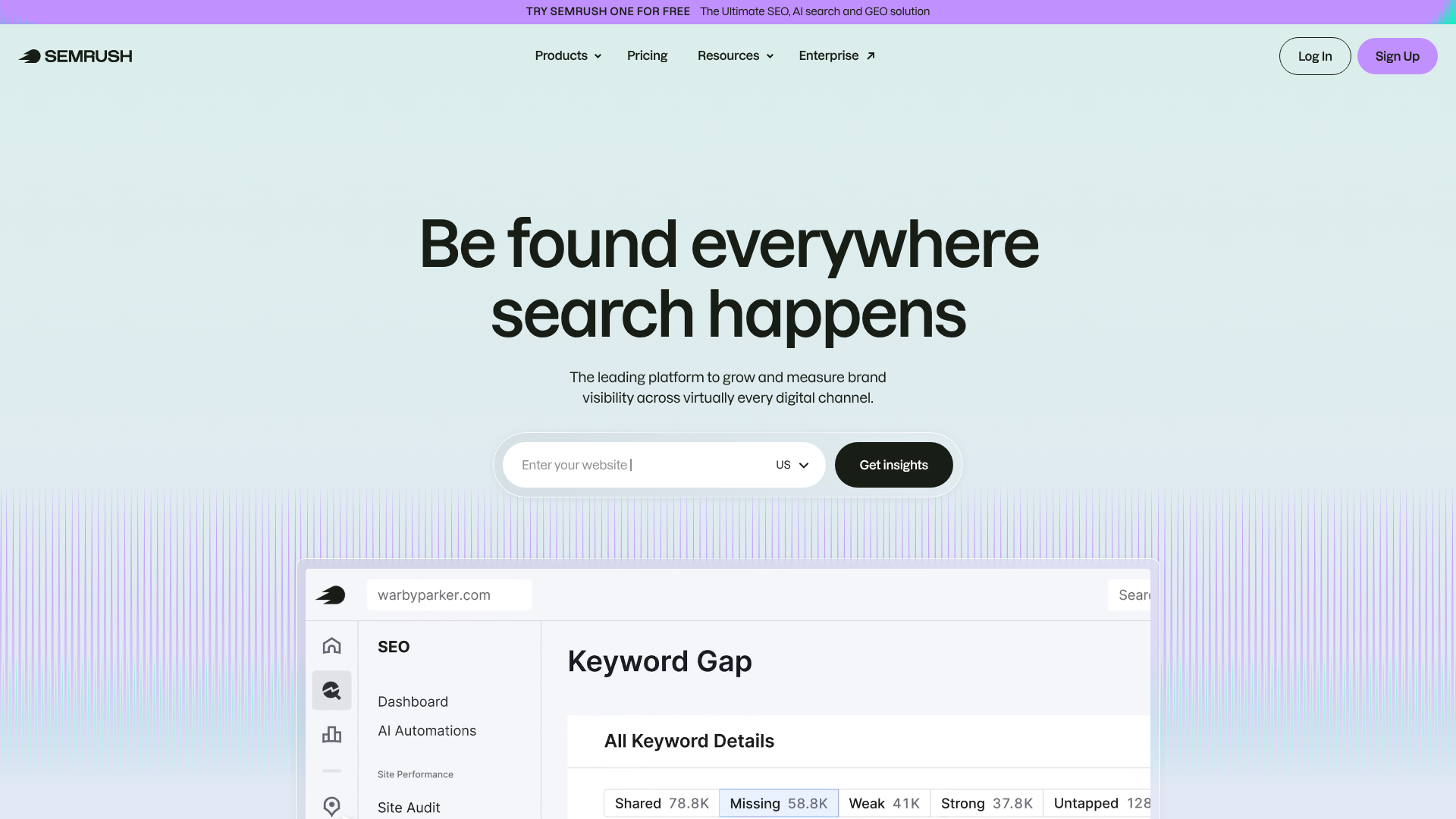
Semrush is a vast digital marketing suite that aims to be the only tool you need for your online strategy. It's a powerhouse of data, covering everything from SEO and content marketing to competitor research, PPC, and social media marketing. Think of it as the command centre for your entire digital operation.
Its primary strength lies in its breadth and depth of data. You can perform a complete technical audit of your website, uncover thousands of keyword opportunities with its Keyword Magic Tool, analyse your competitors' backlink profiles, track your keyword rankings across different locations, and even manage your social media posting schedule. It provides a 30,000-foot view of the competitive landscape, helping you make strategic decisions.
Because of its comprehensive nature, Semrush is the preferred tool for SEO agencies, in-house marketing teams, and businesses that need to manage multiple facets of their digital presence. It answers the big questions: What keywords should we target? Where are our competitors getting their traffic? What technical issues are holding our site back?
What is Surfer SEO? The Content Optimisation Specialist
Surfer SEO, on the other hand, has a much tighter focus. Its entire purpose is to help you create and optimise content that will rank for a specific target keyword. It doesn't concern itself with your site-wide technical health or your overall backlink profile. Instead, it zeroes in on the content itself.
When you enter a keyword into Surfer, it analyses the top-ranking pages in the SERPs (Search Engine Results Pages). It deconstructs what makes them successful—their word count, structure, keyword usage, number of headings, image count, and hundreds of other on-page factors. It then provides you with a data-driven blueprint and a real-time editor to guide your writing.
As you write in Surfer's Content Editor, it gives you a live "Content Score" from 0 to 100, showing how well your article is optimised compared to the competition. It suggests relevant terms to include, ideal heading structures, and optimal word counts. This makes it an invaluable tool for content writers, bloggers, and on-page SEOs who are tasked with the execution of the content strategy.
Semrush vs Surfer SEO: A Side-by-Side Feature Comparison
To understand where each tool shines, let's compare their core features directly. This highlights the specialist vs. generalist dynamic and shows where their capabilities overlap and diverge.
| Feature | Semrush | Surfer SEO | Winner |
|---|---|---|---|
| Primary Focus | All-in-one SEO & Marketing Suite | On-Page Content Optimisation | Tie (Different Goals) |
| Content Editor | SEO Writing Assistant (Good) | Content Editor (Excellent) | Surfer SEO |
| Keyword Research | Extensive, deep database | Good, focused on content clusters | Semrush |
| Site Auditing | Comprehensive, site-wide technical audits | Page-specific on-page audits | Semrush |
| Competitor Analysis | Domain-level traffic, keywords, backlinks | SERP analysis for a single keyword | Semrush |
| Backlink Analysis | In-depth backlink audit & tracking tools | None | Semrush |
| AI Writing | Integrated AI content tools | Fully integrated AI article writer | Surfer SEO |
| Ease of Use | Steep learning curve | Intuitive and user-friendly | Surfer SEO |
Content Creation & Optimisation
This is the core battleground in the semrush vs surfer debate, and it's where Surfer SEO has a distinct advantage. Surfer's Content Editor is its flagship feature. It provides a real-time, data-driven checklist based on what's already ranking. The editor gives you a constantly updated Content Score, a list of NLP-backed terms to include, suggested word counts, heading counts, and paragraph structures.
This granular feedback is designed to take the guesswork out of on-page SEO.
Semrush offers the SEO Writing Assistant. It's a useful tool that integrates with Google Docs and WordPress, providing feedback on readability, SEO, originality, and tone of voice. It suggests keywords to add and checks for over-optimisation. However, its recommendations are less detailed and not as deeply tied to a real-time SERP analysis as Surfer's.
For a writer focused purely on crafting a perfectly optimised page, Surfer's guidance is more direct and actionable.
Keyword Research Capabilities
When it comes to raw keyword data, Semrush is the undisputed leader. Its Keyword Magic Tool provides access to a database of over 25 billion keywords. You can filter by search volume, keyword difficulty, search intent (informational, commercial, etc.), and cost-per-click. It's an incredibly powerful tool for building a comprehensive content strategy from the ground up.
Surfer SEO also has a keyword research tool, but its purpose is different. It's designed to help you find topical clusters around a main seed keyword. This is excellent for planning a single pillar page and its supporting articles. However, it lacks the sheer volume of data and the advanced filtering capabilities that Semrush offers for large-scale strategic planning.
SEO Auditing & Technical SEO
This is another area where Semrush's all-in-one nature gives it a massive lead. The Semrush Site Audit tool crawls your entire website and identifies over 140 technical and on-page SEO issues. It checks for broken links, crawlability problems, missing meta tags, slow page speeds, and much more. It's essential for maintaining the overall health of your website.
Surfer's Audit feature is not a site-wide technical audit. Instead, it audits a single, specific URL against its top competitors for a target keyword. It provides on-page recommendations, such as missing keywords, internal linking opportunities, and page speed suggestions. It’s useful for optimising an existing page but doesn't replace the need for a comprehensive technical site audit tool like Semrush's.
AI Writing & Content Generation
Both platforms have embraced AI, but their implementation reflects their core philosophies. Surfer AI is deeply integrated into the content creation workflow. With a single click, it can generate a full article outline based on top competitors and then write the entire article, complete with headings and relevant terms. It's designed to accelerate content production significantly.
Semrush also has a suite of AI tools, including a content outline generator and paragraph rewriters. These tools are helpful for overcoming writer's block and generating ideas within the broader Semrush ecosystem. However, Surfer's AI is more specialised for the task of writing a complete, SEO-optimised blog post from start to finish, making it a more powerful solution for pure content generation.
The User Experience: Which Tool is Easier to Use?
When comparing surfer seo vs semrush on usability, there's a clear difference driven by their complexity. Surfer SEO is widely regarded as being more user-friendly and intuitive, especially for beginners. Its interface is clean, focused, and guides you through a clear workflow: research a keyword, open the Content Editor, and start writing. The learning curve is minimal because the tool is designed to do one thing exceptionally well.
Semrush, with its vast array of features, naturally has a steeper learning curve. A new user logging in for the first time can feel overwhelmed by the dozens of tools and reports available in the sidebar. While the interface is well-organised, mastering the platform and all its capabilities takes time and dedication. Semrush offers extensive training materials and certifications to help users get up to speed, but it's not a tool you can pick up and master in an afternoon.
This video provides a helpful overview of the differences between the two platforms:
Pricing and Value for Money: A Cost Comparison
Your budget and needs will play a significant role in your decision. Both tools are premium products, and their pricing reflects the value they provide. Pricing structures can change, so it's always best to check their official websites for the most current information.
Surfer SEO Pricing Structure
Surfer SEO's pricing is typically based on tiers that offer a certain number of "Content Editor credits" per month. Each credit allows you to analyse one keyword and create a piece of optimised content for it. Higher-tier plans offer more credits, more user seats for team collaboration, and access to features like the API and white-label reporting.
Plans are generally tailored to different user levels, from individual freelancers and small businesses to large content teams and agencies. The cost is directly tied to your content output. If you're producing a lot of articles, you'll need a higher-tier plan. For the latest details, visit the Surfer SEO pricing page.
Semrush Pricing Structure
Semrush's pricing is structured around three main plans: Pro, Guru, and Business. The tiers differ based on the number of projects you can manage, keywords you can track, pages you can crawl with the site audit, and access to more advanced features. For example, the Guru plan adds historical data and content marketing platform features.
Because Semrush covers so many areas, its price point is generally higher than Surfer's. It's positioned as an investment in your entire marketing infrastructure. For a large agency managing multiple clients or a business serious about dominating its niche, the cost is often justified by the comprehensive data and toolset.
Which Offers Better Value?
Value is subjective and depends entirely on your role. For a freelance content writer, paying for Semrush's full suite might be overkill if they only need content optimisation features. In that case, Surfer SEO offers far better value for money.
Conversely, for a marketing manager responsible for overall site performance, Surfer SEO alone is insufficient. They need the technical audit, backlink analysis, and competitor intelligence tools that Semrush provides. For them, Semrush offers superior value. The best value often comes from identifying your primary need and choosing the tool that serves it best.
Pro Tip: Before committing to an annual plan, use the free trials or monthly plans for both tools. This allows you to test their workflows and see which one integrates better with your daily tasks and provides the most actionable insights for your specific situation.
Pros and Cons: The Honest Breakdown
No tool is perfect. Understanding the strengths and weaknesses of each platform is key to making the right choice. Here’s a straightforward look at the pros and cons of both Surfer SEO and Semrush.
Surfer SEO: Pros and Cons
Pros:
Unmatched On-Page Optimisation: Its data-driven recommendations for content are the best in the industry. – Intuitive and Easy to Use: The clean interface and straightforward workflow make it accessible to everyone, regardless of technical skill. – Excellent AI Writer: Surfer AI can generate high-quality, SEO-optimised drafts in minutes, dramatically speeding up content production. – Actionable Feedback: The real-time Content Score provides clear, immediate feedback that helps writers improve their work on the fly.
Great for Collaboration: Team features make it easy to share content briefs and optimised articles with writers and editors.
Cons:
- Limited Scope: It focuses almost exclusively on on-page SEO, lacking features for technical SEO, link building, or deep competitor analysis.
- Keyword Research is Basic: While useful for content clustering, its keyword research tool can't compete with the depth of Semrush.
- Can Be Expensive for a Single Function: For those on a tight budget, it can seem like a high price for a tool that primarily optimises content.
Semrush: Pros and Cons
Pros:
A Complete Marketing Toolkit: It covers nearly every aspect of digital marketing, from SEO to PPC to social media. – Industry-Leading Data: Its keyword and backlink databases are among the largest and most reliable available. – Powerful Competitor Analysis: Provides deep insights into what your competitors are doing, where they get traffic, and which keywords they rank for. – Robust Technical SEO Audits: The Site Audit tool is essential for identifying and fixing issues that can harm your site's performance.
Highly Versatile: It can be used for a wide range of tasks, making it valuable for many different roles within a marketing team.
Cons:
- Steep Learning Curve: The sheer number of tools and reports can be overwhelming for new users.
- High Price Point: It's a significant investment, which may put it out of reach for freelancers or small businesses.
- Content Optimisation is Weaker: The SEO Writing Assistant is useful but lacks the granular, SERP-driven detail of Surfer's Content Editor.
How to Choose: Semrush or Surfer SEO?
The best choice in the semrush comparison depends entirely on your primary role and objectives. It's not about which tool is universally "better," but which tool is better for you.
Choose Surfer SEO if…
You should choose Surfer SEO if your job revolves around content creation and on-page optimisation. This includes roles like:
Content Writers and Bloggers: Your main goal is to write articles that rank. Surfer provides the exact blueprint to do so. – On-Page SEO Specialists: You are tasked with optimising new and existing content to improve its search performance.
Content Managers and Editors: You need to create data-driven content briefs and ensure your team of writers is following SEO best practices.
If your key performance indicator is organic traffic driven by high-quality content, Surfer SEO is the most direct and effective tool for the job.
Choose Semrush if…
You should choose Semrush if you have a broader responsibility for your website's overall digital marketing performance. This includes roles like:
- SEO Managers and Strategists: You need to conduct keyword research, track rankings, build a backlink strategy, and perform technical audits.
- Digital Marketing Agencies: You manage the entire SEO and marketing strategy for multiple clients and need a comprehensive tool to do so.
- Business Owners: You want a complete overview of your online presence, including your competitors' activities and new market opportunities.
If you need to make high-level strategic decisions based on a wide range of data, Semrush is the indispensable platform.
The "Both" Approach: The Ultimate SEO Workflow
Increasingly, professionals are realising that the question isn't "Semrush or Surfer?" but "How do I use Semrush and Surfer?" The most powerful workflow often involves using both tools together, leveraging each for its core strength.
- Strategy with Semrush: Use Semrush's Keyword Magic Tool to identify high-potential keywords and analyse the competitive landscape. Audit your site to ensure its technical health is sound.
- Execution with Surfer SEO: Take the keywords you found in Semrush and plug them into Surfer's Content Editor. Use its data-driven guidance to write a perfectly optimised article.
This combined approach gives you the best of both worlds: top-tier strategic data and best-in-class content execution. While it requires a larger budget, teams serious about SEO find the investment pays for itself in improved rankings and traffic.
Frequently Asked Questions (FAQ)
Here are answers to some common questions that come up when comparing these two powerful SEO tools.
Is Surfer SEO worth the money?
Yes, for the right person, Surfer SEO is absolutely worth the money. If your primary role is creating content that needs to rank on search engines, the tool can pay for itself very quickly. It removes the guesswork from on-page SEO, saves hours of manual research time, and provides a clear, actionable path to creating competitive content. The time saved and the potential increase in organic traffic make it a strong investment for content writers, bloggers, and content marketing teams.
What is the most accurate SEO tool?
No single SEO tool is 100% accurate because they all rely on their own crawlers and data-gathering methodologies to estimate metrics like search volume and keyword difficulty. However, tools like Semrush and Ahrefs are considered industry standards because they have the largest and most frequently updated databases. Accuracy is less about a single number and more about consistency. Using one primary tool like Semrush for your strategic data ensures you are making decisions based on a consistent data set.
Is Semrush Russian owned?
No, Semrush is not a Russian-owned company. It is a publicly traded American company with its headquarters in Boston, Massachusetts, USA. The company was co-founded in 2008 by Oleg Shchegolev and Dmitry Melnikov, who have Russian origins, but the company itself is globally operated and incorporated in the US. It trades on the New York Stock Exchange (NYSE) under the ticker symbol SEMR.
What is the 80/20 rule for SEO?
The 80/20 rule, also known as the Pareto Principle, suggests that 80% of your results will come from 20% of your efforts. In SEO, this means identifying the most impactful activities and focusing your resources there. For example, 20% of your pages might be driving 80% of your organic traffic. The rule encourages you to prioritise tasks like optimising these high-performing pages, targeting high-value keywords, or fixing critical technical errors that have a disproportionately large impact on your site's performance, rather than spreading your efforts thinly across hundreds of low-impact tasks.
Final Thoughts: The Verdict on Semrush vs Surfer SEO
The debate over Semrush vs Surfer SEO is best settled by understanding that they are two different types of tools designed for different stages of the SEO process. Semrush is the strategic command centre, providing the market intelligence and technical oversight needed to build a winning plan. Surfer SEO is the tactical execution tool, ensuring the content you create based on that plan is perfectly optimised to win in the SERPs.
For the content writer or on-page specialist, Surfer SEO is an indispensable part of the daily workflow. For the SEO manager or marketing agency, Semrush provides the comprehensive data needed to guide the entire digital strategy. The ultimate power move, for those with the budget, is to combine them.
If you have to choose just one, base your decision on your primary role. If your job is to write, choose Surfer. If your job is to strategise, choose Semrush. If you're looking to elevate your content creation process with data-driven insights and powerful AI, you can't go wrong with Surfer SEO.