

SEO Content Generation Explained: A Guide for Marketers to Rank Higher
Creating content that consistently ranks on Google requires more than just good writing; it demands a strategic approach to SEO content generation. This process involves understanding what your audience is searching for and creating the most valuable, comprehensive, and optimised resource to meet their needs. It's a blend of art and science, combining human creativity with data-driven insights to attract organic traffic and build authority.
- What You'll Learn
- What is SEO Content Generation? The Core Principles
- The Transformative Role of AI in SEO Content Generation
- How AI Accelerates the Content Workflow
- The "Human-in-the-Loop" Approach: Why AI Can't Do It All
- AI SEO Automation in Action
- A Step-by-Step Guide to Generate SEO Content That Ranks
- Step 1: Define Your Goals and KPIs
- Step 2: Conduct In-Depth Keyword and Topic Research
- Step 3: Create a Detailed Content Brief and Outline
- Step 4: Draft the Content (AI-Assisted or Manual)
- Step 5: Optimise, Edit, and Enhance
- Step 6: Publish and Promote
- Step 7: Monitor Performance and Refresh
- Choosing the Right SEO Content Generation Tools
- Key Features to Look For in an AI SEO Tool
- All-in-One Platforms vs. Specialised Tools
- Evaluating Free vs. Paid Options
- Top AI Tools for SEO Content Generation
- For Comprehensive SEO and Research: Semrush
- For High-Quality AI Writing: Jasper (formerly Jarvis)
- For SEO-Focused Content Workflows: Writesonic
- For Repurposing Content into Video: Pictory
- Understanding the Costs: Pricing Models Explained
- Subscription Models (SaaS)
- Pay-As-You-Go / Credit-Based
- Agency and Freelancer Costs
- Cost vs. ROI: Is It Worth the Investment?
- The Pros and Cons of Modern SEO Content Generation
- Frequently Asked Questions (FAQ)
- Can a beginner do SEO?
- Is SEO being phased out?
- How to generate SEO content?
- What is the 80/20 rule for SEO?
- Is SEO dying due to AI?
- Can SEO be self-taught?
- Final Thoughts: The Future of Content and SEO
In recent years, artificial intelligence has dramatically changed how we generate SEO content, making it possible to produce high-quality drafts at an unprecedented scale. However, the core principles remain the same: focus on the user, demonstrate expertise, and create content that is genuinely helpful. This guide breaks down the entire process, from research and planning to using AI tools effectively and measuring your success.
What You'll Learn
- A Strategic Process: SEO content generation isn't just about writing articles. It's a multi-step process that includes in-depth research, strategic planning, quality creation, and continuous optimisation to align with search engine algorithms and user intent.
- AI as an Accelerator: Artificial intelligence tools can significantly speed up the content workflow, from generating ideas and outlines to drafting entire articles. However, they are most effective when used as an assistant, not a replacement for human expertise.
- The Importance of E-E-A-T: Google prioritises content that demonstrates Experience, Expertise, Authoritativeness, and Trustworthiness (E-E-A-T). Human oversight is critical to inject these qualities, ensuring content is accurate, authentic, and valuable.
- Measuring Success: The effectiveness of your content SEO strategy is measured by tangible metrics. Key performance indicators (KPIs) include organic traffic growth, keyword ranking improvements, click-through rates, and ultimately, conversions.
What is SEO Content Generation? The Core Principles
SEO content generation is the strategic process of planning, creating, and optimising content with the primary goal of ranking high in search engine results pages (SERPs). It moves beyond simply writing about a topic; it involves a deliberate framework designed to satisfy both search engine crawlers and, more importantly, human readers. A successful strategy is built on a deep understanding of your audience and the algorithms that connect them to your content.
At its heart, this process is about creating the single best answer on the internet for a specific query. It requires a foundational understanding of several key principles that work together to signal quality and relevance to search engines like Google.
Beyond Keywords: Understanding User Intent
Keywords are the starting point, but true success in content SEO comes from understanding the intent behind them. User intent is the 'why' behind a search query. Every time someone types something into Google, they have a specific goal in mind. Your content must align perfectly with that goal.
There are four primary types of user intent:
- Informational: The user is looking for information. Examples include "what is content marketing?" or "how to bake a cake". The goal is to provide comprehensive, clear, and accurate answers.
- Navigational: The user wants to find a specific website or page. For example, searching for "Facebook login" or "YouTube". These are generally not targets for content strategy unless it's your brand name.
- Commercial: The user is researching before making a purchase. They are comparing options and looking for reviews. Queries might include "best running shoes for beginners" or "Semrush vs Ahrefs".
- Transactional: The user is ready to buy or take a specific action. Searches like "buy iPhone 15" or "Grammarly premium discount" signal this intent. Product pages and landing pages are designed for this.
The Four Pillars of Modern Content SEO

To build a robust strategy, you need to focus on four foundational pillars. These elements work in concert to create content that is discoverable, authoritative, and valuable.
- Strategic Research: This is the bedrock of any successful campaign. It involves comprehensive keyword research to identify what your audience is searching for, analysing the search volume, and assessing the competition. Tools like Semrush are invaluable here, helping you uncover not just primary keywords but also long-tail variations and related questions that reveal user intent more deeply.
- Topical Authority: Search engines favour websites that demonstrate deep expertise in a specific niche. Instead of writing random articles, you should build topical authority through 'topic clusters'. This involves creating a central 'pillar page' on a broad topic (e.g., "Digital Marketing") and linking out to more specific 'cluster content' (e.g., "SEO Basics," "Email Marketing Strategies," "Social Media Advertising"). This structure signals to Google that you are an authority on the subject.
- High-Quality Creation (E-E-A-T): Google's ranking systems are designed to reward helpful, reliable content. This is where E-E-A-T (Experience, Expertise, Authoritativeness, Trustworthiness) comes in. Your content must be accurate, well-written, and demonstrate first-hand knowledge where appropriate. This means citing sources, showcasing author credentials, and providing unique insights that go beyond regurgitating information from other sites.
- On-Page Optimisation: This involves structuring your content so that search engines can easily understand and index it. Key elements include using your target keyword in the title tag, meta description, and H1 heading. It also involves using descriptive subheadings (H2s, H3s), optimising images with alt text, and creating a strong internal linking structure that guides users and search crawlers through your site.
The Transformative Role of AI in SEO Content Generation
Artificial intelligence has fundamentally shifted the landscape of SEO writing. What once took days or weeks of manual effort—researching, outlining, and drafting—can now be accomplished in a fraction of the time. AI tools act as powerful assistants, streamlining workflows and enabling content creators to operate at a scale previously unimaginable.
However, the rise of AI doesn't mean human strategy is obsolete. In fact, it's more important than ever. The most successful content teams are those that use AI to handle the heavy lifting while focusing their energy on the strategic elements that AI cannot replicate: unique insights, genuine experience, and creative storytelling.
How AI Accelerates the Content Workflow
AI tools can intervene at nearly every stage of the content creation process to boost efficiency. It starts with ideation, where AI can analyse competitor content and generate hundreds of potential blog topics based on a single keyword. From there, it can create a detailed, SEO-optimised outline in seconds, complete with headings, subheadings, and relevant questions to answer.
When it comes to drafting, AI writers like Jasper or Writesonic can produce a full-length article based on your outline. This first draft serves as a solid foundation, saving countless hours of writing from a blank page. AI can also assist with optimising existing content, suggesting keywords to add, improving readability, and even generating meta descriptions and social media posts.
The "Human-in-the-Loop" Approach: Why AI Can't Do It All
Despite its power, AI is not a magic bullet for SEO success. Google's official stance is that it rewards high-quality content, regardless of how it's produced. The catch is that AI, on its own, often struggles to produce content that meets the high standards of E-E-A-T.
This is why a 'human-in-the-loop' approach is essential. An AI-generated draft must be meticulously reviewed, edited, and enhanced by a human expert. This involves:
- Fact-Checking: AI models can 'hallucinate' or present outdated information as fact. Every claim must be verified.
- Adding Unique Insights: AI can summarise what's already on the internet, but it can't share your personal experiences, case studies, or unique perspective. This is your competitive advantage.
- Ensuring Brand Voice: The content needs to be edited to match your brand's specific tone and style.
- Improving Readability and Flow: AI writing can sometimes be repetitive or clunky. A human editor ensures the final piece is engaging and easy to read.
AI SEO Automation in Action
Modern SEO is moving towards agentic workflows, where AI agents can automate entire sequences of tasks, from research to publishing. The video below provides a fascinating look at how an AI SEO automation system can be built to rank on both Google and generative search engines.
A Step-by-Step Guide to Generate SEO Content That Ranks
Creating high-performing SEO content is a systematic process. By following a structured workflow, you can ensure that every piece of content you publish has the best possible chance of ranking and driving organic traffic. This seven-step guide breaks down the entire journey from initial concept to post-publication analysis.
Step 1: Define Your Goals and KPIs
Before you write a single word, you must know what you want to achieve. Is the primary goal to increase brand awareness, generate leads, drive sales, or educate your audience? Your goal will dictate the type of content you create and the call-to-action you use.
Once your goal is set, define the Key Performance Indicators (KPIs) you'll use to measure success. These might include:
- Organic traffic
- Keyword rankings
- Click-through rate (CTR)
- Time on page
- Conversion rate (e.g., form submissions, downloads, purchases)
Step 2: Conduct In-Depth Keyword and Topic Research
This is the most critical phase. Your goal is to find topics that your target audience is actively searching for and that you can realistically rank for. Use a comprehensive SEO tool like Semrush to identify keywords with a good balance of search volume and low competition.
Don't just look at single keywords. Analyse the entire search results page for your target query to understand the user intent. What kind of content is ranking. Are they blog posts, videos, or product pages.
What questions are being answered in the 'People Also Ask' section. This analysis will inform the angle and structure of your content.
Step 3: Create a Detailed Content Brief and Outline
A content brief is a blueprint for your article. It ensures that the writer (whether human or AI) understands the exact requirements for the piece. A good brief includes:
- The primary target keyword and secondary keywords.
- The target audience and their pain points.
- The user intent to address.
- A proposed title and meta description.
- A detailed outline with H2 and H3 headings.
- Key topics and questions to cover.
- Internal and external linking suggestions.
Step 4: Draft the Content (AI-Assisted or Manual)
With your brief in hand, it's time to start writing. You can write the content manually or use an AI writing tool like Jasper to generate a first draft. Using AI is often more efficient, as it provides a strong foundation that you can then build upon.
Feed your detailed outline into the AI tool to guide its output. The more specific your instructions, the better the initial draft will be. The goal here is not to create a final, publishable piece, but to get the core ideas and structure down quickly.
Step 5: Optimise, Edit, and Enhance
This is where human expertise transforms a generic draft into a high-ranking asset. Review the AI-generated text for accuracy, clarity, and tone. Rewrite sections to add your unique voice, personal experiences, and expert insights. This is how you inject the crucial E-E-A-T signals.
Use an editing tool like Grammarly to catch spelling and grammar errors. Add visuals like images, infographics, and videos to break up the text and make it more engaging. Ensure your on-page SEO elements are perfectly optimised.
Pro Tip: Read your final article out loud. This simple trick helps you catch awkward phrasing and sentences that don't flow naturally, ensuring a better reading experience for your audience.
Step 6: Publish and Promote
Once the content is polished, hit publish. But your job isn't done. To get initial traction, promote your new content across relevant channels. Share it on your social media profiles, send it to your email newsletter subscribers, and consider reaching out to other websites for backlinks.
Step 7: Monitor Performance and Refresh
SEO is not a 'set it and forget it' activity. Regularly monitor your content's performance using Google Analytics and Google Search Console. Track your KPIs to see what's working and what isn't.
Content can become outdated over time. Schedule periodic reviews to refresh and update your top-performing articles with new information, statistics, and examples. This keeps your content relevant and helps maintain its rankings.
Choosing the Right SEO Content Generation Tools

Navigating the market for SEO and AI writing tools can be overwhelming. There are dozens of options available, each with its own set of features and pricing models. Choosing the right tool depends on your specific needs, budget, and workflow. The key is to find a solution that not only helps you create content but also aligns with your strategic goals.
Key Features to Look For in an AI SEO Tool
When evaluating different platforms, there are several core features that provide the most value for content SEO. Look for tools that offer:
- SERP Analysis: The ability to analyse the top-ranking pages for a target keyword to understand what's already working.
- Content Grading: A real-time score that measures how well your content is optimised for your target keyword compared to competitors.
- NLP Term Suggestions: Recommendations for related keywords and semantic terms to include in your content to improve its topical relevance.
- AI-Powered Outlining and Drafting: Features that can quickly generate structured outlines and first drafts based on your research.
- Plagiarism Checker: An integrated tool to ensure your final content is original and unique.
All-in-One Platforms vs. Specialised Tools
SEO content tools generally fall into two categories. All-in-one platforms like Semrush offer a wide suite of features covering everything from keyword research and site audits to content optimisation and rank tracking. These are great for teams who want a single source of truth for their entire SEO strategy.
On the other hand, specialised tools focus on doing one thing exceptionally well. For example, Jasper is a dedicated AI writer known for its high-quality output and brand voice features. Grammarly is purely focused on editing and proofreading. The best approach often involves creating a 'stack' of specialised tools that integrate well together.
Evaluating Free vs. Paid Options
Many tools offer free versions or trials, which are excellent for testing the platform's capabilities. Free tools are often sufficient for beginners or those with very small-scale needs. However, they typically come with limitations on usage, such as a cap on the number of keywords you can track or the number of words you can generate per month.
Paid plans unlock advanced features, higher usage limits, and better support. Investing in a paid tool is usually necessary for any business serious about scaling its content marketing efforts. The return on investment comes from the time saved and the improved performance of your content.
Top AI Tools for SEO Content Generation
Selecting the right tools can make a significant difference in the efficiency and effectiveness of your content strategy. Here are some of the top recommendations, each excelling in a specific area of the SEO content generation process.
For Comprehensive SEO and Research: Semrush

Semrush is more than just a content tool; it's a complete digital marketing platform. Its strength lies in its powerful research capabilities. You can conduct deep keyword research, analyse competitors' backlink profiles, and audit your site for technical SEO issues. Its 'Topic Research Tool' is particularly useful for building out topic clusters and establishing authority.
Pros
- Extensive suite of over 50 tools covering all aspects of SEO.
- Provides robust competitor analysis and market research data.
- The SEO Writing Assistant gives real-time feedback on content optimisation.
Cons
- Can be expensive, especially for small businesses or freelancers.
- The sheer number of features can have a steep learning curve for new users.
For High-Quality AI Writing: Jasper (formerly Jarvis)

Jasper has established itself as a leader in the AI writing space, known for producing content that is often more nuanced and human-like than its competitors. It offers a wide range of templates for different content formats and includes a 'Brand Voice' feature that allows you to train the AI on your specific style and tone. It's an excellent choice for teams that prioritise content quality and brand consistency.
Pros
- Generates high-quality, natural-sounding copy.
- 'Brand Voice' feature helps maintain consistency across all content.
- Offers strong collaboration features for teams.
Cons
- Primarily a writing tool; lacks the deep SEO analytics of platforms like Semrush.
- Pricing can be high for users who need to generate a large volume of content.
For SEO-Focused Content Workflows: Writesonic
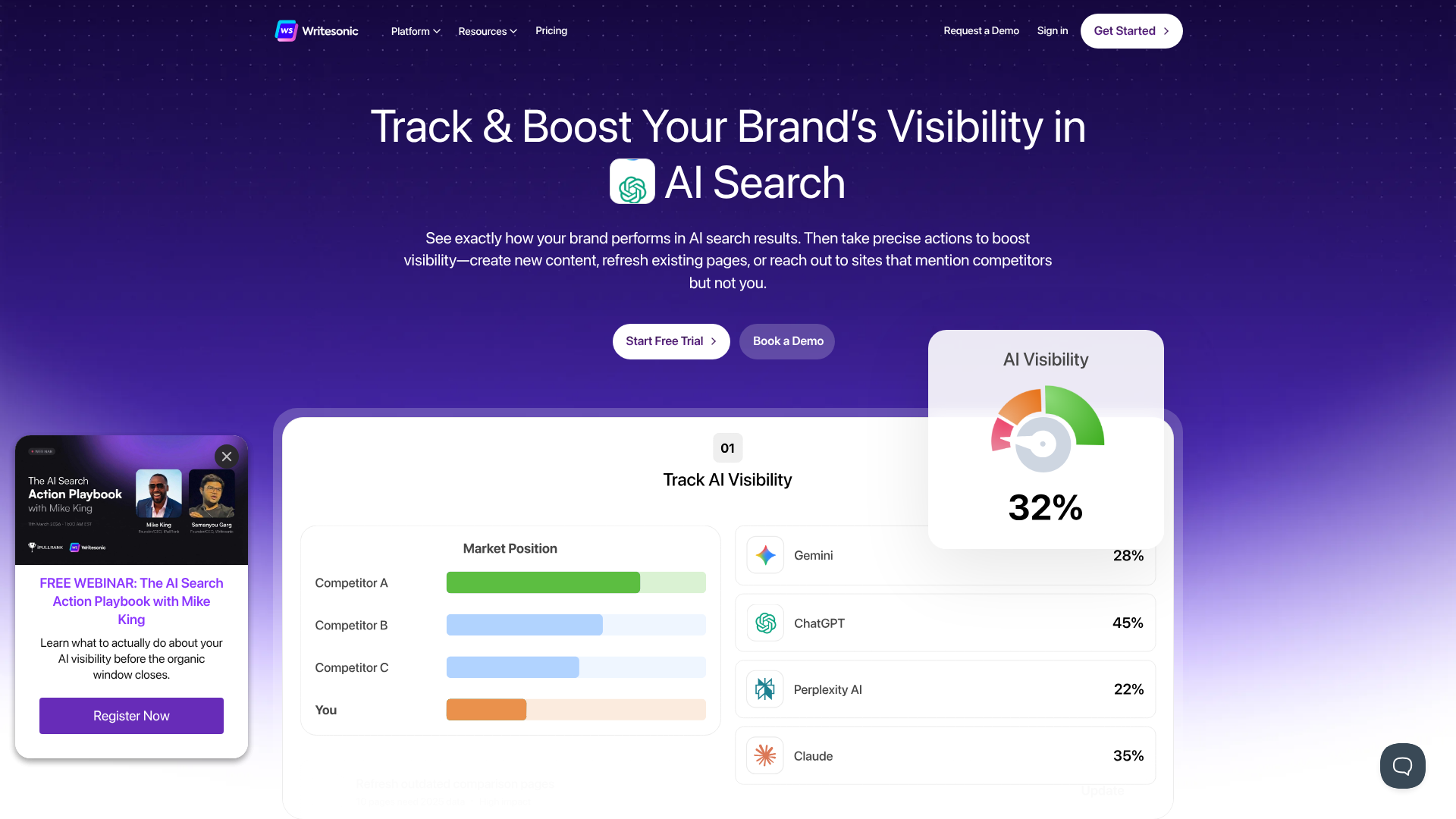
Writesonic is designed specifically with SEO writers in mind. It offers a streamlined workflow that takes you from keyword to fully optimised article. Its 'AI Article Writer 5.0' can generate factual, up-to-date articles by referencing real-time Google search data. It also integrates directly with Surfer SEO, allowing you to optimise your content as you write.
Pros
- Features are tailored specifically for creating SEO content.
- Ability to generate factually accurate articles based on current data.
- Generally more affordable than some of its direct competitors.
Cons
- The user interface can sometimes feel less polished than other platforms.
- Output quality can vary and may require more editing for complex topics.
For Repurposing Content into Video: Pictory

Content SEO isn't just about text. Repurposing your blog posts into videos can significantly expand your reach and provide valuable SEO signals. Pictory is an AI-powered tool that makes this incredibly easy. You can simply paste your article's URL, and Pictory will automatically create a video, complete with stock footage, captions, and an AI-generated voiceover.
It's a powerful way to get more value from every piece of content you create.
Pros
- Quickly transforms long-form text into engaging videos.
- Massive library of stock images, videos, and music.
- Intuitive and easy to use, even for non-video editors.
Cons
- AI voiceovers can sometimes sound robotic, though quality is improving.
- Less customisation available compared to traditional video editing software.
Understanding the Costs: Pricing Models Explained
The investment required for SEO content generation tools can vary widely, from free plans to enterprise-level subscriptions costing thousands of pounds per month. Understanding the different pricing structures is key to finding a solution that fits your budget and provides a positive return on investment.
Subscription Models (SaaS)
This is the most common pricing structure. You pay a recurring monthly or annual fee for access to the platform. Plans are typically tiered, with higher-priced tiers offering more features, higher usage limits (e.g., more keywords to track or words to generate), and more user seats for team collaboration. Annual subscriptions often come with a discount.
Pay-As-You-Go / Credit-Based
Some AI writing tools operate on a credit-based system. You purchase a number of credits, and each word or piece of content generated consumes a certain amount of credits. This model can be cost-effective for users who have inconsistent content needs and don't want to commit to a monthly subscription.
Agency and Freelancer Costs
Another cost to consider is hiring human talent. You might use tools in-house, or you could outsource your content creation to a freelance SEO writer or a digital marketing agency. Freelancer rates can range from £50 to over £500 per article, depending on their experience and the complexity of the topic. Agency retainers typically start in the low thousands per month.
Pro Tip: When comparing costs, think about value, not just price. A more expensive tool that saves your team 10 hours per week might offer a much better ROI than a cheaper tool that requires extensive manual work.
Cost vs. ROI: Is It Worth the Investment?
While the costs can seem significant, it's important to frame them as an investment in a long-term marketing asset. A single well-ranking blog post can generate organic traffic, leads, and sales for years to come, often paying for the initial investment many times over. Unlike paid advertising, where traffic stops when you stop paying, organic traffic from SEO content is sustainable.
The Pros and Cons of Modern SEO Content Generation
The integration of AI into the content creation process has brought about significant advantages, but it's not without its challenges and risks. A balanced perspective is crucial for leveraging these technologies effectively while avoiding the potential pitfalls.
Advantages
- Speed and Scale: The most obvious benefit is the ability to produce content at a much faster rate. This allows businesses to maintain a consistent publishing schedule and cover a wider range of topics, which can accelerate the process of building topical authority.
- Data-Driven Insights: SEO tools analyse vast amounts of data from search engines, providing insights on keywords, competitor strategies, and content structure that would be nearly impossible for a human to gather manually.
- Consistency: AI can help maintain a consistent tone and style across all content, which is especially beneficial for large teams with multiple writers. It also helps enforce SEO best practices consistently.
- Cost-Effectiveness: For many businesses, investing in AI tools can be more cost-effective than hiring a large in-house content team or outsourcing to an expensive agency, especially when producing content at scale.
Disadvantages and Risks
- Risk of Generic Content: Without careful human guidance and editing, AI-generated content can be bland, generic, and lack a unique point of view. It can easily become a rehash of what's already ranking, failing to provide new value to the reader.
- Factual Inaccuracies: AI models are not infallible and can generate incorrect information or 'hallucinate' facts and sources. Relying on AI without rigorous fact-checking can damage your brand's credibility.
- Lack of True Experience (E-E-A-T): This is the biggest challenge. AI cannot replicate genuine, first-hand human experience. For topics where personal experience is crucial, AI-generated content will always fall short unless heavily supplemented by a human expert.
- Over-reliance on Tools: There's a risk of becoming too dependent on tools and forgetting the fundamentals of good marketing: understanding your customer, telling compelling stories, and building a genuine connection with your audience.
Frequently Asked Questions (FAQ)
Can a beginner do SEO?
Yes, a beginner can absolutely learn and implement the basics of SEO. The fundamentals, such as keyword research, on-page optimisation, and creating high-quality content, are accessible to everyone. There are countless free resources, including guides from Google itself, that can help you get started. While advanced SEO can become highly technical, beginners can achieve significant results by focusing on creating helpful, user-centric content.
Is SEO being phased out?
No, SEO is not being phased out; it's evolving. The rise of AI and generative search experiences like Google's AI Overviews is changing how users find information, but the core need for SEO remains. Businesses still need to create high-quality, authoritative content that can be surfaced by these new systems. The tactics may change, but the strategy of being the most relevant answer to a user's query is more important than ever.
How to generate SEO content?
Generating SEO content involves a structured process: 1) Define your goals and target audience. 2) Conduct keyword and topic research to understand user intent. 3) Create a detailed content brief and outline. 4) Draft the content, often with the help of AI tools.
- Meticulously edit, enhance, and optimise the draft with human expertise. 6) Publish and promote the content. 7) Monitor its performance and update it over time.
What is the 80/20 rule for SEO?
The 80/20 rule, or Pareto Principle, suggests that 80% of your results often come from 20% of your efforts. In SEO, this can mean that a small number of your pages (your top 20%) will likely generate the vast majority (80%) of your organic traffic. It highlights the importance of identifying your most valuable pages and keywords and focusing your optimisation efforts there, rather than spreading yourself too thin across less impactful activities.
Is SEO dying due to AI?
SEO is not dying because of AI; it's being transformed by it. AI is becoming an integral part of SEO, from the tools we use to the search engines themselves. AI helps SEO professionals work more efficiently and make more data-driven decisions. Instead of replacing SEO, AI is augmenting it, making the field more dynamic and strategic.
The professionals who adapt and learn to use AI effectively will be the most successful.
Can SEO be self-taught?
Absolutely. SEO is a skill that can be entirely self-taught, and many of the world's top SEO experts started this way. The key is a commitment to continuous learning, as the field is always changing. Start by reading reputable blogs, taking online courses, and, most importantly, experimenting.
Create your own website or blog and use it as a testing ground to apply what you learn. Practical experience is the best teacher in SEO.
Final Thoughts: The Future of Content and SEO
SEO content generation has evolved from a simple keyword-focused task into a sophisticated discipline that sits at the intersection of technology, psychology, and creativity. The rise of AI has not made SEO obsolete; it has raised the stakes. In a world where anyone can generate mediocre content instantly, the value of high-quality, authoritative, and genuinely helpful content created with human expertise has never been higher.
The future of content SEO belongs to those who can master the hybrid approach—using AI for speed and scale while leveraging human strategy and experience to create value that machines cannot replicate. The goal is no longer just to rank on a list of blue links but to become the trusted, authoritative source that both users and search engines rely on.
If you're looking to streamline your workflow, consider exploring tools that can help with different parts of the process. A platform like Semrush is excellent for handling the initial research and ongoing analysis, while a dedicated AI writer like Jasper can significantly accelerate your drafting phase. By combining the right tools with a sound strategy, you can create a powerful content engine that drives sustainable organic growth for years to come.