




How to Master Blog Content Generation: A Step-by-Step Guide for Marketers
Creating high-quality blog posts consistently can feel like a relentless task. The pressure to research, write, edit, and publish engaging articles is immense. Modern blog content generation offers a powerful solution, blending human strategy with the efficiency of artificial intelligence to scale your efforts without sacrificing quality. This approach isn't about replacing writers; it's about empowering them with tools to overcome writer's block, accelerate drafting, and focus on what truly matters: creating value for the reader.
- What You'll Learn
- What Exactly is Blog Content Generation?
- The Core Benefits of Using AI for Article Generation
- A Step-by-Step Guide to Modern Blog Writing
- Step 1: Ideation and Keyword Research
- Step 2: Creating a Detailed, SEO-Informed Outline
- Step 3: Drafting the Content with AI Assistance
- Step 4: The Crucial Human Touch: Editing and Fact-Checking
- Step 5: Enhancing Content with Visuals and Multimedia
- Choosing the Right Blog Content Generation Tools
- Top AI Writing Tools for Efficient Content Creation
- 1. Jasper (formerly Jarvis): Best for Versatility and Quality
- 2. Writesonic: Best for All-in-One Content Marketing
- 3. QuillBot: Best for Editing and Paraphrasing
- Understanding Pricing and Cost-Effectiveness
- The Pros and Cons of AI-Powered Blog Writing
- Frequently Asked Questions about Blog Content Generation
- How do you generate blog content automatically?
- Can AI write a full blog post?
- Is AI-generated content good for SEO?
- What is the best AI tool for blog writing?
- Final Thoughts: The Future of Content Creation
This guide breaks down the entire process, from initial idea to final publication. You'll learn how to build a sustainable workflow, choose the right tools for your needs, and use AI as a creative partner. By mastering this hybrid approach, you can produce better content, faster, and drive meaningful results for your business.
What You'll Learn
- A Hybrid Workflow: The most effective blog content generation process combines AI for speed in drafting and outlining with essential human oversight for quality, voice, and fact-checking.
- Strategic Tool Selection: Choosing the right AI writing assistant depends on your specific needs, from all-in-one platforms for marketing teams to specialised tools for editing and rephrasing.
- The Importance of the Human Touch: AI-generated drafts are a starting point. The real value comes from human editing, adding personal insights, and ensuring the content meets E-E-A-T (Experience, Expertise, Authoritativeness, Trustworthiness) standards.
- Beyond Writing: Successful content creation involves a full lifecycle, including SEO research, visual enhancement, and promotion, all of which can be streamlined with the right software.
What Exactly is Blog Content Generation?
Blog content generation is the end-to-end process of creating and publishing articles for a blog. It encompasses much more than just putting words on a page. A complete content workflow involves several distinct stages: brainstorming ideas, conducting keyword and topic research, structuring an outline, drafting the article, editing for clarity and tone, optimising for search engines (SEO), adding visuals, and finally, publishing and promoting the post.
Traditionally, this entire process was manual, relying solely on the creativity and time of human writers and marketers. The modern approach, however, integrates technology—specifically AI—to augment and accelerate many of these stages. For example, AI can generate hundreds of topic ideas in minutes, create a detailed article outline based on top-ranking competitors, and produce a first draft in a fraction of the time it would take a human.
This evolution doesn't remove the need for human skill. Instead, it shifts the focus from tedious manual tasks to high-level strategy and refinement. The goal of modern content creation remains the same: to produce valuable, engaging, and well-optimised articles that attract and retain a target audience. The difference lies in the tools and methods used to achieve that goal more efficiently.

The Core Benefits of Using AI for Article Generation
Integrating AI into your blog writing process offers significant advantages that can transform your content strategy. It's not just about speed; it's about building a more sustainable and scalable content engine.
One of the most immediate benefits is overcoming writer's block. Staring at a blank page can be daunting, but AI tools can provide instant inspiration. By inputting a simple topic or keyword, you can generate outlines, opening paragraphs, or a list of questions to answer, giving you a solid foundation to build upon.
Efficiency is another major advantage. AI can produce a 1,500-word first draft in minutes, a task that could take a human writer several hours. This frees up valuable time for writers and marketers to focus on more strategic activities like in-depth research, interviewing experts, adding unique perspectives, and crafting a compelling narrative. This acceleration allows for a significant increase in content output without a corresponding increase in team size or budget.
Finally, many modern platforms for article generation come with built-in SEO features. Tools like Semrush offer comprehensive keyword research and content optimisation suggestions, while AI writers often integrate these capabilities directly. This helps ensure that the content you create is not only well-written but also has a strong chance of ranking in search engine results, driving organic traffic to your site.
A Step-by-Step Guide to Modern Blog Writing
Adopting an AI-assisted workflow for blog writing requires a structured approach. Simply telling an AI to "write a blog post" won't yield high-quality results. Follow these steps to create a repeatable process that balances automation with human expertise.
https://www.youtube.com/watch?v=EkuUxIPN2vg
Step 1: Ideation and Keyword Research
Every great blog post starts with a solid idea that resonates with your target audience and aligns with your business goals. Begin by brainstorming broad topics relevant to your niche. Then, use SEO tools to validate these ideas and uncover specific keywords your audience is searching for.
Tools like HubSpot's free Blog Ideas Generator can provide initial inspiration. For a deeper analysis, a platform like Semrush is invaluable. It allows you to analyse keyword difficulty, search volume, and competitor strategies, helping you identify topics where you have a realistic chance to rank and attract traffic.
Step 2: Creating a Detailed, SEO-Informed Outline
An outline is the blueprint for your article. A well-structured outline ensures logical flow, comprehensive coverage of the topic, and proper integration of target keywords. This is a stage where AI can be incredibly helpful. Most advanced AI writers can generate a detailed outline based on your target keyword and title.
These AI-generated outlines often analyse the top-ranking articles for your keyword to suggest headings and subheadings (H2s and H3s) that search engines expect to see. You should then review and refine this outline, adding your unique angle, incorporating specific data points you want to include, and ensuring it tells a coherent story.
Step 3: Drafting the Content with AI Assistance
With a solid outline in place, you can now generate the first draft. Use your AI writing tool, such as Jasper or Writesonic, to flesh out each section of your outline. Instead of generating the entire article at once, work section by section. This gives you more control over the output and allows you to guide the AI more effectively.
Provide clear instructions and context for each section. For example, you might ask the AI to "Write an introduction that explains the problem of inconsistent blog publishing and introduces the solution of an AI-assisted workflow." The quality of your input (the prompt) directly influences the quality of the output.
Step 4: The Crucial Human Touch: Editing and Fact-Checking
This is the most critical step in the process. An AI-generated draft is never ready to publish. You must thoroughly review and edit the content to add your brand's unique voice, verify all facts and statistics, and inject personal experience and anecdotes. AI can't replicate genuine expertise or firsthand stories, which are essential for building trust with your audience.
During this stage, use tools like Grammarly to catch spelling and grammar errors. For sentences that sound robotic or awkward, a paraphrasing tool like QuillBot can help you rephrase them into more natural-sounding language. The goal is to transform the AI draft into a piece of content that is uniquely yours and provides genuine value.
Pro Tip: Read your edited article out loud. This simple technique helps you catch awkward phrasing, unnatural sentences, and sections where the tone feels off. If it doesn't sound like something a human would say, it needs more refinement.
Step 5: Enhancing Content with Visuals and Multimedia
Text-only articles are less engaging than those enriched with visuals. Break up your content with relevant images, infographics, charts, and videos. This not only improves readability but also helps to illustrate complex concepts and keep your audience engaged.
You can even use AI to help with this step. AI image generators can create custom illustrations for your blog. For more dynamic content, tools like Pictory can automatically create short videos from your article text, perfect for sharing on social media. For explainer content, platforms like Synthesia allow you to create professional-looking videos with AI avatars, saving you the time and cost of a traditional video shoot.
Choosing the Right Blog Content Generation Tools

With a growing market of AI writing assistants, selecting the right one can be overwhelming. The best tool for you depends on your budget, team size, technical needs, and the type of content you produce. Focus on a few key areas to make an informed decision.
Key Features to Look For
When evaluating different platforms, prioritise features that align with your workflow. High-quality output is paramount; the AI should be able to generate coherent, well-structured, and grammatically correct text. Look for tools that offer different tones of voice and allow you to create custom templates or brand voice profiles.
SEO integration is another crucial feature. The best tools don't just write; they help you write content that ranks. This can include features like keyword suggestions, content optimisation scores, and competitor analysis. A built-in plagiarism checker is also essential to ensure the originality of your content.
Finally, consider the variety of content formats the tool can produce. While your focus might be on blog writing, a versatile tool that can also handle social media copy, email newsletters, and ad headlines provides much greater value for your investment.
Factors to Consider
Your budget is an obvious starting point. AI writing tools range from affordable monthly subscriptions to more expensive enterprise-level plans. Consider the return on investment—if a tool saves your team 20 hours a month, its cost can be easily justified. Many platforms offer free trials or freemium plans, allowing you to test their capabilities before committing.
Think about your team's needs. Are you a solo blogger or part of a large marketing team? Some tools are designed for individual users, while others offer collaboration features, user roles, and project management capabilities. Ease of use is also important; a tool with a steep learning curve can slow down adoption and reduce its overall effectiveness.
Lastly, check for integrations. A tool that connects with your existing software, such as WordPress, Google Docs, or SEO platforms like Semrush, will create a more efficient and streamlined content creation process.
Top AI Writing Tools for Efficient Content Creation
Navigating the landscape of AI writing tools can be tricky. To simplify your search, here are three top recommendations that cater to different needs within the blog content generation process.
1. Jasper (formerly Jarvis): Best for Versatility and Quality
-4b0cf320-5c62-4d8b-9db1-b1357ebad825-1773134240535-5fliox.png "How to Master Blog Content Generation: A Step-by-Step Guide for Marketers 4")
Jasper is one of the most well-known and respected names in AI writing. It excels at producing high-quality, long-form content, making it a favourite among bloggers, content marketers, and SEO professionals. Its 'Boss Mode' feature allows for a highly interactive writing experience, where you can command the AI with natural language to write, rewrite, or expand upon your text.
Jasper offers a vast library of templates for various content types, from blog post outlines to video scripts. Its Brand Voice feature lets you upload documents or provide a URL to teach the AI your specific style and tone, ensuring greater consistency across all generated content.
Pros
- Excellent Output Quality: Consistently generates well-written, coherent, and contextually relevant content.
- Powerful Long-Form Editor: 'Boss Mode' is ideal for crafting detailed articles, ebooks, and reports.
- Strong Community and Support: Offers extensive training materials and a vibrant user community.
Cons
- Higher Price Point: It's one of the more premium options on the market, which may not suit smaller budgets.
- Learning Curve: To get the most out of its advanced features, there is a learning period.
2. Writesonic: Best for All-in-One Content Marketing

Writesonic positions itself as an all-in-one platform for content marketing, and it delivers on that promise. Beyond its powerful AI Article Writer, it includes features like Chatsonic (a ChatGPT alternative with real-time data), Photosonic (an AI image generator), and tools for everything from landing pages to social media ads.
For blog writing, its workflow is intuitive. You can go from an idea to a fully drafted, 1,500-word article in just a few clicks. It's particularly useful for teams that need to produce a wide variety of content types and want a single platform to manage it all.
Pros
- Feature-Rich: An extensive suite of tools covers writing, image generation, and SEO.
- User-Friendly Interface: The platform is easy to navigate, making it accessible for beginners.
- Good Value: Offers competitive pricing with generous word counts, including a free plan.
Cons
- Variable Long-Form Quality: While generally good, the quality of long articles can sometimes be less consistent than specialised tools like Jasper.
3. QuillBot: Best for Editing and Paraphrasing
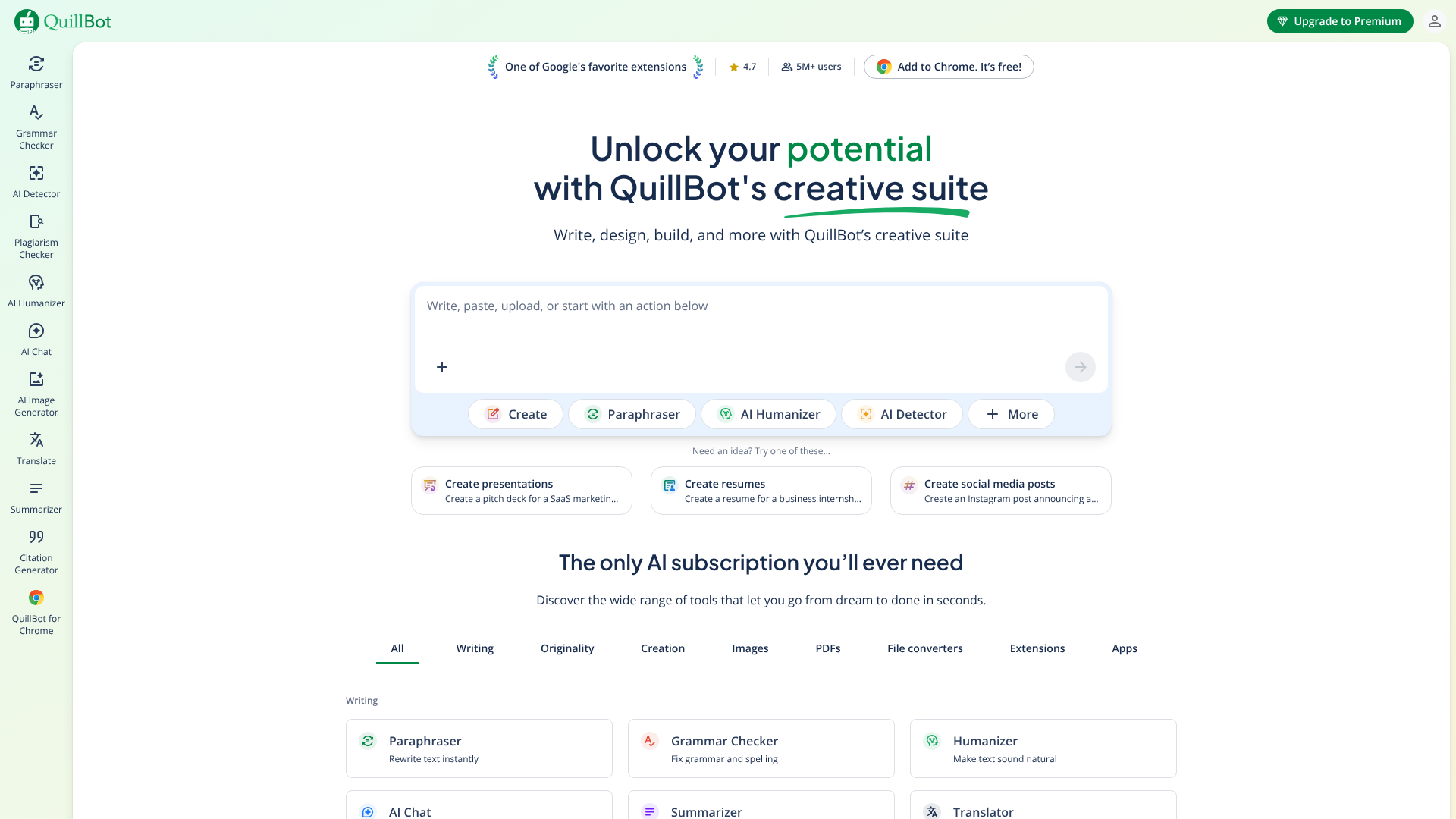
QuillBot is not a full-scale article generator but an essential companion tool for refining your content. Its core strength is its state-of-the-art paraphrasing tool, which can help you reword sentences to improve clarity, adjust tone, or avoid repetition. This is incredibly useful when editing AI-generated drafts that may sound robotic.
In addition to the paraphraser, QuillBot offers a grammar checker, a plagiarism checker, and a 'Co-Writer' feature that combines all its tools into a single editor. It's an affordable and powerful solution for the crucial editing and polishing stage of content creation.
Pros
- Superior Paraphrasing: Its ability to rephrase text naturally is among the best available.
- Affordable: The premium plan is very budget-friendly, offering excellent value.
- Integrated Tools: The Co-Writer provides a unified space for writing, paraphrasing, and checking your work.
Cons
- Not a Primary Writer: It's designed to enhance existing text, not generate long-form content from scratch.
Understanding Pricing and Cost-Effectiveness
Investing in AI tools for blog writing requires understanding their pricing structures and evaluating their potential return on investment (ROI). While subscription fees can seem like an added expense, they often represent a significant cost saving when compared to purely manual content creation methods.
Common Pricing Models
Most AI writing tools operate on a subscription basis, typically with several tiers. A Freemium model is common, offering a limited number of words or features for free, which is great for testing the platform. Paid plans are often structured by word count (e.g., 50,000 words per month) or feature access.
Some platforms use a credit-based system, where different actions (like generating a paragraph or an image) consume a certain number of credits. You then purchase credit packs or a monthly subscription that includes a set number of credits. Finally, per-user pricing is common for plans aimed at teams, where the cost scales with the number of team members who need access.
Cost vs. ROI Comparison
To assess cost-effectiveness, compare the monthly subscription fee to the cost of alternatives. For example, hiring a freelance writer for a single 2,000-word blog post could cost anywhere from £150 to £500 or more. An AI writing tool subscription might cost £40-£80 per month and can help you produce dozens of article drafts in that time.
The true ROI comes from time savings. If an AI tool cuts your drafting time for an article from 6 hours to 2 hours, that's 4 hours saved. Multiply that by the number of articles you produce each month, and the value becomes clear. This reclaimed time can be reinvested into strategy, promotion, and other high-impact activities that grow your business.
| Tool | Typical Starting Price | Best For | Free Trial? |
|---|---|---|---|
| Jasper | Visit website for current pricing | High-quality long-form content | Yes |
| Writesonic | Visit website for current pricing | All-in-one marketing content | Yes (free plan) |
| QuillBot | Visit website for current pricing | Editing and rephrasing | Yes (free plan) |
The Pros and Cons of AI-Powered Blog Writing
While AI offers transformative potential for content creation, it's important to approach it with a balanced perspective. Understanding both the advantages and the limitations is key to using these tools effectively and ethically.
The Advantages
The upsides are compelling. Speed and scale are the most obvious benefits, allowing you to increase your publishing frequency and maintain a consistent content schedule. Cost-efficiency is another major plus, as the investment in an AI tool is often significantly lower than the cost of hiring additional writers or agencies. AI also serves as a powerful antidote to writer's block, providing a constant stream of ideas and starting points.
Pro Tip: Use AI to repurpose existing content. Feed it a webinar transcript, a YouTube video link, or an old blog post, and ask it to create a new article, a series of social media posts, or an email newsletter. This is an incredibly efficient way to maximise the value of your content assets.
The Potential Drawbacks
However, there are risks to manage. Over-reliance on AI can lead to generic, soulless content that lacks a unique perspective. AI models can also produce factual inaccuracies or outdated information, making human fact-checking absolutely essential. As one user on a Reddit discussion noted, AI is great for structure, but the unique insights and stories must come from you.
Furthermore, AI cannot replicate true E-E-A-T (Experience, Expertise, Authoritativeness, Trustworthiness). It can summarise information from the internet, but it cannot share firsthand experience or deep, nuanced expertise. Your content must be heavily edited and enriched with human insight to build trust and authority with your audience and with search engines like Google.
Frequently Asked Questions about Blog Content Generation
How do you generate blog content automatically?
You can generate blog content semi-automatically using AI writing platforms. The process typically involves providing the AI with a topic or keyword, letting it generate an outline, and then having it draft the content for each section. While the drafting is automated, the process still requires significant human input for prompting, guidance, editing, and fact-checking to ensure a high-quality final product.
Can AI write a full blog post?
Yes, an AI can write a full blog post from start to finish. However, the unedited output is rarely of publishable quality. It often lacks a consistent voice, may contain repetitive phrasing, and can include factual errors. For best results, use AI to generate a first draft and then dedicate substantial time to human editing and refinement to add value, personality, and accuracy.
Is AI-generated content good for SEO?
AI-generated content can be good for SEO if it is high-quality, helpful, and meets the needs of the searcher. Google's official stance is that it rewards high-quality content, regardless of how it's produced. Low-quality, spammy AI content created solely to manipulate search rankings will perform poorly. Content that is well-researched, edited by a human expert, and provides genuine value can rank very well.
What is the best AI tool for blog writing?
The "best" tool depends on your specific needs. For users who prioritise the highest quality long-form output and have the budget, Jasper is often considered a top choice. For marketers and teams looking for an all-in-one solution that includes AI image generation and a wide range of templates at a competitive price, Writesonic is an excellent option.
Final Thoughts: The Future of Content Creation
The landscape of blog content generation has fundamentally changed. AI is no longer a novelty but a core component of an efficient and scalable content strategy. By embracing these tools as assistants rather than replacements, marketers and writers can free themselves from the more tedious aspects of content creation and focus on creativity, strategy, and building a genuine connection with their audience.
The key to success is building a hybrid workflow that leverages the strengths of both machine and human. Use AI to accelerate research, outlining, and drafting, but always apply the crucial final layer of human expertise, experience, and editing. This balanced approach will allow you to produce more high-quality content than ever before, driving growth and establishing your authority in your niche.
If you're looking for a versatile writer for long-form articles, Jasper is an excellent place to start. For an all-in-one solution that includes images and SEO features, Writesonic might be the perfect fit for your marketing team.