


Competitor Analysis with Semrush Explained: A Guide for Marketers
Understanding your competition is no longer optional; it's the foundation of a winning digital strategy. A comprehensive competitor analysis with Semrush gives you a clear roadmap, revealing what your rivals are doing right, where they're falling short, and how you can strategically outperform them. By using the powerful suite of tools within Semrush, you can move from guesswork to data-driven decisions that capture market share and drive growth.
- What You'll Learn
- What is Competitor Analysis and Why Use Semrush for It?
- The Core Semrush Toolkits for Competitor Research
- SEO Toolkit: Uncovering Organic Strategies
- Advertising Toolkit: Analysing Paid Campaigns
- Content Marketing Toolkit: Deconstructing Content Success
- .Trends: The Ultimate Market Intelligence Add-on
- A Step-by-Step Guide to Competitor Analysis with Semrush
- Step 1: Identify Your True Competitors
- Step 2: Analyse Competitor Website Traffic
- Step 3: Uncover Their Top Organic Keywords (Keyword Gap)
- Step 4: Investigate Their Backlink Profile (Backlink Gap)
- Step 5: Deconstruct Their Content Strategy
- Step 6: Spy on Their Paid Advertising Strategy
- Choosing the Right Semrush Plan for Your Needs
- Semrush Pricing: What Does Competitor Analysis Cost?
- The Pros and Cons of Using Semrush for Competitor Analysis
- Frequently Asked Questions (FAQ)
- Does Semrush do competitor analysis?
- How do I do competitor analysis in Semrush?
- What are the common mistakes in competitive analysis?
- Is a SWOT analysis the same as a competitor analysis?
- Is Semrush a Russian company?
- Which tool is best for competitor analysis?
- Final Thoughts: Turning Analysis into Action
This guide breaks down exactly how to use Semrush for in-depth competitor research. We'll cover the essential tools, a step-by-step process for uncovering actionable insights, and how to translate that data into a stronger marketing plan. Whether you're analysing keywords, backlinks, content, or paid ads, you'll learn how to find the gaps in your competitors' strategies and turn them into your biggest opportunities.
What You'll Learn
- Core Semrush Tools: Discover the key toolkits within Semrush specifically designed for deep competitor analysis, from SEO to content and advertising.
- Step-by-Step Process: Follow a detailed, actionable workflow for identifying competitors, analysing their traffic, and deconstructing their organic and paid strategies.
- Actionable Insights: Learn how to find crucial data points like keyword gaps, backlink opportunities, and top-performing content that you can use to improve your own campaigns.
- Beyond the Basics: Understand the pros and cons of using Semrush and how to choose the right plan for your specific business needs and budget.
- Common Mistakes to Avoid: Get answers to frequently asked questions about competitor analysis to ensure your research is accurate and effective.
What is Competitor Analysis and Why Use Semrush for It?
Competitor analysis is the process of identifying businesses in your market niche and evaluating their strategies to determine their strengths and weaknesses relative to your own. It's not about copying what others do. Instead, it’s about gathering intelligence to make more informed decisions about your own product, marketing, and sales strategies.
A thorough analysis helps you understand the competitive landscape. You can identify market gaps, spot emerging trends, and benchmark your performance against key players. This process is crucial for setting realistic business goals and developing a unique value proposition that makes you stand out.
So, why is Semrush the go-to platform for this task. While you could manually gather data from search engines and social media, it would be incredibly time-consuming and incomplete. Semrush automates and aggregates this data collection, providing a 360-degree view of your competitors' digital footprint from one central dashboard. It offers a suite of integrated competitor analysis tools that work together, allowing you to cross-reference data from different channels.
For example, you can see how a competitor's top-ranking content (SEO) is also being promoted through their paid ads (PPC), giving you a much richer understanding of their overall strategy.
The Core Semrush Toolkits for Competitor Research
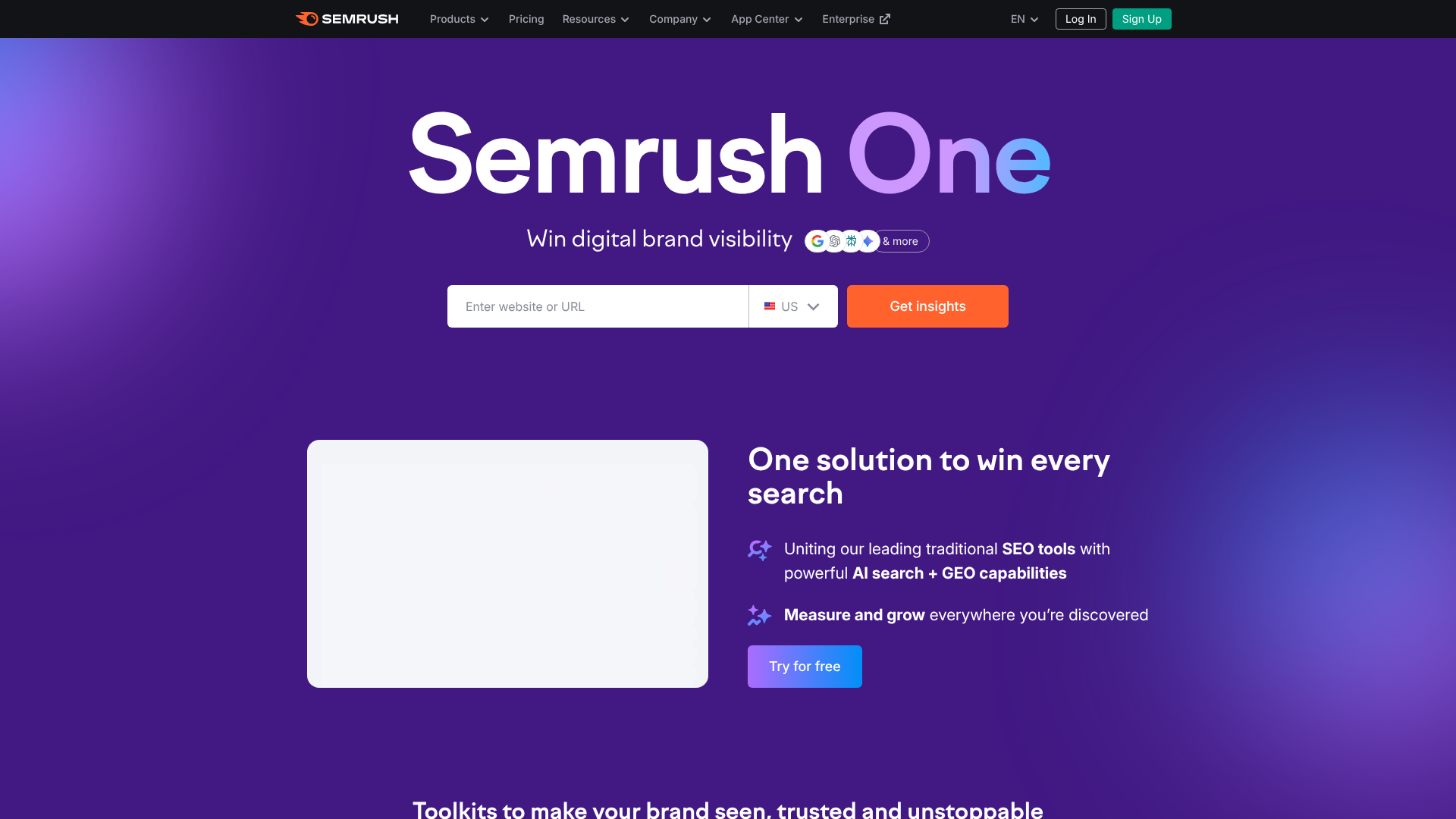
Semrush organises its features into specialised toolkits, each designed to tackle a different aspect of digital marketing. For a complete semrush competitor research project, you'll likely pull insights from several of these. Understanding what each toolkit offers is the first step to unlocking its full potential.
SEO Toolkit: Uncovering Organic Strategies
The SEO Toolkit is the heart of competitor analysis in Semrush. It’s where you'll spend most of your time dissecting how rivals attract organic traffic. You can see which keywords they rank for, who links to them, and the overall health of their website.
Key tools here include:
- Domain Overview: Get a high-level snapshot of any domain's authority, organic traffic, and top keywords.
- Organic Research: Dive deep into a competitor's keyword rankings, see their top pages, and track ranking changes over time.
- Keyword Gap: Compare your keyword profile against up to four competitors to find valuable keywords they rank for, but you don't.
- Backlink Gap: Similarly, find websites that link to your competitors but not to you, creating a list of high-priority outreach targets.
Advertising Toolkit: Analysing Paid Campaigns
If your competitors are running paid search campaigns, this toolkit is your window into their strategy and budget. You can see the keywords they're bidding on, the ad copy they're using, and their estimated monthly spend. This intelligence is invaluable for planning your own PPC campaigns, as it helps you avoid costly mistakes and find profitable opportunities.
Key tools include:
- Advertising Research: See a competitor's live Google Ads, their target keywords, and their ad copy history.
- Display Advertising: Analyse their display and banner ad campaigns, revealing their creative assets and publisher network.
- PLA Research: For e-commerce businesses, this tool shows a competitor's Google Shopping ads and product listings.
Content Marketing Toolkit: Deconstructing Content Success
Content drives modern marketing, and this toolkit helps you understand what kind of content resonates with your shared audience. You can analyse a competitor's blog posts, articles, and landing pages to see what topics perform best, what formats they use, and where their content gaps are.
Key tools include:
- Topic Research: Discover popular subtopics and questions related to your main keywords, based on what's already ranking well.
- Content Audit: Analyse your own content, but it can be adapted to manually assess a competitor's content inventory for quality and performance.
- Post Tracking: Monitor the performance of specific competitor articles across social shares, backlinks, and keyword rankings.
.Trends: The Ultimate Market Intelligence Add-on
For businesses that need a higher-level view of the market, the Semrush .Trends solution is a powerful add-on. It combines two main tools: Traffic Analytics and Market Explorer. Traffic Analytics gives you detailed insights into any website's traffic sources, audience demographics, and user engagement metrics.
Market Explorer goes even broader, allowing you to analyse an entire industry or market niche. You can identify the main players, see their market share, and understand seasonal trends. This is perfect for businesses entering a new market or wanting to benchmark their growth against the industry average.

A Step-by-Step Guide to Competitor Analysis with Semrush
Now that you know the tools, it's time to put them into action. Following a structured process ensures you don't miss any critical insights. This step-by-step guide provides a repeatable workflow for conducting a comprehensive semrush analysis of your competition.
Step 1: Identify Your True Competitors
Before you can analyse anyone, you need to know who you're up against. You probably have a list of direct business competitors—companies that sell a similar product or service. However, your search competitors might be different. These are websites that compete with you for the same keywords in Google, even if they don't sell the same thing (e.g., a blog, a review site, or a news publication).
In Semrush, go to the Organic Research tool and enter your own domain. Click on the 'Competitors' tab. Semrush will generate a list of domains that rank for a similar set of keywords, along with a 'Competition Level' score. This report is your starting point for identifying both direct and indirect search competitors.
Choose 3-5 of the most relevant ones to focus on for your initial analysis.
Step 2: Analyse Competitor Website Traffic
Once you have your list, you need a baseline understanding of their performance. The Traffic Analytics tool (part of the .Trends add-on, but some data is available in Domain Overview) provides an estimate of a website's total traffic, user engagement (like bounce rate and session duration), and traffic sources (Direct, Referral, Search, Social, Paid).
Compare these metrics for your chosen competitors. Is one competitor getting a huge amount of referral traffic. That could indicate a strong PR or affiliate strategy. Does another have a very low bounce rate.
Their website user experience is likely very effective. This high-level view helps you decide where to dig deeper.
Step 3: Uncover Their Top Organic Keywords (Keyword Gap)
This is where the magic happens. The Keyword Gap tool is one of the most powerful features for competitor analysis. Enter your domain and up to four competitor domains. The tool will generate several reports, but the most useful one is 'Missing'.
This report shows you all the keywords your competitors rank for, but you do not.
Filter this list to find keywords with a reasonable search volume and commercial intent. These are your golden opportunities. You've just identified topics your audience is searching for that your competitors are capitalising on, but you're completely missing. Export this list and use it to inform your future content and SEO strategy.
Pro Tip: Use the 'Weak' filter in the Keyword Gap tool. This shows keywords where your competitors rank higher than you (e.g., they are on page 1, and you are on page 3). These are often easier to target than brand new keywords, as you already have some relevance and just need to optimise your existing content.
Step 4: Investigate Their Backlink Profile (Backlink Gap)
Backlinks are a critical ranking factor, and understanding who links to your competitors is key to building your own domain authority. Use the Backlink Gap tool, which works just like the Keyword Gap tool. Enter your domain and your competitors' domains.
The tool will show you a list of websites that are linking to one or more of your competitors but not to you. This is essentially a pre-vetted list of link-building prospects. These websites have already shown a willingness to link to sites in your industry, making them warm leads for your outreach campaigns. You can analyse these referring domains to understand what kind of content attracts links in your niche—is it original research, ultimate guides, or free tools?
Step 5: Deconstruct Their Content Strategy
Great rankings are built on great content. To understand a competitor's content strategy, go to the Organic Research tool and enter their domain. Navigate to the 'Pages' tab. This will show you a list of their top-performing organic pages, sorted by the amount of traffic they generate.
Analyse this list for patterns. What topics are they covering. What content formats are they using (e.g., blog posts, landing pages, 'how-to' guides). Click into a few of the top pages to see their structure, depth, and use of visuals.
This analysis helps you understand what type of content resonates with search engines and your target audience, giving you a blueprint for creating content that performs even better.
As Vanhishikha Bhargava notes in a discussion on LinkedIn, the next frontier is understanding where competitors show up in AI and prompt-based search results. While standard tools are still catching up, Semrush's 'Prompt Tracking' features are beginning to address this, showing how vital it is to look beyond traditional rankings.
Step 6: Spy on Their Paid Advertising Strategy
Finally, if paid advertising is part of your marketing mix, you must analyse your competitors' campaigns. In the Advertising Research tool, enter a competitor's domain. You'll immediately see the keywords they are bidding on, their estimated traffic and cost, and examples of their ad copy.
Look at the 'Ad Copies' report to see the language, offers, and calls-to-action they are using. This can inspire your own ad creative. You can also see their top paid keywords, which can help you discover new campaign ideas or decide which high-cost keywords to avoid. This intelligence saves you time and money by letting you learn from your competitors' ad spend.
Choosing the Right Semrush Plan for Your Needs
Semrush offers several subscription tiers, and choosing the right one depends on the scale of your business and the depth of analysis you require. While all plans offer competitor analysis features, the limits and access to advanced tools vary significantly.
Pro Plan: This is the entry-level plan, best suited for freelancers, startups, and small in-house marketing teams. It provides all the core tools needed for SEO, PPC, and social media research, but with limits on the number of projects, keywords to track, and reports you can run per day. It's a great starting point for basic semrush competitor research.
Guru Plan: This is the most popular plan, designed for small to medium-sized businesses and growing marketing agencies. It includes everything in the Pro plan but with higher limits. Crucially, it also adds features like the Content Marketing Toolkit, historical data, and multi-location tracking, which are essential for a more sophisticated analysis.
.Trends Add-on: This isn't a standalone plan but an add-on available for any subscription tier. It unlocks the full power of Traffic Analytics and Market Explorer. If your primary goal is deep market research and traffic intelligence beyond just search data, this add-on is a necessity.
Business Plan: Aimed at large agencies and enterprises, this plan offers the highest limits, API access, and advanced features like PLA analytics and Share of Voice metrics. It's designed for teams managing many clients or operating in highly competitive, large-scale markets.
When choosing, consider your immediate needs. If you're just starting, the Pro plan is sufficient. However, if your strategy relies heavily on content marketing or you need to understand the broader market landscape, the Guru plan combined with the .Trends add-on offers the best value.
Semrush Pricing: What Does Competitor Analysis Cost?
Semrush pricing is based on a monthly or annual subscription model, with discounts offered for annual payments. As pricing can change, it's always best to visit the official Semrush website for the most current information.
Generally, the plans are structured as follows:
- Pro Plan: Typically starts around £100-£130 per month.
- Guru Plan: Usually priced in the range of £200-£250 per month.
- Business Plan: Starts at approximately £400-£450 per month.
The .Trends add-on is an additional cost on top of your base plan, often around £150-£200 per month. While this might seem steep, the level of market intelligence it provides can be invaluable for strategic planning and can replace multiple other subscription tools.
Is it worth the cost? For any business serious about digital marketing, the investment is almost always justified. The cost of not knowing what your competitors are doing can be far greater. A single insight—like a high-volume, untapped keyword or a successful ad campaign angle—can deliver a return on investment that pays for the subscription many times over.
The Pros and Cons of Using Semrush for Competitor Analysis
No tool is perfect, and it's important to have a balanced view. While Semrush is a market leader, understanding its strengths and limitations helps you use it more effectively.
Pros
- All-in-One Platform: Semrush's biggest strength is its comprehensive nature. You can analyse SEO, PPC, content, social media, and market trends all within a single interface, providing a holistic view that standalone tools can't match.
- Massive Data Volume: The platform crawls an enormous amount of data, including billions of keywords and trillions of backlinks. This vast database ensures the insights you get are based on a comprehensive picture of the web.
- Powerful Gap Analysis Tools: The Keyword Gap and Backlink Gap tools are exceptionally effective and user-friendly. They make it simple to find actionable opportunities that can have a direct impact on your strategy.
- Excellent User Interface: Despite its complexity, Semrush is relatively easy to navigate. The dashboards are clear, and data is visualised in helpful charts and graphs, making it accessible even for beginners.
Cons
- Traffic Analytics is an Add-on: One of the most valuable competitor analysis features, detailed Traffic Analytics, is not included in the standard plans and requires the costly .Trends add-on.
- Learning Curve: While the interface is good, the sheer number of tools and reports can be overwhelming for new users. It takes time to learn how to get the most out of the platform.
- Data is Estimated: Like all third-party competitor analysis tools, the data provided by Semrush (especially traffic and ad spend) are estimates. They are highly accurate and based on sophisticated algorithms, but they are not the same as the direct data you'd see in your own Google Analytics.
- Cost: Semrush is a premium tool, and the subscription cost can be a significant investment for very small businesses or solopreneurs.
Frequently Asked Questions (FAQ)
Here are answers to some common questions about using Semrush and conducting competitor analysis.
Does Semrush do competitor analysis?
Yes, absolutely. Competitor analysis is one of Semrush's core functions and arguably what it's most famous for. It provides a comprehensive suite of tools specifically designed to research and analyse competitors' SEO, content, advertising, and social media strategies.
How do I do competitor analysis in Semrush?
The best way to start is by following a structured process. First, use the Organic Research tool to identify your main search competitors. Then, use tools like Keyword Gap and Backlink Gap to find specific organic opportunities. Finally, use the Advertising Research and Topic Research tools to deconstruct their paid and content strategies, respectively.
What are the common mistakes in competitive analysis?
One of the biggest mistakes is focusing only on direct business competitors and ignoring your search competitors. Another common error is collecting data without turning it into action; the goal is to find insights that inform your strategy, not just to create a report. Lastly, many people only perform a one-time analysis when it should be an ongoing process to monitor changes in the competitive landscape.
Pro Tip: Don't just look at what competitors are doing now; use Semrush's historical data features (available on Guru plans and higher) to see how their strategy has evolved. Did a sudden traffic spike correspond with a big content launch or a new link-building campaign? This historical context provides much deeper insights.
Is a SWOT analysis the same as a competitor analysis?
No, they are different but related. A competitor analysis focuses externally on what your rivals are doing. A SWOT analysis is a broader strategic framework that looks at both internal factors (Strengths, Weaknesses) and external factors (Opportunities, Threats). The findings from your competitor analysis are a crucial input for the 'Opportunities' and 'Threats' sections of your SWOT analysis.
Is Semrush a Russian company?
Semrush was founded in 2008 by Oleg Shchegolev and Dmitry Melnikov, who are of Russian origin. However, Semrush is now a global company with its headquarters in Boston, Massachusetts, USA. It is a publicly traded company on the New York Stock Exchange (NYSE: SEMR) and has offices and employees all over the world.
Which tool is best for competitor analysis?
While there are many excellent competitor analysis tools available, such as Ahrefs and Moz, Semrush is widely regarded as one of the best due to its all-in-one nature. Its strength lies in providing a comprehensive suite of tools that cover everything from SEO and PPC to content and market trends, allowing for a more holistic analysis than many of its more specialised competitors.
Final Thoughts: Turning Analysis into Action
Conducting a competitor analysis with Semrush provides a powerful lens through which to view your market. It equips you with the data needed to understand the competitive landscape, identify strategic opportunities, and mitigate potential threats. The tools within the platform allow you to move beyond surface-level observations and into a deep, data-backed understanding of what it takes to succeed in your niche.
However, the analysis itself is only the first step. The true value comes from translating your findings into a concrete action plan. Use the keyword gaps you've found to create a new content calendar. Use the backlink gaps to launch a targeted outreach campaign.
Use the ad copy analysis to refine your PPC messaging. By consistently monitoring your competitors and adapting your strategy, you can create a sustainable competitive advantage.
If you're ready to stop guessing and start making data-driven decisions, exploring the features within Semrush is your logical next step. The insights you uncover will not only improve your marketing campaigns but will also provide a clearer path to achieving your business goals.