


Top 12 Smart Contract Platforms: A Detailed List for Developers in 2026
Choosing where to build your decentralised application (dApp) is one of the most critical decisions a developer or business can make. With dozens of options available, navigating the complete list of smart contract platforms can be daunting. Each blockchain offers a unique combination of speed, security, cost, and community support, directly impacting your project's success and scalability.
- Essential Points
- What Exactly Are Smart Contract Platforms?
- Key Features to Compare in Smart Contract Platforms
- Scalability and Transaction Speed (TPS)
- Security and Consensus Mechanism
- Decentralisation
- Transaction Costs (Gas Fees)
- Developer Ecosystem and Programming Language
- How to Choose the Right Smart Contract Platform for Your Project
- The Definitive List of Top Smart Contract Platforms for 2026
- 1. Ethereum (ETH)
- 2. Solana (SOL)
- 3. Cardano (ADA)
- 4. BNB Smart Chain (BSC)
- 5. Avalanche (AVAX)
- 6. Polygon (MATIC)
- 7. Polkadot (DOT)
- 8. NEAR Protocol (NEAR)
- 9. Algorand (ALGO)
- 10. Tron (TRX)
- 11. Tezos (XTZ)
- 12. Hyperledger Fabric
- Comparing the Giants: A Side-by-Side Look
- Understanding Costs: Transaction Fees and Development Expenses
- Frequently Asked Questions
- Which smart contract platform is best?
- What are the top 5 blockchain platforms?
- Which blockchain is most commonly used for smart contracts?
- Can Solana do smart contracts?
- Final Thoughts
This guide provides a comprehensive breakdown of the top smart contract platforms available today. We'll move beyond the hype to give you a clear, developer-focused comparison of the leading blockchains. Whether you're building a high-frequency DeFi protocol, a complex NFT marketplace, or a secure enterprise solution, this analysis will help you select the ideal foundation for your project.
Essential Points
- Ethereum is the Pioneer: It has the largest ecosystem and developer community, making it the most battle-tested platform. However, it has historically faced challenges with high transaction fees and slower speeds, which Layer-2 solutions are actively addressing.
- Speed vs. Decentralisation: Newer platforms like Solana offer incredibly high transaction speeds and low costs, but often at the trade-off of less decentralisation compared to Ethereum. This is a core dilemma you must evaluate for your specific needs.
- The 'Blockchain Trilemma' is Key: Understanding the balance between security, scalability, and decentralisation is crucial. No single platform has perfectly solved this challenge, so you must choose which attributes are most important for your application.
- EVM Compatibility Matters: Platforms that are Ethereum Virtual Machine (EVM) compatible allow developers to easily migrate dApps from Ethereum. This significantly lowers the barrier to entry for building on alternative chains like Avalanche, Polygon, and BNB Chain.
- Layer-1 vs. Layer-2: Layer-1s are the foundational blockchains (e.g., Ethereum, Solana). Layer-2s are scaling solutions built on top of Layer-1s (e.g., Polygon, Arbitrum) to offer faster, cheaper transactions while inheriting the security of the main chain.
What Exactly Are Smart Contract Platforms?
A smart contract is a self-executing contract with the terms of the agreement directly written into code. They run on a blockchain, which means the code and the agreements contained within it are stored across a distributed, decentralised network. The contracts automatically execute when predetermined conditions are met, removing the need for a central authority, legal system, or external enforcement mechanism.

A smart contract platform is the underlying blockchain environment—the operating system—that allows these smart contracts to be created, deployed, and executed. Think of it like Windows or macOS for decentralised applications. It provides the necessary infrastructure, including a consensus mechanism to validate transactions, a virtual machine to run the code, and a native cryptocurrency to pay for computational resources (known as 'gas').
These platforms are the foundation of Web3, enabling everything from decentralised finance (DeFi) and non-fungible tokens (NFTs) to supply chain management and decentralised autonomous organisations (DAOs). This contrasts with traditional digital agreements, where platforms like LegalContracts help create legally binding documents that still require manual enforcement and trust in a central authority.
Key Features to Compare in Smart Contract Platforms

When evaluating the best smart contract platforms, it's essential to look beyond marketing claims and analyse their core technical attributes. These features determine how your dApp will perform, how secure it will be, and how much it will cost to operate.
Scalability and Transaction Speed (TPS)
Scalability refers to a platform's ability to handle a growing number of transactions without slowing down or becoming prohibitively expensive. It's often measured in Transactions Per Second (TPS). A platform with low TPS (like Bitcoin's ~7 or Ethereum's historic ~15-30) can become congested during high demand, leading to long wait times and high fees. In contrast, platforms like Solana claim theoretical TPS in the tens of thousands.
Security and Consensus Mechanism
Security is paramount. The consensus mechanism is the protocol that network participants use to agree on the validity of transactions, preventing fraud and ensuring the integrity of the blockchain. The two most common types are:
- Proof-of-Work (PoW): Used by Bitcoin, it's incredibly secure but energy-intensive and slow.
- Proof-of-Stake (PoS): Used by Ethereum (post-Merge), Cardano, and others. It's more energy-efficient and scalable, with security provided by validators who 'stake' the network's native currency.
Decentralisation
Decentralisation refers to how distributed the power and control over the network are. A more decentralised network, with thousands of independent validators or nodes spread globally, is more resistant to censorship, attacks, and single points of failure. This is often a trade-off with speed; highly centralised systems can typically achieve faster transaction processing.
Transaction Costs (Gas Fees)
Gas fees are the payments users make to the network to have their transactions processed and included in the blockchain. On congested networks like Ethereum during peak times, a simple transaction can cost anywhere from a few dollars to hundreds. Low-cost platforms like Solana or Layer-2 solutions like Polygon offer transactions for fractions of a penny, making them more suitable for high-volume applications like gaming or micro-transactions.
Developer Ecosystem and Programming Language
A strong developer ecosystem includes extensive documentation, active developer communities, and readily available tools. The programming language is also a major factor. Solidity is the language for Ethereum and all EVM-compatible chains, giving it the largest pool of developers. Other platforms use languages like Rust (Solana, NEAR), Haskell (Cardano), or Go, which may offer performance benefits but have a smaller talent pool.
How to Choose the Right Smart Contract Platform for Your Project
Selecting the right platform is not about finding the single 'best' one, but the one that best aligns with your project's specific requirements. A dApp for enterprise supply chain management has vastly different needs than a fast-paced decentralised game. Here’s a step-by-step framework to guide your decision.
First, define your application's core priorities. Are you building a DeFi protocol where security and decentralisation are non-negotiable. Ethereum or Cardano might be your top contenders. Or are you creating a social media dApp where user experience is key, requiring near-instant, low-cost transactions.
In that case, Solana or NEAR Protocol would be a better fit.
Second, evaluate your target audience and expected transaction volume. If your dApp involves frequent, small-value transactions (e.g., in-game purchases, tipping), high gas fees will kill user adoption. A low-cost Layer-1 or a Layer-2 scaling solution is essential. If your application handles high-value transactions that occur infrequently, the higher security and decentralisation of a platform like Ethereum may be worth the cost.
Finally, consider your team's technical expertise and long-term vision. Does your team already know Solidity. Sticking with an EVM-compatible chain will dramatically speed up development. If you're building from scratch and prioritise performance, learning Rust for Solana could be a worthwhile investment.
Also, think about interoperability. If you envision your dApp interacting with assets on other chains, a platform like Polkadot or Cosmos, built for cross-chain communication, should be on your radar.
Pro Tip: Don't just look at the current state of a platform; analyse its roadmap. Is the development team actively working on scalability and security upgrades? A strong, transparent roadmap is a good indicator of a project's long-term viability and commitment to improvement.
The Definitive List of Top Smart Contract Platforms for 2026
Here is our detailed breakdown of the leading smart contract platforms, analysing their strengths, weaknesses, and ideal use cases to help you make an informed decision.
1. Ethereum (ETH)
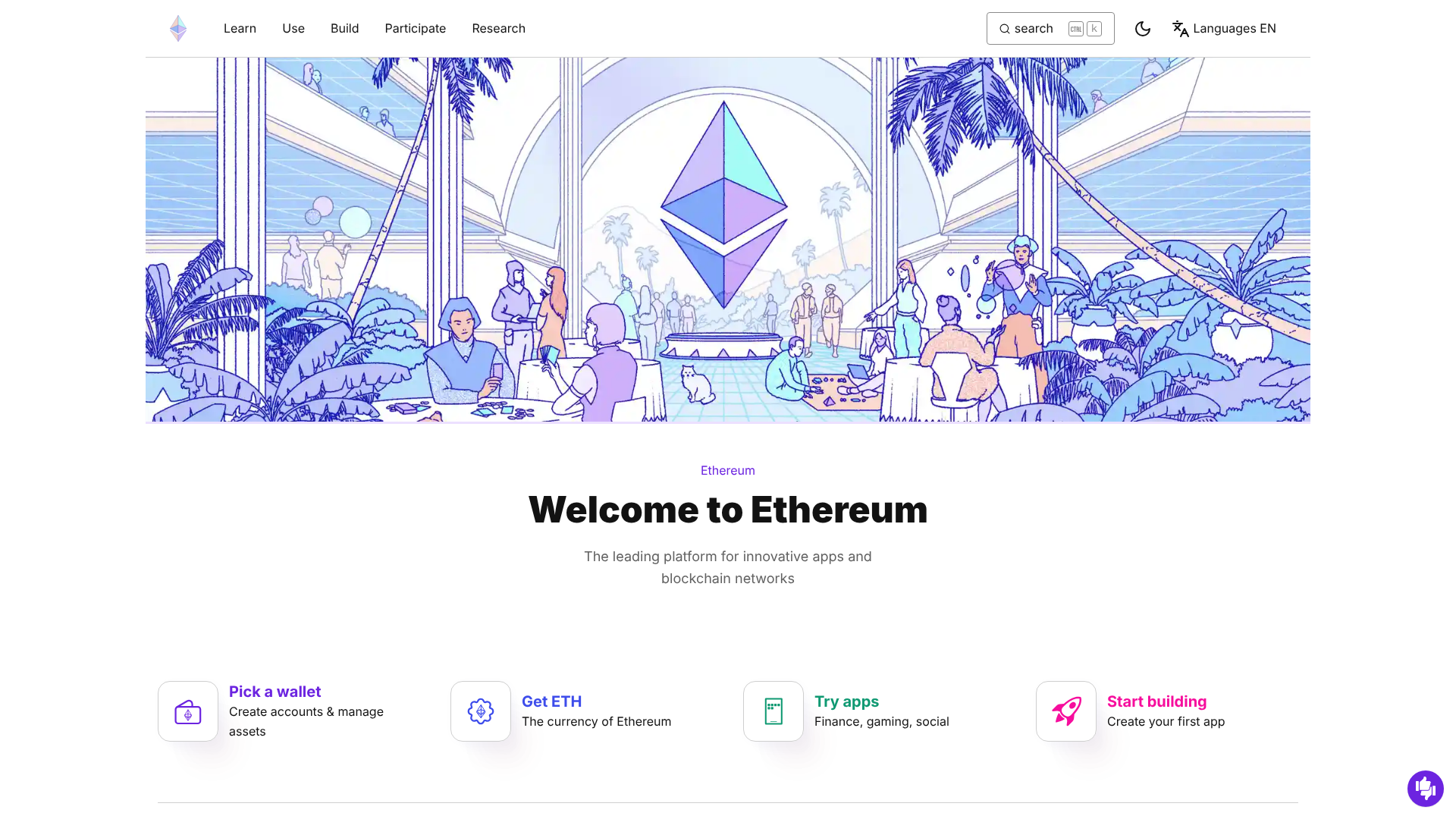
As the original smart contract platform, Ethereum is the undisputed industry leader. It has the largest and most active developer community, the most extensive set of tools and documentation, and the highest total value locked (TVL) in its DeFi ecosystem. Its transition to a Proof-of-Stake consensus mechanism (The Merge) significantly reduced its energy consumption and set the stage for future scalability upgrades.
- Consensus Mechanism: Proof-of-Stake (PoS)
- Programming Language: Solidity, Vyper
- EVM Compatible: Yes (It's the original EVM)
Pros
- Unmatched Decentralisation: The most decentralised and secure smart contract platform, with thousands of validators worldwide.
- Largest Ecosystem: The vast majority of dApps, developers, and users are on Ethereum, creating powerful network effects.
- Most Battle-Tested: Its long history means it has been subjected to more scrutiny and attacks, making it incredibly resilient.
Cons
- High Gas Fees: Despite upgrades, transaction fees on the mainnet can still be very high during periods of congestion.
- Slower Transaction Speeds: The main chain has a lower TPS compared to its modern rivals, relying on Layer-2s for scaling.
2. Solana (SOL)
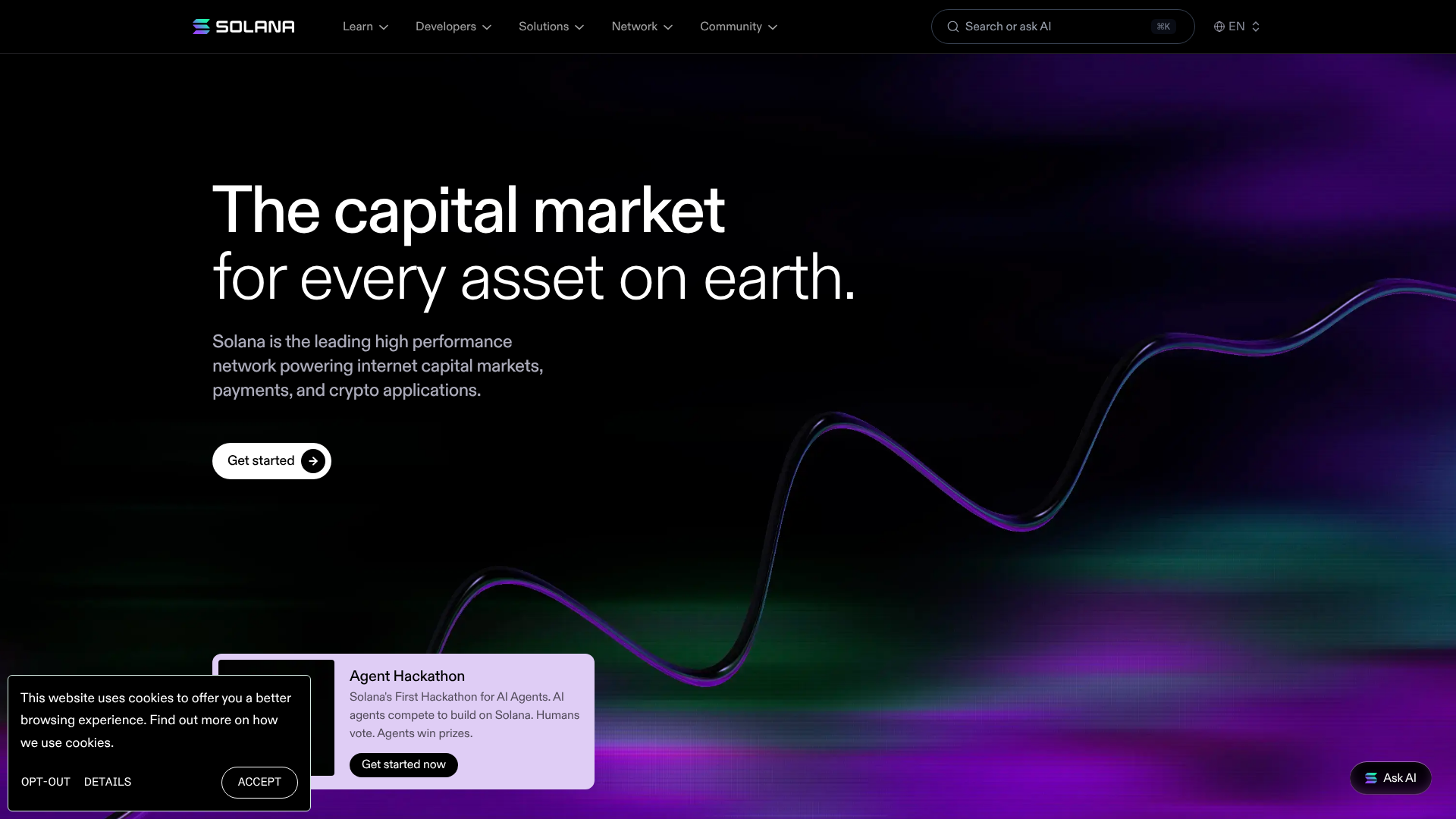
Solana is built for speed. It uses a unique consensus mechanism called Proof-of-History (PoH) combined with Proof-of-Stake to achieve incredibly high throughput and low transaction costs. This has made it a popular choice for applications that require high performance, such as high-frequency trading, NFT minting, and blockchain-based gaming.
- Consensus Mechanism: Proof-of-History (PoH) + Proof-of-Stake (PoS)
- Programming Language: Rust, C, C++
- EVM Compatible: No (but compatible layers like Neon EVM exist)
Pros
- Extreme Speed: Capable of processing tens of thousands of transactions per second.
- Very Low Costs: Transaction fees are typically fractions of a penny, making it ideal for micro-transactions.
- Growing Ecosystem: A rapidly expanding community, particularly in the NFT and gaming sectors.
Cons
- Network Outages: The network has experienced several outages and periods of instability, raising concerns about its reliability.
- Less Decentralised: It has a smaller number of validators, and hardware requirements are high, leading to concerns about centralisation.
3. Cardano (ADA)
Cardano takes a research-driven, academic approach to blockchain development. It prioritises security, sustainability, and formal verification, meaning all components are peer-reviewed before implementation. This methodical process results in slower development but aims to create a more secure and reliable platform for high-stakes applications like finance and identity.
- Consensus Mechanism: Ouroboros (a type of PoS)
- Programming Language: Plutus, Marlowe (based on Haskell)
- EVM Compatible: No (but compatible sidechains are in development)
Pros
- High Security: A strong focus on formal methods and a peer-reviewed development process.
- Energy Efficient: Its Ouroboros PoS protocol is one of the most energy-efficient in the space.
- Strong Community: A passionate and engaged community dedicated to the project's long-term vision.
Cons
- Slower Development: The academic approach means features and upgrades take longer to roll out.
- Smaller Ecosystem: The dApp ecosystem is less developed compared to Ethereum and other rivals due to its later start with smart contracts.
4. BNB Smart Chain (BSC)
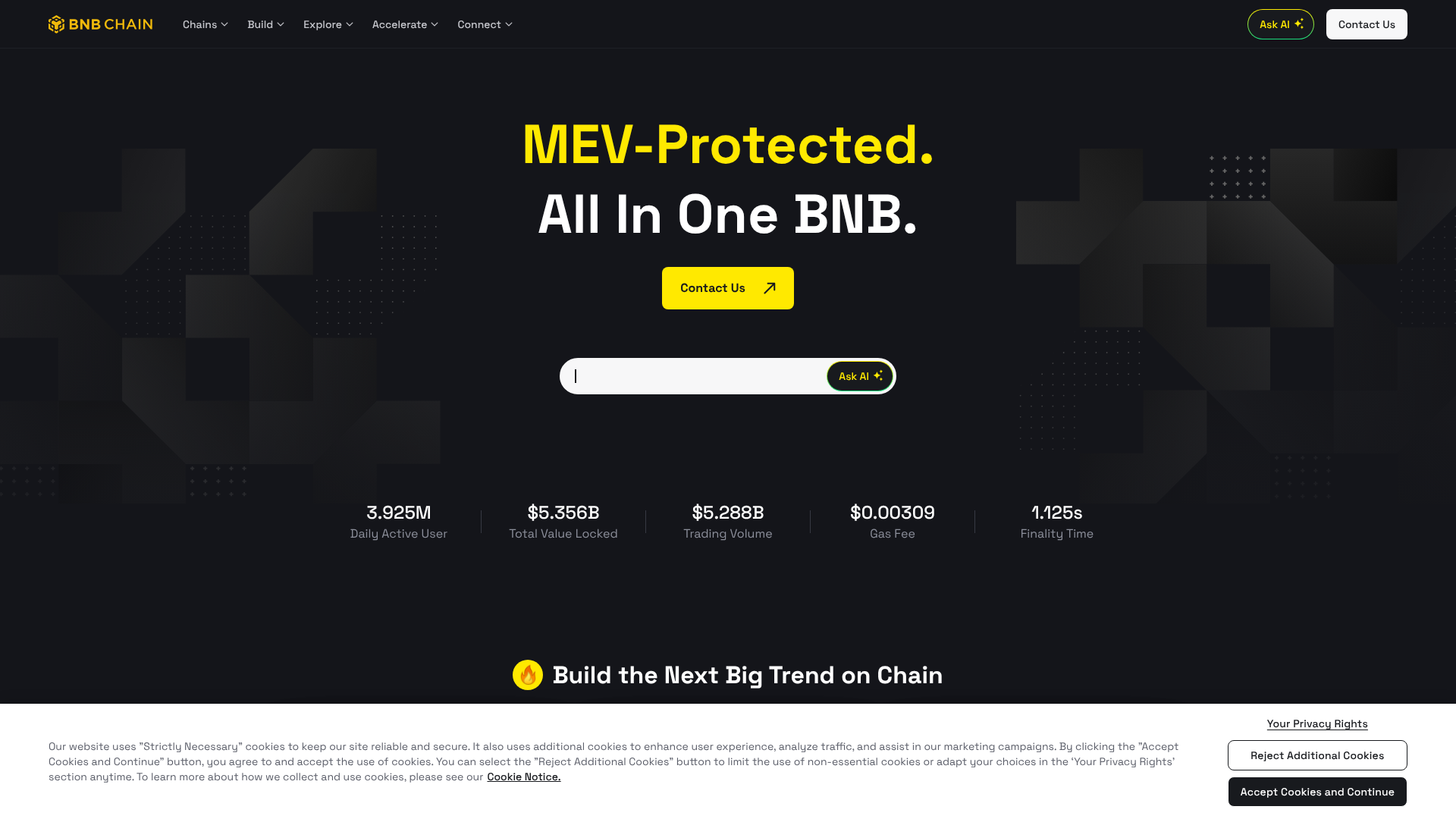
Originally a fork of Ethereum, BNB Smart Chain (now part of the BNB Chain ecosystem) was created to offer a high-speed, low-cost alternative that is fully EVM-compatible. It uses a Proof-of-Staked-Authority (PoSA) consensus model, which relies on a small number of validators to achieve fast block times. This has made it a popular hub for DeFi and GameFi projects looking for cheaper transactions.
- Consensus Mechanism: Proof-of-Staked-Authority (PoSA)
- Programming Language: Solidity
- EVM Compatible: Yes
Pros
- Low Transaction Fees: Significantly cheaper to use than Ethereum's mainnet.
- Fast Transaction Times: Quick block finality provides a smooth user experience.
- EVM Compatibility: Easy for developers to migrate projects from Ethereum.
Cons
- Highly Centralised: Relies on a small, permissioned set of 21 active validators, raising significant centralisation concerns.
- Security Concerns: The chain has been the target of several major exploits and hacks.
5. Avalanche (AVAX)
Avalanche's key innovation is its subnet architecture. It allows developers to create custom, application-specific blockchains (subnets) that can have their own rules, virtual machines, and tokens. This makes the platform highly scalable and flexible, as activity on one subnet does not congest the rest of the network. The main network achieves incredibly fast transaction finality.
- Consensus Mechanism: Avalanche Consensus Protocol (a type of PoS)
- Programming Language: Solidity
- EVM Compatible: Yes (on its C-Chain)
Pros
- Near-Instant Finality: Transactions are confirmed in under a second.
- High Scalability via Subnets: Custom blockchains allow for massive scaling and application-specific optimisation.
- EVM Compatibility: The primary smart contract chain is fully compatible with Ethereum's tools and dApps.
Cons
- Complex Architecture: The multi-chain structure can be more complex for new users and developers to understand.
- Validator Costs: Staking requirements to become a validator are relatively high.
6. Polygon (MATIC)
Polygon is the leading Layer-2 scaling solution for Ethereum. It offers a suite of technologies, including its Proof-of-Stake sidechain, that run alongside the Ethereum mainnet. This allows it to process transactions quickly and cheaply while still benefiting from Ethereum's security. It has become the go-to platform for many dApps, including major brands entering the Web3 space.
- Consensus Mechanism: Proof-of-Stake (PoS)
- Programming Language: Solidity
- EVM Compatible: Yes
Pros
- Very Low Fees: Transactions cost a fraction of what they do on Ethereum.
- High Speed: Fast block times and high throughput.
- Leverages Ethereum's Security: Benefits from the security and decentralisation of the Ethereum network.
Cons
- Not a True Layer-1: It relies on Ethereum for its ultimate security, which some purists see as a drawback.
- Centralisation Points: The PoS chain has some centralisation vectors, though it is continuously working to improve this.
7. Polkadot (DOT)

Polkadot is designed for interoperability, aiming to be the 'internet of blockchains'. Its core is the Relay Chain, which provides security, but the real action happens on 'parachains'—independent blockchains that connect to the Relay Chain. This architecture allows different blockchains to communicate and share data and assets in a secure, trustless manner.
- Consensus Mechanism: Nominated Proof-of-Stake (NPoS)
- Programming Language: Rust (using the Substrate framework)
- EVM Compatible: No (but EVM-compatible parachains like Moonbeam exist)
Pros
- True Interoperability: Enables seamless communication between different blockchains.
- Shared Security: Parachains inherit the security of the main Relay Chain.
- High Scalability: Transactions are processed in parallel across different parachains.
Cons
- Complex System: The parachain auction model can be complex and expensive for new projects.
- Steeper Learning Curve: Building on Substrate requires specialised knowledge compared to Solidity.
8. NEAR Protocol (NEAR)
NEAR Protocol focuses on developer and user experience. It uses a sharding technology called Nightshade to achieve scalability, splitting the network into smaller, manageable pieces to process transactions in parallel. It also offers human-readable account names (e.g., 'yourname.near') and simpler onboarding processes to make Web3 more accessible to mainstream users.
- Consensus Mechanism: Thresholded Proof-of-Stake (TPoS)
- Programming Language: Rust, AssemblyScript
- EVM Compatible: Yes (via Aurora, an EVM layer on NEAR)
Pros
- User-Friendly: Features like named accounts make it easier for non-technical users.
- Scalable through Sharding: Designed for high throughput from the ground up.
- Low Transaction Costs: Very affordable for both developers and users.
Cons
- Younger Ecosystem: Its dApp ecosystem is still growing and is smaller than many competitors.
- Sharding is Complex: While powerful, implementing sharding securely is a significant technical challenge.
9. Algorand (ALGO)
Founded by Turing Award-winning cryptographer Silvio Micali, Algorand uses a unique consensus mechanism called Pure Proof-of-Stake (PPoS). This protocol ensures that the network can achieve speed, security, and decentralisation without forking. It's designed to be a highly reliable and efficient platform suitable for financial applications and institutional use.
- Consensus Mechanism: Pure Proof-of-Stake (PPoS)
- Programming Language: Python (PyTeal), Reach
- EVM Compatible: No
Pros
- Fork-Resistant: The consensus mechanism prevents the blockchain from ever splitting.
- Low Fees and High Speed: Offers fast, cheap transactions with immediate finality.
- Strong Technical Foundation: Backed by a world-class team of cryptographers and researchers.
Cons
- Limited Adoption: Has struggled to gain the same level of dApp adoption as its EVM-compatible rivals.
- Tokenomics Concerns: Past token distribution schedules have drawn criticism from the community.
10. Tron (TRX)
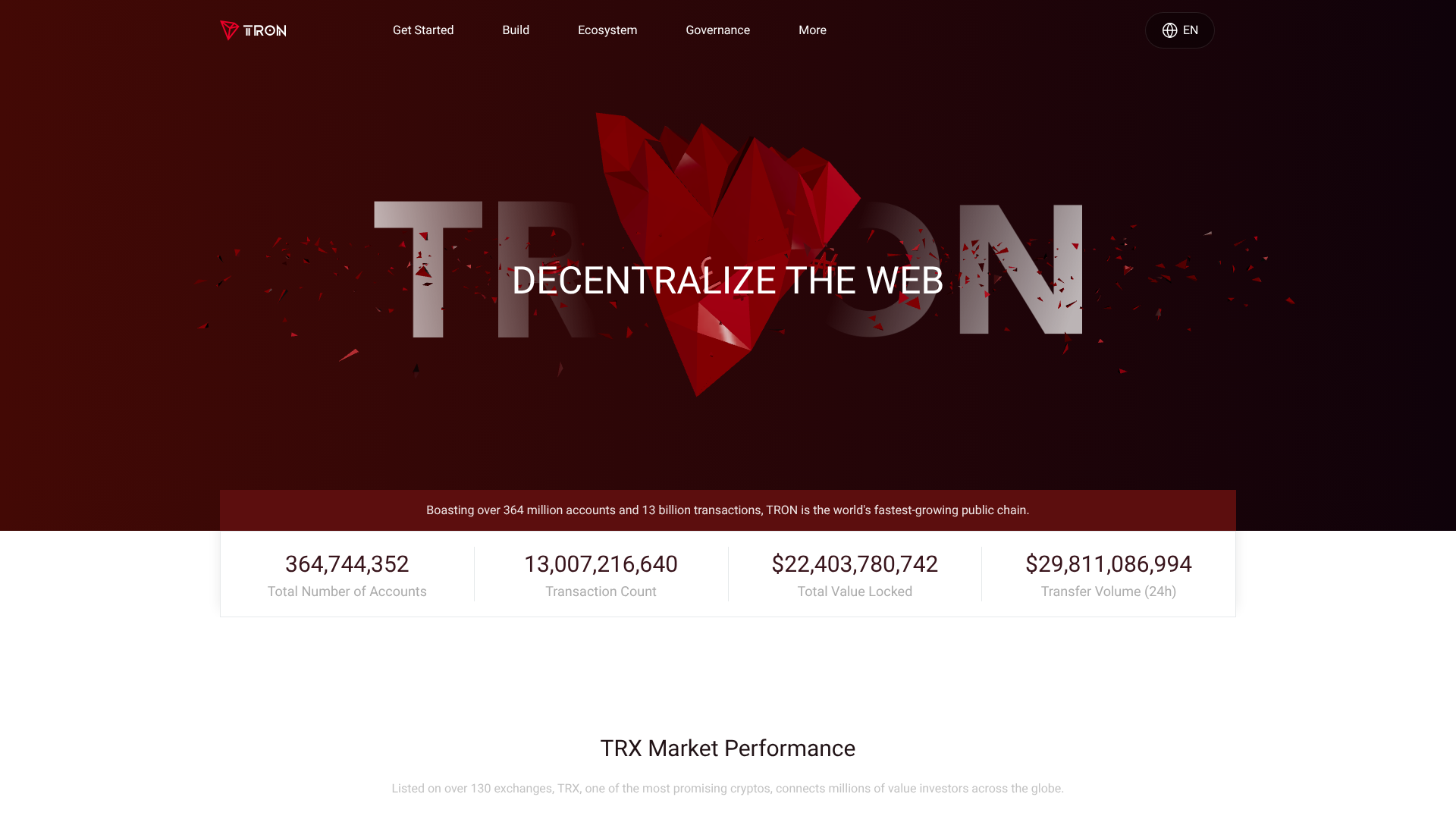
Tron is a high-throughput blockchain platform that aims to decentralise the web, with a strong focus on the entertainment and content creation sectors. It uses a Delegated Proof-of-Stake (DPoS) system, which allows it to process transactions very quickly and at a low cost. It has a large and active user base, particularly in Asia, and is home to the world's largest stablecoin by circulation (USDT).
- Consensus Mechanism: Delegated Proof-of-Stake (DPoS)
- Programming Language: Solidity
- EVM Compatible: Yes
Pros
- High Throughput: Capable of handling a large volume of transactions.
- Extremely Low Costs: Transactions are virtually free.
- Large User Base: One of the most actively used blockchains in the world.
Cons
- Centralisation: The DPoS model with 27 'Super Representatives' is highly centralised.
- Controversy: The project and its founder have been involved in numerous controversies over the years.
11. Tezos (XTZ)
Tezos is a self-amending blockchain, meaning it can upgrade itself without needing to fork or split the network. Changes are proposed and voted on by token holders, allowing the platform to evolve over time. It has a strong focus on formal verification, making it a secure choice for high-value smart contracts and digital assets.
- Consensus Mechanism: Liquid Proof-of-Stake (LPoS)
- Programming Language: Michelson, SmartPy
- EVM Compatible: No (but EVM-compatible layers are being developed)
Pros
- On-Chain Governance: A formalised process for upgrades reduces the risk of contentious forks.
- Security-Focused: Strong emphasis on formal verification for smart contracts.
- Energy Efficient: Its LPoS mechanism is environmentally friendly.
Cons
- Complex Governance: The on-chain governance process can be slow.
- Smaller Developer Community: Its unique programming languages have a steeper learning curve.
12. Hyperledger Fabric
Unlike the others on this list, Hyperledger Fabric is a permissioned blockchain framework designed for enterprise use cases. It's not a public network that anyone can join. Instead, businesses can use it to build private, consortium-based blockchain solutions for things like supply chain management, finance, and healthcare. It offers modularity, confidentiality, and high performance within a controlled environment.
- Consensus Mechanism: Pluggable (e.g., Raft)
- Programming Language: Go, Java, JavaScript (Node.js)
- EVM Compatible: No
Pros
- Permissioned and Private: Ideal for businesses that need control over who can participate in the network.
- High Performance: Can achieve very high transaction throughput in a controlled setting.
- Confidential Transactions: Data can be shared only with the necessary parties on the network.
Cons
- Not Decentralised: It is inherently centralised, which is a feature for enterprises but a bug for public applications.
- Complex to Set Up: Requires significant expertise to deploy and manage.
Comparing the Giants: A Side-by-Side Look
To help you visualise the differences between the top contenders, here’s a comparison table highlighting their key attributes.
| Feature | Ethereum | Solana | Cardano | Avalanche | Polygon (PoS) |
|---|---|---|---|---|---|
| Consensus | Proof-of-Stake | PoH + PoS | Ouroboros PoS | Avalanche PoS | Proof-of-Stake |
| Avg. TPS | ~15-30 (L1) | 2,000+ | ~250 | 4,500+ | ~7,000 |
| Avg. Fee | Variable ($1-$50+) | < $0.001 | ~$0.10 | ~$0.05 | < $0.01 |
| Primary Language | Solidity | Rust | Plutus/Haskell | Solidity | Solidity |
| EVM Compatible? | Yes | No | No | Yes | Yes |
Understanding Costs: Transaction Fees and Development Expenses
The cost of using a smart contract platform extends beyond just the gas fees paid by users. For businesses and developers, the total cost of ownership includes several other critical factors.
Development costs are a major consideration. Hiring skilled blockchain developers is expensive, and the talent pool varies by platform. Solidity developers for EVM-compatible chains are the most abundant, which can make hiring easier. In contrast, finding experienced developers for Rust (Solana) or Haskell (Cardano) can be more challenging and costly.
Another significant expense is security auditing. Before deploying any smart contract that will handle real value, a thorough security audit by a reputable firm is essential. Audits can cost tens of thousands of pounds, depending on the complexity of the code. This is a non-negotiable expense for any serious project, as a single vulnerability can lead to catastrophic losses.
Finally, consider the infrastructure and maintenance costs. Running nodes, monitoring the application's health, and managing upgrades all require ongoing resources. While some platforms offer a more seamless experience, building and maintaining a reliable dApp is a continuous financial and operational commitment.
Pro Tip: When budgeting, factor in a 'gas stipend' for your users, especially during the initial launch phase. Sponsoring user transactions or subsidising gas fees can significantly improve the onboarding experience and drive early adoption, particularly on more expensive networks.
Frequently Asked Questions
Here are answers to some of the most common questions people have when exploring the list of smart contract platforms.
Which smart contract platform is best?
There is no single 'best' platform; the ideal choice depends entirely on your specific use case. If you need the highest level of security and decentralisation for a high-value DeFi application, Ethereum is likely the top choice. If you're building a game that requires thousands of transactions per second at a very low cost, Solana or a Layer-2 like Polygon would be far more suitable.
The best approach is to define your project's priorities across scalability, security, cost, and developer experience. Then, use this guide to find the platform that offers the optimal trade-offs for your needs. It's about finding the right tool for the job.
What are the top 5 blockchain platforms?
Based on market capitalisation, developer activity, and user adoption, the top 5 blockchain platforms for smart contracts are generally considered to be:
- Ethereum (ETH): The original and largest ecosystem.
- Solana (SOL): The leader in transaction speed and low costs.
- BNB Smart Chain (BSC): A popular, low-cost EVM-compatible alternative.
- Avalanche (AVAX): Known for its subnet architecture and fast finality.
- Cardano (ADA): A research-driven platform focused on security and sustainability.
Which blockchain is most commonly used for smart contracts?
Ethereum is, by a significant margin, the most commonly used blockchain for smart contracts. It has first-mover advantage and has cultivated the largest and most robust ecosystem of developers, tools, and decentralised applications. The vast majority of DeFi protocols, NFT projects, and DAOs were first built on Ethereum, and its total value locked (TVL) still dwarfs that of all its competitors combined.
Even with the rise of other platforms, Ethereum's network effect remains incredibly powerful. Its battle-tested security and extensive infrastructure make it the default choice for many high-value projects, establishing it as the foundational settlement layer of the Web3 economy.
Can Solana do smart contracts?
Yes, absolutely. Solana is a high-performance blockchain specifically designed to host smart contracts and decentralised applications. Its ability to execute smart contracts at a very high speed and low cost is its primary value proposition. While Ethereum uses the Solidity programming language, Solana smart contracts are typically written in Rust, C, or C++.
This performance has made it a leading platform for use cases that are difficult to build on slower, more expensive chains. This includes on-chain order book exchanges, NFT marketplaces that require frequent minting and trading, and Web3 games with complex in-game economies.
Final Thoughts
The landscape of smart contract platforms is more vibrant and diverse than ever. The days of Ethereum being the only viable option are long gone. Today, developers and businesses have a rich list of choices, each with distinct advantages and trade-offs. From the unmatched security of Ethereum to the raw speed of Solana and the interoperable vision of Polkadot, there is a platform tailored to nearly any use case.
Making the right choice requires a deep understanding of your project's goals. By carefully evaluating the core features of scalability, security, decentralisation, and cost, you can select a foundation that not only supports your application today but also allows it to grow and thrive in the future. Use this guide as your starting point to explore these powerful technologies and find the perfect home for your next big idea.