


Automatic Content Generation: A Marketer's Guide to Scaling Content
The demand for high-quality content is relentless. For marketers and business owners, keeping up with blog posts, social media updates, emails, and video scripts can feel like a never-ending task. This is where the process of automatic content generation comes in, offering a powerful way to increase output without sacrificing quality—when used correctly. It's not about replacing human creativity but augmenting it, allowing you to produce more, faster, and with greater consistency.
- What You'll Learn
- What Exactly is Automatic Content Generation?
- The Journey of Content Automation: From Templates to AI
- What Can You Create? Types of Automated Content
- The Upside: Key Benefits of Automatic Content Generation
- Unmatched Speed and Scalability
- Significant Cost Reduction
- Enhanced Consistency Across Channels
- Overcoming Writer's Block and Boosting Creativity
- Personalisation at Scale
- Navigating the Hurdles: Challenges and Limitations of Automated Content
- The Risk of Factual Inaccuracy ("Hallucinations")
- Lack of Nuance, Emotion, and Brand Voice
- Potential for SEO Penalties if Misused
- The Need for Human Oversight and Editing
- Auto Content Creation in Action: Industry Applications
- E-commerce: Product Descriptions and Reviews
- Marketing: Ad Copy, Emails, and Social Media Posts
- Journalism: Weather Reports and Financial Summaries
- Real Estate: Property Listings
- Software Development: Code Snippets and Documentation
- Human vs. Machine: A Head-to-Head Comparison
- The Toolkit: Popular Automatic Content Generation Software
- What's Next? The Future of Automated Content
- Hyper-Personalisation and Real-Time Generation
- Multimodal AI
- Deeper Integration with Workflows
- AI as a Creative Partner, Not Just a Tool
- The Human Element: Ethical Considerations in Auto Content Creation
- Transparency and Disclosure
- Bias in AI Models and Its Impact
- Copyright and Ownership of AI-Generated Works
- The Spread of Misinformation
- Frequently Asked Questions
- What is auto-generated content?
- How to automate your content creation?
- What is an example of content automation?
- Why is my text saying it's AI-generated?
- What are the 4 types of content?
- Final Thoughts
This guide explains everything you need to know about content automation. We'll cover how the technology works, its benefits and limitations, the best tools for the job, and the ethical considerations you need to keep in mind. By the end, you'll understand how to integrate automated content into your strategy to save time, reduce costs, and scale your marketing efforts effectively.
What You'll Learn
- What It Is: Automatic content generation uses AI, particularly Natural Language Processing (NLP), to create text, images, video, and audio with minimal human input, moving far beyond simple templates.
- Key Benefits: The primary advantages are massive scalability and speed, significant cost savings compared to manual creation, and enhanced brand consistency across all channels.
- The Human Role is Crucial: Despite its power, automated content requires human oversight for fact-checking, editing for brand voice, and adding the emotional nuance that AI currently lacks.
- It's More Than Just Text: Modern tools can generate a wide array of content, including realistic AI-powered videos, voiceovers, marketing copy, social media graphics, and even computer code.
- A Hybrid Approach is Best: The most successful strategies combine the efficiency of AI with the creativity and strategic oversight of human content creators for the best results.
What Exactly is Automatic Content Generation?
Automatic content generation is the process of using artificial intelligence (AI) and machine learning (ML) algorithms to produce content without direct human writing or creation at every step. At its core, it relies on a technology called Natural Language Generation (NLG), a subset of AI that focuses on creating human-like text from data inputs.
Think of it less like a simple copy-and-paste template and more like a highly skilled assistant. You provide a prompt, data, or a set of instructions, and the AI model uses its vast training to generate a unique piece of content based on your request. For example, you could ask it to write a 500-word blog post about the benefits of email marketing, and it would draft an article complete with an introduction, body paragraphs, and a conclusion.
This process is powered by Large Language Models (LLMs) like OpenAI's GPT series. These models have been trained on billions of data points from the internet, including books, articles, and websites. This training allows them to understand context, grammar, tone, and style, enabling them to generate coherent and often indistinguishable from human-written text.
The Journey of Content Automation: From Templates to AI

The idea of generating content automatically isn't new, but the technology has evolved dramatically. Understanding this history helps clarify how we arrived at the sophisticated tools available today.
In the early days, content automation was rudimentary. Think of mail merge in the 1990s, where you could automatically insert names into a standard email template. This was a form of rule-based generation. The system followed a simple IF-THEN logic, but it lacked any real intelligence or flexibility.
It couldn't create anything truly new.
The next major leap came with more advanced Natural Language Generation (NLG) systems in the 2000s and 2010s. These were primarily used to turn structured data into narrative text. For instance, news organisations used them to automatically write earnings reports by feeding stock data into a template or to generate weather forecasts from meteorological data. While more advanced, these systems were still heavily structured and lacked creative capabilities.
The real shift occurred with the development of the transformer architecture in 2017, which paved the way for modern LLMs. Models like GPT-2, GPT-3, and now GPT-4 demonstrated an incredible ability to generate creative, coherent, and contextually relevant text on almost any topic. This moved auto content creation from a data-to-text function to a true creative partner, capable of drafting articles, writing poetry, and even generating code.
As of 2026, the technology has expanded beyond text. We now have multimodal AI that can generate images from a text description (like DALL-E or Midjourney), create videos with AI avatars, and produce realistic human-like voiceovers. This evolution has transformed content automation from a niche tool for data reporting into a cornerstone of modern marketing and content creation workflows.
What Can You Create? Types of Automated Content
The scope of what you can produce with automatic content generation tools has expanded far beyond simple text. Today's platforms can handle a diverse range of formats, catering to nearly every aspect of a modern content strategy.
Written Content
This is the most common and developed area of content automation. AI tools can produce a vast array of written materials with impressive speed.
- Blog Posts & Articles: Generate drafts, outlines, or even full articles from a simple prompt.
- Social Media Captions: Create engaging captions for platforms like Instagram, LinkedIn, and Twitter, often tailored to each platform's tone.
- Email Marketing Copy: Write subject lines, body copy for newsletters, and entire automated email sequences.
- Ad Copy: Generate multiple variations of copy for Google Ads, Facebook Ads, and other platforms to A/B test performance.
- Product Descriptions: Create unique and persuasive descriptions for hundreds or thousands of e-commerce products.
Visual Content
AI's visual capabilities are rapidly advancing, allowing for the creation of unique graphics and videos without needing design or video production skills.
- AI-Generated Images: Create custom images, illustrations, and graphics from text prompts using tools like OpenArt.
- AI Videos: Produce videos using AI avatars that speak a script you provide. Tools like Synthesia are leaders in this space, making video production accessible without cameras or actors.
- Article-to-Video Conversion: Platforms like Pictory can automatically turn a blog post into a summary video, complete with stock footage, captions, and a voiceover.
Audio Content
Text-to-speech technology has become incredibly realistic, opening up new possibilities for audio content.
- Voiceovers: Generate natural-sounding voiceovers for videos, presentations, and e-learning modules.
- Podcast Production: Create AI-generated audio for podcast intros, outros, or even entire episodes for certain formats.
- Audiobooks: Convert written text into audiobooks with a variety of AI voices.
Data-Driven Reports and Code
Beyond typical marketing content, automation is also powerful for technical and data-heavy tasks.
- Business Reports: Automatically generate summaries of financial data, sales performance, or market analytics.
- Code & Documentation: AI coding assistants like Replit's Ghostwriter can write code snippets, debug existing code, and generate technical documentation.
The Upside: Key Benefits of Automatic Content Generation
Adopting content automation into your workflow can provide a significant competitive advantage. The benefits extend beyond just saving time; they can fundamentally change how you approach content strategy and execution.
Unmatched Speed and Scalability
This is the most immediate and impactful benefit. A human writer might take several hours to research and write a 1,500-word blog post. An AI tool can generate a first draft in minutes. This speed allows you to scale your content production exponentially. Instead of publishing one blog post a week, you could publish five. Instead of testing two ad copy variations, you could test twenty. This ability to scale is impossible to achieve with manual efforts alone.
Significant Cost Reduction
Hiring freelance writers, designers, and video producers can be expensive. While AI tools have subscription costs, they are often a fraction of the price of outsourcing content creation. For a startup or small business, this can make a high-volume content strategy financially viable. The return on investment comes from producing more content—which drives more traffic and leads—for a lower per-unit cost.
Enhanced Consistency Across Channels
Maintaining a consistent brand voice, tone, and style across your website, social media, and email marketing can be challenging, especially with multiple team members or freelancers. You can train or guide AI tools to adhere to specific brand guidelines. This ensures that all your automated content, from a tweet to a whitepaper, feels cohesive and reinforces your brand identity.
Overcoming Writer's Block and Boosting Creativity
Even the most experienced writers face writer's block. AI can be an excellent creative partner. It can generate ideas, create outlines, or provide a first draft that you can then refine and build upon. This removes the pressure of starting with a blank page and allows human creators to focus on higher-level tasks like strategy, editing, and adding unique insights.
Pro Tip: Use AI not just for final drafts, but for brainstorming. Ask it for 20 blog post titles about your topic, to list common customer pain points, or to rephrase a boring sentence in five different ways. This can spark new ideas and improve the quality of your manually written content.
Personalisation at Scale
AI can generate highly personalised content based on user data. For example, an e-commerce company can use AI to create personalised email promotions based on a customer's browsing history. A news site can generate personalised news summaries based on a reader's interests. This level of personalisation at scale is nearly impossible to achieve manually and can significantly improve engagement and conversion rates.
Navigating the Hurdles: Challenges and Limitations of Automated Content
While the benefits are compelling, it's crucial to approach automatic content generation with a realistic understanding of its limitations. Relying on it blindly can lead to poor quality content, factual errors, and even damage to your brand's reputation.
The Risk of Factual Inaccuracy ("Hallucinations")
AI models can sometimes generate information that is plausible-sounding but completely false. This phenomenon is often called "hallucination." The AI doesn't "know" it's lying; it's simply predicting the next most likely word in a sequence, which can sometimes lead it to invent facts, statistics, or sources. For this reason, all AI-generated content, especially content that includes data or factual claims, must be rigorously fact-checked by a human expert.
Lack of Nuance, Emotion, and Brand Voice
AI is excellent at mimicking patterns, but it struggles to replicate genuine human emotion, subtle humour, or deep-seated brand personality. An AI-generated article might be grammatically perfect and well-structured, but it can also feel generic, soulless, or slightly off-brand. The final polish, the unique insights, and the authentic voice that connect with an audience must come from a human editor.
Potential for SEO Penalties if Misused
Google's stance on AI content is nuanced. They are not against AI-generated content itself, but they are against low-quality, spammy content created solely to manipulate search rankings. If you use AI to mass-produce unedited, unoriginal, and unhelpful articles, you risk being penalised. The key is to use AI as a tool to create high-quality, helpful, and people-first content, which always involves human review and enhancement.
The Need for Human Oversight and Editing
This is the most important limitation to understand. Automatic content generation is not a "set it and forget it" solution. It's a powerful assistant, but it still needs a human director. The best workflow involves using AI to generate a first draft (the 80%) and then having a human editor refine, fact-check, and add value (the final 20%). Without this human touch, the quality of your content will suffer.
Auto Content Creation in Action: Industry Applications
Content automation is not just a theoretical concept; it's being actively used across various industries to solve real-world problems and improve efficiency. Here are a few practical examples of how different sectors are using this technology.
E-commerce: Product Descriptions and Reviews
For an online store with thousands of products, writing unique descriptions for each one is a monumental task. E-commerce businesses use AI to generate engaging, SEO-optimised product descriptions at scale. By feeding the AI key product features and specifications, it can produce compelling copy that highlights benefits and encourages purchases. Some platforms even use it to summarise customer reviews, providing shoppers with a quick overview of public opinion.
Marketing: Ad Copy, Emails, and Social Media Posts
This is one of the biggest areas for content automation. Marketing teams use tools like HubSpot's AI features to draft email campaigns, social media updates, and blog posts. For performance marketing, AI can generate dozens of variations of ad copy for platforms like Facebook and Google, allowing marketers to quickly test and identify the most effective messaging.
Journalism: Weather Reports and Financial Summaries
Major news organisations like the Associated Press and Reuters have been using automated content for years. They use NLG systems to convert structured data into news stories. For example, they can automatically generate quarterly earnings reports for companies or create local weather forecasts. This frees up human journalists to focus on more in-depth, investigative reporting.
Real Estate: Property Listings
Writing compelling property descriptions that capture the essence of a home can be time-consuming for real estate agents. AI tools can take a list of property features (e.g., number of bedrooms, square footage, amenities, location) and instantly generate a descriptive and appealing listing. This ensures consistency and saves agents valuable time.
Software Development: Code Snippets and Documentation
In the tech world, AI is used to accelerate development cycles. AI coding assistants can write boilerplate code, suggest code completions, and even identify bugs. They are also used to generate technical documentation, explaining what a piece of code does in plain English, which helps with team collaboration and onboarding new developers.
Human vs. Machine: A Head-to-Head Comparison
To truly understand the role of automatic content generation, it's helpful to compare it directly with manual content creation. Neither is inherently superior; they have different strengths and weaknesses. The optimal strategy often lies in combining them.
| Feature | Manual Content Creation | Automatic Content Generation |
|---|---|---|
| Speed | Slow; hours or days per piece | Extremely fast; minutes per piece |
| Scale | Limited by human capacity | Virtually unlimited |
| Cost | High (salaries, freelance fees) | Low to moderate (software subscription) |
| Creativity | High; capable of original ideas and deep insight | Moderate; excellent at recombination, but lacks true originality |
| Emotional Nuance | High; can convey genuine emotion and empathy | Low; struggles with subtlety and authentic feeling |
| Factual Accuracy | High (with proper research) | Variable; requires human fact-checking |
| Consistency | Can vary between creators | High; can adhere strictly to guidelines |
The table makes it clear: AI wins on speed, scale, and cost-efficiency. Humans win on creativity, emotional depth, and accuracy. This is why a hybrid approach is so powerful. You can use AI for the heavy lifting—generating drafts, brainstorming ideas, and producing content at scale—while relying on human creators for the critical tasks of strategic direction, fact-checking, editing for brand voice, and adding the unique insights that build a true connection with your audience.
The Toolkit: Popular Automatic Content Generation Software
The market for content automation tools has exploded. Choosing the right one depends on the type of content you want to create. Here’s a look at some of the leading platforms across different categories.
AI Writing Assistants
These tools are designed to help with all forms of written content, from blog posts to ad copy.
1. Jasper (formerly Jarvis)
Jasper is one of the most well-known AI writing assistants, praised for its high-quality output and extensive template library. It's designed for marketing teams and content creators who need to produce a variety of content formats quickly.
Pros:
- High-Quality Output: Often produces content that requires less editing than competitors.
- Versatile Templates: Offers over 50 templates for different content types, including blog posts, social media ads, and video scripts.
- Brand Voice Feature: You can train Jasper on your own content to match your specific style and tone.
Cons:
- Higher Price Point: Can be more expensive than some other options, especially for teams.
- Learning Curve: The sheer number of features can be overwhelming for new users.
2. Writesonic
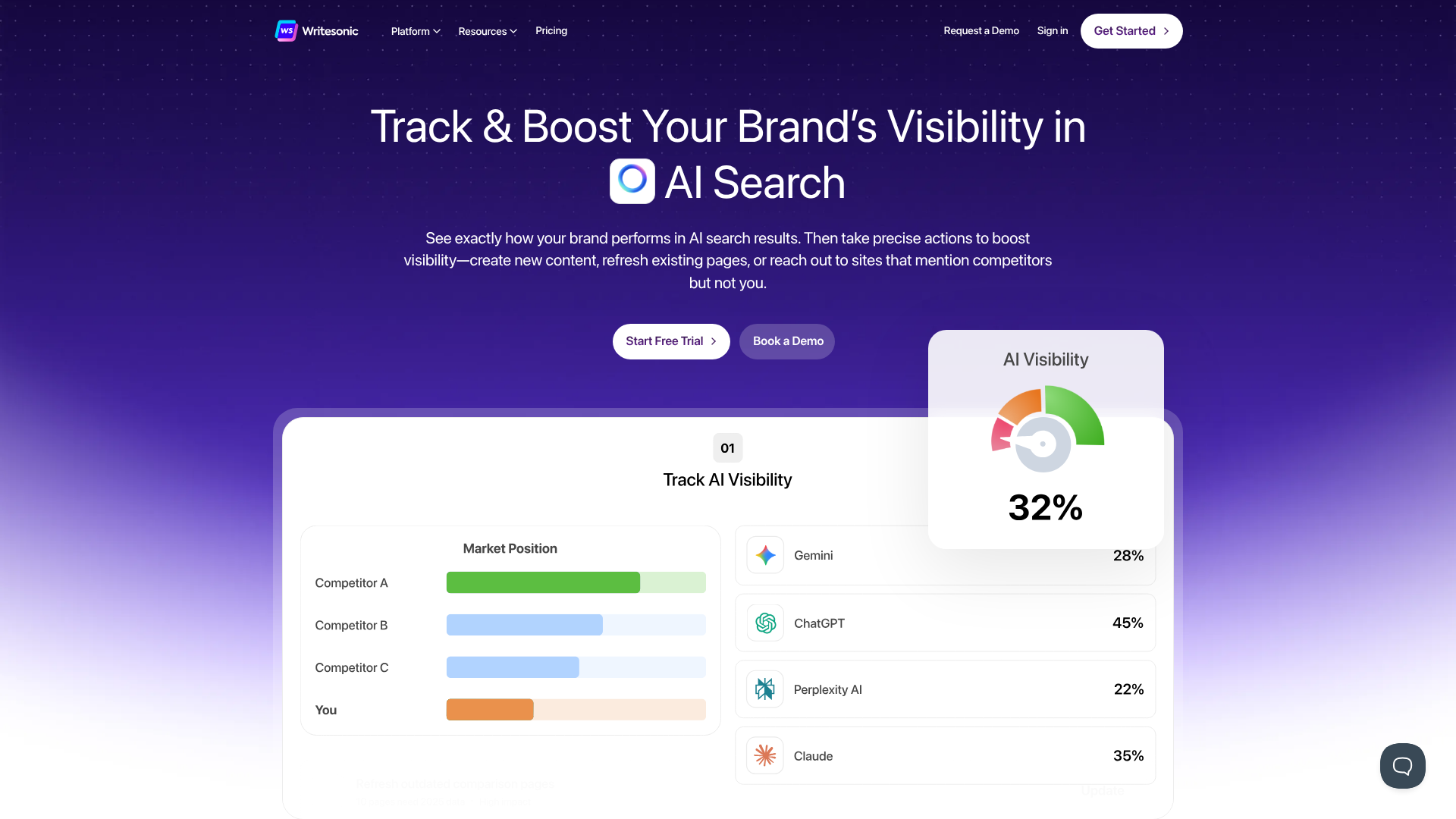
Writesonic is another powerful AI writer that positions itself as an all-in-one platform for content creation. It offers a wide range of features, including an AI article writer, a paraphrasing tool, and integrations with other platforms.
Pros:
- Feature-Rich: Includes tools for writing, editing, and even AI-generated art.
- Factual Accuracy: Offers a feature that integrates with Google Search to provide more up-to-date and factually accurate information.
- Competitive Pricing: Often provides more generous plans compared to direct competitors.
Cons:
- Output Can Be Inconsistent: While generally good, the quality can sometimes vary, requiring more editing.
- UI Can Feel Cluttered: With so many features, the user interface can sometimes be difficult to navigate.
AI Video Generators
These platforms allow you to create professional-looking videos without cameras, microphones, or actors.
1. Synthesia

Synthesia is a leader in AI video generation, focusing on creating videos with realistic AI avatars. You simply type a script, choose an avatar, and the platform generates a video of the avatar speaking your text.
Pros:
- Realistic Avatars: Offers a wide selection of high-quality, natural-looking AI avatars.
- Multi-Language Support: Can generate videos in over 120 languages and accents.
- Easy to Use: The platform is incredibly intuitive, making video creation accessible to anyone.
Cons:
- Cost: It's a professional tool with pricing that may be high for individuals or very small businesses.
- Limited Customisation: While you can change backgrounds and add text, the creative options are more limited than traditional video editing.
2. Pictory
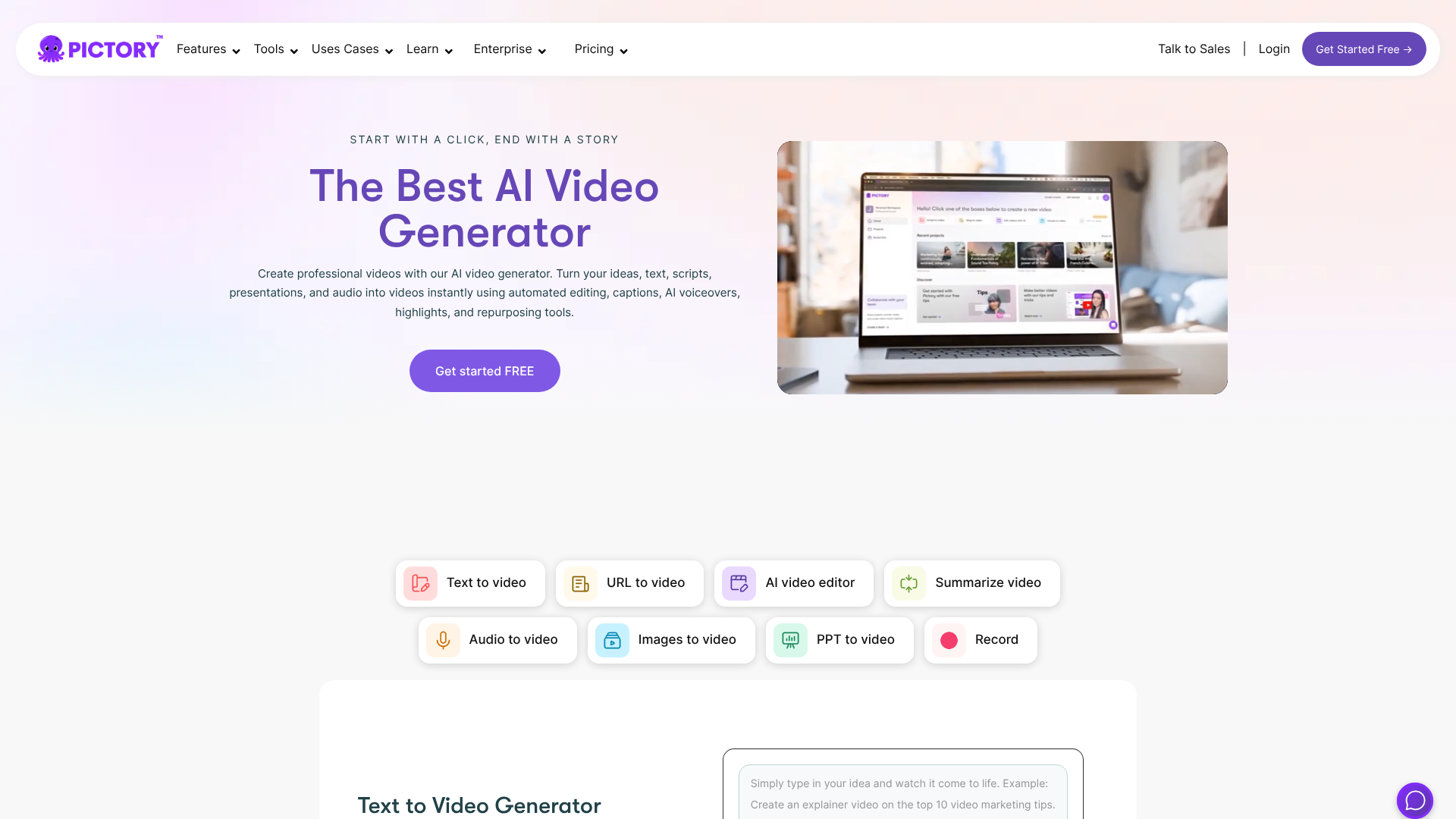
Pictory takes a different approach to AI video. It excels at turning long-form content, like blog posts or webinars, into short, engaging summary videos for social media.
Pros:
- Content Repurposing: Makes it incredibly easy to turn one piece of content into multiple formats.
- Automatic Visuals: The AI automatically selects relevant stock video clips and images to match your text.
- Fast and Efficient: Can create a video from a long article in just a few minutes.
Cons:
- AI Voice Quality: The AI-generated voiceovers are good but can sometimes sound less natural than dedicated voice tools.
- Stock Footage Can Be Generic: The AI's choice of visuals may occasionally need to be manually adjusted for better relevance.
AI Voice and Audio Tools
For podcasts, video voiceovers, and e-learning, these tools provide incredibly realistic text-to-speech generation.
1. Murf AI
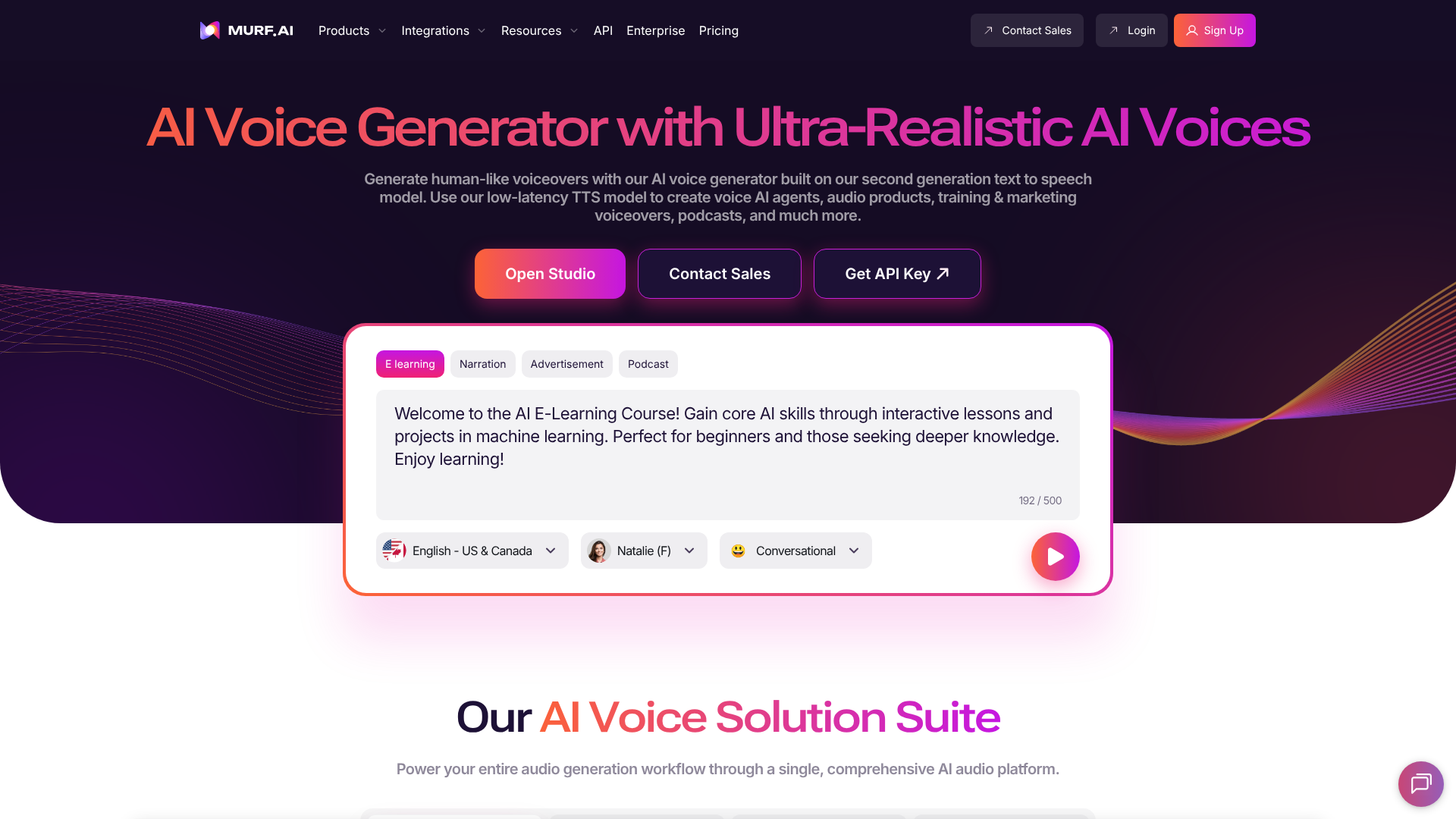
Murf AI is a versatile AI voice generator that offers a library of studio-quality voices for various applications. It provides extensive control over pitch, pacing, and emphasis.
Pros:
- High-Quality Voices: The voices are exceptionally realistic and suitable for professional projects.
- Voice Cloning: Allows you to create a digital clone of your own voice for consistent branding.
- Integrated Video Editor: You can sync voiceovers to videos and images directly within the platform.
Cons:
- Pricing Structure: Plans are based on voice generation time, which can add up for large projects.
2. ElevenLabs
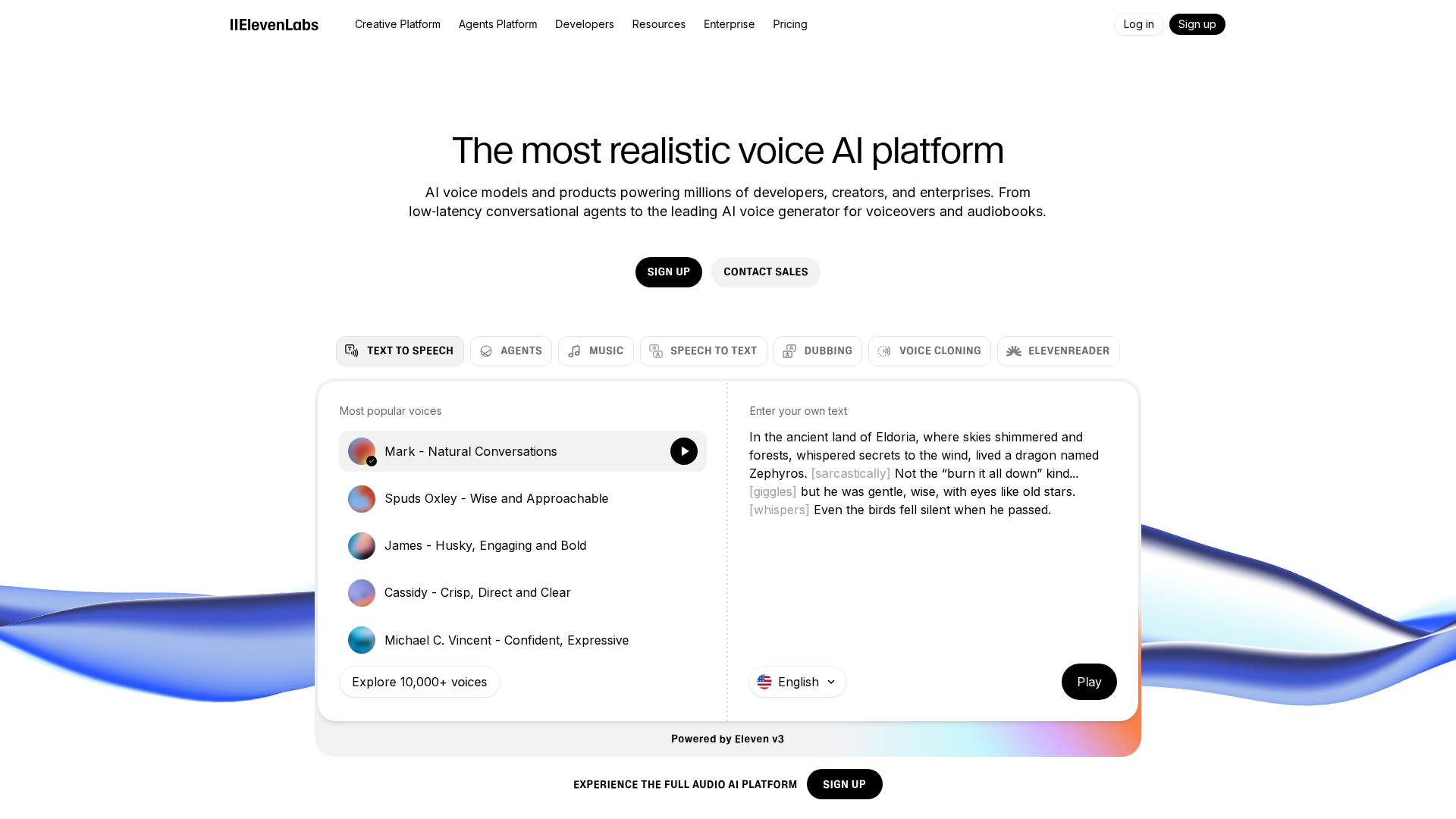
ElevenLabs is renowned for its emotionally expressive and lifelike AI voices. It's a top choice for creators who need narration that sounds truly human, particularly for storytelling and audiobooks.
Pros:
- Unmatched Realism: The AI voices are among the most natural and emotionally resonant on the market.
- Generous Free Tier: Offers a good amount of free usage for users to test the platform.
- Simple Interface: The platform is straightforward and easy to use.
Cons:
- Fewer Editing Features: Offers less granular control over voice characteristics compared to some competitors like Murf AI.
What's Next? The Future of Automated Content
The field of automatic content generation is evolving at a breathtaking pace. What seems advanced today will likely be standard tomorrow. Here are some of the key trends that will shape the future of automated content.
Hyper-Personalisation and Real-Time Generation
In the future, content won't just be created in advance; it will be generated in real-time for individual users. Imagine a website that rewrites its copy to match the visitor's technical expertise or an e-learning module that adapts its explanations based on a student's answers. This level of dynamic personalisation will create more engaging and effective user experiences.
Multimodal AI
Currently, we use different tools for text, images, and audio. The future is multimodal AI, where a single model can understand and generate content across all these formats simultaneously. You could give a prompt like, "Create a 30-second video about the benefits of our new software, using a confident female voiceover and showing visuals of the user interface," and the AI would generate the entire asset in one go.
Deeper Integration with Workflows
AI content tools will become less standalone and more deeply integrated into the platforms marketers already use. We're already seeing this with HubSpot and other CRMs incorporating AI writing assistants. In the future, your project management tool might automatically generate progress reports, or your analytics platform might write up a summary of key insights for you.
Pro Tip: To get the most out of content automation, create a detailed style guide for your brand. Include rules on tone of voice, preferred terminology, and formatting. Feed this guide to your AI tools (many now support this) to ensure the generated content aligns closely with your brand from the first draft.
AI as a Creative Partner, Not Just a Tool
As AI becomes more capable, its role will shift from a simple production tool to a genuine creative collaborator. It will be able to suggest novel marketing angles, identify gaps in your content strategy based on competitor analysis, and help you brainstorm truly original ideas. The human-AI partnership will be central to innovation in content creation.
The Human Element: Ethical Considerations in Auto Content Creation
With great power comes great responsibility. As we embrace content automation, it's vital to consider the ethical implications and establish best practices to ensure the technology is used responsibly.
Transparency and Disclosure
Should you disclose when content is AI-generated? There is a growing debate around this. For creative works or opinion pieces, transparency is key to maintaining trust with your audience. For more functional content like product descriptions, it may be less critical. Establishing a clear policy on disclosure is an important step for any brand using AI extensively.
Bias in AI Models and Its Impact
AI models are trained on vast amounts of data from the internet, and this data contains human biases. As a result, AI-generated content can sometimes perpetuate stereotypes related to gender, race, or culture. It's the responsibility of users and developers to be aware of these biases and to review and edit content to ensure it is fair and inclusive.
Copyright and Ownership of AI-Generated Works
The legal landscape around AI and copyright is still evolving. Who owns a piece of content created by an AI? The user who wrote the prompt? The company that developed the AI? The current legal consensus in many regions, including the US, is that works without human authorship cannot be copyrighted. This is a complex area that will continue to be defined by courts and legislation.
The Spread of Misinformation
The same technology that can be used to scale marketing content can also be used to generate and spread misinformation at an unprecedented scale. As creators, it is our ethical duty to ensure the information we publish is accurate. This reinforces the critical need for human fact-checking and oversight in any AI-driven content workflow.
Frequently Asked Questions
What is auto-generated content?
Auto-generated content is any text, image, video, or audio created using artificial intelligence algorithms with minimal direct human input. It's produced by AI models that have been trained on vast datasets, allowing them to generate new, unique content based on a user's prompt or instructions. This is different from template-based content, as the AI creates entirely new sentences and ideas rather than just filling in blanks.
How to automate your content creation?
To automate your content creation, start by identifying repetitive, high-volume tasks in your workflow, such as writing social media captions, product descriptions, or first drafts of blog posts. Next, choose an AI tool suited for that task (e.g., an AI writer like Jasper or a video generator like Synthesia). Develop clear prompts and provide the AI with brand guidelines to ensure consistency. Finally, and most importantly, establish a human review process to fact-check, edit for tone, and add unique insights to the AI-generated draft.
What is an example of content automation?
A common example is using an AI writing tool to generate product descriptions for an e-commerce website. A business can provide the tool with a list of product features, such as "100% organic cotton t-shirt, blue, crew neck, available in S-XL." The AI will then automatically write a unique, persuasive description for that product. This process can be repeated for thousands of products, saving hundreds of hours of manual work.
Why is my text saying it's AI-generated?
Text can be flagged as AI-generated by AI detection tools that analyse patterns in the writing. These tools look for certain characteristics that are often found in AI-generated text, such as overly consistent sentence structure, low perplexity (predictable word choices), and a lack of a distinct personal voice. While these detectors are not always accurate, text that is unedited straight from an AI model is more likely to be flagged. Editing the text to add your own voice and vary the sentence structure can help make it indistinguishable from human writing.
What are the 4 types of content?
While there are many ways to categorise content, a common framework divides it into four main types: written, visual, audio, and video. Automatic content generation tools are now available for all four categories. Written content includes blogs and emails. Visual content includes AI-generated images and infographics. Audio includes AI voiceovers and podcasts. Video content includes AI-avatar videos and article-to-video conversions.
Final Thoughts
Automatic content generation is no longer a futuristic concept; it's a practical and powerful tool that is reshaping the content landscape. When used strategically, it can help you break through production bottlenecks, scale your marketing efforts, and free up your team to focus on what humans do best: strategy, creativity, and building authentic connections.
The key to success is to view it not as a replacement for human talent, but as a powerful collaborator. The combination of AI's speed and scale with human insight and oversight is the formula for a truly effective and sustainable content strategy. By embracing this hybrid approach, you can stay ahead of the curve and meet the ever-growing demand for great content.
If you're ready to explore how these tools can fit into your workflow, platforms like Writesonic for text or Pictory for video offer a great starting point to experience the power of content automation firsthand.