

Semrush vs Ahrefs (2026): Which SEO Suite is Best for Your Business?
The debate over Semrush vs Ahrefs is one of the most common discussions in the digital marketing world. Both are powerful, industry-leading SEO platforms packed with tools to help you dominate search engine results. Choosing between them can feel overwhelming, as the right tool often depends entirely on your specific goals, budget, and marketing strategy.
- Quick Summary
- Semrush vs Ahrefs: A Quick Comparison Table
- An Introduction to the SEO Titans
- User Interface and Experience
- Core Feature Showdown: A Detailed Look
- SEO Toolkit: Technical and On-Page Audits
- Keyword Research: Uncovering Opportunities
- Backlink Analysis: The Link Building Battleground
- Content Marketing and Strategy Tools
- Pricing and Plans: Which Tool Offers Better Value?
- Who Should Choose Semrush? (Ideal Use Cases)
- Who Should Choose Ahrefs? (Ideal Use Cases)
- FAQ: Semrush vs Ahrefs
- Is there anything better than Semrush?
- What are the disadvantages of Semrush?
- Is Semrush a Russian company?
- Which tool is best for keyword research?
- Is Google Analytics better than Semrush?
- Final Thoughts: Making Your Decision
This guide cuts through the noise. We're not just listing features; we're breaking down the core strengths and weaknesses of each platform. Whether you're an in-house marketer needing an all-in-one solution or an SEO specialist focused on deep backlink analysis, this comparison will give you the clarity to make the right choice for your business.
Quick Summary
- Choose Semrush for an All-in-One Solution: Semrush is a comprehensive digital marketing suite that extends beyond SEO into PPC, content marketing, and social media management. It's ideal for marketers who need a single platform to manage multiple channels.
- Choose Ahrefs for SEO Specialisation: Ahrefs is widely considered the gold standard for backlink analysis and offers incredibly deep data for organic search strategy. It's the preferred tool for SEO purists and link-building experts.
- Key Differentiator: The core of the ahrefs vs semrush debate comes down to breadth versus depth. Semrush offers a wider range of marketing tools, while Ahrefs provides deeper, more specialised SEO and backlink data.
- Pricing and Value: Semrush's pricing tiers can offer more flexibility and features for small businesses and solo entrepreneurs, while Ahrefs' structure may provide better value for agencies managing many client projects.
Semrush vs Ahrefs: A Quick Comparison Table
To get a high-level overview, here's how the two platforms stack up against each other in key areas.
| Feature | Semrush | Ahrefs |
|---|---|---|
| Primary Focus | All-in-one digital marketing suite | Specialised SEO & backlink analysis |
| Backlink Database | Large and comprehensive | Widely considered the largest & most accurate |
| Keyword Research | Excellent, with powerful filtering & intent analysis | Strong, with deep SERP analysis features |
| Site Audits | Detailed technical and on-page SEO audits | Robust site audit tool with clear prioritisation |
| Content Marketing | Full content marketing platform (ideation, writing, audit) | Content Explorer for topic research & analysis |
| PPC & Ad Research | Extensive toolset for competitor ad analysis | Limited PPC features, focused on organic keywords |
| User Interface | Feature-rich, can have a steeper learning curve | Clean, data-focused, and generally intuitive |
| Free Trial | Offers a free trial | No free trial, offers free limited tools |
| Pricing | Starts around $129.95/month | Starts around $99/month |
An Introduction to the SEO Titans
Before diving into a feature-by-feature breakdown, it's important to understand the philosophy behind each tool. This context helps explain why they excel in different areas.
What is Semrush?
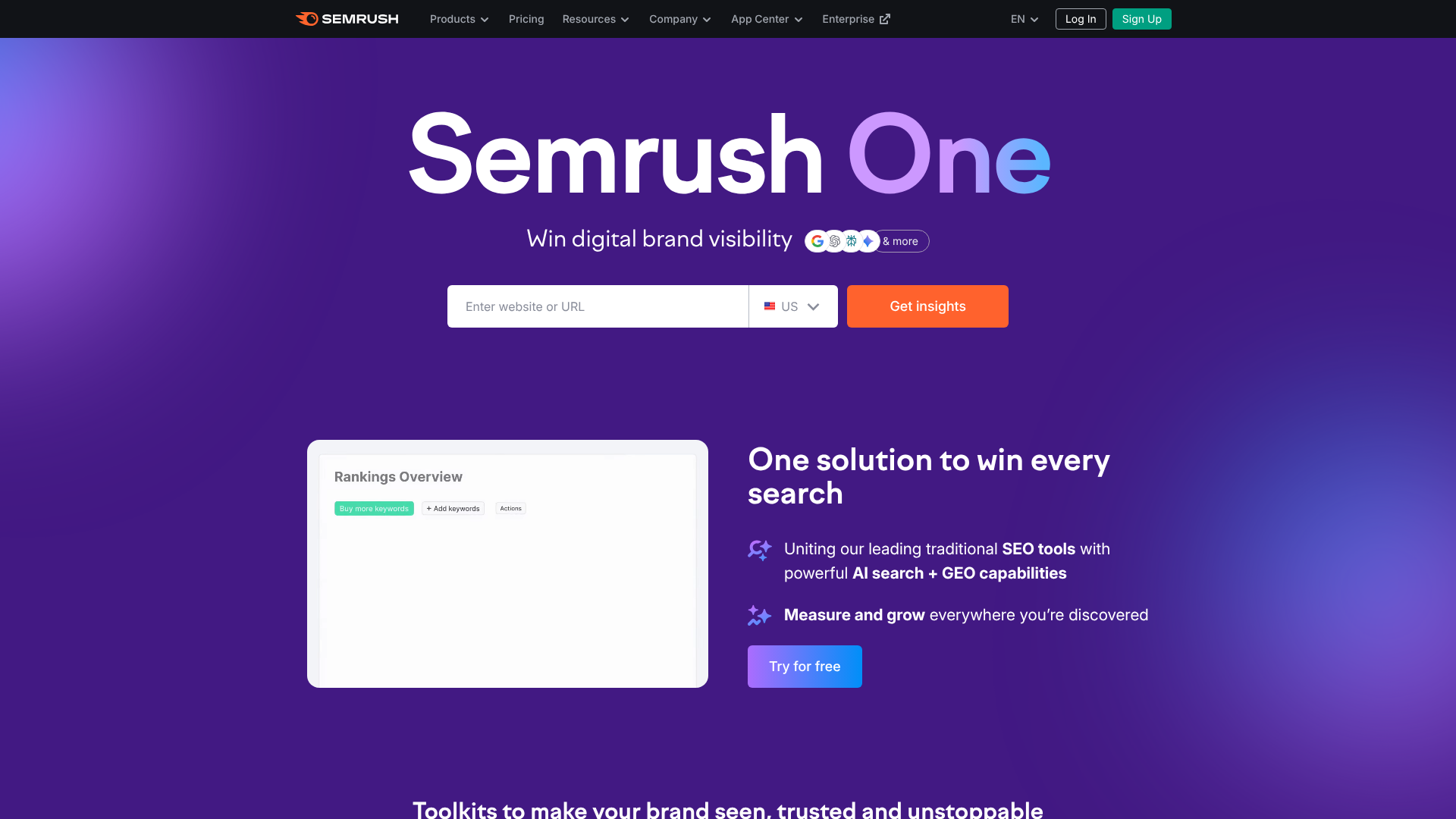
Semrush positions itself as a complete online visibility management platform. It started as an SEO tool but has since expanded dramatically to cover nearly every aspect of digital marketing. Its toolkit includes features for SEO, pay-per-click (PPC) advertising, content marketing, social media marketing, and market research.
This makes Semrush an attractive option for marketing generalists, small business owners, and marketing teams who need to see the bigger picture. Instead of subscribing to separate tools for keyword tracking, ad analysis, and social media scheduling, you can get it all under one roof. The platform's strength lies in its integration, allowing data from one toolkit to inform strategies in another.
What is Ahrefs?
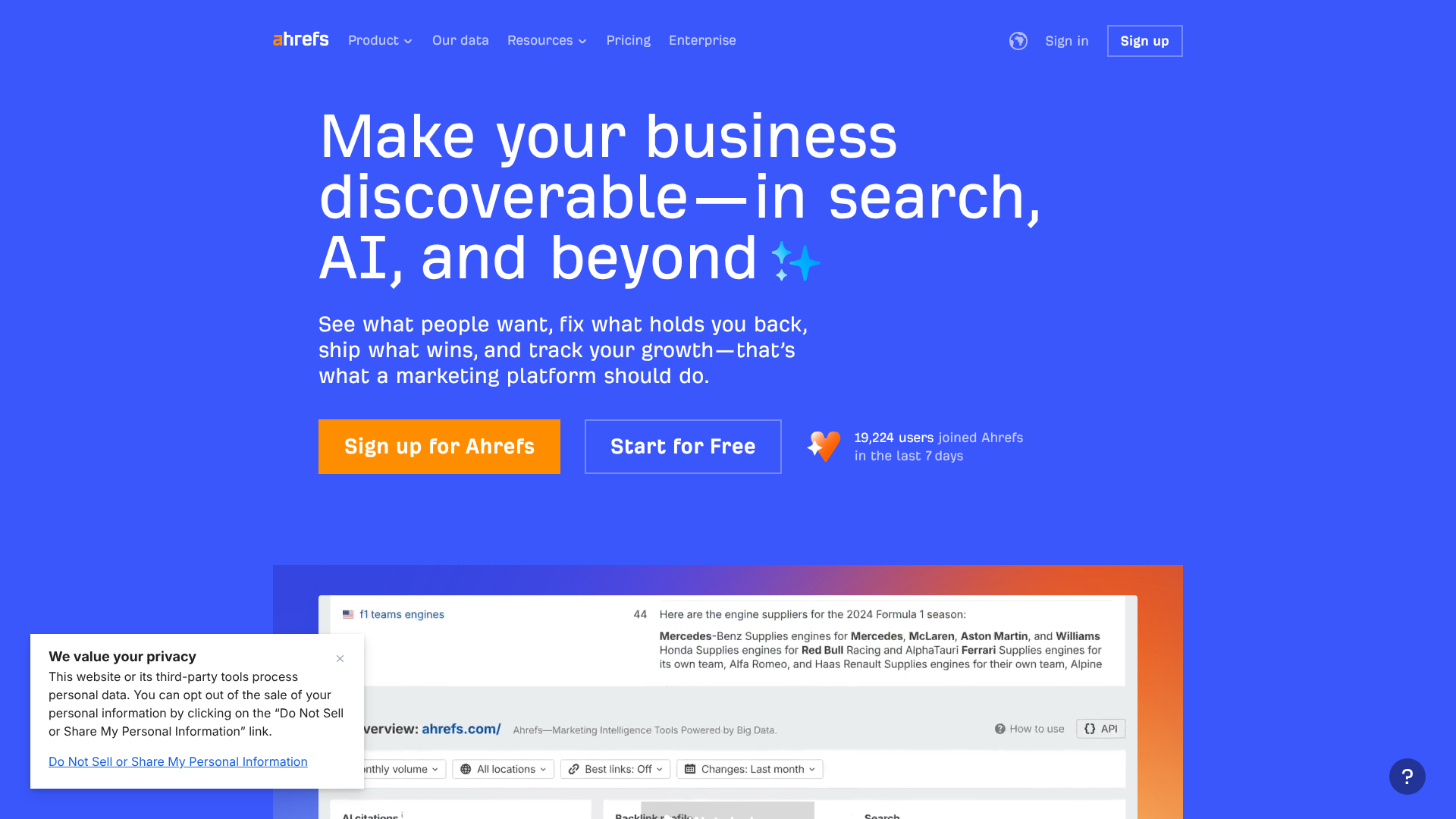
Ahrefs, on the other hand, has maintained a laser focus on being the absolute best tool for SEO professionals. While it has added features over the years, its heart and soul remain in its backlink index and organic search analysis capabilities. Ahrefs is renowned for having the most active web crawler next to Google, meaning its backlink data is incredibly fresh and comprehensive.
This specialisation makes Ahrefs the go-to choice for SEO agencies, in-house SEO experts, and anyone whose primary job is to improve organic search rankings through link building and technical SEO. The platform is built around providing deep, actionable data to inform sophisticated SEO strategies. If your role is purely SEO, Ahrefs offers a depth that is hard to match.
User Interface and Experience
How a tool feels to use daily can be just as important as the data it provides. Both Semrush and Ahrefs are complex platforms, but they approach user experience differently.
Semrush's dashboard is packed with information, menus, and options. Because it covers so many different marketing disciplines, the initial navigation can be slightly intimidating for new users. However, it organises its toolkits logically (SEO, Advertising, Content Marketing, etc.), and once you find your bearings, the workflow becomes more intuitive. The platform uses a lot of colourful graphs and charts to visualise data, making reports easy to understand at a glance.
Ahrefs presents a cleaner, more data-centric interface. The main dashboard provides a high-level overview of your tracked projects, and the primary tools (Site Explorer, Keywords Explorer, etc.) are clearly laid out. The design is minimalist, prioritising numbers and data tables over flashy graphics. This approach is often preferred by seasoned SEOs who want to get straight to the data without distractions.
The learning curve might be less about navigating menus and more about understanding the advanced metrics Ahrefs provides.
Core Feature Showdown: A Detailed Look

Now, let's get into the nitty-gritty. The choice between semrush or ahrefs often comes down to which tool performs better in the areas most critical to your work. We'll compare their core functionalities head-to-head.
SEO Toolkit: Technical and On-Page Audits
Both platforms offer powerful site audit tools that crawl your website to find technical and on-page SEO issues. These tools are crucial for maintaining a healthy site that search engines can easily crawl and understand.
Semrush's Site Audit tool is incredibly thorough, checking for over 140 different issues. It categorises problems into Errors (most critical), Warnings, and Notices. Each issue comes with a detailed explanation and a 'Why and how to fix it' guide, which is extremely helpful for beginners. It also provides thematic reports, focusing on areas like crawlability, site performance, and internal linking.
Ahrefs' Site Audit is equally capable and known for its speed. It provides an overall Health Score for your site and visualises data in a clear, actionable way. A key feature is its pre-configured filters for common SEO issues, such as finding orphan pages, pages with slow load times, or pages with missing meta descriptions. This allows you to quickly identify and prioritise fixes.
For many users, the way Ahrefs presents technical data feels more direct and less cluttered.
Keyword Research: Uncovering Opportunities
Keyword research is the foundation of any successful SEO strategy. Both tools offer fantastic features, but they have different strengths.
Semrush's Keyword Magic Tool is a powerhouse. You start with a seed keyword, and it generates millions of related terms, which you can filter by search volume, keyword difficulty, CPC, competitive density, and search intent (informational, navigational, commercial, transactional). The intent filter is particularly useful for aligning content with user needs. Semrush's keyword database is one of the largest on the market, covering over 140 countries.
Ahrefs' Keywords Explorer is also excellent. It provides in-depth SERP analysis for any keyword, showing you key metrics for the top-ranking pages, like their Domain Rating (DR), number of backlinks, and estimated traffic. A unique feature is the 'Clicks' metric, which estimates how many of the searches for a keyword actually result in a click. This helps you avoid targeting keywords where users get their answers directly from the search results page (like for weather forecasts or dictionary definitions).
Pro Tip: When comparing keyword difficulty scores between the two tools, don't focus on the absolute number. Each platform calculates this metric differently. Instead, use the score to compare the relative difficulty of keywords within the same tool.
Backlink Analysis: The Link Building Battleground
This is where the ahrefs vs semrush comparison becomes most heated. For years, Ahrefs has been considered the undisputed champion of backlink analysis.
Ahrefs' backlink index is massive and updated frequently. Its crawler is incredibly active, meaning it often finds new and lost backlinks faster than its competitors. The Backlink Profile report in Ahrefs is rich with data, allowing you to analyse a competitor's link profile with granular detail. You can see new and lost links, broken links, and filter by link type (e.g., dofollow, nofollow, governmental).
The 'Link Intersect' tool, which shows you sites that link to your competitors but not to you, is a goldmine for link-building opportunities.
Semrush has invested heavily in improving its backlink tools and has made significant strides. Its Backlink Analytics tool provides all the essential metrics you need, and its database is vast. Semrush offers a unique 'Backlink Audit' tool that integrates with Google Search Console. It analyses your backlink profile for toxic signals and helps you create and manage a disavow file, which is a valuable feature for sites recovering from penalties.
While its raw data might not be as fresh as Ahrefs', its workflow tools for link building outreach and auditing are excellent.
Content Marketing and Strategy Tools
Creating high-quality, SEO-optimised content is essential for ranking. Semrush has a clear advantage here with its dedicated Content Marketing Platform.
Semrush's platform is an end-to-end solution. It starts with the 'Topic Research' tool, which helps you brainstorm content ideas based on a seed keyword. From there, you can use the 'SEO Content Template' to get recommendations for your content based on the top 10 ranking rivals. As you write, the 'SEO Writing Assistant' (which integrates with Google Docs and WordPress) gives you real-time feedback on readability, SEO, originality, and tone of voice.
Finally, the 'Content Audit' tool helps you analyse your existing content to find pieces that need to be updated or removed.
Ahrefs' approach is more focused on analysis than creation. Its 'Content Explorer' tool is fantastic for research. You can enter a topic and find the most popular articles based on social shares, referring domains, and organic traffic. This is incredibly useful for understanding what type of content performs well in your niche and for finding 'content gaps'—keywords your competitors rank for that you don't.
While it doesn't offer writing assistance, its research capabilities are top-notch for informing your content strategy.
Pricing and Plans: Which Tool Offers Better Value?

Budget is a major factor in any software decision. The pricing structures of Semrush and Ahrefs cater to slightly different users, and it's important to understand the details.
Disclaimer: Pricing is subject to change. Please visit the official websites for the most current information.
Semrush Pricing
Semrush typically offers three main tiers:
- Pro: Aimed at freelancers, startups, and in-house marketers with a limited budget. It provides access to all the core toolkits but with limits on the number of projects, keywords to track, and reports you can run per day.
- Guru: Designed for SMEs and growing marketing agencies. This plan increases all the limits and adds features like the Content Marketing Platform, historical data, and branded reports.
- Business: Built for large agencies, e-commerce projects, and enterprises. It offers the highest limits, API access, and more advanced reporting features.
Semrush's value comes from the breadth of features included even in its base plan. You get access to SEO, PPC, and social media tools from the start.
Ahrefs Pricing
Ahrefs also has a tiered structure, often with four main plans:
- Lite: Suitable for small business owners and hobbyists. It provides access to all the core tools but with significant limitations on usage.
- Standard: Their most popular plan, aimed at SEO professionals and content marketers. It offers a good balance of features and usage limits.
- Advanced: For growing teams and businesses that need more data and higher limits.
- Enterprise: For large agencies and enterprises with extensive data needs.
Ahrefs' pricing is heavily tied to data consumption. A key difference is that higher-tier plans often include more 'power users' (seats) and more generous data allowances, which can make it more cost-effective for larger teams compared to Semrush's per-user pricing model.
Who Should Choose Semrush? (Ideal Use Cases)
You should choose Semrush if you are:
- An All-in-One Marketer: If your role involves managing SEO, PPC campaigns, social media, and content strategy, Semrush provides a unified platform that saves you from juggling multiple subscriptions.
- A PPC Specialist: Semrush's advertising toolkit is far more advanced than Ahrefs'. It offers deep insights into competitors' ad copy, keywords, and landing pages.
- A Content Marketing Team: The integrated workflow from topic research to writing assistance and content auditing makes it a superior choice for content creation at scale.
- A Small Business Owner: The Pro plan offers a huge range of tools for a competitive price, giving you a comprehensive marketing toolkit without breaking the bank.
Who Should Choose Ahrefs? (Ideal Use Cases)
You should choose Ahrefs if you are:
- An SEO Specialist or Purist: If your job lives and breathes organic search, Ahrefs' depth of data, especially in backlink analysis, is unparalleled.
- A Link Building Expert: The freshness and completeness of its link index, combined with tools like Link Intersect, make it the ultimate weapon for building high-quality backlinks.
- An SEO Agency: The platform's project management and reporting features are well-suited for agencies handling multiple clients, and its data is considered the industry benchmark.
- A Data-Driven Content Strategist: While it lacks writing tools, the Content Explorer is perfect for analysing what content works and identifying strategic opportunities based on hard data.
FAQ: Semrush vs Ahrefs
Here are answers to some of the most common questions people ask when comparing these two SEO giants.
Is there anything better than Semrush?
"Better" is subjective and depends on your needs. For backlink analysis, many experts argue Ahrefs is better. For an all-in-one marketing suite, Semrush is arguably the market leader. Other competitors like Moz offer strong features with a focus on user-friendliness, while SE Ranking provides a more budget-friendly alternative with a surprisingly robust feature set.
The best tool is the one that aligns with your specific goals and workflow.
What are the disadvantages of Semrush?
The primary disadvantage of Semrush can be its complexity. Because it does so much, the interface can feel overwhelming for new users. Some specialists also argue that while it's a jack-of-all-trades, it's a master of none, meaning its individual tools might not be as deep as a dedicated, specialised platform like Ahrefs for SEO or Buffer for social media.
Is Semrush a Russian company?
This is a common misconception. Semrush was founded in 2008 by Oleg Shchegolev and Dmitry Melnikov, who are of Russian origin. However, the company is now headquartered in Boston, Massachusetts, USA, and is a publicly traded company on the New York Stock Exchange (NYSE: SEMR). It operates globally with offices in several countries.
Which tool is best for keyword research?
Both are excellent, but they serve slightly different purposes. Semrush's Keyword Magic Tool is fantastic for brainstorming and generating a massive list of ideas, with great filtering options like search intent. Ahrefs' Keywords Explorer excels at deep SERP analysis, helping you understand the true difficulty and traffic potential of a keyword by analysing the top-ranking pages in detail.
Is Google Analytics better than Semrush?
This is like comparing apples and oranges. Google Analytics tells you what is happening on your website—who your visitors are, how they got there, and what they do. Semrush is a competitive research tool that tells you what is happening on other websites and across the entire search landscape. You need both: use Semrush to find opportunities and build your strategy, and use Google Analytics to measure the results of that strategy on your own site.
Final Thoughts: Making Your Decision
The semrush vs ahrefs comparison doesn't have a single winner for everyone. The right choice is deeply personal to your role, your team's needs, and your company's overall marketing objectives.
To put it simply: If you are a marketing professional who needs a powerful, versatile toolkit that covers SEO, PPC, content, and social media in one place, Semrush is almost certainly the better choice. Its breadth of features provides incredible value and allows for a more integrated marketing strategy.
However, if your primary focus is SEO, and you demand the most accurate, comprehensive, and up-to-date backlink and organic search data available, then Ahrefs is your tool. Its specialisation and depth in these core SEO areas remain the industry standard for a reason. Both platforms offer immense power; the key is to align that power with your specific mission.