

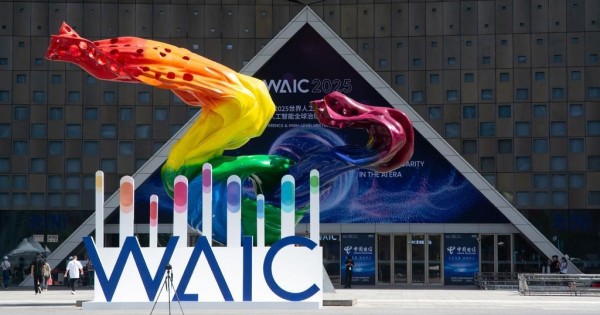

At the World AI Conference (WAIC) 2025 in Shanghai, Chinese Premier Li Qiang stood before tech leaders from over 40 countries and delivered a message that was part peace offering, part power move: If we don’t work together on AI, a few countries will run the table, and spoiler alert, China does not plan on being left out.
“AI can’t just be an exclusive club,” Li essentially said, hinting (without naming names) at the U.S. and its increasingly tight export controls on AI chips. Instead, he called for global cooperation and a shared AI governance framework that everyone, or at least most of the world, can get behind. Unity talk, sure. But the subtext? A clear shot at America’s tech dominance.
Just days after the White House dropped its national AI strategy, China has responded with its action plan.
The core strategy looks something like this: An economy-wide transformation by pushing AI across all industries, from manufacturing to healthcare. Building a domestic ecosystem through new industry alliances aimed at creating a tech stack that doesn’t rely on US chips.
Alternative chip development, demonstrated through Huawei’s CloudMatrix 384 system, is designed to overcome individual chip limitations. Partnerships with the Global South by offering technology transfers with fewer regulatory strings attached. The establishment of a global AI cooperation organization that will give China a leading voice in how AI is governed worldwide. We have seen this before, during the 5G rollout, countries were forced to choose between Huawei or Western alternatives. But AI raises the stakes significantly. Nations that align with China’s ecosystem may get access to technology with fewer strings attached, while those in the US camp get premium tech with stricter export controls.
For tech companies, the pressure to choose an AI ecosystem is intensifying. Chinese firms are doubling down on domestic chips and LLMs, while US export curbs continue to limit China’s access to advanced semiconductors. George Chen, partner at the Asia Group, notes that “two camps are now being formed”. One focused on multilateralism, the other on containing China’s rise.
China’s AI proposal comes exactly when it needed to. The U.S. just dropped a 28-page AI action plan built to cement its leadership in the sector. It’s pro-business, anti-red tape, and aims to clear the runway for American AI companies to soar.
So China did what any tech-savvy rival would do: It clapped back, diplomatically, of course.
Related: Former U.S. Officials Push To Block Nvidia’s AI Chip Sales To China.
But beyond the polite speeches is a bold counter-strategy. China’s vision?
A full-blown economic transformation by flooding industries with AI.
A domestic tech stack free from U.S. chips, with Huawei already flexing its CloudMatrix 384 system.
A pivot to the Global South, offering AI tools with fewer political strings attached.
And yes, a global AI governance group that gives China a seat at the head of the table.
This is not just regulation; it is a form of geopolitical signaling. It’s 5G déjà vu except the stakes are even higher. China’s AI industry is massive and moving fast. As of April 2025, over 5,000 AI companies and an $84 billion core industry have been accumulating patents and demonstrating significant growth. Between 2013 and 2023, China’s government-backed venture firms poured over $209 billion into AI startups. This year alone? A projected $56 billion in public sector spending.
Still, it is not all sunshine. Compared to the U.S., private investment is still a fraction. America clocked in $109.1 billion last year vs China’s $9.3 billion.
But what China lacks in private dollars, it makes up for in velocity and efficiency.
Case in point: DeepSeek’s R1 model, built in under a year for just $5.6 million, smoked legacy models from Meta and Anthropic. Meanwhile, Moonshot’s Kimi K2 is getting serious attention for outpacing big players like OpenAI and Google, on a budget.
These are not just moonshots. They are proof that China can punch above its financial weight.
WAIC 2025 wasn’t a quiet policy discussion. With over 800 companies in attendance, visitors got up close with bipedal popcorn-serving robots (yes, really), dancing robot dogs from China Mobile, and mahjong-playing humanoids from PsiBot. Tencent rolled out sleek new AI models. Alibaba showed off its AI-powered smart glasses. And ZTE debuted cuddly “pet” bots.
This was China reminding the world: We’re not just building tech; we’re shaping the future with it. Even Eric Schmidt, former Google CEO, took the mic and urged the U.S. and China to work together, or risk turning AI into a battleground.
What’s really at stake here is global alignment. China wants to build a self-sustaining AI ecosystem, and it is offering it to the Global South, with tech transfers and fewer hoops. The message? Skip the premium US export controls and go with us.
In contrast, American tech still wins on top-tier quality and innovation, but often comes with tight strings, export laws, regulatory conditions, and political baggage. And that leaves smaller countries and companies at a crossroads: Which side of the AI wall do you want to be on? George Chen of the Asia Group puts it plainly: “Two camps are being formed.” One about openness and multilateralism. The other is about containment and control.
So now it is official: The AI race is not just about who builds the smartest bot or fastest chip. It is about influence, economics, and who sets the rules of the digital world we are all about to live in. As China and the U.S. double down on competing visions, the real question becomes: Who do you trust to govern the machines?